

D.I.Y. Greenhouses
Ella Whitehead, Ellie Pryor
Dr. E. W. Coffin School
Grade 6
Presentation
No video provided
Hypothesis
Our hypothesis is that the grass will grow the best in the plastic bin covered with poly sheeting because greenhouses are often built with plastic or glass covered with poly sheeting so it is very similar to a an official greenhouse. Greenhouses are often made with plastic and wrapped with poly sheeting so it is most like a greenhouse. We also think this will grow the best because it is the largest space which means it can trap the most heat.
Why we chose this topic We chose this topic because some people can't afford to buy a green house so we want to make an affordable greenhouse for all four seasons because most greenhouses can cost between $1000 for a basic DIY kit or up to $100 000 for a very large and substantial one. Also if you don't have enough room in your house but are still interested in having a greenhouse, hopefully our presentation will give you some ideas. Both of us are very interested in growing plants and the idea of greenhouses so that also gave us some inspiration.
Problem Our problem is greenhouses are very expensive and when people can’t afford one, they set it outside without any protection. Another problem is if you have something like a fruit plant, animals, such as squirrels and bunnies will eat them. Also, it might take a lot of resources to build that greenhouse, package it up, and ship it. Plus, building a greenhouse may not be the best option for some folks physical abilities so hopefully they will be able to get some ideas from our project
Research
what is the purpose of a greenhouse? The purpose of a greenhouse is to protect plants from freezing temperatures. Trapping the sun's rays in your greenhouse can quickly create an oven. Although it is important to trap heat in your greenhouse, it is also very important that you don't trap to much heat or else your plants might get over heated. Maintaining a temperature range is critical to keeping your plants safe, and healthy.
Size If you want to grow mostly seeds in your greenhouse, a smaller greenhouse is more suitable. But, if you want to grow larger plants, a larger greenhouse or environment is recommended.
Flooring The choice of flooring will impact a greenhouse more than you think.
- A bare ground may be the most affordable, but it allows bugs and pests to dig from underneath and enter the interior. When the plants are being watered, it also creates an uneven surface for the plants to grow on which affects their growth. 2)Pea Gravel is very affordable and works quite well. On hot days, spraying the gravel will help keep the space cool, which will also help keep the temperature constant. Animals and bugs prefer not to dig through pea gravel so not as many critters are able to get into the greenhouse. 3)Bark mulch is avoided by most gardeners due to increase of pest issues. Another problem is when the air gets to humid, bark mulch becomes much more challenging to maintain. 4)Even though crushed marble is more expensive than the others, the results are some of the best! With all of the small pieces mushed together, it creates a smooth surface. Much like Pea Gravel, crushed marble reduces pest invasions and diseases . It will also reflect the sunlight to keep your plants warm in the winter.
A path is a very good option if gardeners are planning Placement One of the best spots to put a greenhouse is a very sunny spot. This is because more sun can enter the greenhouse. Even if you've used the best materials out there, its extremely important to set you're greenhouse on a base. The base will provide a more stable position and give the greenhouse a long, healthy life. Some materials used for gravel, concrete or soil. A tip is to set the end of a greenhouse facing the east. This lets the long side to face the south which allows it to get most direct sunlight. Also, set in on the south or southeast side of a structure or home that may obstruct light.
Must haves
- Ventilation - it is vital to have a ventilation system in a greenhouse to keep the air flowing and maintain a good temperature. In every greenhouse, there are inevitably pockets of warmer, and colder air. These will make sure the plants are healthy and keep the air moving. Depending on the size of the greenhouse, each will need two to five different fans for proper ventilation and air flow. Vents do a good job of allowong hot air to escape the greenhouse.
- Temperature monitor - These help with keeping track of the temperature in the greenhouse.
- Heat - When planning to grow in a greenhouse, heat mats are recommended by many. Even if it is below 0 degrees Celsius, the seedlings will continue to not only survive, but survive. When placed under plants, heating mats can increase surrounding areas by 10 degrees Fahrenheit. When you use these, be careful. You don't want to overheat the plants or that could lead to a setback.
- Electricity - most of the items in this section of our research require electricity. So, to let a greenhouse run smoothly, gardeners often hook up an extension cord to let electricity run through. In the past few years, new electricity devices have been introduced to provide solar energy. These would also be a great option.
-
shade cloth - Shade cloths are commonly used when the light getting into the greenhouse gets too intense. This blocks out all of the light coming into the greenhouse so the plants don't get over heated.
Don't Do's * Take precautions - don't take plants from friends and family. Although it may seem harmless, they might carry some dangerous diseases. *
Materials to build greenhosues Common materials to make a greenhouse wall, ridges, and roof are made of polycarbonate, plastic film made up of polyethylene, or glass panes.
Tempature cause The warmer temperature in a greenhouse occurs because solar radiation passes through the walls and roof, then absorbed by the ground, which is dirt most of the time.
Structure You can cool your greenhouse by opening doors and windows in the structure of the greenhouse. Some examples of thsi are opening the doors, roof vents, fans, and shade cloth. Here are some ways to warm up a greenhouse. Poly sheeting, large volumes of water or big solid objects (concrete blocks), large drums/tanks of water, insulation, and heating devices.
Types of greenhouses The three main types of greenhouses are: Dutch light, Greenhouses with spectrally selective solar modules, and high-latitude solar greenhouses.
Germination The essentials to grow a seed in a greenhouse are water, oxegen, soil, and warmth. If the tempature is over 15 degrees celecuis, most seeds would be ready to be planted. A heated greenhouse can change this.
Benifits
- provides safe place for plants to grow
- extends the growing season
- allows poeple to grow special planst
- chance of all-year season
- provides protection
Variables
Manipulated Variables -
- wooden box
- metal tin
- nothing
- plastic bin
- glass jar
Controlled variable -
- Plant (grass)
- wrap - poly sheeting
- fertillizer
- grass seeds
- jiffy pots
- spray bottle
- measurement - ruler
Responding variable - Our responding variable was the grass being grown with no container wrapped with poly sheeting.
Procedure
- Gathered all variables
- We went and bought grass seeds, fertiliser, poly sheeting, spray bottle and jiffy cups.
- cut jiffy cups so they're roughly 3 cm
- put fertiliser in jiffy cups
- plant grass seeds in fertiliser
- tape jiffy cups to the bottom of each container
- wrap each container with poly sheeting
- set each of the variables in a window sill with sunlight
- let them grow for 11 days
- water them every morning and evening
- take pictures of progress every evening
- record observations and put data in chart
- we used grass because we thought that other plants would not grow as fast as grass. We also chose to use grass because it would be much easier to measure and be able to see the growth in the plants.
- poly sheeting is a plastic film often used to trap heat in greenhouses. We wrapped the poly sheeting around the containers fairly tightly.
Observations
We observed that the grass took a long time to grow, if it even did. The grass started growing around day six, and when it did start growing, they grew relatively fast. We also observed that the grass grew a bit longer on sunny and warm days. Some other observations was that the containers that were more compact grew longer and faster. The grass being grown wrapped with poly sheeting started growing first, followed by the metal tin and glass jar.
Analysis
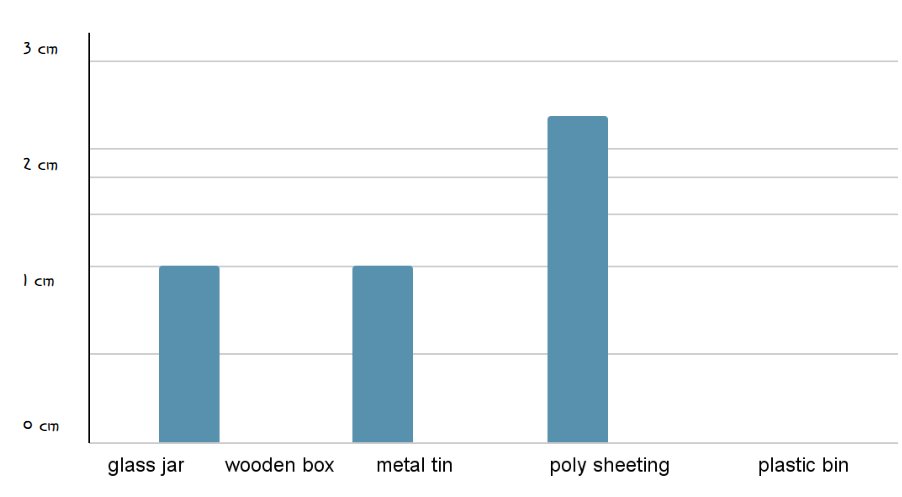
| Variable | Day 1 | Day 2 | Day 3 | day4 | Day 5 | Day 6 | Day 7 | Day 8 | Day 9 | Day 10 | Day 11 |
|---|---|---|---|---|---|---|---|---|---|---|---|
| Wooden box | 0 cm | 0 cm | 0 cm | 0 cm | 0 cm | 0 cm | 0 cm | 0 cm | 0 cm | 0 cm | 0 cm |
| Glass jar | 0 cm | 0 cm | 0 cm | 0 cm | 0 cm | 0 cm | 0 cm | 0 cm | 0 cm | 0 cm | 0 cm |
| nothing | 0 cm | 0 cm | 0 cm | 0 cm | 0 cm | 0.5 cm | 1 cm | 1.3 cm | 1.5 cm | 2 cm | 2.4 cm |
| Plastic bin | 0 cm | 0 cm | 0 cm | 0 cm | 0 cm | 0 cm | 0 cm | 0 cm | 0 cm | 0 cm | 0 cm |
| Metal tin | 0 cm | 0 cm | 0 cm | 0 cm | 0 cm | 0 cm | 0 cm | 0 cm | 0 cm | 0 cm | 1 cm |
Both of these were also part of our obsevations.
Conclusion
In conclusion, our hypothesis was proven wrong. We thought the plastic bin would grow the best but it was nothing but poly sheeting. It grew 2.4 cm in 11 days. In second place is the metal tin and glass jar growing at 1 cm in last place was the plastic bin, and wooden box growing at 0 cm. So, the grass growing in with nothing but poly sheeting worked the best. This might of been because the variables that worked the best were more compact.
Application
Knowing this information might benefit us and others because people can use reusable items for around their house to build a environmental friendly greenhouse that is cost effective. Hopefully many people can use our research and experiment in their everyday life. this would also be a great way to get a head start on plants so that in the spring, they're already partially grown.
How we could improve our project Next time we do this, we would:
- grow the plants for longer with more seeds and get plant food so we could really see the full effect.
- We would add a heat source to it so we could trap water vapour so they could be more warm and it might help it grow faster.
- Plus, we would grow all the plants in one spot.
- If the weather is nicer, we could also grow them outside to see how they would survive.
Sources Of Error
- We had trouble figuring out how to water the grass with the poly sheeting on.
- We had trouble getting our experts to respond
- We had trouble keeping the humidity good inside the plots
- We had trouble keeping Ellie's dog away from the grass
Citations
https://www.cysf.org/ https://en.wikipedia.org/wiki/Greenhouse https://kids.kiddle.co/Greenhouse https://joegardener.com/podcast/hobby-greenhouse-faqs/ https://www.canada-greenhouse-kits.ca/pages/gardening-information https://homesteadandchill.com/beginners-guide-using-hobby-greenhouse/?srsltid=AfmBOooIC6V3DNdR23y91tL2a5jwm7Kd7FPLH_75v7mpyFcOx3ANqV1e
Acknowledgement
Here are some people we would like to acknowledge for helping us a ton with our project.
- Mrs Saunders for signing us up for the CYSF
- Mr. Pedenko, Mr. O'Reilly, Ms. Cowdy, and Mr. Ramsey for giving us feedback along the way.
- David Wees, Neil Mattson, and William Miller. These were our experts who responded. Each of them had different and helpful answers!
- Our parents for driving us to the Olympic oval for the science fair, taking us to get supplies and the support along the way.