
SpektraLens - A D.I.Y Smart Glasses to reduce phone pick-ups & screen time throughout the day.
Mohtad Abdullah Qutab
Madeeha Fayyaz
Grade 7
Presentation
Problem
Too many people are on their mobile phones these days. I have noticed that a single notification can easily turn into more than ten minutes of scrolling and checking apps that had nothing to do with the original alert. Research from the RescueTime digital‑wellbeing study shows that the average person receives 50 to 80 notifications per day and more than half of all phone pickups begin because of a notification. Once the phone is unlocked about 89 percent of those pickups turn into unintentional use which means the person ends up doing something they never planned. This extra drift time adds roughly 30 to 50 minutes of additional screen use each day. Over time this constant interruption does more than drain battery life. It affects health too. Research from the Vision Council shows that people who use screens for long periods have a 90 percent chance of developing digital eye strain which includes headaches blurry vision and dry eyes. Experiments from the University of California Irvine also show that frequent notifications make people three times more likely to lose focus and switch tasks even if they do not open the alert. All of this suggests that notifications are powerful triggers that pull people into longer and less intentional phone use.
Method
The construction of SpektraLens followed a step‑by‑step engineering workflow that combined mechanical assembly, electronics integration, and software development. The goal was to create a wearable display capable of receiving and showing filtered phone notifications in real time.
1. Frame Construction and Physical Assembly
- I began by designing and 3D‑printing a custom glasses frame intended to hold a transparent OLED between the lenses.
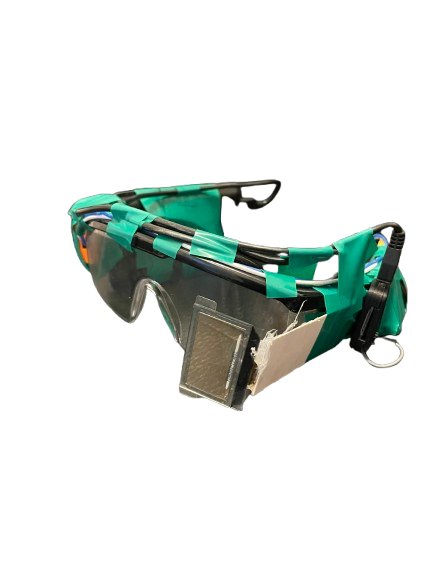
- After testing, the frame was found to be too flexible, so I replaced it with a pair of safety glasses.
- The safety glasses provided a rigid structure and included lenses already cut to size, eliminating the need to fabricate custom lenses.
- I mounted the transparent OLED onto the safety glasses using cardboard shims to adjust the angle and distance.
- I first used thin, crinkly tape to attach components, then replaced it with green electrical tape for stronger adhesion.
- I routed all wiring neatly across the top of the glasses using electrical tape to keep the cables secure and out of the user’s view.
- I tested the physical durability by dropping the glasses from a height of about one foot several times; no damage occurred.
2. Power System Construction
- I attempted to build a rechargeable power system using a lithium‑ion battery, a charger board, and a boost converter.
- After a week of assembly and testing, the circuit failed, producing no output to the display.
- Based on behavior, I hypothesized that both the charger board and the boost converter were faulty.
- With no spare boost converters and only one day remaining, I replaced the entire system with a powerbank.
- The powerbank included four LED indicators (each representing 25 percent charge) and a built‑in on/off button, making it simple to operate.
3. Android Setup and Notification Pipeline
- I originally planned to use iOS, but due to software restrictions, I switched to Android.
- The only available device was a Samsung S5 Duo, which is extremely old.
- I manually extracted the required software on my computer, copied the APK files (including ntfy) onto an SD card, and installed them on the phone.
- The phone took approximately seven hours to extract and process the files due to its age and slow hardware.
- Once installed, the phone was configured to send notifications to an ntfy server.
4. Python Program for Filtering and Displaying Notifications
- I wrote a Python script that connected to the ntfy server and listened for incoming notifications.
- The script filtered out metadata and extracted only the message text.
- The filtered message was then sent to the transparent OLED for display.
- I configured the Python file to auto‑run on startup so the glasses would begin receiving notifications without manual input.
- Due to hardware limitations, the glasses required about five minutes to fully boot, load Python, and connect to the ntfy server.
5. Testing and Evaluation
- I tested the glasses with multiple users to evaluate readability and comfort.
- I observed differences in how clearly people could see the display, which I later traced to differences in near‑point distance.
- I recorded how often I checked my phone with and without the glasses to measure the effect on notification‑driven phone usage.
Analysis
During the development of SpektraLens, I evaluated how well the prototype worked and what engineering challenges appeared during construction. My original plan was to mount a transparent OLED between the lenses of a custom 3D‑printed frame and connect it to an iOS device. However, several mechanical, optical, electrical, software, and hardware‑availability limitations forced major redesigns, including switching to Android, replacing the frame with safety glasses, and holding the entire system together using electrical tape, cardboard, and a powerbank.
1. Structural and Mechanical Analysis
The 3D‑printed frame I designed was not strong or precise enough to support the transparent OLED and wiring. The print flexed, and even small movements caused the display to shift out of view. Because the frame failed, I replaced it with safety glasses, which were already shaped to fit a face and strong enough to hold weight. The safety glasses also provided lenses that were already cut to size, which saved time and removed the need to fabricate or shape custom lenses. During early prototyping, I used thin, crinkly tape to attach the components, which made the structure unstable. After testing, I replaced it with green electrical tape, which was much stronger and more adhesive. I routed the wires neatly across the top of the glasses and secured everything tightly. I tested the durability by dropping the glasses from a height of about one foot several times, and there was no damage. This showed that even improvised materials can become reliable when applied correctly, and that the final taped structure was more durable than expected.
2. Optical Alignment and Human Vision Differences
The original idea of placing the screen between the lenses failed because the transparent OLED requires a very specific distance and angle from the eye. Too close and the text becomes blurry; too far and it becomes too dim. Safety glasses gave me a fixed distance but not the correct angle, so I had to manually adjust the screen using cardboard shims and tape. While testing with different people, I learned that many adults could not see the text clearly unless they pushed the glasses to the tip of their nose and closed one eye. Through simple home testing, I realized that my own near‑point is much closer than most adults, which made the display appear clear to me but blurry to others. This showed that optical systems must be designed around a wide range of users, not just the builder.
3. Wiring\, Electronics\, and Power System
The prototype originally had exposed wires that were messy and easy to disconnect. I improved this by routing the wires neatly across the top of the glasses using electrical tape, which made the system more stable and easier to handle. I spent a full week building a custom battery circuit using a charger board and a boost converter, but the system failed on the final day because the display showed no light. My hypothesis is that both the charger board and the boost converter were faulty. I could have replaced them, but I had no spare boost converters and only one day left to finish the project. Because of this, I switched to powering the device with a powerbank. The powerbank had four LED indicators, each representing 25 percent battery, and a built‑in on/off button. While this made powering the device simple and reliable, the powerbank added significant weight on one side of the glasses, creating a noticeable imbalance and making the glasses tilt during use. This showed that weight distribution and compact electronics are major design factors in wearable technology.
4. Software and Platform Analysis
My original plan was to use iOS for notifications, but iOS is very restricted. It does not allow easy access to background notifications, custom overlays, or direct data output to external displays without special permissions. Because of these limitations, I switched to Android. The only Android device I had available was a Samsung S5 Duo, which is extremely old. To install the required apps, I had to manually extract the software on my computer, copy the APK files onto an SD card, and load them onto the phone. The phone took about seven hours just to extract everything, which slowed development and made testing more difficult. This showed that hardware availability can significantly affect the speed and quality of prototyping.
5. Usability and Effectiveness
Even with the taped‑together prototype, the core idea still worked: I checked my phone less often because essential information was visible in my field of view. The prototype reduced curiosity‑based phone pick‑ups, which are the ones that usually lead to long scrolling sessions. However, the instability of the mount, the weight imbalance from the powerbank, the lack of a proper lens system, the slow Android device, and the near‑point differences between users limited comfort and long‑term use.
6. What These Results Suggest
The analysis shows that the concept behind SpektraLens is effective. Redirecting notifications to a wearable display can reduce unnecessary phone pick‑ups. However, the engineering challenge lies in integrating the hardware and software into a comfortable, stable, balanced, and compact form that works for a wide range of users. The failures in the frame, optical alignment, wiring, weight distribution, power system, and software platform highlight the next steps needed for a more polished version.
Feedback from my dad: He confirmed that the notification system worked well and that the messages appeared reliably on the transparent OLED. However, he found the display difficult to see because of his near‑point vision differences, which are common with age. He also noted that the current frame design does not rest on the ears like normal glasses. Instead, the electrical tape grips the sides of the head tightly, which makes the device uncomfortable to wear for longer periods. His feedback highlighted the need for better ergonomics and improved optical clarity.
Feedback from my mom: She also found the system functional but noticed a slight weight imbalance, with more weight concentrated on one side of the frame. This made the glasses feel uneven while wearing them. She also mentioned that the screen text was hard to see, especially when trying to focus quickly. Her feedback emphasized the importance of balancing the hardware on both sides of the frame and improving text visibility for different users. Together, their feedback helped identify important areas for improvement, including comfort, weight distribution, and display readability.
Conclusion
The development of SpektraLens showed that redirecting notifications to a wearable display can meaningfully reduce unnecessary phone usage, even when the prototype is built from improvised materials and limited hardware. Throughout the project, I encountered mechanical, electrical, optical, and software challenges, but each obstacle revealed important constraints that real wearable devices must overcome. The switch from a 3D‑printed frame to safety glasses, the replacement of a failed battery circuit with a powerbank, and the use of green electrical tape for structural stability demonstrated how rapid iteration can keep a project moving forward under tight deadlines.
The Python‑based notification system successfully filtered and displayed messages from an ntfy server, proving that a simple software pipeline can deliver real‑time information to a transparent display. Although the system required several minutes to boot and relied on an extremely old Android phone, it still functioned reliably once running. User testing showed that the concept worked, but also revealed important optical limitations, such as differences in near‑point distance that affected readability for adults.
Overall, SpektraLens achieved its core goal: it reduced curiosity‑based phone pick‑ups by placing essential information directly in the user’s field of view. At the same time, the project highlighted the need for a more compact power system, a stable custom frame, a better display technology, and a more efficient software environment. These findings provide a clear direction for future versions and show how even a rough prototype can generate meaningful engineering insights.
Citations
Waveshare Electronics. 1.51‑inch Transparent OLED – Product Wiki. Official documentation including wiring diagrams, pinouts, and hardware specifications for the OLED module. https://www.waveshare.com/wiki/1.51inch_Transparent_OLED Pinout.xyz Team. Raspberry Pi GPIO Pinout. Official 40‑pin header diagram showing SPI pins used to connect the transparent OLED display. https://pinout.xyz/ Gus (Pi My Life Up). Installing the NTFY Push Notification Server on the Raspberry Pi. Step‑by‑step guide for installing and configuring ntfy on a Raspberry Pi. https://pimylifeup.com/raspberry-pi-ntfy/
I used generative AI tools only for minor troubleshooting help with my Python code. All writing, analysis, and engineering decisions were done entirely by me.
Acknowledgement
I would like to thank my family for supporting me throughout the development of this project. They helped me obtain materials, test early prototypes, and encouraged me during the many redesigns and troubleshooting stages. I also want to acknowledge Waveshare Electronics for providing clear documentation for the transparent OLED module, the Raspberry Pi community for maintaining accessible GPIO pinout resources, and the developers of ntfy for making their open‑source tools available. Their work made it possible to build the notification system used in this project.