
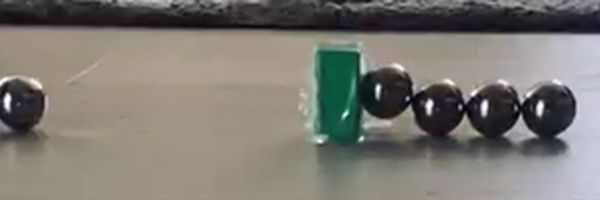
Mini Magnetic Accelerator
Meer Gosain
STEM Innovation Academy Jr. High N.W. Campus
Grade 7
Presentation
No video provided
Hypothesis
If I use more sets or add more stack balls to the Mini Magnetic Accelerator, the exit ball will launch faster and travel farther. This is because each set creates a more powerful pull on the incoming ball, and with more momentum transferred through the ball stack, the final ball is released with greater force.
Research
Physics is the study of motion and the forces that cause it. One of the most important rules in physics is that energy cannot be created or destroyed, only changed from one form to another or transferred between objects. When objects collide, momentum can move from one object to another. When something speeds up, it gains kinetic energy, which must come from a source such as a push, gravity, or a magnetic force. Magnets are interesting because they can affect objects without touching them. They produce invisible fields around them. When a metal object like steel enters this field, it experiences a pulling force. As the object moves closer, it accelerates. This shows that magnetic potential energy is being converted into kinetic energy. In simple terms, stored energy in the magnetic field turns into motion.
Another key idea in physics is momentum, which depends on an object’s mass and speed. During a collision, momentum can be transferred between objects. When the objects are hard, like steel balls, most of the motion passes through them with very little energy lost. These types of interactions are called elastic collisions. Energy can also travel through a series of connected objects. A well-known example is Newton’s Cradle. When one ball is lifted and released, the ball on the far end swings out. The movement travels through the middle balls even though they hardly move. This happens because both momentum and kinetic energy are passed along the line. Magnetic accelerators, such as a Gauss rifle, combine all of these physics ideas. A magnet pulls a steel ball forward, increasing its speed. The moving ball then hits others arranged in a row, transferring energy and momentum through them. The last ball launches forward. It can travel faster than the first ball started because it gained extra energy from the magnetic field. This may seem surprising, but it still follows the laws of physics because the energy was already stored in the magnetic system. In real life, no system is perfect. Some energy is always lost as heat, sound, or tiny vibrations. Friction and air resistance also reduce motion. Because of these factors, energy transfers are not 100% efficient, especially after several steps. Even so, the overall behavior still follows the laws of conservation of energy and momentum. These physics principles are used in real-world technology. Electric motors, generators, and particle accelerators all rely on forces and energy changes to control movement. Studying small models helps people understand how larger and more complex machines work.
Variables
Independent Variable (what I change):
- The number of magnets placed in a line or the number of sets.
Dependent Variable (what I measure):
- The distance the launched steel ball travels after leaving the accelerator.
Controlled Variables (kept the same):
- The type and size of steel balls (same brand/style each trial).
- The length and position of the Hot Wheels track.
- The angle of the track (kept level).
- The starting distance of the first ball from the magnet.
- The placement and spacing of magnets.
- The surface and environment (same floor, indoors, no wind).
- The number of trials done for each setup.
Procedure
- Set up the track on a flat surface at home, away from electronics, and attach a foam block at the end to safely stop the ball after launch.
- Place a magnet on the track and attach 1–2 steel balls directly against the sets of magnets (these are the stack balls).
- Mark a starting point about 20–30 cm away and place the sets there so each trial begins the same way.
- Release the shooter ball from the marked spot and allow it to roll freely into the magnet and stack.
- Observe the exit ball as it shoots forward and note how fast it moves, using approximation.
- Repeat the experiment 3 times for the same setup to ensure consistent data.
- Change the variable one at a time (number of stack balls or number of sets) and repeat the same set of trials.
- Record all results in a table and compare how different amounts of sets or stack shooters affect the distance the exit ball travels.
Observations
Speed Observations by Configuration
1. (1 set\, 1 stack ball)
- The exit ball didn't move.
- The sound was loud but short-lived.
- The least energetic launch among all configurations.
2. (1 set\, 2 stack balls)
- The exit ball vibrated violently, almost shooting out.
- The sound was noticeably quieter than configuration 1.
- Increased momentum was observed due to the additional stack ball.
3. (1 set\, 3 stack balls)
- The exit ball moved slowly.
- The sound was silent.
- An additional stack ball produced greater energy transfer.
After the previous results, I concluded that having fewer than 3 stack balls would make the rifle not work, so I didn't experiment with fewer than 3balls for 2 sets.
4. (2 sets\, 3 stack balls)
- The exit ball accelerated a little more than in #3.
- The most energetic launch was observed in the experiment.
- The exit ball traveled the fastest with minimal loss of distance.
Analysis
The results show that using more stack balls helped transfer energy better through the system. When only one stack ball was used, the exit ball did not move, which means most of the energy stayed near the magnet instead of passing through the balls. Adding a second and third stack ball allowed more motion to transfer through the line, so the exit ball started to move. When two magnet sets were used with three stack balls, the exit ball traveled the fastest and farthest, showing that extra magnetic stages increased the acceleration. This supports the idea that both the number of balls and the number of magnets affect how much energy reaches the final ball.
Conclusion
This experiment showed that magnetic force can transfer energy and motion from one ball to another in a Mini Magnetic Accelerator. The results supported the hypothesis that using more stack balls and adding another magnet stage would make the exit ball travel faster and farther. Configurations with too few stack balls did not transfer energy well, while the setup with two magnet sets and three stack balls produced the strongest launch. Although small factors like friction and alignment may have affected some trials, the overall trend was clear and consistent. This project successfully demonstrated how magnetism and momentum work together to create acceleration.
Application
The Mini Magnetic Accelerator demonstrates principles that are used in real-world technologies involving magnetism and motion. Similar ideas of magnetic force and energy transfer are used in electric motors, generators, and magnetic levitation trains. Particle accelerators also use magnetic fields to control and speed up tiny particles for research in physics and medicine. Understanding how momentum transfers between objects is important in engineering fields like transportation safety and mechanical design. This experiment helps show how basic physics concepts can connect to advanced technology used in everyday life and scientific research.
Sources Of Error
Small misalignments between balls could change how energy is transferred. Friction on the track and air resistance may have reduced the distance. Magnets may not have been identical in strength, affecting consistency.
Citations
Eisco Labs. (n.d.). Gauss gun – linear magnetic accelerator demonstration apparatus. https://www.eiscolabs.com/products/gsdemo Southern Manitoba University. (n.d.). Using magnetic balls to show conservation of energy. https://www.demos.smu.ca/index.php/demos/e-n-m/48-magnetic-accelerator Colorado State University Department of Physics. (n.d.). Gauss accelerator [Physics demonstration]. https://www.physics.colostate.edu/physics-demos/gauss-accelerator/ Flinn Scientific. (n.d.). Magnetic linear accelerator https://www.flinnsci.ca/magnetic-linear-accelerator---demonstration-kit/ap6838/ Instructional Resources, University of Iowa. (n.d.). Magnetic linear accelerator – Gauss rifle [Demo notes]. https://physicsinstructional-resources.prod.drupal.uiowa.edu/5g1055-magnetic-linear-accelerator-gauss-rifle KidsLoveKits. (n.d.). The Gauss rifle: A magnetic linear accelerator. https://www.kidslovekits.com/projects/gauss_rifle/index.html Flinn Scientific. (n.d.). Magnetic linear accelerator background information. https://www.flinnsci.ca/magnetic-linear-accelerator_f0814952/dc11177ca/ Physics Outreach, Idaho State University. (n.d.). Magnetic linear accelerator demonstration. https://www.isu.edu/physics/outreach/physics-class-demos/electricity-and-magnetism/magnetic-linear-accelerator/
Acknowledgement
I want to thank my mom for guiding me through this science fair. Her calm presence helped me stay focused when things got hard. She believed in me and showed me how to think clearly and work hard. Another person I would like to thank is Ms. Bretner, who helped guide and set goals for us.