
Heart in Motion: How to Exercise Efficiently and Recover Properly
Samraj Bhattacharya
Glamorgan School
Grade 8
Presentation
No video provided
Hypothesis
•I think that people with a lower fitness level will have a longer recovery time as their body isn’t as used to physical exercise as people with higher fitness level. When you are not used to something, it is guaranteed to be harder on you. •I think younger people will have a faster recovery time, as their bodies are smaller and require less blood and O2. •People with higher energy levels overall should have a faster recovery time, as the body has more resources to work with •Boys might recover faster than girls because boys have a higher hydration level Because my sample size was on the smaller side, I used controlled pair comparisons to isolate the effect of each variable.
Research
According to developmental statistics (and trends found in my data): •Fitness Level: Individuals with higher fitness levels tend to perform better in physical exercise and recover more quickly than those with lower fitness. This is because fitter people have stronger cardiovascular systems, more efficient oxygen transport, and greater muscular endurance, which reduces physiological strain and allows the body to return to resting conditions faster. Fitness reflects exercise capacity and systemic conditioning, not body fat, since muscles break down and strengthen with training. •Sex: Males generally perform slightly better in strength-based activities and recover more slowly than females on average (Females recover faster), due to higher muscle mass, greater hemoglobin levels, and testosterone. However, females often exhibit strong endurance and recovery. My trends and these same statistics also say you can be a strong athlete regardless of gender •Age: Age also significantly affects performance. Young adults (20–30) typically achieve peak exercise capacity with fully matured cardiovascular and respiratory systems. Adolescents often recover the fastest due to lower metabolic demand and rapid autonomic regulation, despite still-developing pulmonary and aerobic systems. Children, whose resting and exercise heart rates are elevated by ongoing growth, can recover moderately quickly, though lower stroke volume and cardiopulmonary efficiency make recovery less effective than in teens.
Variables
- Independent Variables: The type and intensity of exercise the volunteers do.
- Dependent Variables: How long it takes for their heart rate to return to resting levels and the rate at which it drops after exercise.
- Controlled Variables: The rest time before measuring heart rate, the equipment used, the exercise method, and preparation factors like environment and avoiding caffeine.
Procedure
Materials: •Heart rate monitor or pulse oximeter •Stopwatch or timer •Exercise equipment (e.g., treadmill or stationary bike) •Volunteers (atleast 5) Method: 1.Pre-Exercise Measurement: Measure and record the resting heart rate (HR) of each volunteer after they have been at rest for at least 3 minutes. 2.Exercise: Have each volunteer perform a 5-10 minute exercise at moderate intensity (e.g., running on a treadmill or cycling). Record the peak heart rate immediately after the exercise. 3.Post-Exercise Recovery: After exercise, monitor the volunteer’s heart rate every 30 seconds until it returns to the resting heart rate. 4.Data Collection: For each volunteer, record: •Peak HR during exercise •Time taken for HR to return to resting levels (Recovery Time) •HR Drop Rate (calculated as Peak HR - Resting HR / Recovery Time in seconds) Calculations:

1.Recovery Time: Time taken for HR to return to resting levels. 2.HR Drop Rate: Analysis: Analyze how different volunteers recover (i.e., faster or slower recovery times). Discuss the relationship between exercise intensity and recovery rate.
Observations
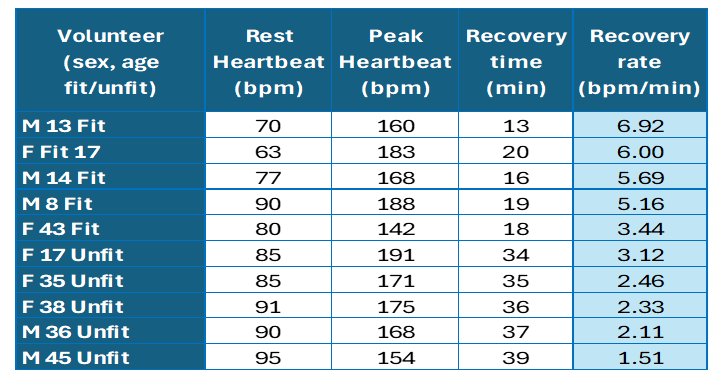
Observations Fit people, who lead an active & healthy lifestyle have higher Heart Rate Recovery (HRR). This means their heart rate comes back to normal faster after exercising. Unfit people, who are overweight and/or lead a less active lifestyle, have lo HRR. This means their heart rate takes longer to come back to normal after exercising. Younger people tend to have higher HRR, though kids can sometimes show inconsistent HRR. Females have slightly higher HRR as compared to males. Fitness level was determined with endurance observations, weight and age.
Analysis
 Observations
Fit people, who lead an active & healthy lifestyle have higher Heart Rate Recovery (HRR). This means their heart rate comes back to normal faster after exercising.
Unfit people, who are overweight and/or lead a less active lifestyle, have lo HRR. This means their heart rate takes longer to come back to normal after exercising.
Younger people tend to have higher HRR, though kids can sometimes show inconsistent HRR.
Females have slightly higher HRR as compared to males.
Fitness level was determined with endurance observations, weight and age.
Observations
Fit people, who lead an active & healthy lifestyle have higher Heart Rate Recovery (HRR). This means their heart rate comes back to normal faster after exercising.
Unfit people, who are overweight and/or lead a less active lifestyle, have lo HRR. This means their heart rate takes longer to come back to normal after exercising.
Younger people tend to have higher HRR, though kids can sometimes show inconsistent HRR.
Females have slightly higher HRR as compared to males.
Fitness level was determined with endurance observations, weight and age.
Conclusion
•My study showed the heart recovers faster in fit, younger, and female individuals, while less fit, older, and some males take longer to return to resting heart rate. •Understanding these factors helps you exercise safely, work within your limits, and stay motivated, so you can enjoy long-term, consistent progress. By respecting your limits and persisting, you can build fitness, strengthen your heart, and achieve your goals without overexertion.
Application
This project can be applied to help people exercise more safely and effectively by understanding how quickly their heart recovers after physical activity. By knowing their heart rate recovery, individuals can plan proper rest times, choose suitable exercise intensity, and avoid overexertion. Athletes, students, and fitness beginners can use this information to improve training performance, prevent injury, and build endurance gradually.
Coaches and physical education teachers can apply these findings to design workout plans that match different ages, fitness levels, and abilities. This study can also help promote healthy lifestyles by encouraging people to stay active, track their progress, and understand how their heart adapts to exercise. Overall, this research supports safer exercise habits and long-term cardiovascular health.
Sources Of Error
There might be slight error based on how quickly we check the bpm after we stop exercise, but this may differ by a few seconds each time and at max it will drop by 1-3bpm by the time check our watch after exercise.
Citations
References:
411 heart guide, by Marc Gillinov
https://my.clevelandclinic.org/health/body/21648-heart-conduction-system
https://my.clevelandclinic.org/health/body/circulatory-and-cardiovascular-system
Acknowledgement
Special Thanks to:
Samraj Bhattacharya - Student researcher Soumyadeep Bhattacharya - Adult supervisor Patrick Howey - Science fair director
Participants: Majed Daduski Samraj Bhattacharya Soumyadeep Bhattacharya Amrita Bhattacharya Ankur Jain Jiyaansh Jain Anchal Jain Jill Hagerman Christina Quartarone Marina Stein