
Exothermic v.s Endothermic
Alexandra Forrester, Munroop Kaur Dhillon
Delta West Academy
Grade 7
Presentation
No video provided
Hypothesis
We think that the ice pack will have a larger impact on the temperature of the water because when you feel an ice pack you often have to take it off after a certain amount of time, while with the heat pack you don’t.
Research
What is an exothermic reaction? An exothermic reaction is a chemical reaction that releases energy from the chemicals. The energy from these reactions is normally released as heat, so the surroundings get hotter. Little Hotties Handwarmers are an example of an exothermic reaction. They release heat into their surroundings, heating your fingers. Sometimes, exothermic reactions don’t release heat, they release light. An example of this would be a glowstick, you crack it and it glows instead of heating up. What is an endothermic reaction? An endothermic reaction is a chemical reaction that absorbs energy from their surroundings. The energy is usually absorbed in heat, so the surroundings get colder. An example of this is an ice pack that you bang on and then it gets cold. Another example of an endothermic reaction is photosynthesis because the plants absorb energy from the sun. Heat is energy that is transferred from one object or system to another because of a difference in temperature. When two objects at different temperatures touch or interact, energy flows from the warmer one to the colder one, that flow of energy is what scientists call heat. What is combustion? Combustion is the generation of heat and light in the form of fire, or a flame. It is a chemical reaction often involving oxygen and other substances. An example of combustion is: a match being struck, friction heats the head to a temperature at which the chemicals react and generate more heat than can escape into the air, and they burn with a flame. Convection is a method of heat transfer. It occurs when heat is transferred by movement of a heated fluid such as air or water. An example of convection is: the movement of air particles through a spinning ceiling fan. What is convection? Convection is a method of heat transfer. It occurs when heat is transferred by movement of a heated fluid such as air or water. An example of convection is: the movement of air particles through a spinning ceiling fan. What is energy? Energy is defined as the ability to do work. Energy is used in many ways, such as powering cars, heating our homes, cooking food, and sending astronauts into space. What is heat? Heat is energy that is transferred from one object or system to another because of a difference in temperature. When two objects at different temperatures touch or interact, energy flows from the warmer one to the colder one, that flow of energy is what scientists call heat. What is the chemical reaction in a cold pack? The materials inside the cold pack are water and ammonium nitrate fertiliser. The fertiliser is inside a tube or plastic bag. When you hit the bag, the bag pops, or the tube breaks. The fertiliser mixes with the water, creating an endothermic reaction. For about ten-fifteen minutes, the temperature of the pack is about 1.6 degrees Celsius. What is the chemical reaction in a heat pack? There are five main ingredients in a hand warmer, water, iron powder, activated charcoal, salt, and vermiculite. The pack becomes hot because oxygen reacts with the iron, water, and salt in the packet, which makes the iron oxidize. Oxidization, more commonly known as rust, is a type of exothermic reaction. The vermiculite and activated charcoal in the pack keep the amount of water in the packet from stopping the iron from oxidising, making the reaction last for hours.
Variables
Controlled: Amount of water, time spent in contact with the icepack /Heat pack, material of bowl, temperature of air, time prior to the star of our temperature recordings (wait 2 minutes) Manipulated: If the water is placed on the heat or cold pack Responding: Temperature of the water in the beaker after five minutes
Procedure
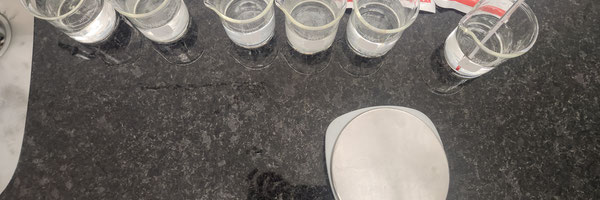
1. Gather all necessary materials 2. Record the mass of the hot packs and the ice packs. (temperature change/gram of chemical) 3. Activate both the exothermic (heat) and endothermic (cold) packs according to the package instructions. 4. Fill the 250mL beakers with 200mL of water 5. Take the temperature of both waters to make sure they are the same temperature 6. Place one beaker on top of cold pack and one on top of heat pack 7. Wait five minutes 8. View the temperature of the water in the beakers throughout the 5 minutes, recording the temperature every 30 seconds. 9. Repeat 3x
Observations
The temperature did not change too much with both the ice pack and the hot pack. The hot pack was smaller, but had about the same temperature change as the ice pack. The thermometer didn't seem to move much, but it showed us what we were looking for.
| Trial 1 | Trial 2 | Trial 3 | |
|---|---|---|---|
| Temperature Change per gram Hot Pack | 0.016155089 | 0.017799353 | 0.01300813 |
| Temperature Change per gram Ice pack (Absolute value) | 0.006512301 | 0.006329114 | 0.011764706 |
| 0 | 30 | 60 | 90 | 120 | 150 | 180 | 210 | 240 | 270 | 300 | |
|---|---|---|---|---|---|---|---|---|---|---|---|
| Trial 1 | 22.0 | 22.0 | 22.1 | 22.1 | 22.2 | 22.2 | 22.3 | 22.3 | 22.4 | 22.8 | 23.0 |
| Trial 2 | 21.9 | 22.0 | 22.1 | 22.2 | 22.4 | 22.5 | 22.5 | 22.8 | 22.9 | 22.9 | 23.0 |
| Trial 3 | 22.0 | 22.0 | 22.1 | 22.2 | 22.4 | 22.8 | 22.8 | 22.8 | 22.8 | 22.8 | 22.8 |
| 0 | 30 | 60 | 90 | 120 | 150 | 180 | 210 | 240 | 270 | 300 | |
|---|---|---|---|---|---|---|---|---|---|---|---|
| Trial 1 | 21.8 | 21.8 | 21.6 | 21.5 | 21.2 | 21.2 | 21.1 | 21.0 | 21.0 | 21.0 | 20.9 |
| Trial 2 | 21.8 | 21.5 | 21.1 | 21.0 | 21.0 | 20.8 | 20.7 | 20.5 | 20.2 | 20.2 | 20.1 |
| Trial 3 | 21.6 | 21.2 | 20.9 | 20.8 | 20.8 | 20.5 | 20.2 | 20.1 | 20.0 | 20.0 | 20.0 |
Analysis


Conclusion
In conclusion, the thermal hot packs-exothermic reactions- had a better temperature change per gram and they had almost half the mass of the icepacks. The icepacks were larger, with almost double the mass. The icepacks had about the same temperature change as the hot packs, despite being about double the mass. So the exothermic reaction is stronger than the endothermic reaction.
Application
To make the ice packs safer and smaller, you could dissolving ammonium chlorite, ammonium nitrate, urea, or potassium chlorite in water. This could make the ice pack smaller, safer, and possibly last longer.
Sources Of Error
· Had to sometimes stabilize the beaker on the hot pack and cold pack, so my hand was touching the top of the beaker sometimes. This could have heated it up. Next time, I would try to tie the hot pack and cold pack to the beaker, or use a box to keep things standing up. · We did not have a lid on our beaker which meant that some of the heat could have escaped and it was not close to a closed system. This would have impacted our temperature changes slightly. Next time, I would try to keep it more contained. · The air in the cold pack made it difficult for the beaker to be touching the cold within the pack. This could have reduced the impact on the temperature change of the water. Next time, we could try to tie the cold pack to the beaker, or perhaps remove some of the air once the reaction was started.
Citations
BBC. (2024, July 11). What are exothermic and endothermic reactions? BBC Bitesize. https://www.bbc.co.uk/bitesize/articles/zb7wwnb#zjynn9q Sciencemadness discussion board - little hotties - powered by XMB 1.9.11. (n.d.). https://www.sciencemadness.org/whisper/viewthread.php?action=printable&tid=15287#:~:text=Reactions-,1.,been%20added%20and%20tie%20it Hall-Geisler, K. (2023, November 28). How do hand warmers work? A scientific look. HowStuffWorks Science. https://science.howstuffworks.com/disposable-hand-warmers.htm#:~:text=And%20it’s%20totally%20safe%20to,the%20crystals%20to%20a%20liquid. U.S. Energy Information Administration - EIA - independent statistics and analysis. What is energy? explained - U.S. Energy Information Administration (EIA). (n.d.). https://www.eia.gov/energyexplained/what-is-energy/ NASA. (2023, March 3). Heat transfer. NASA. https://www1.grc.nasa.gov/beginners-guide-to-aeronautics/heat-transfer-3-2/ Beceiro-Novo, S. (n.d.). Heat transfer. An Introduction to Physics for Curious Minds. https://openbooks.lib.msu.edu/isp201/chapter/heat-transfer-methods/ Libretexts. (2022, August 8). 7.3: Exothermic and endothermic reactions. Chemistry LibreTexts. https://chem.libretexts.org/Courses/Saint_Francis_University/CHEM_113%3A_Human_Chemistry_I_%28Muino%29/07%3A_Chemical_Reactions_-_Energy_Rates_and_Equilibrium/7.03%3A_Exothermic_and_Endothermic_Reactions?utm Exothermic and endothermic reactions - student academic success. (n.d.). https://www.monash.edu/student-academic-success/chemistry/carbon-based-fuels/exothermic-and-endothermic-reactions Hall-Geisler, K. (2023, November 28). How do hand warmers work? A scientific look. HowStuffWorks Science. https://science.howstuffworks.com/disposable-hand-warmers.htm Brain, M., & Elliott, S. (1970, January 1). How refrigerators work. HowStuffWorks. https://home.howstuffworks.com/refrigerator7.htm#:~:text=The%20liquid%20inside%20the%20cold,for%2010%20to%2015%20minutes.
Acknowledgement
We would like to thank our science teacher, Mr. Reimche, for inspiring us to do this project.
We would also like to thank our school, Delta West Academy for allowing us to use their beakers and thermometers to complete the project.
We would like to thank Ms. Tammy, our office assistant for providing us with the ice packs that we use when students get hurt for the project.