
Creating Biodegradable plastic and the effects on plants
Akash Ashok
STEM Innovation Academy Jr. High SW
Grade 8
Presentation
No video provided
Problem
In Canada, each year around 9.8 million tonnes of plastic materials from both residential and non-residential sources are diverted t o landfills (Statistics Canada). Most plants sold at garden centres come in plastic pots which are often discarded. These pots often end up in landfills for hundreds of years and contribute to environmental pollution.
Method
Materials •Water •Tapioca starch •Glycerin •Vinegar •Compostable paper •Potting soil •Plant of choice
Method
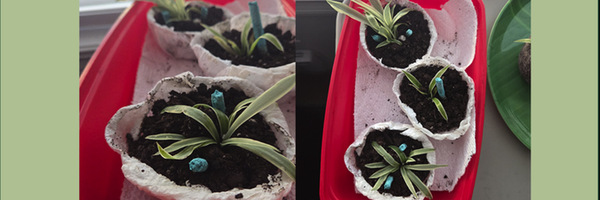
Step 1: Mix Tapioca starch, Water, Glycerin, and Vinegar into a pot Step 2: Cook it in medium heat Step 3: Shape the mixture into a mold using compostable paper Step 4: Wrap in compostable paper to secure shape and control waterlogging
Analysis
- Test more biodergradable materials - Run the experiment for a longer time -Experiment with different plants - Measure soil nutrients - Test in real world conditions
Conclusion
The results of this experiment suggest that tapioca-based biodegradable plant pots can successfully replace plastic pots for short-term plant growth. Unlike plastic pots, the biodegradable planters supported healthy plants and broke down naturally in soil. If large garden centers adopted biodegradable planters, this could significantly reduce the amount of plastic plant waste sent to landfills.
Citations
- Statistics Canada https://www.statcan.gc.ca/en/start
- Statistics Canada. More plastic diverted from landfills in Canada; waste and pollution remain high. https://www.statcan.gc.ca/o1/en/plus/8174-more-plastic-diverted-landfills-canada-waste-and-pollution-remain-high
- Canadian Council of Ministers of the Environment. (n.d.). Waste. https://ccme.ca/en/current-activities/waste
- Environmental Defence Canada. (2020). Policy brief: Plastic pollution. https://environmentaldefence.ca/wp-content/uploads/2020/10/EDC_Plastic-Pollution_Policy-Brief.pdf
- Nature Reviews Materials, 6(2021). https://doi.org/10.1038/s41578-021-00407-8
- Hands‑on engineering activity: Making bioplastic. https://alltogether.swe.org/2021/08/hands-on-engineering-activity-making-bioplastic/
- Developments in Polymer Engineering https://www.sciencedirect.com/science/article/pii/S0079670025001431
Acknowledgement
I would like to thank my parents for their continued support, encouragement, and help throughout this project. Their motivation and belief in me played a big role in keeping me focused and confident. I would also like to thank Brandon Sweeney from Green-Plastics.net for sharing his knowledge and providing helpful guidance on sustainable plastics.