
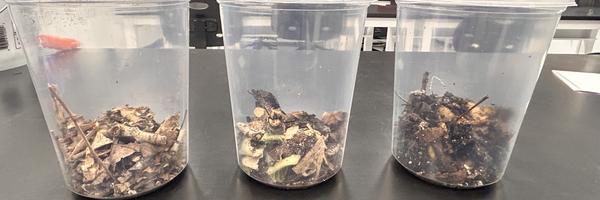
Cold Climate Compost
James Horne
R. T. Alderman School
Grade 9
Presentation
Problem
Abstract:
This project explores the optimization of cost and function of an electric composter. This project aims to address the large-scale environmental issue of organic waste ending up in landfills and a healthy solution for our planet. It also discusses the issues of electric composting and making an invention that can accomplish successful composting in short periods of time. This preliminary invention experiments with different insulation methods. Future versions would use solar powered heating instead of conventional energy sources.
Objective:
Creating a cheap and reliable electric composter that operates effectively in below freezing temperatures.
Background Research:
What is Composting?
Composting is the managed aerobic (oxygen required) biological decomposition of organic materials by microorganisms. – EPA Environment protection agency of America. Composting takes organic material and converts it into compost. Organic matter is anything from a once living organism. Organic matter is essential for decomposition. Compost also known as ‘nature’s black gold’ and is a soil like material that is high in nutrients. Some of these nutrients include nitrogen, potassium, and various types of phosphates. The basic formula for decomposition is 90% Brown Materials+10% Green Materials+H2O+O2+Heat=Compost Where Brown Materials are carbon rich and Green Materials is nitrogen rich. The names do not necessarily describe the material’s color. Not everything can be composted. Materials like plastic cannot be composted because microbes cannot break up the synthetic chemical chains that connect the molecules in plastic.
Types of Composting
There are many different forms of composting, including vermicomposting, bokashi and standard composting. First of all, vermicomposting or worm composting. This form of composting uses worms to decompose the organic material. Secondly is bokashi composting, this process uses fermentation to decompose the material. After you then compress the compost to get any liquid that comes out, this liquid is called bokashi juice. This form of composting works best with precooked items that have high contents of oil in them.
One of the most widespread methods of composting is hot composting. There are 3 main stages of this process, the initiation phase, theomorphic phase and finally the maturation phase. The temperature changes depending on the phase. This allows different microorganisms to flourish in different temperatures. The first stage is the Initiation phase stage. The temperature is around 20-40 degrees Celsius allowing more cold related organisms to flourish. Then comes the Then comes the theomorphic phase, raising the temperature to 40-66 helps more hot resistant organisms to flourish. After this phase was the maturation where the compost cools down to allow it to naturally decompose. These three stages allow a great multitude of life to help decompose the rotting material.

Ideal Composting Conditions
To measure the success rate during decomposition some major indicators are Carbon and nitrate levels, respiration rate, pH, Soluble salts, Ammonium nitrate ratio, Organic matter, particle size, and lastly Eco toxicity and bioassay.
| Measurement | Amount | Description and Why it’s important |
|---|---|---|
| Carbon and nitrogen levels | ||
| 10:1 | A major part in how materials decompose and is what defines green and brown material | |
| Respiration rate | < 2 mg CO₂-C/g | Aerating compost is a vital part of decomposition and is a very large indicator of progress in the compost heap. |
| pH | 5.5-8.5 | Different plants prefer different amounts on the pH scale and with control over that specific composting can be controlled |
| Soluble salts | < 4.0 mmhos/cm | If this number gets to high it can harm or even kill plants |
| Ammonium nitrate ratio | Greater than 1 but lowers in end product | Mature compost has converted ammonium into nitrate at the end product. |
| Organic matter | 30-70% | If there is large quantities of organic matter in the compost this is a sign that the material did not decompose. |
| Particle size | 3/8-1/2 of an inch | The smaller the better because then plants can absorb the nutrients better |
| Eco toxicity | Non toxic | Having the material toxic id very dangerous to the plant and to people. |
Compost Regulations
In 1964 the CCME (Canadian council of ministers of the environment) was founded under the Canadian federal government. The role of CCME was to act as a forum for collective action on environmental issues. Members comprised of federal provincial and territorial environment ministers. The structure of this council was then improved in 1989 to improve intergovernmental cooperation.
The table below is the current standards for trace elements in compost created by the CCME.
 In September 1997 the government passed Bill T-4-120 "Regulation of Compost under the Fertilizers Act and Regulations,” Bill T-4-120 was introduced to regulate the quality of compost and safety of the material being used and the general quality of the compost. This bill was separate from the table above.
Why is composting Important?
Composting has two main benefits. Firstly, it diverts organic materials from going to landfills. Secondly, the process creates nutrient-rich soil that can be used to enhance plant growth.
Composting not only helps us but can help protect the environment. An estimated 20 million tons of food ends up in Canadian landfills each year. All that food that ends up there takes several months or even years due to the lack of oxygen to decompose. Calgary’s composting facility alone reduces the amount of food waste that would end up in the landfill by 51%. Not only does composting get rid of food waste but it diverts it into nutrients.
Healthy soil is made up of many different chemicals and minerals including nitrogen, potassium, and other kinds of phosphates. Through the process of decomposition, the nutrients recycle from organic matter straight into compost. Nutrient rich compost is relatively easy and cheap to make. Manmade fertilizers are more water soluble than compost and are often less effective at providing plants with nutrients. This can harm the roots of the plants if not managed correctly. While fertilizers can burn plants if overused, compost is simple to use and is absorbed more easily by the plant.
Challenges of Composting
Although composting seems like the perfect alternative for food waste there are still challenges that arise. Composting can take long periods of time and needs patience. Organic material can up to 4-10 months to fully decompose. This is also conditional and if everything goes to plan. Secondly composting does not work in cold temperatures below zero. This usually kills off most of the micro bacteria inside of the compost. Aerobic bacteria are essential for decomposition to occur. Finally it takes effort and hard work to make and maintain a successful compost bin. Inorganic materials At this moment we do not have a complete understanding on how long it takes for inorganic materials to decompose. But some studies have shown that materials like Styrofoam could last up to 500 years before decomposing and depending on the material they might never decompose. Micro plastic are a worldwide issue that has invaded many parts of ecosystems. An estimated 710 trillion micro plastic particles contaminate European farmland (according to the BBC). Not only is this harmful to the quality of the crops it also means that we could potently be consuming these plastics. One study showed that a woman was found to have 0.5% of her brain to be plastic. At this moment the effects of micro plastics on the human anatomy are still under research today. There are many ways that people can help reduce the amount of food waste that ends up in the land fill. First of all you can use a green bin provided by your municipal community. Green bin facilities not only decompose the material but make it available for pickup. Another thing you can do is home composting. This allows all your food waste to be turned into nutrients and can be used for gardening. Finally and most importantly making people aware about the issues that rise with landfills.
How to Accelerate the Composting Process?
Composting can be accelerated in many ways. First of all is controlling the amount of heat exposed to the compost. This can be done by adding a heater around the pile or making a big pile for insolation. Another thing that can be done is aerating the compost. This can be done by turning over the compost. Oxygen (O2) is essential for aerobic bacteria to flourish in a compost bin. Another important aspect of composting is a balance of green and brown materials. Green being nitrogen rich and brown being carbon rich. This allows a variety of nutrients in the compost. This also allows different microorganisms to flourish in these environments. Aerating compost is essential for aerobic bacteria to not only flourish but to also survive in your compost bin. While composting the right amount of moisture is very important. The right amount is 40-60% moisture content with the right amounts of moisture the microorganisms in the compost should flourish. Organic material can be classified into two groups green and brown. Green materials are nitrogen rich material that is easy for bacteria to break down. Brown materials on the other hand are high in carbon and are easier for fungi to break down. Brown materials also tend to be dry while green materials have more moisture content in them. Green and brown materials allow lots of life and microorganisms to thrive in your compost allowing decomposition to take its place.
Commercial Composting
In Calgary we have a green bin program where organic material is collected once a week by city workers. Trucks then take it to the Calgary composting facility. There they turn all your waste into compost over 60 days. Over that time period the facility takes out any contaminants like plastic or metal through a screening process. Then the remaining material is sent to a composting vessel. In this vessel the temperature is sent to 55 degrees Celsius and is given access to water and oxygen. This allows microbes to flourish in the compost. After 21 days of decomposition it is sent to a curing building to cool down for 3 weeks and to finish the complete decomposition of materials. Then the compost is sent to the storage facility where people who live in Calgary can pick it up for home and garden use. In Calgary composting gets rid of 51% of food waste that ends up in the landfill. The big difference between home compost and municipal composting is that one is controlled and operated by you and the other is run by a municipal government
Another commercially available composting method is electric composters. Electric composters are small table top machines that claim to decompose organic food waste within 9 hours. The machine dehydrates and blends the material into a brown dust. Although it sounds like the perfect alternative to standard composting the material is not actually compost as it claims to be. This is because microorganisms need moisture to survive and break down the material. Studies have shown that the material cannot be used in the garden for at least 90 days for it to be safe. Meaning this ‘invention’ is just a fancy blender with a dehydrator.
Green Energy
Clean energy is any form of collecting energy that does not lead to any form of pollution. Clean energy allows us to stop harming the environment while still allowing us to hold up our electric infrastructure. Some forms of clean energy include solar panels, wind turbines and hydro power.
Similar to clean energy is renewable energy. Renewable energy is energy that comes from a source that replenishes itself. An example of renewable energy is solar energy. Solar energy can replenish itself because the sun will always shine. Other forms include hydro and wind energy.
Solar Panels
Solar energy is the radiation from the sun that is capable of making energy. This energy is commonly collected using solar panels. Solar energy is a form of clean or green energy as the alternative to fossil fuels. 60% of the world’s energy comes from fossil fuels while the rest is from clean alternatives.
Solar panels are made up of solar cells. Each one of these solar cells is made up of silicon. Crystalized silicon is formed in many layers to form a positive and negative side separated by a P/N junction. When a proton comes in contact with these cells it puts a hole through the cell. This causes a free flowing electron. This electron moves to the N side while the hole moves to the P side. Then the electron makes its way through an around causing an electric current. Then it returns to fill that hole reversing the damage and repeating the loop. This happens thousands of times in the solar panel causing the formation of electricity.
An electric current is the flow of charged electrons through a circuit causing the flow of electricity. This allows systems that use electricity to use this current and perform its tasks.
Vermiculite: Is a shiny lightweight mineral that is expands when heated and is fire resistant. It has a smooth texture and appears to be goldenly silver. Vermiculite is commonly used for insulation because it expands while still holding small pockets for air.
Microorganisms
A microorganism or microbe for short is any living thing that has to be seen through a microscope. These species are not plants nor animals but their own kind of species themselves. Microorganisms are split up into 3 groups’ bacteria, viruses, and fungi. Bacteria are unicellular microorganisms that have no organelles and have a weak cell wall. Because of the lack of organelles bacteria are prone to caring disease and other illnesses. To this date there are more than 1 trillion species of bacteria.
Viruses
Viruses are microorganisms that can infect hosts such as humans, plants or animals. Without a host, the virus cannot reproduce and flourish. Viruses are pathogens or small germs. These germs look for specific types of hosts to hold their needs. Viruses are made up of genetic material. (RNA or DNA). Viruses also have a protective protean coating called capsid. Around the capsid is the envelope, Viruses without one are called naked viruses. Viruses need hosts to survive or there capsid will break down. Meaning the virus will die off.
Fungi
The fungi kingdom is home to more than 144,000 species. Some of which include yeast, molds and mushrooms. Fungi are responsible for the breakdown of brown material in composting. They are also responsible. We use fungi everyday if it’s baking with yeast or eating a mushroom. Fungi are around us all the time.
Mold
Mold is an off branch of fungi and acts and behaves similar to a fungus. Mold can help with decomposition because of its ability to consume and break down organic material. Mold, in biology, a conspicuous mass of mycelium and fruiting structures produced by various fungi.- Encyclopedia Britannica Different single celled organisms need different kinds of living conditions to survive in. For example in human skin cells if we are dehydrated we can get dry lips. Which is really our skin cells dying of dehydration.
Method
Project Variables
Manipulated Variables: (What changes in between samples) Insulation/Heating methods - Invention (heater and insulation) - Only Insulation - A bucket without insulation or added heat
Responding Variables: (What is looked for or changed) - pH - Moisture Content - % Change of Organic Material
| Controlled Variable: (What stays the same)
Exterior climate Anything that happens outside of the bucket will be the same.Inside of a freezer (-10°C)Room temperature (20° C)Temperature, Humidity, Pressure, and air quality etc.The experiment will take place on the same days so all of the samples experience the same climate. (when taking the sub samples)
Buckets Same buckets are used for each sample (Same manufacture, material, and chemical makeup)Standard paint buckets
Intervals when measuring change Also making sure my length of my experiment lasts the same for all of the samplesWhen measuring change give the same amount of time for that change
Compost The materials that I put into the compost will be the same in all of the samples I test The amount of each material will also be the same (Green and Brown)
Manipulated Variables
For this project, I tested 3 different types of composters, My invention, only insulation, and a bucket at room temperature.
My first sample I Tested was my invention. Which included a heated and my own form of insulation. This sample was to test if my designs were successful or not.
I tested a sample with only insulation to see how effective my insulation methods worked in temperatures bellow zero. I replicated this temperature by using a freezer set to -10 °C.
My third sample was a non insulated non heated sample at room temperature. This sample was a control to compare as a standard to the other samples. To replicate normal composting conditions this sample was kept at 20°C.
Responding Variables
| Measurement | Why is it important? | Ideal range |
|---|---|---|
| pH | Provides a safe environment for plants to grow. Neutral pH is ideal (7). | 5.5-8.5 |
| Moisture Content | Moisture content provides aerobic bacteria to flourish for a healthy soil. | 30-60% |
| Organic matter (Carbon Nitrogen ratio) | One of the most important aspects of composting allowing different microorganisms to flourish. | 10:1 (Carbon to nitrogen) 30-80% |
My Invention
I designed an efficient electric composter with the following design features: -Insulation -Electric heat -A circular Design
I designed an “Isolation Burrito” that consisted of vermiculite rapped in aluminum foil. Vermiculite is a lightweight insulation that is used commonly used in house insulation. I wrapped this material with aluminum foil to reflect any heat that made it past the layer of vermiculite. The “Burrito” was wrapped around an internal bucket. Both the bucket and burrito were incased by a larger bucket and a lid. All these factors led to successful insolation.
Secondly, I used heat tape to add heat to the interior of the bucket. I did this by rapping it around the inner bucket and securing it using aluminum foil tape to insure the heat was trapped. Heat tape is commonly used in insuring metal pipes do not freeze during winter seasons. Electrically powered by a wall socket, it was very helpful in ensuring the temperature would stay warm during the experiment.
Finally, the general shape of my invention reflects of the needs of decomposition.\With a cylindrical design to wrap around the compost and provide an equal amount of heat throughout the inner bucket. I used a bucket lid to provide easy access to the compost to stir and to add organic material to the composter.

Materials
- Compost material
- Green (leaves, Lettuce, Banana, and potato)
- Brown (small twigs)
- FLIR Camera (Inferred Camera)
- Buckets
- Large (3)
- Large lids (3)
- Small (3)
- Tin foil (aluminum foil)
- Vermiculite
- Heat tape
- Drill
- Electrical source
- Freezer -10°C
- Pencil and paper to record observations
- Muffle Furnace
- pH Meter
Procedure
1.Collect all materials needed for the experiment (see material list)
2.Place all three of the small buckets inside of the 3 big buckets
3.To prepare the Vermiculite foil strips
a)Place a large piece of tin foil on a lab bench or table
b)On top of the tin foil place a line of tin foil on the
c)Wrap the tin foil around the vermiculite
4.Place 3 of the vermiculite foil strips in between the small and big buckets. (Do this for 2 out of the 3 bucket pairs.
5.On the first bucket with a vermiculite tin strip, wrap the heat tape around the small bucket.
a)Around the heat tape secure in with the aluminum tape.
6.Finally layer the compost material in each of the small buckets and place the lid on them
7.For the first three days of the experiment you an initiation phase is needed to get the compost started.(do not put samples inside of the freezer)
8.Every week for the rest of the experiment:
a) Take samples out of Freezer
b) Collect small sub samples from each compost bucket
c) Record observations (Qualitative)
d) Stir the remaining compost and place then back into the freezer.
e) Place the samples into the freezer
f) Repeat steps A-E every week for roughly 5 weeks (One repeat every week)
9.At the end of the experiment take the samples out of the freezer for further testing.
10. To measure moisture content do the following:
a)Weight all of the samples using a scale. (Record those Weights)
b)After measuring place all the samples into a tin foil shaped bowl. Then onto a baking sheet.
c)Put the samples into the oven and bake at 110 degrees Celsius for 12 hours. (This allows the moisture to evaporate and leave the sample)
d)After baking is complete let them cool and measure the weight difference to get the total percentage of moisture in each sample
11.To measure pH do the following
a)Weigh out exactly 4 grams of each dried sample into small jars
b)Accurately measure out 30mL of distilled water to each sample (inside the Jar)
c)Wait 15 minutes
d)Measure the pH by using some form of measuring tool for pH
12.To measure the Organic material content do the following:
a)Using the rest of the dried material measure out exactly 5g and place that into a small beaker with covers on them.
b)Place them into an ash oven for 4 hours to burn off any organic material (LOI)
c)To calculate loss of ignition let the samples cool and measure there wait using a scale
d)Compare the pre weight and post weight
e)Calculate the LOI using this equation ((Pre-weight-Post weight)/Post-weight*100
13.Finally draw an analysis and start to make conclusions based off of the data.
Pre-Lab Observations
The following observations were taken for each material before the lab started.
Potato: Weight: 626.52g While preparing the potato for the experiment I noticed that they were filled with moisture. They had a high malleability (reshapability) but a low ductility (Stretchiness). The potato also was light beige in the inside with some darker spots a little brownish. The outside was a dark opaque brown with some bruises and attempts to sprout. I also noticed that the texture on the outside was very rough compared to the interior which was smooth and almost squishy.
Lettuce: Weight: 264.28g During the preparation I noticed a lot about the lettuce. First of all they were filled with moisture and when cut that moisture would come out a little bit. I also noticed that similar to the potato the pieces of lettuce had a high malleability and a low ductility. The only thing keeping it together was string like cells. I also found that the lettuce was very light weight. The color of the surface of the lettuce varied from light green to some dark browns which indicated that the lettuce was not 100% fresh.
Leaves: Weight: 107.05g While preparing the leaves for the experiment I noticed a lot. First of all there were many different types and colors of leaves that I collected. From reds, browns, and greens. Because of when I collected them the moisture levels differed from one another.
Soil: Weight: 113.54g During the preparation phase of this project I noticed a lot of key details about the soil. First of all there was white rock like structures within the soil. As well as small bits of roots.
Twigs Weight:148.9g While preparing the twigs for the experiment there was a lot to notice. First of all the texture of the twigs were rough with dome of the small parts of the twigs having small amounts of rotting bark. They were easily flexible with little effort for the materials to break. Moisture content inside was overall very low compared to the other organic material.
Banana Weight: 450.42g An opaque yellowish surface with small bits of black in the center. The texture was very moist and mush and more rough and the ends. With a high malleability and a low ductility.
Weight of all materials combine: 1,710.71g Weight of materials in each bucket: 513.213g
Observations During the Lab
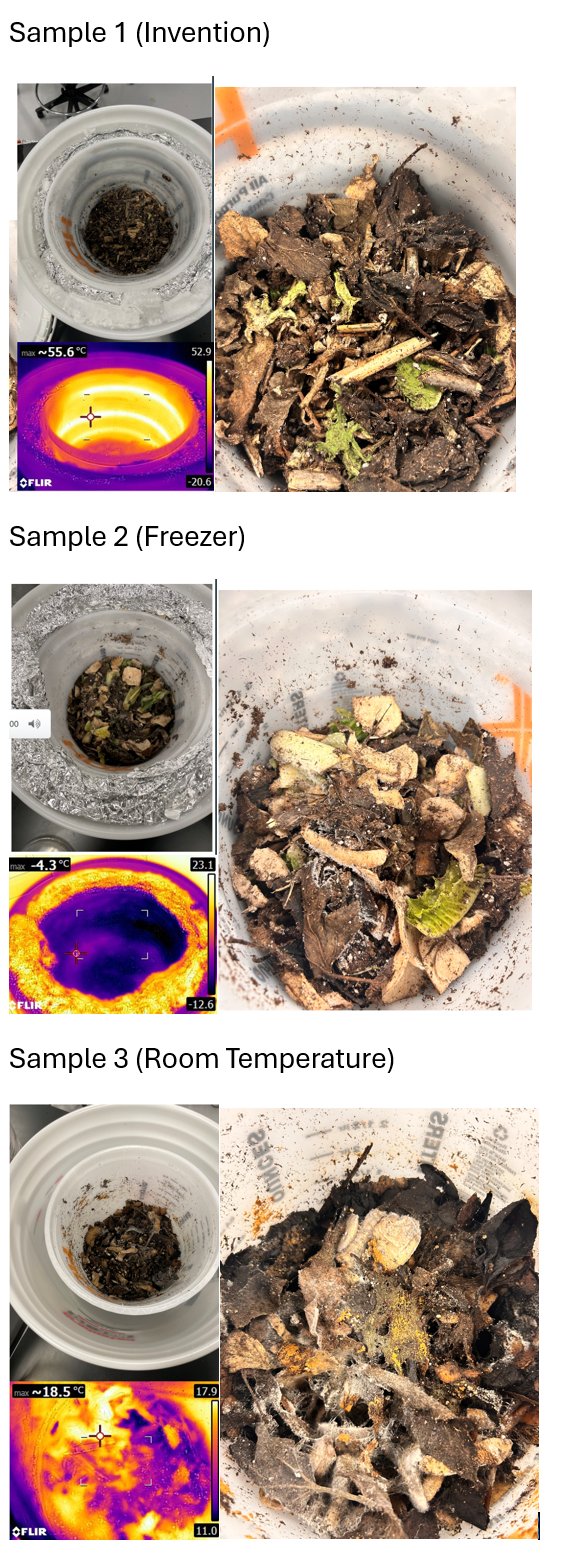
Sample #1 (Invention)
During this experiment there were a lot of outstanding features about this sample. First of all the compost bin got to temperatures up to 54 degrees Celsius inside of a freezer with a temperature of minus 10. Even when the bin was taken out of the freezer the heat was still hotter than the room and radiated the heat around the bucket. I was really surprised to see how successful the insulation and the heating tape performed. Secondly there were large amounts of ice around the tin foil rapped vermiculite. This was due to the hot climate in the center of the bucket, eventually evaporating the material then freezing in the insulation layers. This caused the outside of the bucket to be cold but the inside very hot. Thirdly the compost was very dry with the moisture content being just below 20% percent. The material felt crunchy and very dry. Finally I noticed on the thermal imaging that there were cold spots near the exposed parts of the bucket. This was due to areas with less insulation such as the bottom.
Sample #2 (Freezer sample)
Through the process of decomposition there was a lot to notice about this sample. First of all this sample stayed frozen the entire experiment roughly the same temperature the freezer was set to. There were very large amounts of moisture inside of the bucket which allowed small amounts of material to decompose. Overall this sample did not smell and smelled relatively sweet (good sign). Finally there were signs of little to no signs of aerobic bacteria because of the lack of decomposition.
Sample #3 (Room temperature)
During this experiment there were a lot of outstanding features about this sample. First of all there were large amounts of mold on the top layer of the compost. Mold is an off branch of fungi so this was a good sign that microorganisms were taking over the bin. This compost bucket smelled relatively good and had a large stench of banana. Throughout the experiment this sample retained its moisture content and provided a great feeding ground for aerobic bacteria. Finally this sample was very warm reaching temperatures of 20°C.
Analysis
Graphs
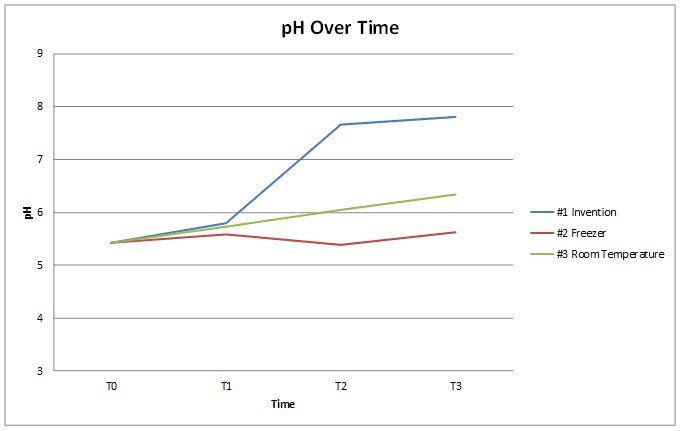
The following graph bellow shows the pH of each sample over the course of the experiment .
 The graph below shows the moisture content of each sample over the experiment.
The graph to the right shows Organic Material % over the coarse of the experiment.
The graph below shows the moisture content of each sample over the experiment.
The graph to the right shows Organic Material % over the coarse of the experiment. 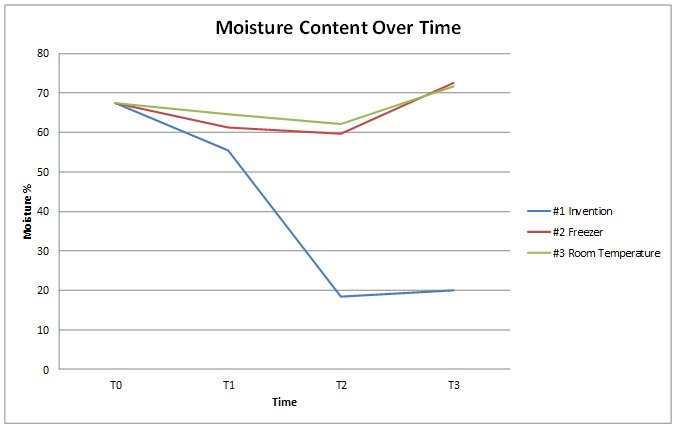 The graph bellow shows Organic Material % over the coarse of the experiment.

Sources of Error
During an experiment there are many aspects of the project that can go wrong. With my project there was no exception.
Firstly of all the amount of organic material in each compost bucket. This could have impacted how fast the material decomposed and well as weighed the results. Secondly the climate of each bucket. During the experiment the organic material had to be stirred every week. During this time period it also gave the buckets time to get warmer. The amount of time that each bucket could have varied by a few seconds but that could allow more heat to be trapped inside of the compost.
Any failure with the measuring equipment also could have negatively changed the results. Some examples of this during the experiment is the incorrect calibration of the pH meter. On sample #1 T2 the pre weight was smaller than the post weight. Because of this I made the inference to raise the number by ten to ensure that the results were accurate based off of the data I received.
Analysis
There was a lot that I learned about during this experiment. Down below are the results of how effective the organic material decomposed over the experiment and are listed from most effective to the least effective.
| #1. Invention | #2. Room Temperature | #3. Freezer | |
|---|---|---|---|
| Final pH | 7.8 | 6.34 | 5.62 |
| Final Moisture Content | 19.98% | 71.59% | 72.53% |
| Final Organic Material Content % | 5.62% | 8.23% | 8.17% |
1 Invention:
There were many reasons why my invention worked so well compared to the other samples I tested during this experiment. First of all the temperature reached up to 54 degrees Celsius. This allowed aerobic bacteria to flourish in the climate and break down the material substantially faster than the other samples. Second the organic material content percentage was relatively low but overall performed well as the trend continued Third the heater kept the material warm enough so then it would not melt. The downside of this was that there was very little moisture content inside of the bucket leading to slightly less efficient compost. In colder temperatures I predict that the heater will hold up a little better and not remove as much moisture. Finally my invention maintained a safe and very close to neutral pH at the final moments of the experiment sitting at 7.8. This is important because in guarantees that the compost can be used on plants and is safe for the environmental integration.
2 Sample at room temperature
This sample decomposed very well during this experiment. This was due to the steady temperature of 20 degrees Celsius allowing aerobic bacteria to steadily grow under the temperatures circumstances. The one sign that proved this compost bin to be less effective than my invention was the fact that it smelled bad. Compost should smell sweet or even unscented if the right conditions are met. Although this samples pH was slightly acidic sitting at 5.62 at the end of the experiment it continues to trend closer to neutral over the experiment. Other than that this sample performed really well under the circumstances.
3 Freezer sample
There were many reasons why this sample did so poorly compare to my invention and a sample kept at room temperature. First of all there were high levels of moisture content in the bucket but all that moisture was frozen not only not allowing aerobic bacteria to flourish but completely restricting any form of microorganism to survive. Second the temperatures were way too cold to allow aerobic bacteria to survive. Most aerobic bacteria require temperatures ranging from 20-40 Celsius. This sample was also slightly acidic meaning it would integrate poorly into an environment. Overall this sample provided a poor habitat for bacteria and made little progress over the experiment.
Conclusion
Conclusion
In conclusion based off of my data I collected my invention was very successful. In my objective I stated, ‘Creating a cheap and reliable electric composter that operates effectively in below freezing temperatures.’
I believe the success came from the insulation methods and heating methods used to create a warm environment for aerobic bacteria to flourish. Not only had that but the bin provided an optimal temperature to resist the cold temperatures of the freezer but also kept out any cold that threatened the process of decomposition. Although my invention heated the compost too well and got rid of most of the moisture I predict that this project would perform very well in Canadian winters.
In conclusion I believe this project could positively impact many aspects of composting and how we manage organic waste.
Real World Applications
There are many reasons why my project reflects the problems that are happening in the real world. With my invention could accelerate home composting methods, commercial composting methods, and organics waste diversion.
Firstly of all my invention could revolutionize home composting methods. My invention allows organic materials to decompose during the winter and successfully withstand the cold temperatures. This also allows compost to be an easily accessible source of nutrient rich soil for spring time gardening. This could also be an easy alternative for organic food waste in self-sufficient homes. With the large abundance for composting gardening and other home uses of composting will become more cheap and accessible. This could also be extended to larger world issues like world hunger providing compost can increase food production and divert the food waste to help stop starvation.
Secondly my invention could be used for larger scale commercial operations. If up scaled, my inventions could potentially take on more products allowing more organic material to decompose. Not only could my method be a cheap alternative for a green bin project but could also be turned into something that decomposes inorganic material. This invention breaks the surface for further research and other commercial uses in the future. If used responsibly could positively impact the economy in a time where tariffs and trade are in economic uncertainty.
Finally this invention would divert organic material from going to the landfill. At this moment 21 million tons of food waste goes to waste in Canada each year. If we could reduce this number by composting this material not only would it get rid of waste but it would turn it into an alternative to fertilizer. This would also deter the amount of animals that get into contaminated landfills because of the shortage of food waste in the piles of garbage. Lowering our impact on wildlife and the environment would help us into a sustainable and affordable future.
This invention is a POC (Proof of Concept) or prototype that aims to increase the rate of composting in cold temperatures. The future of this project would be powered by solar energy and be completely self-sufficient. This would allow the composter to be environmentally safe while withstanding the cold temperatures of a Canadian winter.
Future Improvements
There would be a lot of things that I would do if I had more time with this project. First of all, my original designs had solar panels in them. Not only would this provide energy for my invention, but it would also be renewable and self-sufficient. Second, I would add some form of electronics to turn this into a smart composter that would monitor and act on situations of the compost. Finally, I would want to test it in real Canadian winter to see how well it would perform in colder temperatures.
Citations
Bibliography
admin. (2023\, February 11). Cells\, Organelles\, and Their Functions | Livius Prep. Livius Prep. https://www.liviusprep.com/cells-organelles-and-their-functions.html
Ahmadjian, V., & Moore, D. (2019). Fungus - Importance of fungi. In Encyclopædia Britannica. https://www.britannica.com/science/fungus/Importance-of-fungi
Britannica. (2024). Solar panel | technology. Encyclopedia Britannica. https://www.britannica.com/technology/solar-panel
Cathey, A., & Ashrap, P. (2019, September 19). Trash to Treasure: The Incredible Benefits of Composting. Sph.umich.edu. https://sph.umich.edu/pursuit/2019posts/benefits-of-composting.html
(CCME Canadian Council of Ministers of the Environment Le Conseil Canadien Des Ministres de l’Environnement Guidelines for Compost Quality)
Cleveland Clinic. (2023, March 29). Virus. Cleveland Clinic. https://my.clevelandclinic.org/health/body/24861-virus
Klopp, H. (2024, January 3). What makes up a healthy soil? Extension.sdstate.edu. https://extension.sdstate.edu/what-makes-healthy-soil
Komp, R. (2016). How do solar panels work? - Richard Komp. TED-Ed; TED-Ed. https://ed.ted.com/lessons/how-do-solar-panels-work-richard-komp
Moore, D., Ahmadjian, V., & Alexopoulos, C. J. (2019). Fungus. In Encyclopædia Britannica. https://www.britannica.com/science/fungus
Nutrient-Rich Soil vs. Nutrient-Depleted Soil. (n.d.). Seven Sons Farms. https://sevensons.net/blog/nutrient-rich-soil-vs-nutrient-depleted-soil
O’Meara, E. (2023, August). What is a motherboard and how it works. Currys. https://www.currys.co.uk/techtalk/computing/what-is-a-motherboard.html
Science of Composting. (n.d.). Www.olus.co.uk. https://www.olus.co.uk/Basic-Science-of-Composting
Trefil\, J.\, Bertsch\, G. F.\, & McGrayne\, S. B. (2019). atom | Definition\, History\, & Examples. In Encyclopædia Britannica. https://www.britannica.com/science/atom
U.S. Energy Information Administration. (2024, May 24). Photovoltaics and Electricity. Eia.gov; U.S. Energy Information Administration. https://www.eia.gov/energyexplained/solar/photovoltaics-and-electricity.php
United Nations. (2025). What Is Renewable Energy? United Nations. https://www.un.org/en/climatechange/what-is-renewable-energy
US EPA, O. (2013, April 17). Composting At Home. Www.epa.gov. https://www.epa.gov/recycle/composting-home#whatcom
What is a microorganism? (n.d.). BBC Bitesize. https://www.bbc.co.uk/bitesize/articles/zsgtrwx
Books:
Aloian, Molly. Green Gardening and Composting. Crabtree Classics, 15 Sept. 2013.
Donnelly, Rebecca, and Christophe Jacques. Green Machine : The Slightly Gross Truth about Turning Your Food Scraps into Green Energy. New York, Godwin Books, Henry Holt And Company, 2020.
Dowding, Charles. Compost. Dorling Kindersley, 10 Sept. 2024.
Flood, Kate. The Compost Coach. Allen & Unwin, 1 Aug. 2023.
Louie, Rebecca. Compost City : Practical Composting Know-How for Small-Space Living. Boston, Roost Books, 2015.
Porter, Esther. What’s Sprouting in My Trash? Capstone, 2013.
Acknowledgement
Thank you so much to Dr.O'Sullivan for sharing her laboratory at MRU and for being a great mentor in science.
Another thank you is to my Grandparents for driving me to MRU and for providing me with a printer to print off my science fair report.
Finally, my parents encouraged me to follow my dreams as a young scientist.