
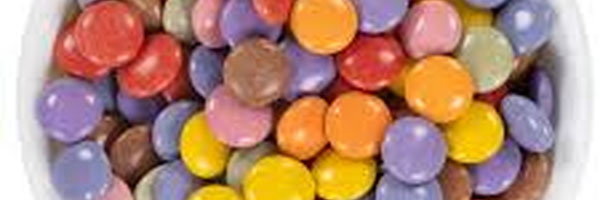
Does eating your favorite color influence how much chocolate you eat?
Victoria Sundin
River Valley School
Grade 5
Presentation
No video provided
Hypothesis
PROBLEM/HYPOTHESIS 1) I hypothesize that the people getting their favorite color will eat more even though the content of the smarties is the same in both groups 2) I hypothesize that kids like chocolate more than adults do, and that color will matter less for kids since they like chocolate so much 3) I hypothesize that kids will eat more chocolate than adults
Research
People subconsciously associate certain colors with distinct flavors and tastes. • Even infants can do that! • For example, pink or red might tell us a fruit is ripe and sweet and green might mean it’s still bitter and sour. There are a lot of studies showing that color can trick us into thinking we are eating something else. • For example, people can “taste sweetness that isn't really there, experience flavors that are not present, and accept or reject foods simply based on their shade” • When people are given many different colors all at once they eat more, this something called “sensory specific satiety” • Even the color of the plate on which food is given can change how much we eat: one study found that if food is served on bright red plates, food intake will increase by 24% and liquid by 84% This also matters for all companies deciding what color their food should be, for example, fruit roll ups, M&Ms , smarties, gummies and all other candy and drinks that are sold artificially or naturally colored. • It costs to make a different variety of colors, but also companies want people to like and buy a lot of their candy. • Still no one asked if getting food with your favorite color will change how much will you eat • Research also shows that kids love chocolate, especially milk chocolate that’s sweet and not bitter. Candy like Smarties have exactly the right nutrients for kids to like them, chocolate flavor, fat and sugar, and a bit of protein. • Adults are thought to like chocolate less, especially milk chocolate like Smarties.
Variables
• Controlled variable: The content of the food that I offered (the chocolate ingredients are the same)
• Manipulated variable: The color of the smarties
• Responding variable: How much people eat
• Other measured variables: - Age - Chocolate liking - Hunger - Ranking preference for 8 colors - Gender
Procedure
-Participants are asked to fill out qestions
Questions I asked on the form: 1.How old are you? 2.Gender (only if you are comfortable answering) 4. Rank the colors from most to least favorite: Red, Green, Blue, Pink, Orange, Yellow, Purple, Brown 3. When did you eat last and are you hungry now ( on a scale of 1-10) 5. How much do you like chocolate on a scale of 1-10?
-- I then gave either their most or least favorite preferred color of smarties (randomly 50/50%) and asked participants to eat as much as the wanted
◼ Things I measured: How many smarties each participant ate
Observations
First I measured how many smarties of each color are in the boxes. I used a food scale. All bags of smarties had the highest # of PINK and the lowest # of PURPLE. I then compared this with people's color preferences. The conclusions were very interesting!
Since adults were a bit shy about eating smarties in front of me, I left them and told them to come back to me when they have eaten as many smarties as they wanted to, this way I could count them and people would not be influenced by me looking at them.
I then collected the answers and compared the answers to the number of smarties eaten. This way I could see how age, color given, and favorite color, and hunger state influence the numbers of chocolate smarties eaten.
Analysis
I have attached my data analysis. My main finding was that colour doesn’t really affect how much you eat. Blue was the most popular colour.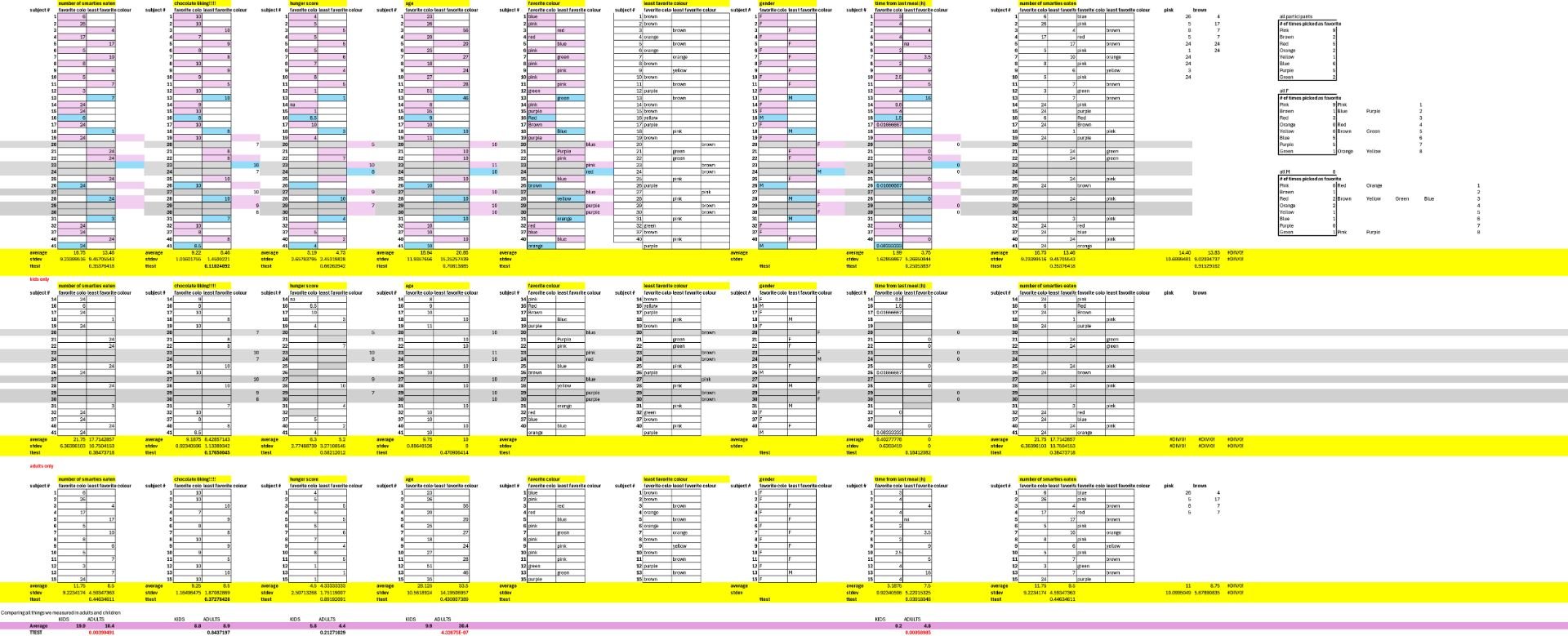
Conclusion
• Unlike what I hypothesized (that color would matter and people would at more if they got their favorite) the results proved opposite, people that got their least favorite color ate a similar amount. • This was especially the case for kids. • For adults, it looks like color mattered a bit more but still the difference between how much smarties adults who got their favorite color compared to adults who got their least favorite color ate was not significant. • I also learned interesting things about how gender influences color preferences: - As we might predict\, girls and women picked pink as their favorite color and for boys and men\, the most common choice for favorite color was red and orange. - Since 2 times more girls than boys agreed to participate in my experiment\, when all participants’ favorite color choice is analyzed - it’s pink (that’s because there are more girls than boys in my experiment). • The next way I analyzed color: I added all the points that each participant gave to each color and then calculated the average, I got very interesting results from this. - Now the highest ranked color for all groups was blue! - It was blue for boys\, men\, girls\, and women (so that’s the color that was less often picked as favorite but often second or third favorite by girls and boys). - So this is the best “compromise” and color – the color that everybody quite likes\, and no one dislikes. Some people think we should vote for politicians this way (it’s called rank ordering). • In my experiment the average age of the kids that participated was 10. For adults, the average age is 30. • Surprisingly, and opposite to my hypothesis, kids and adults said they liked chocolate a lot and adults did not like chocolate any less than kids. • But like I hypothesized, kids ate more chocolate than adults; kids ate twice as much chocolate than adults. • This is interesting because kids wrote that they like chocolate same as adults and also kids said were actually less, and not more hungry, when I gave them chocolate to eat. • What could this mean? • This might mean that kids are not allowed much chocolate at home because their parents don’t let them, so when they get chocolate without parents, they eat it all! • I found that there were studies that suggested this “Severe parental restriction of sweet foods may increase children’s liking and desire for them which can lead to increased consumption when parents are absent”
Application
• To prevent kids from eating so many smarties when there are no limits, parents should let them eat smarties or chocolate at home more freely. Otherwise, they eat a lot even if they are not very hungry. And it’s not great in the long run to eat a lot when you are not hungry. • Blue looks to be the color that everybody likes, it might not be their favorite, but still, if 1 color has to be chosen that’s good for everyone, blue should be the choice based on my data. • Based on my data, companies that make smarties or M&Ms could save money by only selling 1 color (Blue?), and people would still eat the same amount.
Sources Of Error
• When running the experiment, some participants left without letting me count their smarties, next time, I would tape a reminder on the bag of smarties given, so they are less likely to leave. • I also had fewer boys than girls participating, this number should have been more equal, I asked more boys but they didn’t want to participate as much. • Maybe favorite color in general and favorite color for foods might not be the same, I could have asked more specifically what the favorite color for food is. • Maybe when adults think of chocolate, they were thinking about the sophisticated dark chocolate they some studies say like. So next time I would be more specific and ask about milk chocolate. Maybe then the liking score would be lower for adults, and better predict the amount of chocolate they ate (which was less than kids, even though they said they like it the same).
Citations
• Reardon, Patricia, and Emily W. Bushwell. Infants sensitivity to arbitrary pairings of color and taste. Infant behavior & development(1998) • Spence C., “On the relationships between color, taste and flavor”, Experimental Psychology (2019) • Standen holmes JE, Chocolate in children’s food and flavor preferences y (2013) from book chocolate and health nutrition • Hunter lab, “Effect color has on food perception, flavor and quality (2022) • “Do natural colors affect a product’s taste profile” by Dave Gebhardt, Sensient. Na.sensientfoodcolors.com
Acknowledgement
I want to thank all my participants who took the time to help with my experiment, and my teachers, and my parents who bought all the smarties. It was helpful to have so many participants to gather a larger sample size.