
The Household Defense Against Microfibers: A Comparative Analysis of Differential Filter Media in Capturing Synthetic Microfibers
Japnaam Ghuman
Khalsa School Calgary Educational Foundation
Grade 8
Presentation
No video provided
Hypothesis
The total amount of microfibers that is collected most by the different types of filters depend on the way the filter is weaved. If the fabric has a tighter weave, it will probably have a higher chance to catch more microfibers. This is because the tighter weaves allow less microplastics to flow through and capture more of the microfibers.The coffee filter, has the smallest openings amongst all the other filters. Hence it will catch the most amount of microfibers. The pantyhose filter will be in the middle. Meaning that it will not catch the most or the least, because pantyhose has smaller opening and a tighter weave compared to the fine mesh filters, and it has bigger openings when compared to the coffee filter. The least amount of microfibers will be caught by the fine mesh filter. This filter was meant to separate large items from a liquid. Microfibers are very small to be caught by this fine mesh filter, because the opening of the filter is very big. This filter has a loose weave.
Research
Microplastics are small broken down pieces of plastic. They are smaller than 5 mm in diameter. Microplastics are formed when bigger pieces of plastic are broken down by Ultra Violet radiation, heat, or even water. Sometimes, microplastics are made to be small. Microplastics can be found in areas like the ocean, soil and even the air. These small plastics are shimmery and have a glossy surface, have an uneven shape, and can even have sharp edges. They usually have colours that do not look very natural, like a very vibrant blue. Many microplastics enter our food by bioaccumulation, packaging, and food processing. Bioaccumulation is “the accumulation over time of a substance and especially a contaminant (such as pesticide or heavy metal) in a living organism.”
Highlighted= Taken from https://www.merriam-webster.com/dictionary/bioaccumulatio
What are microfibers? Microfibers are the most popular type of microplastic. Microfibers are small pieces of plastic that come from synthetic clothing. Synthetic clothes are made from plastic fibers. Plastic fibers are made from plastic that is shaped in long threads. When the synthetic clothes are washed, small pieces of the synthetic clothing (the plastic fibers) break apart from the clothing. Synthetic clothing includes nylon and polyester. Slide 3 - December 21, 2025
What do these microfibers look like?
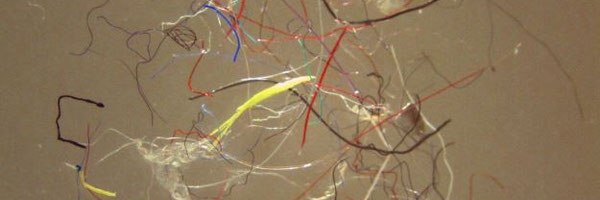
Microfibers are small pieces of plastic that are shaped like tiny threads. They are smaller types of plastic fibers, which come from synthetic clothing. Many microfibers are smaller than 5 millimeters long. Since they are so small, I will be needing a microscope to see the microfibers clearly. They are also lightweight, so they can float in the water. Microfibers can be many different colours, like blue, red and black. Some are also clear. The colour usually depends on the colour of the cloth. Microfibers do not have very sharp edges, but they are still sharp enough to create small cuts in our organs.
How do microfibers pollute water bodies
- When clothes made from synthetic cloth are washed, clothes rub against each other and small pieces of plastic fall off into the water. They are small and have a fiber- like shape.
- The water from the washing machine is then drained and goes to the sewer system. “A sewer system, also called a sanitation system, is the infrastructure that’s designed to collect and dispose of storm water and wastewater.” The water from the washing machines has many microfibers in it.
- The water then goes to wastewater treatment plants. Since the microfibers are too small, the wastewater treatment plants can not separate the microfibers. A wastewater treatment plant, WWTP, is an industrial facility where a combination of mechanical, physical, chemical and biological processes is used to achieve pollutants removal from the incoming wastewater.
- This water then goes back to rivers and lakes, and this goes back to oceans.
- Microplastics, which include microfibers, can not break down easily. So the plastics stay in the oceans and then are eaten by fish and other creatures.
Information taken from- https://www.agreenerfuture.ca/blog1/microfibres-actionguide
Why are microfibers considered dangerous
When fishes and other sea creatures eat microfibers, the microfibers build up in their bodies. When another sea creature eats the fish that has microfibers in its body, the predator then builds up microfibers in its body too. When microfibers enter the human body, it can cause the organs in the body to swell. It also may leave some small and deep cuts in different organs. Microfibers also can sometimes have some dangerous chemicals which can damage the body. Microfibers/microplastics can damage the cells and DNA. It also increases the risk of heart attack, strokes and cancer.
https://hsph.harvard.edu/news/microplastics-are-everywhere-and-can-harm-human-health-say-experts/
How will I view the microfibers?
Microfibers are very hard to see. To see the microfibers I will be using a microscope. A microscope is an optical device that uses the power of 2 or more lenses. For this project I will be using a microscope that has 4x magnification. Magnification is the ability to view objects larger than they would usually appear. When a microscope has 4x magnification, it means that the objective lens, which is the lens in the microscope that collects light that comes from an object to create an image, magnifies the object 4 times. My eye lens has a magnification of 25x. So altogether, I will have a magnification of 100x. I will then count the visible microfibers for each trial. Afterwards, I will add the microfibers of each of the three trials and divide it by 3, which is the number of trials, to get the average.
Definitions taken from Science in Action Textbook
For this project I will be using 3 different brands for my three filter types, which are, coffee filter, fine mesh filter and pantyhose filter. A tighter weave will catch more microfibers than a loose weave one. This is because the smaller gaps will catch the microfibers which are around 5mm long. The bigger openings will not catch the tiny microfibers.
Coffee Filters- Coffee filters are made from cellulose fibers. This filter has a tight weave. A tighter weave can catch more microfibers than looser ones. A coffee filter will probably catch the most microfibers because the coffee filter has the tightest weaves. The three brands that I will be using for the coffee filters are Melitta, Mr.Coffee, and Kirkland. Coffee filters are used to filter coffee ground from brewed coffee and also cleaning glass.
Fine Mesh Filters- Fine mesh filters are used in sinks and bathrooms, to catch large solids and let liquids go through. They are also used in straining food, such as chai or pasta. These filters are made from steel, nylon and polyester. Since the weaves in the fine mesh filters are larger than the ones in the coffee filters and pantyhose filters, this type of filter will catch the least microfibers. The three brands that I will be using are OXO, Cuisinart, and KitchenAid.
Pantyhose Filters- Pantyhose filters can be used in clothing, filtering small particles in drains or washing machines and can also be used as dust filters as well. Pantyhose filters are made from nylon and spandex. This type of filter has very fine fibers meaning that the nylon fibers in the filter are very thin and small. Since they are very thin, they can be stretched a lot. This type of filter has tighter weaves , when compared to the fine mesh filter. It has looser weaves when compared to the coffee filter. The three types of brands that I will be using for this type of filter are Hanes, L’eggs, and No Name.
The reason I will be using three different brands is because the filter type can not be justified by just one filter. By using 3 different brands, I am being more fair because sometimes the quality of the filter may not be perfect. Also with this, I can calculate the average of each type of brand and compare it to the other filter, and make the comparisons part easier and my data will then be more reliable.
For this project I will be using a single shirt for all of the trials. By using the same shirt, it creates a fair test because I am not using a different shirt for each trial. Some shirts may shed more microfibers when compared to another. Also my testable question is, “ which filter filters the most microfibers?” not, “which cloth sheds the most microfibers?” Each sample will measure 10cm by 10cm. The cloth/shirt is made only from polyester, no cotton.
 Taken from- https://ui.adsabs.harvard.edu/abs/2020AGUFMH182...03D/abstract
Do non-synthetic cloth shed microfibers?
Taken from- https://ui.adsabs.harvard.edu/abs/2020AGUFMH182...03D/abstract
Do non-synthetic cloth shed microfibers?
Clothes made from wool and cotton are made from non-synthetic material. Though, the clothes still will create microfibers. According to the CLEANR website, cotton and wool create more microfibers than polyester and nylon. Clothes made from nylon and polyester are considered synthetic material. Though the microfibers created from cotton and wool will decompose and will not stay in the oceans and lakes for decades, the microfibers created from polyester, and nylon will not decompose and stay in oceans for decades. https://www.cleanr.life/news/natural-clothes-unnatural-pollution#:~:text=A%20study%20published%20in%20Environmental,so%20less%20tends%20to%20shed.
There are some some specialized filters designed to catch microfibers, which are created by synthetic clothes like polyester and nylon, when washing. Some filers are, the PlanetCare Washing Machine Microplastic filter, the Filtrol 160 Washing Machine Laundry Lint Filter, and the Electrolux AEG Accessory. Some appliance brands, such as, Samsung and Grundig, are starting build machines that already have microfiber filters in them. These filters can be built into new washing machines or can even be added to the hose or an older machine to trap up to 98 percent of the plastics. Some areas around the world, are already starting to create laws to reduce pollution. For example, France became the first country in the world to pass a law, regarding the country, to include microfiber filters by 2030. Another example would be California, in the United States, which has passed bills to make sure that there are microfiber filters built in washing machines in by 2029.
Because these fibers are so small, they can easily get inside our bodies through the air we breathe and the food or water we consume. Once inside, they have been found in many important areas, including our lungs, where they can cause irritation, and our digestive system, where they may upset the healthy bacteria in our gut. Scientists have even discovered these tiny plastics traveling through our bloodstream, allowing them to reach the heart, liver, and even the brain. Because these fibers often carry harmful chemicals, researchers are worried they could cause long-term health problems like inflammation or interfere with how our bodies grow and develop.
Variables
My independent variable for this project would be the filter types, which are coffee filters, pantyhose filters, and fine mesh filters. Another independent variable would be the different brands for each filter. For the uncontrolled variable, the variables would be the colours of the filters, especially the fine mesh filter, which made it harder to see the microfibers, and also the temperature of the mixture, when I was stirring it. The responding variables would be, the number of microfibers caught by each filter. The controlled variable would be the type of fabric for the clothing, which is POLYESTER, the size of fabric and filters, the volume of water and detergent, the stirring time, water temperature before mixing the mixture, using a microscope to view the visible microfibers, the number of trials and the magnification level, which was 100x.
Procedure
Coffee Filter
Step 1- -Cut out a piece of cloth made from polyester, it should measure 10 cm in width and 10 cm in length -Add 250 ml of water that measure 40 degrees Celsius and add 1 teaspoon of detergent-I will be using Gain for each- to a container -Wear safety equipment- gloves and lab coat -Keep in mind to use a different container for each trial -Add the piece of cloth into the mixture -Use an electrical whisk to evenly mix the mixture, use a moderate speed, not to high or low, and keep it the same throughout the 2 minutes of shaking
Step 2- -Label the container with Coffee Filter- and the specific brand -Repeat this three times for the same filter and brand, and do it three more times for each brand for the Coffee Filter -You can also label this on the filter- I will be doing that
Step 3 - -Cut the filter so that it also measures 10 cm in length and 10 cm in width -Then pour the mixture through the filter -Since the filter might be fragile when water goes through, let the filter dry, so it will be easier to see the microfibers under the microscope
Step 4- -Once the filter is dry, put in under a microscope -Use an object lens that give a magnification level of 4x, and an eyepiece lens that provides a magnification of 25x- so altogether I should be able to see my filter 100 times larger than normal -If it makes it easier, switch the colour of light for the microscope so you can see the microfibers even clearer- as some microfibers might be white, and might blend in with the light
Step 5- -Observe the microfibers, and I will be counting the microfibers that are visible -Calculate the average (number of microfibers found per each trial divided by the number of trials)
Step 6 -Create a chart which lists the average for each brand and filter type -Then, calculate the the average for each filter, combine all the averages for the 3 coffee filter brands and divide it by 3 -Compare the average for the coffee filter, to the fine mesh filter and pantyhose filter
Additional tip for each procedure- Also instead of pouring the mixture onto the filter which is secured by my hands, use a tall glass and cover the top of the glass with the filter. Then secure it with a rubber band. This makes it easier.
Pantyhose Filter
Step 1 -Cut out a piece of cloth made from polyester, it should measure 10 cm in width and 10 cm in length -Add 250 ml of water that measure 40 degrees Celsius and add 1 teaspoon of detergent- I will be using Gain for each- to a container -Wear safety equipment - lab coat and -Make sure to use a different container for each trial -Add the piece of cloth into the mixture -Use an electrical whisk to evenly mix the mixture, use a moderate speed, not to high or low, and keep it the same throughout the 2 minutes of shaking
Step 2- -Label the container with Pantyhose Filter- and the specific brand -Repeat this three times for the same filter and brand, and do it three more times for each brand for the Pantyhose Filter -You can also label this on the filter- I will be doing that
Step 3 - - Cut the pantyhose filter so that it also measures 10 cm in length and 10 cm in width -Pour the mixture through the cut filter -Since the filter might be fragile when water goes through, let the filter dry, so It will be easier to see the microfibers under the microscope
Step 4- -Once the filter is dry, put in under a microscope -Use an object lens that give a magnification level of 4x, and an eyepiece lens that provides a magnification of 25x- so altogether I should be able to see my filter 100 times larger -If it makes it easier, switch the colour of light for the microscope so you can see the microfibers even clearer- as some microfibers might be white, and might blend in with the light
Step 5- -Observe the microfibers, and I will be counting the microfibers that are visible -Calculate the average (number of microfibers found per each trial divided by the number of trials)
Step 6 -Create a chart which lists the average for each brand and filter type -Then, calculate the the average for each filter, combine all the averages for the 3 pantyhose filter brands and divide it by 3- the number of brands for each filter -Compare the average for the Pantyhose filter, to the fine mesh filter and coffee filter Additional tip for each procedure- Also instead of pouring the mixture onto the filter which is secured by my hands, use a tall glass and cover the top of the glass with the filter. Then secure it with a rubber band. This makes it easier.
Fine Mesh Filter Step 1 -Cut out a piece of cloth made from polyester, it should measure 10 cm in width and 10 cm in length -Add 250 ml of water that measure 40 degrees Celsius and add 1 teaspoon of detergent- I will be using Gain for each- to a container -Use a different container for each trial -Add the piece of cloth into the mixture -Use an electrical whisk to evenly mix the mixture, use a moderate speed, not to high or low, and keep it the same throughout the 2 minutes of shaking
Step 2- -Label the container with Fine mesh filter- and the specific brand -Repeat this three times for the same filter and brand, and do it three more times for each brand for the Coffee Filter -You can also label this on the filter- I will be doing that
Step 3 - -Pour the mixture through one specific spot - Do not cut it now Step 4 -Let the filer dry -Once it is dry, cut the specific spot where you poured the mixture- it should measure 10 cm in both height and width- use a wire cutter - Use a microscope to observe the microfibers -Use an object lens that give a magnification level of 4x, and an eyepiece lens that provides a magnification of 25x- so altogether I should be able to see my filter 100 times larger -If it makes it easier, switch the colour of light for the microscope so you can see the microfibers even clearer- as some microfibers might be white, and might blend in with the light
Step 5- -Observe the microfibers, and I will be counting the microfibers that are visible -Calculate the average (number of microfibers found per each trial divided by the number of trials)
Step 6 -Create a chart which lists the average for each brand and filter type -Then, calculate the the average for each filter, combine all the averages for the 3 fine mesh brands and divide it by 3- the number of brands -Compare the average for the fine mesh filter, to the coffee filter and pantyhose filter
Observations
When I filtered the mixture through the coffee filters, Melitta, Mr.Coffee, and Kirkland, I noticed that when I poured a little of the mixture, these filters had already caught 3-4 visible microfibers! When I poured all of the mixture, many small dot/thread-like shapes were visible. At first I was concerned that the coffee filters wouldn't hold their shape as they were made from cellulose paper, but surprisingly, it held its shape very well. There were more microfibers caught by the coffee filter when compared to the fine mesh filters and pantyhose filters. There were less microfibers in the water compared to the fine mesh filters and the pantyhose filters. The brand that captured the most visible microfibers was the Melitta brand, and from what I saw, it had a tighter weave compared to the other brands. Kirkland had caught the least visible microfibers, from what I saw, the paper was thinner when compared to the other brands. Once the filters were dry, the filters looked a little more coarse, but the black dots/threads became even more visible. The microfibers were black, because the polyester was also black.
When I filtered the mixture through the Fine Mesh filters, OXO, Cuisinart, and KitchenAid, I noticed that even when I poured all of the mixture through my filter, there were barely any visible microfibers. The fine mesh filters had very big weaves, when compared to the pantyhose filters and coffee filters. Though the filtered water was not really filtered. There were many more microfibers in the mixture than there were on the filter. The fine mesh filter water/ mixture probably had the most microfibers when compared to the pantyhose filters and the coffee filters. The reason why I cut the filter later was so that the filter’s wires would not get damaged before the filtration. I cut around the area where the mixture was poured through after it fully dried. Though the filter still measured 10 cm in length and width. The brand that captured the most visible microfibers would probably be OXO, and this brand had smaller pores when compared to the other brands. The brand that had caught the least amount of microfibers would be Kitchen Aid, it had larger openings/pores and it had zero visible microfibers!
When I filtered the mixture through the pantyhose filters Hanes, L’eggs, and No Name, I could see some of the visible microfibers. Most of the microfibers that were visible were separated when most of the mixture was already poured through the filter. The pantyhose filters were very stretchy, so the weaves really did just depend on how far each filter could stretch. This filter did not catch the least or most visible amount of microfibers. Neither did the water that was filtered have the most or least amount of microfibers in it. The brand that caught the most visible microfibers would be the Hanes, this did not stretch a lot, so the pores/openings were smaller compared to the other brands. The brand that caught the least amount of visible microfibers would be the No Name brand, this one stretched the farthest, and had the biggest opening/pores when compared to the other brands. When each filter had dried, you could see the microfibers even more.
Mistakes in my Data- A science fair will have mistakes. In my data, there are significant differences between the number of microfibers caught by each filter. The reason why this could possibly be was because not every piece of cloth sheds the same amount of microfibers. Some areas of the shirt could have fibers that are tightly packed and hard to break, and some samples might have fibers that break up easily. Also, I could have poured the mixture through the filter at different speeds. For the pantyhose filters, for L’eggs, I did take pictures for trial 1, when I was pouring I did not pour all of the mixture in one go, I consecutively took breaks for pictures. But for the second trial for the same brand, I poured all of the mixture in one go. Also, I could have missed many small microfibers in each filter


Analysis
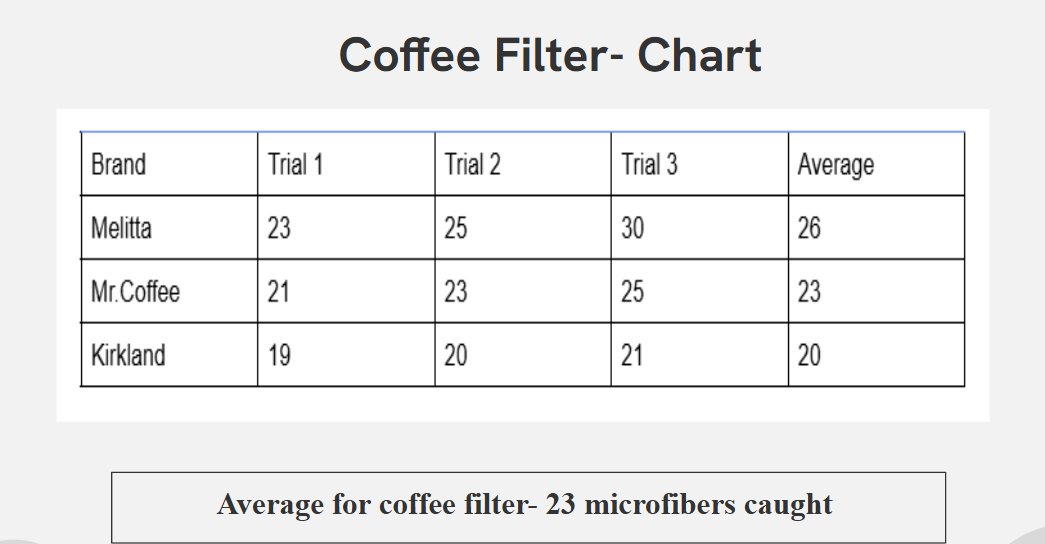
Melitta Brand- Trial 1- 23 Melitta Brand- Trial 2- 25 Melitta Brand- Trial 3- 30
(23+25+30)/3= 26 average for Melitta
Mr.Coffee- Trial 1- 21 Mr.Coffee-Trial 2- 23 Mr.Coffee-Trial 3-25
(21+23+25)/3= 23 average for Mr.Coffee
Kirkland- Trial 1-19 Kirkland-Trial 2-20 Kirkland-Trial 3-21
(19+20+21)/3= 20 average for Kirkland
(26+23+20)/3= 23 average for Coffee Filter
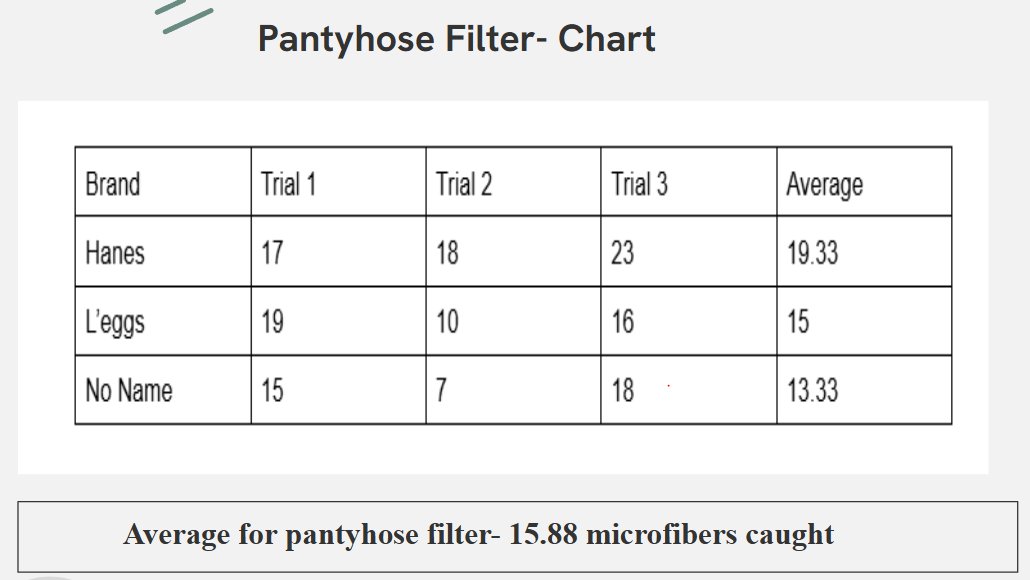
Hanes- Trial 1- 17 Hanes- Trial 2- 18 Hanes- Trial 3- 23
(17+18+23)/3= 19.33- Average for Hanes
L’eggs- Trial 1- 19 L’eggs- Trial 2-10 L’eggs- Trial3-16 (19+10+16)/3= 15 average for L’eggs No Name- Trial 1- 15 No Name- Trial2- 7 No Name- Trial 3-18
40/3= 13.33 average for No name
Average for Pantyhose would be around 15.88
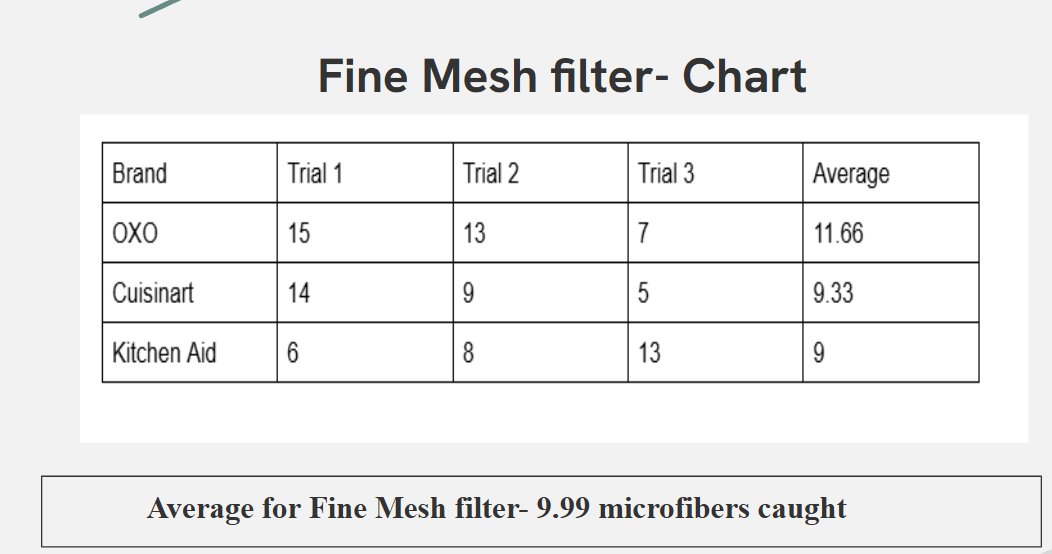
OXO- Trial 1- 15 OXO- Trial 2- 13 OXO- Trial 3- 7 Average- 11.66 Cuisinart- Trial 1- 14 Cuisinart- Trial 2- 9 Cuisinart- Trial 3- 5 Average-9.33 Kitchen Aid- Trial 1- 6 Kitchen Aid- Trial 2- 8 Kitchen Aid- Trial 3- 13 Average- 9
Average would be around- 9.99

Conclusion
When conducting this experiment, I thought that I would not be able to see all microfibers all clearly with 1000x magnification. But surprisingly, I was able to see the microfibers with 100x magnification. My hypothesis was correct. The coffee filter was most successful, with filtering the mixture. The three brands were Melitta, Mr.Coffee and Kirkland. The brand that was most successful was Melitta, then Mr.Coffee, and lastly, Kirkland. Melitaa caught an average of 26 microfibers. The average for Mr.Coffee was 23 microfibers caught. The average for Kirkland was 20 microfibers caught. The average microfibers caught for the coffee filter was 23. Then came the pantyhose filters. The pantyhose’s openings were not the biggest, or the smallest. The three brands were Hanes, L’eggs, and No Name. Hanes had caught the most, then L’eggs, and lastly, No Name. The average for Hanes was 19.33 microfibers caught. The average for L'eggs was 15 microfibers caught. The average for No Name was 13.33 microfibers caught. The average for the pantyhose filter was around 15.88 microfibers caught. The filter that caught the least amount of microfibers was the fine mesh filter. The three brands that had caught the most were OXO, then Cuisinart, and lastly, Kitchen Aid. The average microfibers caught for OXO was 11.66. The average for Cuisinart was 9.33 microfibers caught. The average for Kitchen Aid was 9 microfibers caught. The average for this filter was. It was surprisingly very close to the pantyhose. The colour of the steel made it hard to see the visible microfibers during the observations. In conclusion, the filter that has the tightest weaves and smallest openings, will separate the most microfibers. A filter, which has loose weaves and big openings will catch the least amount of microfibers.
Application
My project helps because today, most of you know what microfibers are. In Canada, about 1920 tonnes of microfibers are released every year. In one full load of laundry, several of millions of microfibers are released. My project also demonstrates that a filter with a tighter weave, smaller openings, and a filter that is not very stretchable, can capture more microfibers when compared to ones that have a loose weave, bigger openings and a more stretchable fabric. A filter that captures more microfibers is the coffee filter, and a filter that captures less is the fine mesh filter. This project shows that wastewater treatment plants need to do a better job at filtering microfibers by using a filter that is built like a coffee filter, meaning that it has smaller openings and a tighter weave. Washing machines also need to use a better filter to capture more microfibers. Now you know what microfibers are, and how they are created. You can help by using cloth made from non-synthetic material. Before purchasing a washing machine, make sure that it has a strong filter, so that it can filter the microfibers. A strong filter would have a tighter weave and smaller openings.


Sources Of Error
-When I let the filters dry, some of the microfibers, from the air could have landed on my filters -I could have counted too many, or less microfibers under the microscope -The colour of the fine mesh filter made it more difficult to see the microfibers, so I could have counted a little less than the microfibers that were actually caught -Some fibers might have overlapped when filtering, so counting them were a little more difficult -The water temperature may have not been 40 degrees celsius throughout the whole shaking step -I may have poured the mixture through a certain filter at a faster speed, so the microfibers caught cold have been less, than what would have actually been caught -I may have poured a little over or under a teaspoon of Gain (detergent) in the mixture -The volume of water may have been a little less or more than 250 ml
Citations
Micron Size Comparison Chart. (n.d.). Www.clearstream.ca. https://www.clearstream.ca/micron-size-comparison-chart Report on Microfiber Pollution 2022 REPORT TO CONGRESS: DRAFT FOR PUBLIC COMMENT Report Provided on Behalf of the Interagency Marine Debris Coordinating Committee. (n.d.). Retrieved January 8, 2026, from https://downloads.regulations.gov/NOAA-NOS-2022-0061-0029/attachment_1.pdf Water Filters FAQs. (2025). Nsf.org; NSF. https://www.nsf.org/about-nsf/faqs/water-filters-faqs Akyildiz, S. H., Fiore, S., Bruno, M., Sezgin, H., Yalcin-Enis, I., Yalcin, B., & Bellopede, R. (2024). Release of microplastic fibers from synthetic textiles during household washing. Environmental Pollution, 357, 124455–124455. https://doi.org/10.1016/j.envpol.2024.124455 Sheikhi, M., Bianco, C., Tiraferri, A., & Sethi, R. (2025). Evaluating microfiber emissions and point-of-use filtration efficiency in household washing and drying cycles. Journal of Hazardous Materials, 489, 137646. https://doi.org/10.1016/j.jhazmat.2025.137646 Merriam-Webster. “Definition of BIOACCUMULATION.” Merriam-Webster.com, 2020, www.merriam-webster.com/dictionary/bioaccumulation.
How, Microfibres. “A Greener Future.” A Greener Future, 20 June 2022, www.agreenerfuture.ca/blog1/microfibres-actionguide . Accessed 20 Sept. 2025. How, Microfibres. “A Greener Future.” A Greener Future, 20 June 2022, www.agreenerfuture.ca/blog1/microfibres-actionguide . Accessed 20 Sept. 2025. DeLeon, M. “Microfibers: From the Store to the Shore.” AGU Fall Meeting Abstracts, vol. 2020, Dec. 2020, pp. H182-03, ui.adsabs.harvard.edu/abs/2020AGUFMH182...03D/abstract . Accessed 8 Jan. 2026.
“Microplastics Are Everywhere and Can Harm Human Health\, Say Experts | Harvard T.H. Chan School of Public Health.” Harvard T.H. Chan School of Public Health\, HSPH\, 16 Oct. 2025\, hsph.harvard.edu/news/microplastics-are-everywhere-and-can-harm-human-health-say-experts/ .Savchuk, Katia. “What’s the Deal with Microplastics, the Material That “Never Goes Away”?” News Center, 2025, med.stanford.edu/news/insights/2025/01/microplastics-in-body-polluted-tiny-plastic-fragments.html.
neil.mccoy. “Microplastics & Microfibers Research in the Classroom | OR&R’s Marine Debris Program.” Marinedebris.noaa.gov\, 22 Feb. 2022\, marinedebris.noaa.gov/curricula/microplastics-microfibers-research-classroom.
Debris\, Marine. “What Are Microplastics? Microfibers? | Marine Debris Program.” Noaa.gov\, 18 Nov. 2019\, marinedebris.noaa.gov/what-are-microplastics-microfibers-0
. Accessed 10 Jan. 2026.
 US EPA. “Microplastics Research.” Www.epa.gov, 22 Apr. 2022, www.epa.gov/water-research/microplastics-research
.What You Should Know about Microfiber Pollution. 2020.https://www.epa.gov/sites/default/files/2020-08/documents/article_2_microfibers_formatted.pdf
Ocean Conservancy. “Fibers to Filters.” Ocean Conservancy, 8 Sept. 2025,oceanconservancy.org/work/plastics/plastics-deep-dive/fibers-to-filters/.
sfei.org/. “Microplastic Fibers | San Francisco Estuary Institute.” Sfei.org\, 2019\, www.sfei.org/programs/cw/microplastics/microfibers.
Accessed 16 May 2025.
US EPA. “Microplastics Research.” Www.epa.gov, 22 Apr. 2022, www.epa.gov/water-research/microplastics-research
.What You Should Know about Microfiber Pollution. 2020.https://www.epa.gov/sites/default/files/2020-08/documents/article_2_microfibers_formatted.pdf
Ocean Conservancy. “Fibers to Filters.” Ocean Conservancy, 8 Sept. 2025,oceanconservancy.org/work/plastics/plastics-deep-dive/fibers-to-filters/.
sfei.org/. “Microplastic Fibers | San Francisco Estuary Institute.” Sfei.org\, 2019\, www.sfei.org/programs/cw/microplastics/microfibers.
Accessed 16 May 2025.
https://www.facebook.com/unep. “Everything You Should Know about Microplastics.” UNEP, 2025, www.unep.org/news-and-stories/story/everything-you-should-know-about-microplastics. National Geographic Society. “Microplastics | National Geographic Society.” Education.nationalgeographic.org\, National Geographic\, 20 May 2022\, education.nationalgeographic.org/resource/microplastics/. Wood, Krystle, et al. The United States Federal Plan to Address Microfiber Pollution. https://www.epa.gov/system/files/documents/2023-04/The%20United%20States%20Federal%20Plan%20to%20Address%20Microfiber%2031Mar2023.pdf
Debris\, Marine. “At the Store | Marine Debris Program.” Noaa.gov\, 15 Jan. 2025\, marinedebris.noaa.gov/how-help/store . Accessed 10 Jan. 2026. krista.e.stegemann. “Quantification of Microplastics and Microfibers on U.S. National Park Beaches | OR&R’s Marine Debris Program.” Noaa.gov\, 11 Apr. 2017\, marinedebris.noaa.gov/research/quantification-microplastics-and-microfibers-us-national-park-beaches.
Clothes Dryers May Be a Major Source of Airborne Microplastics. 11 Feb. 2022, www.snexplores.org/article/clothes-dryers-may-be-major-source-airborne-microplastics.
Liu\, Ning. “Harmonizing Methods to Monitor Microplastic Pollution | Northwest Pacific Action Plan (NOWPAP).” Unep.org\, 2019\, www.unep.org/nowpap/news-and-stories/story/harmonizing-methods-monitor-microplastic-pollution. Accessed 10 Jan. 2026. Marie, Elisabeth. “Laundry Is a Top Source of Microplastic Pollution – Here’s How to Clean Your Clothes More Sustainably.” Australian Geographic, 17 Jan. 2024, www.australiangeographic.com.au/news/2024/01/laundry-is-a-top-source-of-microplastic-pollution/. Perez, Jennifer. “What Are Microplastics and Microfibers? - Ocean Conservancy.” Ocean Conservancy, 27 Aug. 2024, oceanconservancy.org/blog/2024/08/27/what-microplastics-microfibers/.
What You Should Know about Microfiber Pollution. https://19january2021snapshot.epa.gov/sites/static/files/2020-07/documents/article_2_microfibers.pdf “Microplastics and Microfibres.” MEC, 2017, www.mec.ca/en/explore/microplastics. Cotton Today. “Microfibers.” CottonToday, If Cotton produces Microfibers and contributes to the microfiber plastic pollutioncottontoday.cottoninc.com/our-sustainability-story/microfibers/.
Somers, Sienna . “Our Clothes Shed Microfibres - Here’s What We Can Do...” Fashion Revolution, 25 Feb. 2020, www.fashionrevolution.org/our-clothes-shed-microfibres-heres-what-we-can-do/. No Plastic No Problem. “No Plastic, No Problem.” No Plastic, No Problem., 2025, www.noplasticnoproblem.com/blog/microfibers-bad-for-the-environment-and-worse-for-you. Brodde, Kirsten. “What Are Microfibers and Why Are Our Clothes Polluting the Oceans?” Greenpeace International, 6 Nov. 2019, www.greenpeace.org/international/story/6956/what-are-microfibers-and-why-are-our-clothes-polluting-the-oceans/. Ocean Diagnostics. “PRESS RELEASE: New Report Tackles Microfibre Pollution Crisis, Outlines Solutions.” Oceandiagnostics.com , Ocean Diagnostics Inc., 26 Nov. 2024, oceandiagnostics.com/ocean-diagnostics-blog/press-release-microfibre-report.
Accessed 17 Jan. 2026.
Acknowledgement
I would like to acknowledge-
- My parents- They bought me the necessary materials- we went over my budget, which was $100- and they recounted the visible microfibers on the filters to make sure my data was accurate
- Aarshdeep Boparai- A biology student at the UofC, who helped me recount the microfibers so that the data was accurate
- My science teacher- for giving me feedback to improve my project
