
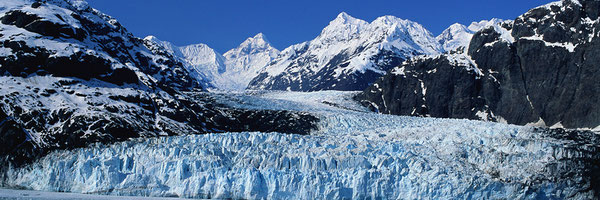
Can we grow glaciers?
Muhammad Awab Arif
Almadina Language Charter Academy, Ogden Campus
Grade 6
Presentation
No video provided
Problem
Climate change is becoming an ongoing problem in our world, and global warming has a significant impact. One of the effects of global warming is melting glaciers, which is a big problem for water conservation on Earth. To help fight against global warming, people have figured out a solution to "artificially rebuild glaciers". These techniques of building glaciers originate in the Himalayan and Karakorum mountain ranges, but I want to implement these ideas in the Rocky Mountain range of Canada. The main techniques of remaking glaciers are called glacier grafting and making ice stupas, but people in the Switserland have also been saving their glaciers with reflective blankets and making artificial glaciers in other ways by reusing the glacier melting water to make another one. As you can see, individuals have thought of many creative ways of fighting against climate change and global warming.
Glaciers are significantly important to the environment, so here are the pros and cons for buiding artificial glaciers.
| Pros: | Cons: |
|---|---|
| When a glacier melts in spring, it can affect agriculture. | It takes lots of people and lots of labour to build one. |
| It helps preserve fresh water in dry areas where there is barely any precipitation. | It can only work in cold areas below the freezing level. |
| and it helps maintain the environment. |
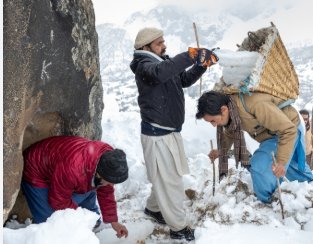 Figure 1: Glacier grafting in the Karakorum mountain range
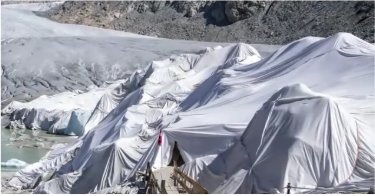
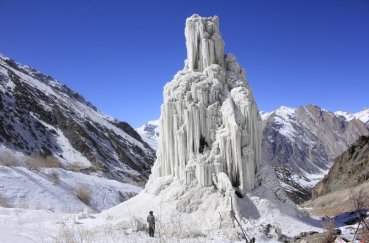 Figure 2: Building artificial glaciers in the Swiss Alps. Figure 3: Ice stupa in Ladakh.
Method
- Research Stage: I've studied the environmental conditions, such as temperature, wind, sunlight, and snow patterns. of both the Karakoram and the Rocky Mountains. I also used resources like Google Scholar and other online websites.
- Design Stage: I then demonstrated and set up a scaled-down version of glacier grafting and measured its growth each day.
- Experiment Stage:
- I created a small ice bucket to replicate glacier grafting, one dirty and one clean
- Track melting or growing over several days.
- Observation Stage: Then I recorded the times when it gained height or lost height. Finally, I made a list of all the ideal places where glacier grafting can be used in the Rocky Mountains, using Google Earth.
About the map: Glaciers should grow in elevated places where the temperature is below the freezing level and is accessible for humans to reach.
Figure 1: Ideal places to use glacier grafting.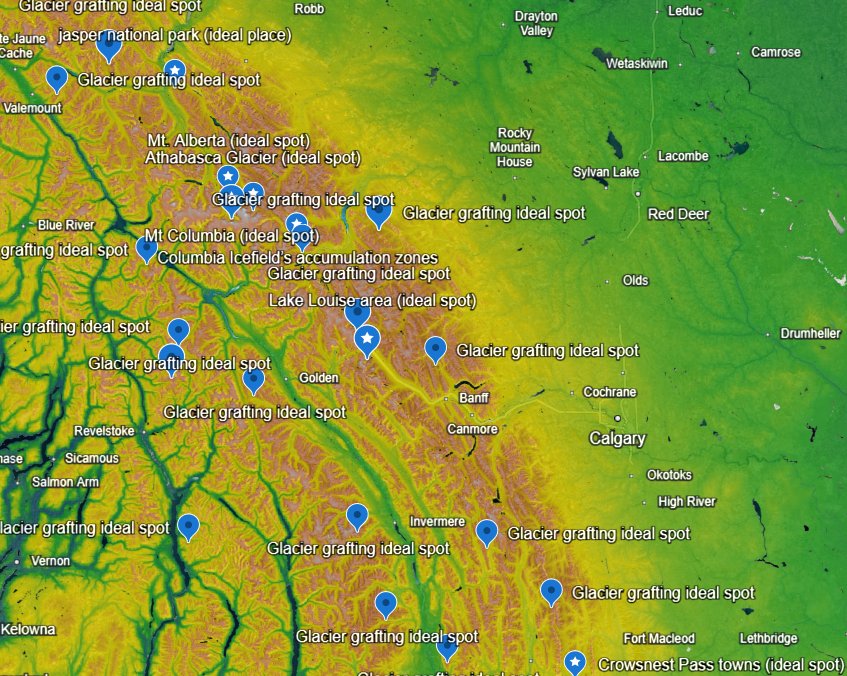

 More important and ideal spots for glaciers
 Suitable spots for glacier grafting
Research
Background information: Introduction to the problem: There is no doubt that Canada's glaciers are melting. Global warming is speeding up the retreat of the glaciers at a pace never seen before. The impacts of global warming include the rise in temperature on Earth, which may result in melting of glaciers, corresponding floods, droughts and rising sea levels in coastal areas. It made me wonder if we could slow down global warming or at least its effects, and if we do, we can make a livable planet for generations to come. Glaciers are important sources of water that form rivers, which in turn are responsible for providing water for agriculture, drinking and other human needs. They also have an influential impact on the climate. If we can grow glaciers, we might be able to conserve the water supply through the same water-melt system. I was able to explore a few prevalent strategies for growing glaciers in some parts of the world. For instance, Swiss scientists have recently been covering their glaciers with reflective blankets and reusing glacier melting water to make another glacier, while the people in the Himalayas and Karakoram have been using techniques like glacier grafting and ice stupas for decades. Scientists in Chile are also experimenting with these techniques, so I believe the Canadian Rockies can also benefit from these strategies. Swiss glaciers covered with reflective material Defining the problem: More than 200 million people around the world rely on glaciers to access fresh water that are unfortunately disappearing faster than ever this century. The Canadian Rockies, often called the region’s “water towers,” are losing their ice at a remarkably fast rate. This is leading to spring runoffs and lower summer flows. According to the Canadian encyclopedia, by 2100, scientists predict that those in Alberta and British Columbia will have lost over 70 percent of their 2005 volume of glaciers due to climate change. This trend threatens water security in Canada, which relies on the glaciers and rivers of the Rocky Mountains. The major river basins include the North and South Saskatchewan rivers, the Columbia River and the Athabasca River. These may impact up to 7 million people who depend on this water from the Rocky Mountains.
Importance of Rocky Mountain glaciers for Canada : Glacial melt is essential for maintaining river flows in Canada during late summer when precipitation is low. This supply is crucial for:
- Drinking Water: e.g., Supplying water to cities in Canada
- Agriculture: Giving water to large agricultural land (like the prairies)
- Hydropower: e.g., More water in rivers supplies cleaner energy to use in Canada.
- Ecosystem Health: Maintaining temperature and helping to fight against global warming.
Four provinces that benefit from glacial water through major river basins include:
- Alberta: The glaciers are the primary source for five of the province's seven major river basins. The Athabasca River, fed by glaciers like the Peyto and those in the Columbia Icefield provide drinking water for cities like Edmonton and Calgary, and water for agriculture and industry in the southern prairies. The Peace River basin provides water to Alberta and BC.
- British Columbia: Glacier meltwater feeds major rivers, with the Columbia Icefield, located on the BC/Alberta border, contributing to the Columbia and Fraser river systems. BC relies on glacial melt for up to 90% of its electricity through hydropower.
- Saskatchewan: The Saskatchewan River Basin ( North and South ), which flows eastward from the Rocky Mountains, provides water for the province. Almost 90% of the flow in the North and South Saskatchewan Rivers comes from the Eastern Slopes of the Rockies.
- Manitoba: The Saskatchewan River system eventually flows into Manitoba, contributing to its water supply and hydro-power potential.
Suggested solution to the problem: The present condition highlights the importance of taking immediate action to save glaciers. Some solutions that I was able to figure out are glacial grafting and ice stupas. Glacier Grafting is a local ancient practice of developing a glacier by combining pieces of ice from two different glaciers through indigenous wisdom and experience. Glacier grafting is emerging as a life-saving adaptation strategy for mountain communities in Gilgit-Baltistan and Chitral, Pakistan, as well as in Ladakh, India, facing water scarcity due to glacial retreat. The northern part of Pakistan is estimated to cover 15,00 km, and has over 7,000 glaciers, the highest number outside the polar regions. History of Glacier grafting : While the term "glacier grafting" isn’t widely established in scientific literature, Historical folk tales claim such human-made glaciers were even “grown” across mountain passes in the 13th century to block invaders like Genghis Khan. Colonial records from 1812 and the 1920s also confirm that artificial glaciers were periodically made for irrigation in these regions. It relied on the idea that when snow and ice mixed with water in the cold, high-altitude conditions, the mass could slowly turn into a small glacier over time. Modern observations suggest glacier grafting can indeed work under the right conditions. For example, a village near Skardu, Pakistan, benefits from a glacier that local ancestors grafted \~150 years ago. The glacier now feeds the fields of 500 households at 2,228 m elevation – an otherwise too-low altitude for a natural glacier, indicating human intervention jump-started it. Farmers in that area report improved crop yields and reliable water after the glacier grafting, whereas previously, water was irregular. These successes, however, required extremely cold sites – the reported grafting site saw winter temperatures of –40 °C and heavy snowfall, which helped the nascent glacier accumulate. Pakistan’s climate authorities have revived glacier grafting in multiple locations. By 2020, at least 19 new glaciers were reported to have been successfully “grown” via grafting, with a \~80% success rate. Glacier grafting might involve:
- Reinforcing existing glaciers by adding glacial ice from other locations or creating artificial snow to slow down the melting process. This could be done using snowmaking technologies, typically used in ski resorts, to create fine snow particles that can accumulate on the glacier and slow down its melting.
- Introducing technologies to reflect sunlight, such as geoengineering methods, to prevent further melting. This could involve placing reflective materials or aerosols on the glacier to reduce the absorption of solar radiation. It also involves spreading reflective materials (such as white tarps, reflective beads) across the glacier surface, which would help to reduce heat absorption and slow down the melting process. Some scientists have suggested using aerosols or reflective chemicals in the upper atmosphere to increase the Earth’s albedo (reflectivity) and reduce the amount of solar energy absorbed by the glaciers.
Glacial grafting proposed steps: According to Yage and Sun, the following are the steps of a typical glacier grafting ( Grafting 2 pieces of ice together to initiate a glacier. Local Site Selection through Observation The Villagers select a good location relying on their lifelong experiences and understanding of the local environment. They observe snow behaviour, past glacier movement, and microclimatic patterns to identify ideal sites for the grafting. These are usually at elevations of around 12,000 feet above the village. The locations contain rocky hollows or basins that may retain snow and ice, are naturally sheltered, and face north to reduce exposure to sunshine. Ice collection by the community teams: Small teams go to neighbouring glaciers, frozen rivers, or snow-covered slopes to harvest ice during the coldest months of the year, usually December to February, when the ice is most stable and accessible. The ice is manually cut using simple tools like axes, spades, or even wooden instruments. Once collected, it is carefully transported to the glacier grafting site using traditional means like baskets, wooden sleds, or with the help of donkeys. Identification of female and male ice: According to folklore, Glaciers are also given male and female identities. Male glaciers are grey in colour, having a lot of debris ( rocks and soil ). They move slowly and change shape less often, and they don't give out much water. Female glaciers are shiny white or blue. A female glacier is often clean and almost made up of pure ice. They are prone to movement and change shape, and give out more water. Grafting a new glacier requires a piece of a male and female glacier weighing approximately 35 kilograms. Villagers carefully pack these pieces in some coal and barley hay to keep them safe from warmer temperatures. It was strongly considered that if both the ice blocks were taken from a similar gender, they would not grow properly.
Layering with natural insulators:
A vital stage in the glacier grafting procedure is to guarantee the transplanted ice’s durability. They dig a shallow trench, 2-3 feet deep, to hold the Ice. To increase volume and moisture, the harvested ice is placed in the basin and covered with layers of snow. Later, natural insulating materials like dirt, charcoal, wood ash, sawdust, and dried leaves are used to shield the ice from direct sunshine and quick melting.
Seasonal monitoring by locals:
The villagers observe the accumulation of snow, the stability of the ice layers, and signs of early melting. They may add more snow if needed. If all goes well, after \~10–12 years, a new glacier forms at the site. It can release meltwater at rates of up to \~5,000 L per day in late spring, exactly when farmers need it.
 Challenges and Considerations for Glacier Grafting
1. Technological and Practical Feasibility
2. Less environmental impacts
3. Sustainability
Second Technique: Ice stupas formation
This technique was invented by engineer Sonam Wangchuk from Ladakh, India, around 2013-2015. These are artificial glaciers shaped like cones that store winter water in ice form. The name comes from its resemblance to Buddhist stupas (dome-like shrines). Ice stupas do not move or gain mass like true glaciers, but they preserve water through the winter. Here, gravity and freezing air do the work. Water is piped from a stream (often a glacial melt stream) at a higher elevation and expelled through an upright pipe as a fine spray into the cold air. In Ladakh’s winter (night temperatures reaching –20 °C or below ), the water droplets freeze as they fall, building layer upon layer of ice in a tall cone shape. By “making ice shade itself”, the structure minimizes surface area relative to volume, reducing melt from solar radiation. These require totally shaded locations and still melt by early spring at lower elevations. An ice stupa can be built even near villages (\~3,000 m altitude).
The prototype ice stupa (6 m tall) stored about 150,000 L of water and lasted until mid-May (18 days longer than expected) even in >20 °C weather. A second, larger cone (approx. 20 m tall) survived until early July, providing water to a newly planted tree nursery. Subsequent projects grew stupas \~30 m (100 ft) high. Each 18–30 m stupa can hold on the order of 1.5–2 million litres of water in solid form.
In fact, two stupas \~24 m (80 ft) tall built near Phyang village were reported to contain enough ice to irrigate 10 hectares of land through the dry months and also help combat the effects of climate change.
Challenges and Considerations for Glacier Grafting
1. Technological and Practical Feasibility
2. Less environmental impacts
3. Sustainability
Second Technique: Ice stupas formation
This technique was invented by engineer Sonam Wangchuk from Ladakh, India, around 2013-2015. These are artificial glaciers shaped like cones that store winter water in ice form. The name comes from its resemblance to Buddhist stupas (dome-like shrines). Ice stupas do not move or gain mass like true glaciers, but they preserve water through the winter. Here, gravity and freezing air do the work. Water is piped from a stream (often a glacial melt stream) at a higher elevation and expelled through an upright pipe as a fine spray into the cold air. In Ladakh’s winter (night temperatures reaching –20 °C or below ), the water droplets freeze as they fall, building layer upon layer of ice in a tall cone shape. By “making ice shade itself”, the structure minimizes surface area relative to volume, reducing melt from solar radiation. These require totally shaded locations and still melt by early spring at lower elevations. An ice stupa can be built even near villages (\~3,000 m altitude).
The prototype ice stupa (6 m tall) stored about 150,000 L of water and lasted until mid-May (18 days longer than expected) even in >20 °C weather. A second, larger cone (approx. 20 m tall) survived until early July, providing water to a newly planted tree nursery. Subsequent projects grew stupas \~30 m (100 ft) high. Each 18–30 m stupa can hold on the order of 1.5–2 million litres of water in solid form.
In fact, two stupas \~24 m (80 ft) tall built near Phyang village were reported to contain enough ice to irrigate 10 hectares of land through the dry months and also help combat the effects of climate change.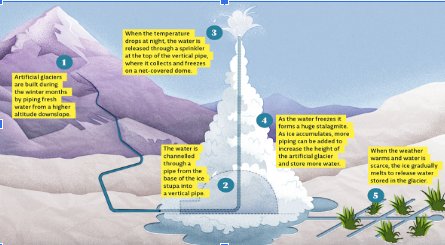
Ice stupas formation method
1. Artificial glaciers are built during the winter months by piping fresh water from a higher altitude downslope
2. Water is channelled through a pipe from the base of the ice stupa into a vertical pipe.
3. When the temperature drops at night\, the water is released through a sprinkler at the top of a vertical pipe\, where it collects and freezes on a net- covered dome
4. As the water freezes\, it forms a huge stalagmite. As ice accumulates\, more water can be added to increase the height of the glacier
5. When the water melts in summer\, it is used for agriculture.
Over a dozen ice stupas have been built in Ladakh since 2014, collectively providing tens of millions of litres of water. The idea has since spread to other mountain regions: engineers in the Andes of Chile launched the Nilus Project to test ice stupas for Santiago’s water supply, building a prototype that stored 550,000 kg of ice in 2021.
Now the question arises, how can this old practice in the Karakoram be implemented in the Rocky Mountains? For this, we need to study and compare the characteristics of the two mountain ranges.
Comparing the geography and Climate of the two regions:
The Canadian Rockies, a segment of the Rocky Mountains ( around 4800 Km), extend southeastward ( about1,600 km) from northern British Columbia, forming nearly half the border between the provinces of British Columbia and Alberta. To the North it extends to the border between the Northwest and Yukon territories.To the west, the Rocky Mountain Trench (a geologic depression) separates the front ranges of the Canadian Rockies from the Columbia Mountains in Idaho, Montana, and Washington ( USA ).
About 50 peaks in the Canadian Rockies surpass (3,350 metres). Mount Robson [3,954 metres] in British Columbia is the highest. Others include Mount Joffre, Mount Assiniboine, Mount Columbia and Mount Forbes. The Canadian Rockies are the source of many headstreams such as the Kootenay, Columbia, Fraser, Peace, Liard, Athabasca, and Saskatchewan rivers.
The range’s climate is cold continental, with heavy winter snowfall on the western slopes and a drier rain shadow to the east. Summers are generally warm during the day but cool at night, while winters are consistently cold. Precipitation often arrives as heavy snow, particularly on the western slopes, with more arid conditions in lower valleys. Higher altitudes are colder with longer winters.
In the Canadian/Southern Rockies, warm, dry winds ( Chinook) can rapidly descend the eastern slopes, raising temperatures rapidly. This is a unique feature of the Rocky Mountains. The Canadian Rockies are known for long, severe winters and short, moderate summers with high snow accumulation, while the Southern Rockies in the USA experience higher sunshine and have a greater tendency for seasonal changes.
Rocky mountains glacier types: Cold rocky landforms (CRLs) are composed of rocky debris, ice, and water, and have diverse origins and appearances. When an alpine glacier becomes covered with rock and soil, it transitions to
(a) debris-covered glacier, which still contains substantial amounts of ice. The debris cover insulates the ice, reducing its rate of melt. (Anderson et al., 2018).
(b) Rock glaciers are masses of fragmented rock and ice that move downslope. Rock glacier genesis can occur through progression from debris-covered glaciers, the formation of ice within rocky debris under permafrost conditions.
The Rock Glacier and Debris-covered Glacier are the most suitable for ice grafting because they provide the necessary combination of internal ice and insulating rock cover.
- Rock Glacier: Best suited. These landforms typically consist of angular rock blocks that insulate an internal ice core. They are highly resilient to warming and contain the "male" ice (debris-heavy) needed for the traditional "marriage" process.
- Debris-covered Glacier: Highly suited. These are valley glaciers with a thick mantle of sediment that protects the ice from ablation. They are often the source of "male" ice and serve as stable foundations for grafting new ice masses.
- Female glaciers: As of now, I have been unable to find any information about a glacier that can serve as a female counterpart in the Rocky Mountains. Glacier monitoring in Canada is very sparse, making it difficult to find the right information.
Comparing conditions with Karakoram range : To check the feasibility of the two strategies mentioned, we can compare it to the place wher these are being practiced successfully i.e the Karakoram range. This range makes (part of the greater Himalayas in Pakistan/ India/China, contains some of Earth’s tallest peaks (many exceeding 7,000–8,000 m) and thousands of glaciers. High Karakoram valleys like Baltistan in Pakistan are cold arid deserts. They receive scanty rainfall (Ladakh, for instance, gets <50 mm annually ) and rely almost entirely on winter snow and glacial melt for water. Location and elevation of the Karakoram range Comparing the Two Mountain Ranges: Himalayas and Canadian Rocky Mountains
| Feature | Karakoram Mountains | Rocky Mountains |
|---|---|---|
| Location | Pakistan, India, and China, with extending extremities in Afghanistan and Tajikistan. | Canada & USA (western North America) |
| Average Temperature at High Altitude | Very cold, often below freezing, year-round | Cool to cold, but warmer summers |
| Wind Speeds | Moderate | High — Chinook winds up to 60–75 mph |
| Elevation | Up to 8,000 m | Up to 3956 m |
| Climatic Challenge | Arid but cold — low precipitation | Variable — may have strong winds and occasional warm spells |
Data
Expert's opinion: Distinguished Professor John Pomeroy, FRSC, FRGS, AGU Fellow UNESCO Chair in Mountain Water Sustainability, University of Saskatchewan Replied to my questions in an email.
- Do you think glacier grafting could be a feasible and successful way to reduce the effects of climate change on glaciers in the Canadian Rockies? No, I do not. The mass of ice that is relocated from low to high elevations using this labour-intensive technique is very small compared to the mass of a glacier. The claim that relocating a piece of ice to a high elevation will cause a glacier to grow is from folklore and is not supported by scientific investigations. The only effective way to increase glacier size in the Rockies is an increase in snowfall or a decrease in temperatures, and both require reductions in greenhouse gas concentrations in the atmosphere on a global scale. To preserve glaciers, we have to reduce global warming.
- I have noticed that there seems to be limited publicly available data about the Canadian Rocky Mountain glaciers. How do researchers like you overcome challenges related to limited data when studying glacier change? Glacier monitoring in Canada is very sparse. You can find data on Canadian glaciers reported to the World Glacier Monitoring Service https://wgms.ch/ . A data paper we published on one Canadian Rockies glacier that has a long record of scientific investigation, Peyto Glacier, can be found here https://research-groups.usask.ca/hydrology/documents/pubs/papers/pradhananga-d._et_al_2021.pdf . An alternative is to use satellite information to track the many thousands of glaciers in Canada. Here is an example https://glambie.org/
I also experimented with comparing different types of water, so I knew if there was a reason why they put 2 different types of glacier ice. For this experiment, I used a Total Dissolved Solids meter (TDS meter) *ppm means parts per million.
| Red Deer ice water | Edmonton tap water | Red deer tap water | Calgary tap water |
|---|---|---|---|
| 316 ppm | 208 ppm | 246 ppm | 161 ppm |
0-50 ppm - Excellent 51-150 ppm-Good 151-300 ppm-Moderate 301-500 ppm-Elevated 500+ Exceeds EPA limit (EPA means Environmental Protection Agency)
Then I did an experiment in which I combined two ice buckets (one dirty [Male] and one clean [Female]) to see if they could grow over time.
| S. No. | Date / Time | Temperature | Volume (cm 3 ) |
|---|---|---|---|
| 1. | Feb 17, 3 pm | -14 Light snow | 426728.48 |
| 2 | Feb 18,4 pm | -23 | 1038485.77 |
| 3 | Feb 19, 4 pm | -21 snow flurries | 1038484.29 |
| 4 | Feb 21, 4 pm | -16 snow shower a day earlier | 426728.48 |
| 5 | Feb 22, 5 pm | -13 | 426063.66 |
| 6 | Feb 25, 5:30 pm | 2 | 376989.48 |
| 7 | Feb 28 | -8 | 1772249.94 |
Conclusion
Conclusion: This research project shows that ancient and modern glacier preservation methods, such as glacial grafting and ice stupas, can offer sustainable solutions to climate-induced glacier loss. However, analyzing the conditions of the two areas, I infer that successful adaptation to the Rocky Mountains will require adjusting for local wind patterns, temperature ranges, and sunlight exposure. With innovation and environmental care, these techniques could help protect water sources for future generations. Results suggest that while Rockies conditions differ, carefully selected high-altitude, north-facing sites could support artificial glacier growth. Ice stupas might provide seasonal water storage, but at this point, I realize that Canada does not need much water in spring due to its weather, where most crops are planted in May when the glaciers also melt, serving the purpose. While cities like Vancouver feel spring-like in March/April, many parts of Canada, particularly in the interior and northern regions, may not experience true spring weather until late April or May and need water. So Ice stupas would neither be feasible nor needed. We conclude that “growing” glaciers in the Rockies is challenging but potentially feasible on a limited scale, offering a supplement to traditional water management. Throughout, detailed maps, tables, and photographs are provided to illustrate the key concepts. Glacier grafting requires very cold, shaded, avalanche-prone sites (traditionally >4,000 m in Karakoram), and ice stupas require a dependable winter water source and sub-freezing temperatures for several months. The Canadian Rockies are significantly lower in elevation; only a few peaks reach \~3,500 m; however, the higher latitude of the Rockies means the freezing level can be lower in elevation. For instance, permafrost and perennial snow may exist near 2,700–3,000 m in the Rockies. Long winter cold spells are common (e.g., –20 °C or colder nights), though they may be interrupted by occasional warm Chinook winds on the eastern slopes. The Rockies also receive more precipitation in winter than Ladakh’s desert climate, which could help accumulate snow on a grafted glacier, but also means cloudier weather (potentially less intense cold radiative nights for ice stupa formation). In Himalayan sites, winter skies tend to be clear and very cold – ideal for freezing water into ice cones. The two areas also differ culturally and logistically. In South Asia, remote villages directly depend on local glaciers and have a motivation to invest labour in “growing” glaciers. In Canada, mountain water is usually managed by larger-scale infrastructure (reservoirs, dams) and users are far downstream (e.g., cities, large farms). There is no tradition of villagers tinkering with glaciers. Implementing these techniques in the Rockies would likely fall to park managers, researchers, or maybe Indigenous communities. Some Indigenous peoples in North America have traditional knowledge of glaciers but do not actively manipulate the water supply, as far as records show. An analysis of geographic information system (GIS) data for the Canadian Rockies to identify potential sites has been shown in the data. A comparative framework contrasting Himalayan vs. Rocky Mountain conditions has been collected.
Citations
Citations : Google Earth for terrain visualization https://earth.google.com/ Faraz, S. (2020, June 3). The glacier ‘marriages’ in Pakistan’s high Himalayas. Dialogue Earth – The ThirdPole Project. Retrieved from dialogue. earth (original article detailing glacier grafting in Gilgit- Baltistan) .94.95 30 12 climate.columbia.edu (report on Himalayan ice reservoirs and Chile’s pilot project). Safi, M. (2017, Apr 22). The ice stupas of Ladakh: Solving water crisis in the high desert of the Himalaya. International Year of Glaciers – Canada (2025). Canada’s Glaciers. Retrieved from UnglacierYear.ca (educational site by Canadian glaciologists) Amusing Planet. Retrieved from amusingplanet.com (provides a descriptive overview of ice stupas https://www.amusingplanet.com/search?q=ice+stupas https://www.researchgate.net/figure/Glaciers-in-the-central-and-southern-Canadian-Rocky-Mountains-Glaciers-encompassed- by_fig1_258723411 The glacier ‘marriages’ in Pakistan’s high Himalayas | Dialogue Earth https://dialogue.earth/en/water/the-glacier-marriages-in-pakistans-high-himalayas/ Ice Stupa Project: Making glaciers for drinking water - Red Bull https://www.redbull.com/gb-en/theredbulletin/incredible-man-made-glaciers-ice-stupa-project Britanica: https://www.britannica.com/place/Canadian-Rockies Glacier Grafting - Innovative and Unique Idea to cope with Melting Glaciers in Upper Himalayas! 21 Apr 2025 Written by YAGAY andSUN https://research-groups.usask.ca/hydrology/documents/pubs/papers/pradhananga-d._et_al_2021.pdf https://library.wmo.int/viewer/56294/download?file=State_of_the_Global_Climate_2021.pdf&type=pdf&navigator=1 Distinguished Professor John Pomeroy, FRSC, FRGS, AGU Fellow UNESCO Chair in Mountain Water Sustainability, Co-chair, UN Advisory Board, International Year of Glaciers’ Preservation Chair, Ad Hoc Strategic Management Committee for the Decade of Action for Cryospheric Sciences Director: Global Water Futures Observatories USask Centre for Hydrology Coldwater Laboratory, Canmore, Alta. Department of Geography & Planning University of Saskatchewan RABECCA THIESSEN Bachelor of Science, MacEwan University
Acknowledgement
My dear teachers, Mr. David Maruyama and Simran Chaggar, helped me by reviewing my material and guiding me for improvements, and Professor John Pomeroy for giving an experts opnion, and Rabecca Thiessen, Bachelor of Science, MacEwan University