
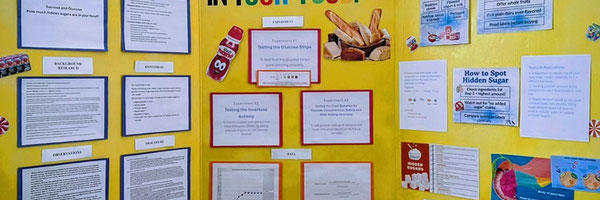
Sucrose and glucose. Finding hidden sugars in your food!
Ellie Igarashi, Emma Kucheran
Webber Academy
Grade 6
Presentation
No video provided
Hypothesis
Our hypothesis is that: Foods containing more hidden sugar (sucrose) would show a greater increase in glucose levels after the invertase enzyme was added.
We decided to use 6 types of foods to find hidden sugars in: - Apple grape juice - Honey - Tomato sauce - Bread - Raspberry Yogurt - Chocolate ice cream (melted and no cookie crumbs or chunks)
Research
- Sucrose\, which is table sugar\, is broken down into glucose and fructose. - Glucose is the body’s primary fuel. - Enzymes break down larger sugar molecules into simple smaller sugar molecules that the body can use right away for energy.
Digestion:
Sucrose + Enzyme -------> Glucose + Fructose
 -Sucrase is the natural enzyme in our bodies that digests sucrose into glucose and fructose.
-Invertase is the enzyme we used to copy Sucrase in our experiment.
- Enzymes work better in warmer temperatures.If we store our food samples in the fridge\, we should take them out of the fridge and leave the foods out overnight so it would be ready to test the next morning. If we didn't\, when we took it out the next morning\, it would be cold and not at room temperature.
-Sucrose is granulated and often used in baking. Sucrose is made of one glucose molecule and one fructose molecule linked together. When digested, sucrose gets broken down into glucose for the bloodstream energy. Sucrose also gets broken down while digested into fructose which is processed by the liver. If too much sucrose is eaten, it can cause illnesses or health issues (type 2 diabetes, extra body mass, or even tooth decay). Glucose is often found in honey and many fruits. Glucose test strips change colour depending on the amount of glucose. The sucrose is converted into glucose with the help of an enzyme called invertase.
-Melted ice cream's liquid tastes sweeter because warmth increases sweetness perception, and sugars such as glucose/fructose lower freezing points, meaning sweeter, more concentrated sugary liquid left as it melts. The ice cream has 27 grams of carbohydrates and 20 grams of sugars. The chocolate Parlour ice cream contains glucose, sugar, and carrageenan.
-Honey is made up of primarily fructose and glucose, which present the sweet taste. Honey also is made up of water, trace amounts of antioxidants, vitamins, enzymes, and minerals. Honey consists of about 38% of glucose but it can vary from 27% - 44% depending on the kind of honey.
-Yogurt is 5% sugar and contains cane sugar (sucrose - one glucose molecule and one fructose molecule).
-The oasis apple grape juice has 27 grams of carbohydrates -Juice has 24 grams of sugars
-Artesano style white bread has 31 grams of carbohydrates and 2 grams of sugar.
-Founders and Farmers Tomato Sauce has 4 grams of carbohydrates every 1/4 cups and 2 grams of sugar every 1/4 cups.
Variables
Independent Variable: (What we changed) - Type of Food tested (Different foods with varying sugar content) - Addition of Invertase (before vs. after enzyme treatment) Dependent Variable: (What we measured))
- Glucose concentration % (measured using the Glucose test strips).
This was measured: Before adding invertase & after adding invertase - Amount of sugar - Amount of water - Amount of liquid food samples Controlled Variable: (What we kept the same) - Amount of Invertase added (15 drops) - Temperature of the room (20 degrees Celsius) - The testers (Emma & Ellie) - The cups for the food samples and various concentrations - Glucose test strips - Measuring equipment (cylinder, spoons, Transfer pipettes, Timer) - Calculating equipment (Excel, calculator) - Waiting 30 seconds before we read the glucose test strips
Procedure
Experiment #1. Assessing the Glucose Strips: - The goal was to make sure the glucose test strips were working properly. - First, we made the positive control with glucose powder. We measured the glucose powder and diluted it as we went down the percentages of glucose in the cups. To do this, we made a dilution series to create the following concentrations: 2%, 1%, 0.5%, 0.25%, 0.125%, and 0.0625% (we also had a negative control). Then we dipped glucose test strips into the seven solutions. We matched the colour on the glucose test strips to the colour chart on the glucose test strip container. - Because we were able to confirm that the glucose test strips were working, we proceeded with Experiment #2. Experiment #2. Assessing the Invertase: - The goal was to get the linear time point for sucrose calculation by using invertase solution with 10% sucrose solution. - We evaluated the activity of the invertase enzyme by investigating how long it will take to turn a known sucrose solution amount into glucose. We wanted to find the time we will use to evaluate our selected food samples. We made an invertase solution one day before starting the experiment. We also made a 10% sucrose solution. Prepared thirteen test strips labeled 0mins, 5mins, 10mins, 15mins, 20mins, 25mins, 30mins, 40mins, 50mins, 60mins, 70mins, 80mins, and 90mins. We set a 90 min timer. We added fifteen drops of the pre-made invertase enzyme solution to the 10% sucrose solution. We evaluated how much sucrose the invertase made into glucose each 5min time points up to 30min, then every 10mins until 90min after that. We recorded our results and made a graph to find our plateau point, then find our linear time point. We used these results to use in our third experiment. Experiment #3. Testing the Food Samples for Glucose Concentration Before and After Adding Invertase - Our goal of this activity was to evaluate our hypothesis and find hidden sugars in our selected foods. - We found different testing foods around the house, and we found six foods to assess in our experiment. (Apple grape juice, honey water, tomato sauce, bread water, raspberry yogurt, and chocolate ice cream). Ensured that all food samples were at room temperature by leaving them out overnight. - made sure the samples with high glucose concentration was diluted and we noted the dilution ratios (e.g. 1:10, 1:2). We pre-evaluated the food solution by using glucose test strips. If the colour changed to deep brown (maximum range 2%) before 30 seconds, we diluted the food samples until the test strips showed a colour within the allowable range (0.1-1%, or light green to light brown). Prepared 3 food samples (as multiple trials made sure our results are accurate) - We assessed the glucose test strip BEFORE adding the invertase enzyme solution. This was at 0 minutes. Added fifteen drops of invertase enzyme solution, then mixed each cup for 30 seconds. Waited 20mins (linear time point, found from Experiment #2). Lightly mixed food solution, then evaluated with the glucose test strip and recorded the colour/glucose concentration at 30 seconds for each sample. We then recorded the readings on chart, completed calculations with our parents help to find the "original sucrose concentration", which allowed us to find the hidden sugars.
Observations
- "Before adding invertase" glucose reading for the food samples were not all zero (negative glucose reading). We found out that some of our food samples already had glucose in them. - Glucose Test Strip function: We observed that all the glucose test strips worked before we used it for the food sample testing. We did not have to return the package and complain to the manufacturers. - The Need for Dilution: We observed that we had to dilute many of the food samples. Thicker liquids like the chocolate ice cream were thick and had to be diluted enough for the glucose test strip to work. During our experiment, we observed that the tomato sauce and the bread water had an unexpected amount of glucose in it. We then diluted the mixture. We diluted all the solutions with a 1:10 dilution except for the honey water. The honey water was diluted with a 1:2 dilution. Also, for when we did the invertase activity for the 10% sucrose solution, the linear time point was at 20 minutes. - The need for proper preparation: We observed that understanding and planning the experiment ahead of time was especially important. This was to make sure that the scientific method was correct, and we were following the procedure step by step. - The need for consistency: We observed that we had to be consistent with how to use and assess the Glucose test strips. In the end, we all followed the same steps to wet, shake excess liquid off the strip so it could dry in a consistent way. We also observed that for consistency, having different people put the fifteen drops of invertase in the food solution could result in errors. We decided to have the same one person put the fifteen drops in the cups.
Analysis
Experiment 3: Testing Foods for Glucose Concentration Before and After Adding Invertase Before Adding Invertase - Most foods had some glucose already, except raspberry yogurt. - Apple grape juice and honey water had lots of glucose. - Tomato sauce, bread water, and chocolate ice cream had just a little glucose. - Raspberry yogurt had no glucose at all. - Honey is mostly made of glucose and fructose, not sucrose. After Adding Invertase - Chocolate ice cream had the most glucose after invertase. - Apple grape juice was next. - Honey water and tomato sauce were tied for third place. - Bread water and raspberry yogurt were tied for fourth place. What Does It Mean? - Honey and Apple Grape Juice: These didn’t have hidden sucrose because their glucose didn’t change after adding invertase. - Tomato Sauce, Bread Water, Chocolate Ice Cream: These had some hidden sucrose. Their glucose went up after adding invertase. - Raspberry Yogurt: This had only hidden sucrose. It had no glucose at first, but after adding invertase, glucose showed up.
Conclusion
Our experiment showed that some foods have hidden sugars that you can't see just by looking at them. When we added the invertase enzyme, it broke down sucrose into glucose, and we found more sugar in foods like chocolate ice cream, tomato sauce, bread water, and raspberry yogurt. Chocolate ice cream had the most hidden sugar, while apple grape juice and honey water had the least. This means that many foods and drinks can have sugars we don't notice unless we test them. Finding hidden sugars is hard because we need special tools and time to do the tests.
Application
Why should we care about sugar? - We should not eat too much sugar because it can cause problems like diabetes, heart disease, and make us gain extra weight. - Our experiment showed us that most foods have sugar in them, and it is hard to know how much we are really eating. Food labels only say “sugar” and do not tell us if it is natural or added sugar. How does sugar affect our bodies? - Our pancreas is an organ that helps control blood sugar. If we eat too much sugar, the pancreas works extra hard, which can lead to insulin resistance, and will cause health problems. - Hidden sugars result in weight gain, type 2 diabetes, inflammation of joints and blood vessels, and stomach issues. These illnesses can disrupt your daily life and can result in death. What can we do? - Eat less sugar and choose healthy foods. - Give your body a break from sugar so you can feel good and stay healthy. - Learn to spot hidden sugars in snacks and drinks. - Food labeling rules can only be enforced by government agencies and law makers, but scientists and consumers can bring change and raise awareness about hidden sugars. - Act by lobbying Health Canada and Canadian Food Inspection Agency, our Members of Parliament.
Sources Of Error
Possible Sources of Error: 1. Inaccurate Glucose Strip Reading - The strip and colour matching could have been too early or late. - The lighting in the room may have affected colour matching. - The colours may not have matched the chart. The error would be that the % glucose value could be slightly wrong. 2. Temperature Differences - Enzymes work best at certain temperatures\, usually better when warmed. If room temperature changed\, the enzyme activity and reaction time could have changed. 3. Dilution Errors - Measurement mistakes in water volume, - Multiplying by the wrong dilution factor would cause incorrect results. 4. Incomplete mixing - If the food samples were not mixed well after the enzyme was added\, the reaction may not happen evenly.
Citations
Hidden Sugars: The Different Names for Sugar — and What They Mean for Your Health | Meto blog
-how does insulin work https://diabetesandwellnessclinic.com/how-does-insulin-work/
-pancreas https://seenamagowitzfoundation.org/resource/the-pancreas/
How much sugar is bad https://www.heart.org/en/healthy-living/healthy-eating/eat-smart/sugar/how-much-sugar-is-too-much
World Health Organization https://www.who.int/publications/i/item/9789241549028
Acknowledgement
We acknowledge the following people (or dog) greatly: Ellie, Emma, Hannah, Scott, Sandra, Bass (the doggy mascot), and Mr. Baillie. We have all put in extreme amounts of hard work to make this possible, so we thank everyone.