
Burning Candles
Kate Desjardins, Sasha Schweitzer
East Lake School
Grade 6
Presentation
No video provided
Hypothesis
We think that paraffin will burn faster than beeswax because beeswax comes from bees and it needs to be strong to protect the hive so it will take longer to melt.
Research
Testing which candles to include in the experiment:
- We did a test with a paraffin candle to see how long to make the time.
- From the weight of wax burned, we learned that the candle shape and container changes the amount of melting. The soy candle was in a jar and there was less weight change, so we did not include it.
Research interview - please look at our presentation.
What is paraffin?
Paraffin wax is know as a petroleum wax It comes from petroleum, coal and oil shale. Paraffin wax is separated from the oil. Although paraffin wax comes from a natural source, it usually isn’t considered a natural wax.
What is beeswax?
Beeswax is long-chain alkanes, acids, esters, polyesters and hydroxy and it comes from a worker bee’s abdomen.
How tall was the tallest candle?
The tallest candle was 24.38 meters [80 feet] high and 2.59 meters [8 feet and 6 inches] in diameter. The overall height including the brick base was 38.7 meters [127 feet].
How do candles work?
There are two parts of the candle that work together:
- The fuel, made of some sort of wax
- The wick, made of some sort of absorbent string or twine
The wick needs to be naturally absorbent. If you buy an unwaxed wick at a store, you will find that it feels soft and absorbs water quickly. This absorbency is important in a candle because the wick needs to absorb liquid in the wax and move it upward through the candle while the candle is burning.
When did humans start to use candles?
Candles have been used as a source of light for more than 5,000 years, yet little is known about their origin. The earliest candles were used by Ancient Egyptians, who made rushlights and torches by soaking the pithy core of reeds in melted animal fat. However, the rushlights had no wick like a true candle.
What did people use candles for in ancient/history times?
Ancient Greece and Rome adopted candle-making techniques, but with an important difference: the Romans began making candles from beeswax, a cleaner and more efficient alternative to tallow. Candles became common in Roman homes, public spaces, and religious rituals, and were later adopted by the early Christian Church as a representation of the "light of Christ. Due to the cost of beeswax, these candles were considered a luxury item and were often reserved for churches, monasteries, and in households. The ancient Egyptians believed that light symbolizes life and the afterlife, which is why candles were often used during funerals and placed in tombs.
What are the parts of a candle? When a candle is lit, heat melts the wax near the wick. This hot wax rises through the wick by capillary action, vaporizes, and breaks down into hydrogen and carbon. These elements then combust to produce light, heat, carbon dioxide, and water vapor.
Why do people use candles today?
People use candles for power outages, dinner, lights and festivals. And sometimes just to make the house nicer.
What were early candles like?
Early candles were made from sperm whale wax and beeswax until 1879 when light bulbs were invented.
Variables
Independant varible: Type of wax- Paraffin or Beeswax Dependant variable: Amount of candle that is melted Controlled variable:
- Size of candle
- Start at the same time
- Same lighter used every time
- Same phone used for the stopwatch
- All candles set up in holders at the same time the same way
- Same people measuring every time
- Experiment done at one time in one place
- Indoors so that the wind could not blow them out
Procedure
Our procedure is:
- Cut the candles to be the same length.
- Weigh the candles starting weight.
- Trim the candle wicks to 0.5 cm.
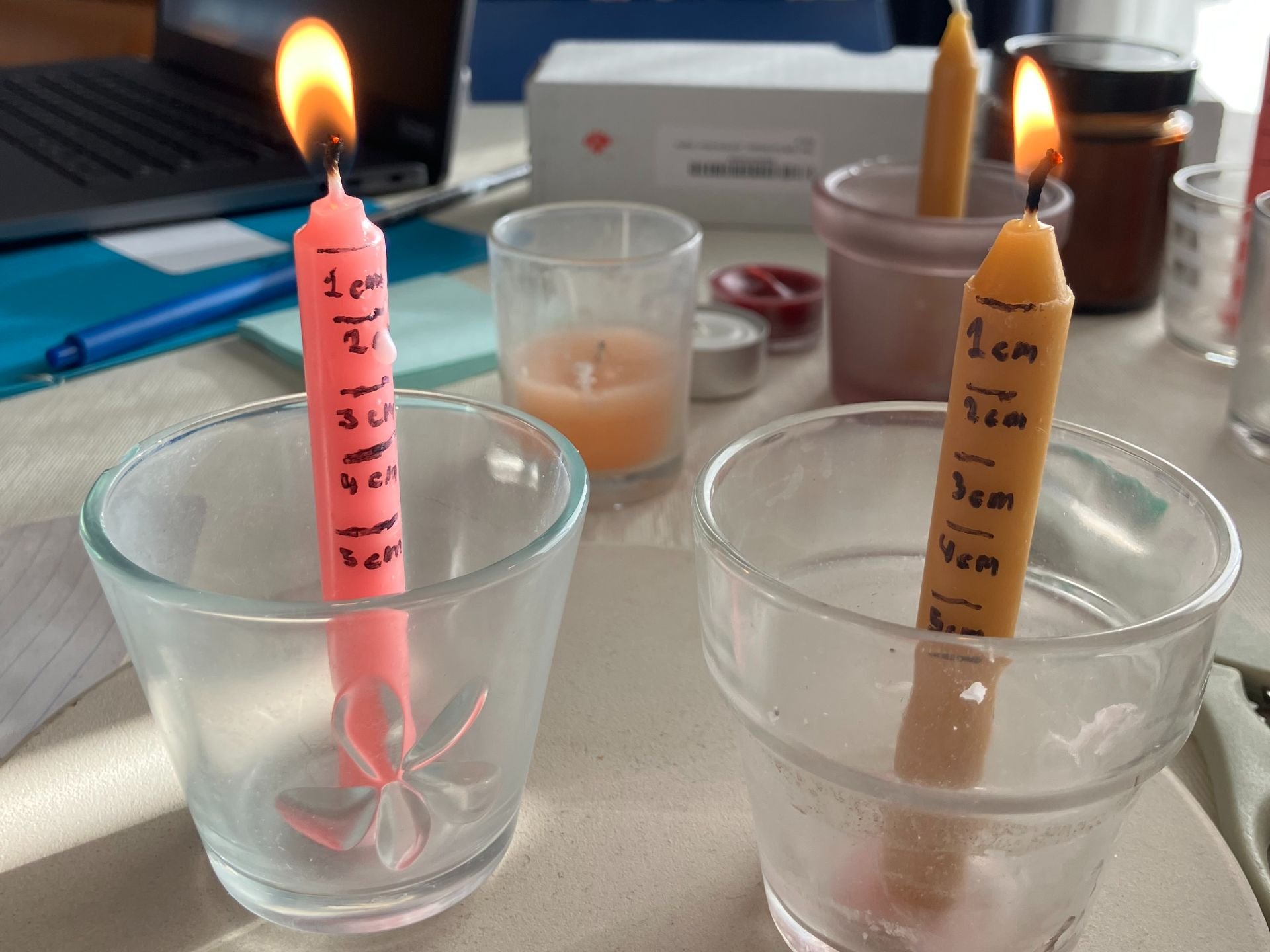
- Mark centimetre lines on the candles to help see progress.
- Put candles in melted wax from a different candle to hold them in candle holders.
- Light the candles (1 paraffin and 1 beeswax) at the same time and start the stopwatch.
- Every 5 minutes record the amount burned or melted.
- After 25 minutes put out the candles CAREFULLY.
- Record the final burned or melted length.
- Record the final weight.
- Clean up.
Safety Procedures:
- Fire safety: have an adult light the candles and stay in the room.
- Fire safety: put out the candles by stopping the flame, not by blowing them and making wax blow off the candles.
- Fire safety: put the candles in candle holders and on a heat-proof tile, not just on the table.
- We had a bowl of water so if needed we could dump the candles in.
Observations
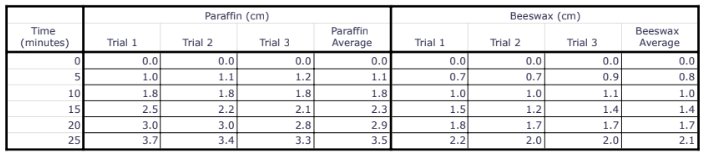 Observations measuring the amount of candle melted every 5 minutes.
| Paraffin (cm) | Beeswax (cm) | |||||||
| Time (minutes) | Trial 1 | Trial 2 | Trial 3 | Paraffin Average | Trial 1 | Trial 2 | Trial 3 | Beeswax Average |
| 0 | 0.0 | 0.0 | 0.0 | 0.0 | 0.0 | 0.0 | 0.0 | 0.0 |
| 5 | 1.0 | 1.1 | 1.2 | 1.1 | 0.7 | 0.7 | 0.9 | 0.8 |
| 10 | 1.8 | 1.8 | 1.8 | 1.8 | 1.0 | 1.0 | 1.1 | 1.0 |
| 15 | 2.5 | 2.2 | 2.1 | 2.3 | 1.5 | 1.2 | 1.4 | 1.4 |
| 20 | 3.0 | 3.0 | 2.8 | 2.9 | 1.8 | 1.7 | 1.7 | 1.7 |
| 25 | 3.7 | 3.4 | 3.3 | 3.5 | 2.2 | 2.0 | 2.0 | 2.1 |
Analysis
The graph for paraffin and beeswax shows that over the 25 minutes much more paraffin candle melted.
In the results the lines of the different trials are close together that means the experiment can be repeated and have the same results and we were surprised that the lines were so close together.


Conclusion
Our conclusion is that paraffin melts faster than beeswax, so our hypothesis was correct.
We learned a lot about candles.
Application
Our application is that if there is a power outage or you’re eating dinner you can use a beeswax candle because they last longer.

Sources Of Error
Our sources of error:
- Air movements make the flames flicker and not burn steady if people move around.
- Candle wicks did not seem to be identical.
- Candles were hot so measuring was hard, used a metal ruler to not burn
- Forgot how to use the stopwatch the first trial so we stopped it too early and had to restart
Citations
CandleScience https://www.candlescience.com › paraffin-wax-how-it-s… and, What Exactly is Paraffin wax? Blended Waxes Https://blendedwaxes.com › Blog & Resources Interview with Mrs Rita Clyde What is beeswax? https://www.motherearthnews.com/natural-health/what-is-beeswax-ze0z1511zcwil/ How tall was the tallest candle? https://www.guinnessworldrecords.com/world-records/67215-tallest-candle How does a candle work? HowStuffWorks https://home.howstuffworks.com question 267 How does a candle work? History of Candles National Candle Association https://candles.org › history-of-candles The History of Candles: From Ancient Times to Modern Day Beelight Candle https://beelightcandles.net › benefits-of-beeswax-candles What are the parts of a candle? https://www.britannica.com/technology/candle#ref429599 Why do people use candles today? https://generalwax.com/blogs/news/9-reasons-why-people-are-lighting-candles#:\~:text=March%2018%2C%202023,the%20light% What were early candles like? https://salcombecandlecompany.com/pages/candle-making-history#:\~:text=Middle%20Age,to%20product%20of%20its%20time.
Acknowledgement
We would like to thank:
- Joanne (Kate’s mom)
- Mark (Sasha’s dad)
- Mrs Rita Clyde