
How quantum entanglement will help with communication in the future? (Quantum Connections: The future of communication)
Aanaya Khan, Natalie Deng
STEM Innovation Academy Jr. High N.W. Campus
Grade 8
Presentation
No video provided
Problem
Right now, modern communication can be unreliable or insecure, especially prone to hacking or the risk of personal information. Slowly society will depend more on safety for things such as government, banking and these weaknesses become more serious as newer threats can approach this society. Quantum entanglement has special particles which can reach long distances as it is reliable. This method can enable a secure way to spread information because the connection will almost instantly break within detection of an interference. Our project explores how we can use quantum entanglement to create a better method to communicate.
Method
1. We researched quantum entanglement using reliable sources such as kid-friendly science encyclopedias\, educational websites\, and science articles. 2. After a broad understanding of entanglement\, we took notes and summarized key ideas in our own words. We had a document where we put in questions and answered we both had our share in answers. 3. To prepare ourselves for the school science fair\, we made slides together\, displaying what we had and pasted that into our trifold. This helped us understand complex information at grade 8 level and avoid copying directly from sources. 4. We attempted to build a model describing how particles are entangled. This did not work due to the failure of materials\, but before the actual CYSF\, we plan to build a model conveying the setup of how entanglement is made in the labs. 5. Then\, we looked for errors or anything that doesn’t seem right and needs extra research. 6. Together\, we went over and practiced our script to get a natural flow of speech\, as we also practiced answering questions by speaking to audiences like our coordinator Ms. Bretner\, and our family members. 7. Finally\, we organized the information into sections and used it to write our report and explain how quantum entanglement could help communication in the future.
Research
Background information:
What is quantum entanglement? Quantum entanglement is when two particles are linked so that their measurement results are correlated, meaning measuring one immediately determines lets you know outcome of the other, no matter the distance between them.
What is a photon? A photon is the smallest piece of light or energy from an electromagnetic field. It has no mass or electric charge, but it carries energy and can interact with matter as it travels through space.
How do scientists entangle photons? Scientists use a laser to send photons into a nonlinear crystal, such as beta-barium borate (BBO). Through a process called spontaneous parametric down-conversion, one photon splits into two lower-energy photons whose polarizations are entangled. The crystal splits the photon into two, so now their polarizations are connected as they are in a state of superposition, meaning their state is undetermined until measured. This diagram accurately depicts the process in a clear way:

Glossary/important terms:
| Decoherence | When Quantum Entangled particles interact with the environment and the quantum state becomes disrupted. |
|---|---|
| Superposition | When a particle (like a photon) exists in multiple states at the same time until it’s measured. |
| Polarization | The direction a light wave (or photon) vibrates (like vertical, horizontal, or diagonal). |
| Nonlinear crystal | Special crystal that can change the property of light that passes through it. It can split a photon particle into two lower energy ones. |
| Beta-Barium Borate | A crystal commonly used for entanglement in particles. |
| Measurement | The act of forcing a quantum particle to interact with equipment, causing it to take a definite state. |
| Wave-plate | A tool that changes the polarization of a photon before it is measured. |
| Quantum key distribution (QKD) | Quantum key distribution is the process of using entangled photons to send secure encryption keys so that if someone eavesdrops, it is detected immediately. |
Research questions:
We had many questions throughout this project. Some of the main ones include:
1. How does quantum entanglement really work. Is it connected by some kind of force? 2. Who discovered this\, and how? 3. How is quantum entanglement “made”? Why is it reliable? 4. What tools do scientists use to create entangled photons? 5. Can entanglement really work through walls and buildings? 6. How fast does entanglement communication happen\, and is it faster than messages? 7. Can entanglement be effective for space? 8. Is quantum entanglement the same as teleportation?
Quantum entanglement communication vs. normal communication:
In normal communication, information is sent as electrical signals or light pulses through wires. These signals can sometimes be intercepted or hacked without the senders knowing which can have lots of risk. However, in quantum communication, information is encoded onto particles of light called photons that are entangled. When two photons are entangled, they share a connected quantum state. If someone tries to measure or intercept one of the photons while it is traveling, the act of measuring it changes its state. Because of this, the sender and receiver can immediately detect that interference has occurred. This principle is used in something called quantum key distribution, where entangled photons are used to create a shared secret key for encrypting messages. The actual message is still sent through regular communication channels, but the encryption key is protected by the laws of quantum physics. This makes hacking extremely difficult, because any attempt to spy on the key automatically leaves evidence.
QKD - The heart of quantum communication:
Quantum Key Distribution is the method of using photons to create an encryption key shared between the sender and the receiver. This can be done using different protocols like the E19, BB84 and more. This principle is used to create a shared secret key between two parties, commonly called Alice and Bob. Each photon is prepared with a property that can be measured in different ways, and both parties randomly choose measurement bases (vertical and horizontal basis, and the x basis). After all photons are sent, they compare which measurements were done in the same way without revealing their results, keeping only the matching measurements to form the key. If an eavesdropper, called Eve, tries to intercept photons, she must guess the correct measurement basis. Wrong guesses disturb the photon states, introducing detectable errors. Too many errors indicate an eavesdropper. Once the key is established securely, it can be used to encrypt messages sent over regular channels, making the information effectively 'not hackable'. QKD primarily uses the “same polarization” method, though other entanglement types exist, which can be engineered in the lab by adjusting crystals and other factors. This ensures that quantum mechanics protects the encryption key, and any eavesdropping attempt automatically leaves evidence, guaranteeing secure communication.
Here is a image that accurately depicts the explanation above:

QKD-The BB84 Protocol
The BB84 protocol remains the most used protocol for QKD today as most other protocols are based off of this one. In 1984, Charles Bennet and Gilles Brassard published this protocol which is based on the HUP principle. There are most commonly two parties: Alice, and Bob. In this protocol, Alice can send the photons to Bob in different basis. Either the 'plus' basis (horizontally/vertically) or the 'x' basis (diagonal both ways). The bases are also known to be the direction the light moves as waves. Alice would then also choose a random bit (0,1), e.g. vertical = 1, horizontal = 0, diagonal#1 = 1, diagonal#2 = 0. Alice would use special optic tools ( a weak laser, a single-photon LED, and a heralded single-photon source) to force how the photon would vibrate and then she would send it to Bob either in a fiber optic cable, or just free space (more risky). Bob receives the photon, and he would use a beam splitter and randomly choose his basis. If he picks the same one as Alice, he would get the same bit. If he doesn't, the state of the photon changes. Alice and Bob would then talk to each other using normal communication lines and they would compare their bits, and throw out the mis-match bits. This would form the raw key.
Why entanglement matters:
- Quantum entanglement matters because it helps scientists understand how the quantum world works. It also allows new technologies to be developed, such as quantum computers and secure communication systems.
- Entanglement is especially important for communication because it can detect hacking attempts and keep information safe. Learning about entanglement now can help improve technology in the future.
Real world applications in the future:
- Quantum entanglement can be used in real world communication systems through quantum key distribution, which allows secret messages to be shared securely.
- It can also help protect banking information, government data, and online communication. In the future, entanglement may allow secure communication between Earth and spacecraft, including missions to Mars. Although this may be a good way of protecting information, it is important to note that not everyone can use this. This technology is predicted to be used for high end organizations and roles.
During our process we did have many limitations:
- No access to the actual photons being entangled, not enough technology to do it.
- To run the experiment, you need potentially hazardous equipment.
- Uses radioactive sources
Quantum Entanglement communication comes with its own benefits, but there are some considerations to think about. First, when this technology is developed it will cause unfair advantages to larger groups. Some people may use it in a negative way dealing with privacy issues to hide information or control it. Quantum systems are also hard to build, costing rare materials (BBO crystals) and lots of energy. Crystals like these need to be lab grown perfectly and large enough to work. Scientists need to take into consideration how this will impact the environment as lots of materials are used. Lastly, if this technology can’t benefit everyone, it should be used responsibly and it should help society rather than cause harm.
Data
The following data shows how quantum entanglement has been tested through key achievements like the Jinan-1 quantum satellite and the Micius satellite experiments. This comparison shows the difference between the two experiments, Jinan-1 as the most recent experiment testing over 12,900km, and the Micius satellite as the first ever experiment to be run with satellites:
Micius: Launch Year: 2016 Maximum Distance: 1,200 km+ Purpose: First proof of concept for space based quantum entanglement Significance: Demonstrated that quantum communication from space is possible
Jinan-1: Launch Year: Recent mission Maximum Distance: Intercontinental 12,000 km+ Purpose: Practical long distance quantum key distribution Significance: Moves toward real world global quantum communication
The list above compares the achievements of the Micius satellite and the Jinan-1 microsatellite. It shows that Jinan-1 has significantly greatened the distance over which quantum key distribution can be performed, reaching intercontinental ranges, while Micius demonstrated the first successful space-based entanglement over long distances. This comparison shows the way that scientists have started to allow farther lengths of QKD through the Jinan-1, while the Micius satellite proved the theory to be correct.
The Micius Satellite experiment:
Goal of the experiment: To prove that quantum entangled particles would still work over long distances, and that communication would would be secure. Case study:
- Test entangled particles over 1200+ km length
- Photons were sent to distant ground stations for testing
- Distant did not break entanglement
What happened: This experiment tested two particles sent to a continental length to see if they were still going to be entangled. Using a satellite, scientist used it to send the particles to far apart places on earth, as they stayed in an entangled state.
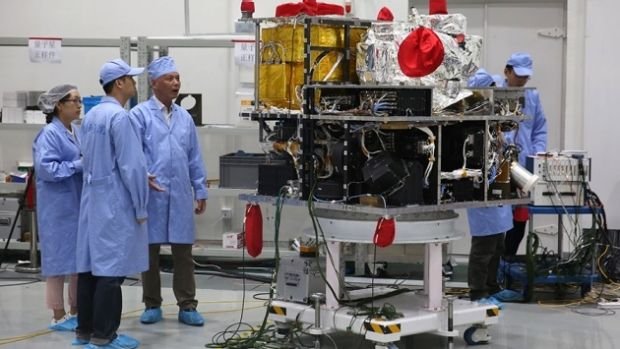 This photo shows scientists entangling photons during the Micius satellite experiment.
Explanation/what happened: The Micius Satellite experiment was the first ever satellite experiment to be able to entangle photons at such a length, specifically used to test quantum communication in space. It was launched by the Chinese Academy of Sciences in 2016 breaking the world record during that time for the longest quantum communication. The satellite generated pairs of entangled photons and sent them to distant ground stations on Earth that were up to about 1,200 kilometers apart. This experiment demonstrated that quantum entanglement could survive transmission from space to Earth, even over very large distances.
This experiment allowed scientists to realize that quantum communication was possible in space based quantum communications. The reason that scientists used satellites to transport particles is that on ground transportation has too much airflow. The Micius satellite experiment showed that QKD was possible and it was the base for the Jinan-1 to develop. This experiment did not reach to global lengths but it rather made the foundation to newer experiments.
The Jinan-1 experiment:
The Jinan-1 satellite is a quantum communication microsatellite designed to expand the practical use of quantum key distribution. Different than earlier experimental satellites, Jinan-1 is smaller and more efficient. Its purpose is to test whether quantum-secured communication can be performed over extremely long, global length distances.
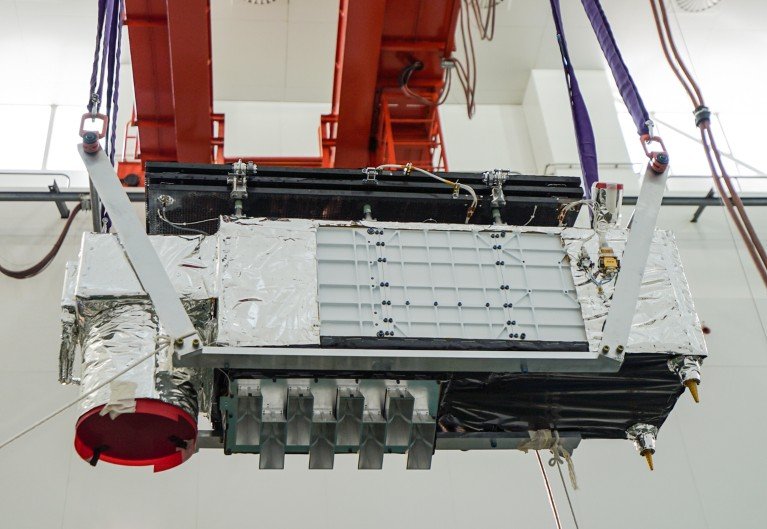
Goal of the experiment: To test if quantum communication/ QKD would work over intercontinental lengths, to see if this would work globally mimicking real time use.
Case Study:
- 12,900km+ between each other
- Distant did not break entanglement, experiment was successful
- Builds on the Micius experiment achievements
Jinan-1 successfully demonstrated intercontinental quantum communication by distributing secure encryption keys between ground stations separated by thousands of kilometers. This achievement shows significant progress beyond earlier missions like Micius, which first proved that space entanglement was possible. The Micius satellite demonstrated the concept, and the Jinan-1 focuses on improving distance, efficiency, and trying to improve this for often use.
Conclusion
Quantum entanglement is a unique property of quantum physics in which particles (photons) become strongly connected and share a linked quantum state. Although entanglement cannot be used to send information faster than light itself, at can greatly improve communication security.
Research shows that entanglement works over long distances, including satellite based experiments such as the Micius mission, which successfully demonstrated entanglement over more than 1200 kilometres. This proves that quantum communication is possible on a global scale.
One of the most important applications of entanglement is quantum key distribution. This method allows two parties to create a shared secret encrypted key. Any attempt to intercept the key changed the quantum state, which immediately reveals the presence of an eavesdropper. This makes quantum communication significantly more secure than traditional communication methods.
As research and technology continue to advance, quantum entanglement has the potential to improve global data security, protect sensitive information, and support future space communication systems. It represents an important step toward safer and more reliable communication in the future.
Citations
“Jinan-1 Satellite.” Skyrocket, https://space.skyrocket.de/doc_sdat/jinan-1.htm. Accessed 4 Mar. 2026.
“Micius Satellite.” Bing, https://www.bing.com/search?pglt=2339&q=miscius+satelite&cvid=95ac512c4b9e4c49b640dec98387ad88&gs_lcrp=EgRlZGdlKgYIABBFGDkyBggAEEUYOdIBCDgxMDBqMGoxqAIAsAIA&FORM=ANNTA1&PC=U531. Accessed 4 Mar. 2026.
“Micius, the World’s First Quantum Communication Satellite, Was Hackable.” arXiv, https://arxiv.org/abs/2505.06532. Accessed 4 Mar. 2026.
“Quantum Communication 101.” University of Science and Technology of China, https://news.ustc.edu.cn/info/1056/63730.htm. Accessed 4 Mar. 2026.
“Quantum Decoherence.” Quandela, https://www.quandela.com/resources/quantum-computing-glossary/quantum-decoherence/. Accessed 4 Mar. 2026.
“Quantum Entanglement.” Wikipedia, https://en.wikipedia.org/wiki/Quantum_entanglement. Accessed 4 Mar. 2026.
“Quantum Entanglement: Explained in Simple Terms.” Caltech Science Exchange, https://scienceexchange.caltech.edu/topics/quantum-science-explained/quantum-entanglement. Accessed 4 Mar. 2026.
“Quantum Entanglement and AI.” Popular Mechanics, https://www.popularmechanics.com/science/a64056829/quantum-entanglement-ai/. Accessed 4 Mar. 2026.
“Quantum Entanglement Facts for Kids.” Science Facts, https://www.sciencefacts.net/quantum-entanglement.html. Accessed 4 Mar. 2026.
“Quantum Experiments at Space Scale.” Wikipedia, https://en.wikipedia.org/wiki/Quantum_Experiments_at_Space_Scale. Accessed 4 Mar. 2026.
“Quantum Key Distribution and BB84 Protocol.” Medium, https://medium.com/quantum-untangled/quantum-key-distribution-and-bb84-protocol-6f03cc6263c. Accessed 4 Mar. 2026.
“Quantum Network Studies.” CBC News, https://www.cbc.ca/news/science/quantum-network-studies-1.4164210. Accessed 4 Mar. 2026.
“Quantum Entanglement – What Laser and BBO Are Needed to Create Entangled Laser Streams?” Physics Stack Exchange, https://physics.stackexchange.com. Accessed 4 Mar. 2026.
“Theory of General Relativity.” Space.com, https://www.space.com/17661-theory-general-relativity.html. Accessed 4 Mar. 2026.
“World’s First Quantum Microsatellite Communication with Multiple.” Phys.org, https://phys.org/news/2025-03-world-quantum-microsatellite-communication-multiple.html. Accessed 4 Mar. 2026.
“World’s First Quantum Satellite Developed by China Can Be Hacked.” Accessed 4 Mar. 2026.
“Study Finds Security Flaw in World’s First Quantum Satellite.” Nature, https://www.nature.com/articles/d41586-025-00581-7. Accessed 4 Mar. 2026.
“Micius: World’s First Space-Based Quantum Science Experimental Satellite.” USTC, https://news.ustc.edu.cn/info/1056/63730.htm. Accessed 4 Mar. 2026.
Bamania, Dr. Ashish. “The BB84 Protocol Explained From Scratch.” Into Quantum, 22 Aug. 2025, https://www.intoquantum.pub/p/the-bb84-protocol-explained-from. Accessed 5 Mar. 2026.
“Quantum Satellite Sets Globe‑Spanning Distance Record.” New Scientist, 6 Oct. 2019, https://www.newscientist.com/article/2472766-quantum-satellite-sets-globe-spanning-distance-record/. Accessed 5 Mar. 2026.
Qi, Ciel. “China’s Quantum Ambitions: A Multi‑Decade Focus on Quantum Communications.” Yale Journal of International Affairs, https://www.yalejournal.org/publications/chinas-quantum-ambitions. Accessed 5 Mar. 2026.
Acknowledgement
We would like to acknowledge Ms. Bretner for being the amazing coordinator that she is. She helped us through this project, and consistently gave us advice while talking to other groups too. Ms. Bretner gave us tips on our script, and was the main reason why we got through this especially for our first time doing science fair. Another thanks to Ms. Peters who printed all of the slides for our trifold. Big thanks to judges for critically taking the time to judge, listen to our project and write some feedback four our presentation. Lastly, we would love to give a huge thanks to our parents and family who listened to us practice, asked questions, and supported us throughout the process.