
Vitiligo : Melanocyte Destruction
Akshita Rawat
STEM Innovation Academy High School
Grade 11
Presentation
No video provided
Problem
Question : How do B-cell derived autoantibodies correlate with melanocyte destruction and vitiligo severity, and what molecular or immunological factors influence changes in their production or activity, based on publicly available data?
Background Research : - Vitiligo
- vitiligo is an autoimmune condition where melanocytes (pigment-producing cells) are destroyed : T-cell responses (CD8) (Pawar, P, 2025)
- main cause is immune dysregulation involving both humoral (antibody) and cellular immune responses (MohammadA Gaballah, 2020)
- affects \~0.5–2% of the global population
- Types - Non-segmental vitiligo is the most common type of vitiligo\, causing symmetrical patches on both sides - Segmental Vitiligo\, one side

- Common Areas Affected
- Hands and fingers
- Around eyes and mouth
- Elbows and knees
- Genitals
- Areas of friction
- triggered or worsened by factors like severe sunburn, emotional stress, skin trauma (cut, opening in the skin), certain chemicals, genetics, hormonal changes, and oxidative stress
- not physically dangerous or contagious, however can significantly affect mental health and self-esteem
- Treatments (most common)
- Light Therapy (UV Phototherapy) - works for 10-20% of patients
- Corticosteroid creams (exterior application)
- Immune response suppressors (steroids)
- *no permanent cure, but treatments aim to restore pigment or stop progression*
Why I picked this question : This question intrigued me because as a vitiligo patient myself, I was curious about the main factors in this disease and how they come to play a role in my treatment. My plans to pursue a career in dermatology encourage me to research further into skin pigment and the diagnosing of vitiligo. Furthermore, autoimmune disorders have a lot of varying variables that impact their state and cause, leaving a lot of unknowns in vitiligo and the goals of treatments.
Method
1 - vocab, understanding the topic of research 2 - read articles, documented findings and chose relevant data based on experimental goals and variables 3 - identify triggers and causes regarding factors and listed experimental variables
Research
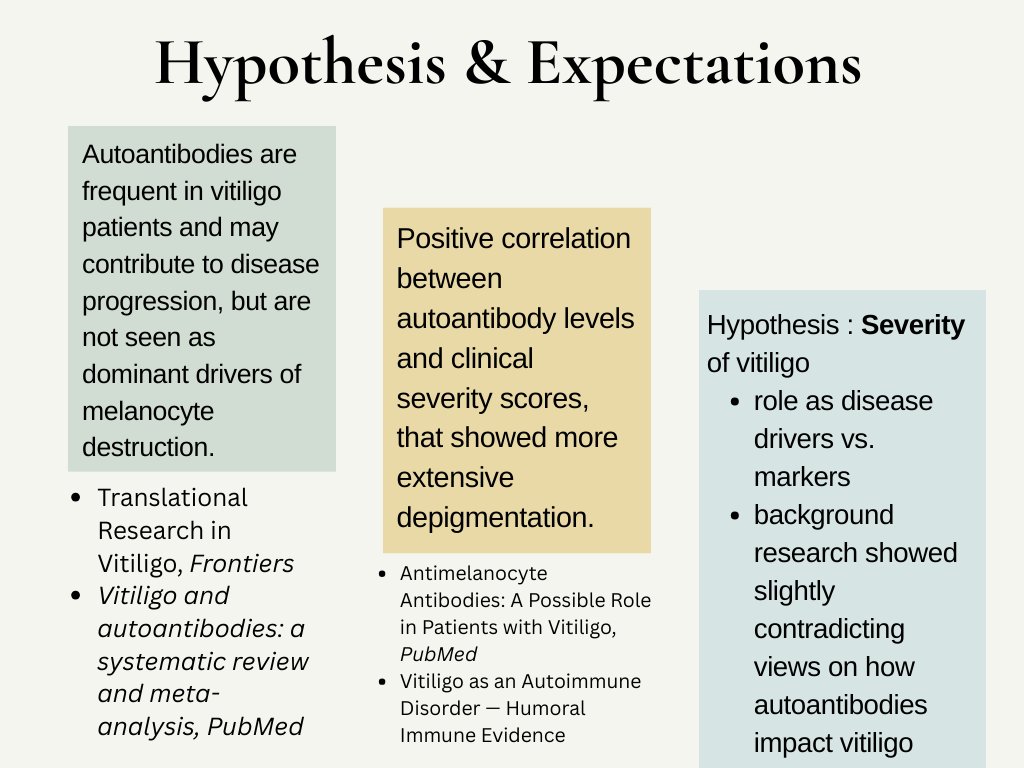
The types and causes of autoantibody production in our bodies and their impact on vitiligo patients.
Data
A positive correlation in the role of AMA in the pathogenesis and severity of nonsegmental vitiligo.
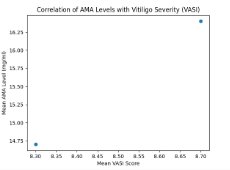 Scatter plot is of data showing mean antimelanocyte antibody (AMA) concentration versus vitiligo severity, scored using VASI (Body surface area affected/Degree of depigmentation).
Data from published clinical studies show that higher mean AMA values are associated with higher VASI scores in vitiligo patients, indicating a positive relationship between B-cell-derived autoantibodies and disease severity.
Scatter plot is of data showing mean antimelanocyte antibody (AMA) concentration versus vitiligo severity, scored using VASI (Body surface area affected/Degree of depigmentation).
Data from published clinical studies show that higher mean AMA values are associated with higher VASI scores in vitiligo patients, indicating a positive relationship between B-cell-derived autoantibodies and disease severity.
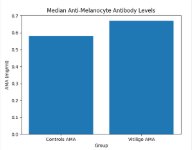 Complied the findings of multiple research cases to compares the median levels of antimelanocyte autoantibodies (AMA) between two groups: healthy controls and patients with non-segmental vitiligo. Subtype (NSG) specified because its most strongly linked to immune mechanisms (more researched in terms of AMA contribution).
Conclusion
Conclusion :
- Autoantibodies are markers of immune dysregulation rather than primary drivers of melanocyte destruction in most patients.
- Melanocyte destruction is primarily driven by cellular immunity, especially cytotoxic T cells.
- Immune dysregulation in vitiligo patients leads to the overexpression of B-cell activating factor (BAFF), promoting survival of autoreactive B cells that produce melanocyte-reactive antibodies.
- Present, but inconsistent higher humoral responses (autoantibody prevalence). Cellular damage from oxidative stress or T-cell cytotoxicity may expose melanocyte antigens, amplifying humoral responses.
Sources of Errors :
- main problem encountered - data found and if it was usable or not for my purpose
- standardizing the chosen samples using set variables and methods like VASI
- misinterpretation
- organization of findings
- Reliability and relevancy of public data - sample sizes - severity scale - testing conditions
Next Steps : *****know vitiligo patients produce higher amounts of AMA and that this does have an impact on vitiligo severity to an extent
- Gathering more data that explains the factors that influence this
- Fluctuation in patient data and triggers for immune dysregulation
Citations
- Liu, C.-W., & Huang, Y.-C. (2018). Vitiligo and autoantibodies: a systematic review and meta-analysis. JDDG: Journal Der Deutschen Dermatologischen Gesellschaft, 16(7), 845–851. https://doi.org/10.1111/ddg.13574
- Pawar, P., Pawar, P., Kulkarni, A., Bhavana Pansare, Pawar, P., Pawar, P., Prachi Bahekar, & Madhavi Kapre. (2025). Self-Supervised Learning for Complex Pattern Interpretation in Vitiligo Skin Imaging. 9–9. https://doi.org/10.3390/cmsf2025012009
- MohammadA Gaballah, MahaA El-Gayyar, Helmy, M., Amer, E., & MoustafaA Elsaied. (2020). Antimelanocyte antibodies: A possible role in patients with vitiligo. Indian Journal of Dermatology, 65(1), 33–33. https://doi.org/10.4103/ijd.ijd_344_18
- AL-smadi, K., Imran, M., Leite-Silva, V. R., & Mohammed, Y. (2023). Vitiligo: A Review of Aetiology, Pathogenesis, Treatment, and Psychosocial Impact. Cosmetics, 10(3), 84. https://doi.org/10.3390/cosmetics10030084
- Katz, E. L., & Harris, J. E. (2021). Translational Research in Vitiligo. Frontiers in Immunology, 12. https://doi.org/10.3389/fimmu.2021.624517
- Kutlubay. (2012). Vitiligo as an Autoimmune Disease. Journal of the Turkish Academy of Dermatology, 6(2). https://doi.org/10.6003/jtad.1262r1
- APA Citation Generator
Acknowledgement
A sincere thank you to my science fair mentors at STEM, Ms.O'Keefe and Mr.Hatchard, along with my parents for being there for me throughout the whole process! Your constant support was essential in the building of this project. I also extend my gratitude to all those who directly or indirectly contributed to the realization of this project, as your collective efforts have undoubtedly enhanced its quality.