
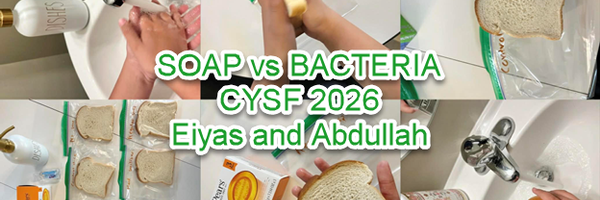
Soap vs Bacteria
Abdullah Ammar, Eiyas Ghazali
Al-Amal Academy
Grade 5
Presentation
No video provided
Hypothesis
- More bacteria means more mold.
- A soap or any other washing mechanism removes bacteria and dirt from our hands. Some will do a better job than others.
- We expect the following results:
- MOST MOLD ----> Bread which is touched with dirty hands not washed
- LEAST MOLD ----> Bread which was not touched at all
- The other samples will fall between these two
- We expect the “Dirty hands" (No wash) sample to have more mold than the other samples
From the soap samples (antibacterial, dishwashing, and regular), we expect the antibacterial soap to have the least mold and the dishwashing soap to have the most mold.
Research
Mold
Mold is a type of fungus and usually grows as tiny threads called hyphae. These threads form a fuzzy patch that you might see on old food or damp surfaces. Molds are usually made out of cells.Molds are a big group of fungi. When their hyphae grows, they can make things look discolored and fuzzy. This network of branching threads is called a mycelium. Each mycelium is like a single living thing. Mold grows from tiny seeds called spores. They are so tiny that they float all around us. When spores land on a damp surface with food, then they can start to grow.
Soap
Soap is a cleaning product that helps us get rid of dirt, oil, and germs. It comes in many forms, like solid bars, liquid, or even foam. How soap works : Each soap molecule has two ends:
- One end LOVES water
- One end LOVES oil and dirt
When we wash hands the oil-loving end sticks to the dirt, oil, and germs on your hands. The water-loving end sticks to the water. When you rub your hands together, the soap surrounds the germs and dirt and forms little bubbles called micelles. Now the dirt, oil, and germs are trapped inside these bubbles. When you rinse with water, the bubbles get washed away — taking the dirt and germs with them!
Bread
Bread is a common food which is usually baked. It is basically made out of dough, which is a mix of flour and water. Most bread also has salt and yeast. It is usually cooked in an oven. There are many kinds of bread. You can toast bread or you can use it in a sandwich. You can also use it to make yummy pizza! There are two main types of bread, leavened bread and unleavened bread.
Variables
Control Variable: untouched bread.
Dependent Variable: how much mold on bread slices.
Independent Variable: different hand cleaning products (antibacterial soap, regular soap, dish-washing soap, hand sanitizer, water, and none).
Procedure
- Touch hands on the grass outside to collect bacteria
- Touch hands on a bread. Use tongs to hand the bread.
- Put the bread in a ziplock and seal it
- Label the ziplock “dirty hands”
- Do step 1 and wash your hands with water only
- Do step 2 and 3, also label the ziplock “Water only”
- Do step 1 and wash your hands with a regular soap
- Do step 2 and 3, also label the ziplock “Regular soap”
- Do step 1 and wash your hands with an antibacterial soap
- Do step 2 and 3, also label the ziplock “Antibacterial soap”
- Do step 1 and wash your hands with a dishwashing soap
- Do step 2 and 3, also label the ziplock “Dishwashing soap”
- Do step 1 and clean hands with a hand sanitizer
- Do step 2 and 3, also label the ziplock “Hand sanitizer”
- Pick up a bread with a tong.
- Do step 3 and label the ziplock “Control slice”
- Put all 7 samples in a dark, moist, and warm place
- Observe the change and look for mold growth in the samples daily.
Observations
- Observation from Experiment # 1
- No change/ Mold was observed in any of the samples over the 3 weeks period.
- The bread was checked daily
- Observation from Experiment # 2
- We are in day 10 of the revised experiment and starting to see mold on “dirty hands” sample and “water only” sample
- No change on other samples yet.
Analysis
| Day | control | Dirty Hands | Water Only | Anti-bacterial | Regular | Dishwashing | Handsanitizer |
|---|---|---|---|---|---|---|---|
| 1 | No Change | No Change | No Change | No Change | No Change | No Change | No Change |
| 2 | No Change | No Change | No Change | No Change | No Change | No Change | No Change |
| 3 | No Change | No Change | No Change | No Change | No Change | No Change | No Change |
| 4 | No Change | No Change | No Change | No Change | No Change | No Change | No Change |
| 5 | No Change | No Change | No Change | No Change | No Change | No Change | No Change |
| 6 | No Change | Few spots | No Change | No Change | No Change | No Change | No Change |
| 7 | No Change | Few spots | Small area | No Change | No Change | No Change | No Change |
| 8 | No Change | Few spots | Small area | No Change | No Change | No Change | No Change |
| 9 | No Change | Large Spots | Large Area | No Change | No Change | No Change | No Change |
| 10 | No Change | Large Spots | Large Area | No Change | No Change | No Change | No Change |
- Analysis for Experiment # 1
- Why No Mold was observed ?
- We used the bread bought from the big chain store. This bread has preservatives (Calcium Propionate) which prevents mold growth.
- The outdoor bacteria do not survive well indoors and we need to find bacteria inside the house for our test.
- To help mold growth we did the following steps after 1 week
- We added extra moisture by spraying an equal amount of water to all bread loafs
- We put the samples in a warmer location with a humidifier to increase the amount of moisture and heat. We know mold grows faster in moist and warm places.
- No improvement was seen after the above steps
- Why No Mold was observed ?
- Analysis for Experiment # 2
- We repeated the experiment with the following:
- Bought fresh bread from a bakery (without preservatives)
- Used indoor places where mold spores may already exist for the test
- Under the kitchen sink
- Under kitchen cabinets
- Door knobs, light switches etc.
- Places which typically do not get a wipe/cleaning.
- 2 worst samples (“water only” and “Dirty hands”) have already started to catch mold
- Dirty hands sample has the most mold.
- We expect the remaining samples to catch mold in 1-2 weeks.
- We repeated the experiment with the following:
Conclusion
- The revised experiment is successful
- All soaps remove germs, and washing with soap removes more germs compared to not washing hands or washing with water only.
- We learnt the following through research and experiment
- Store bread / food has preservatives to increase the shelf life of products and to reduce mold growth
- Outdoor bacteria is different from the indoor bacteria
- Mold does not grow easily in winter conditions.
- The results prove the hypothesis correct
- The experiment is important to know how much bacteria is removed by using a good soap and washing hands properly.
- If we wait longer, we would see the mold on all samples
Application
- The experiment is important to know how much bacteria is removed by using a good soap and washing hands properly.
- If we wait longer, we would see the mold on all samples
Sources Of Error
Temperature fluctuations: If the temperature becomes too high or low, it will affect results, like adding more mold.
Contamination: If the tongs that you use are dirty, it will add extra mold to the breads. Other possible contamination is mold spores that might be present in the air.
Additives: Some breads have preservatives, that privent/slow down mold. Our first trial took more than months to mold. Right now they still didn't mold! This is the work of preservatives.
Citations
Bread facts for kids. (n.d.). https://kids.kiddle.co/Bread
Soap Facts for Kids. (n.d.). https://kids.kiddle.co/Soap
Mold facts for kids. (n.d.). https://kids.kiddle.co/Mold
Acknowledgement
We would like to thank the following:
Our teacher(Ms.Khan): Thank you for giving us an idea when we first failed.
Our Coordinator (Louise Savari): You made us reach this promising moment. Thanks a lot!
Our parents: They all helped with ideas and research, also telling us designs! Thank you guys!