
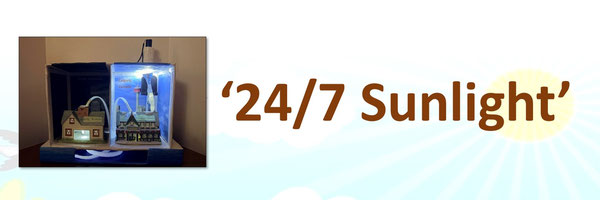
24/7 Sunlight
Param Panchal
Glamorgan School
Grade 6
Presentation
Hypothesis
Project Title:
24/7 Sunlight
Question:
- Can we maximize the use of natural sunlight for illumination in homes and workplaces?
- How can we harness 24/7 Sunlight for illumination and reduce dependence on artificial lighting, even during nighttime?
Hypothesis:
I think, when we install the fiber optic cables on a house/building roof, it can transmit enough direct sunlight for illumination inside the house/building.
Also, I believe that the fiber optic cable can transmit sunlight from the daytime location to the nighttime location on the other side of the world for illumination.
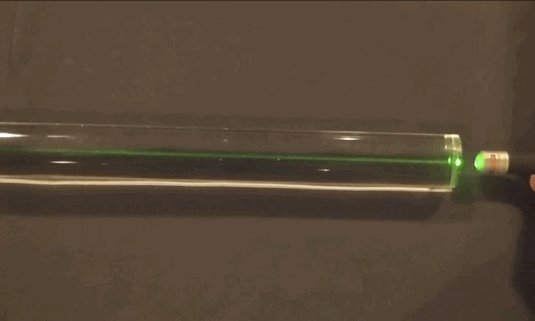 Photo Sources: https://www.thefoa.org/tech/sciproj.htm
Prediction:
If I install the fiber optic cables on a house/building roof, it will transmit direct sunlight inside the house/building for illumination.
Besides, if we install the fiber optic cable at one location (such as Calgary, Canada) and connect it to its antipodal or another location (like Perth, Australia), we will transmit sunlight for illumination from the daytime location to the nighttime antipodal location and vice versa.
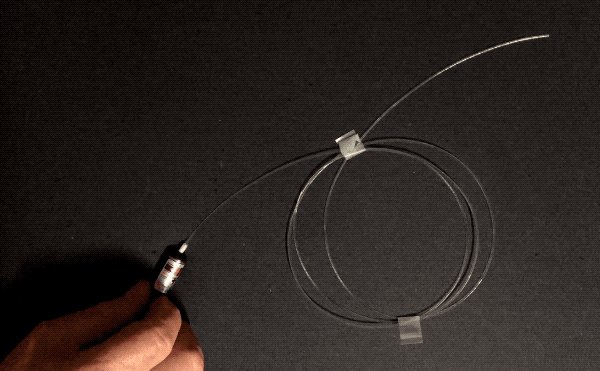 Photo Sources: https://www.thefoa.org/tech/sciproj.htm
Research
Background Research:
Big Topic:
Light energy (electromagnetic energy)
Why is this important for society:
- Light energy is very important in our daily life.
- Sunlight is very useful for giving us light and it helps to make Vitamin D cells in our body.
- Artificial light energy is used in our houses and other buildings such as workplaces etc.
- Light can be used for both nighttime and even daytime too.
What do we already know about the topic:
- Sunlight gives energy, light and it helps to make Vitamin D to our body
- From Sunlight, we can get electricity through solar panels
- Speed of Light is very fast and efficient (300,000,000 meters per second in a vacuum)
- Fiber optic cable helps to transfer the light quickly from one place to the other
- There is about 1.48 million kilometers of fiber optic cables under the ocean to transmit data (includes Internet and communication) in the form of light all across the world
Map of undersea cables
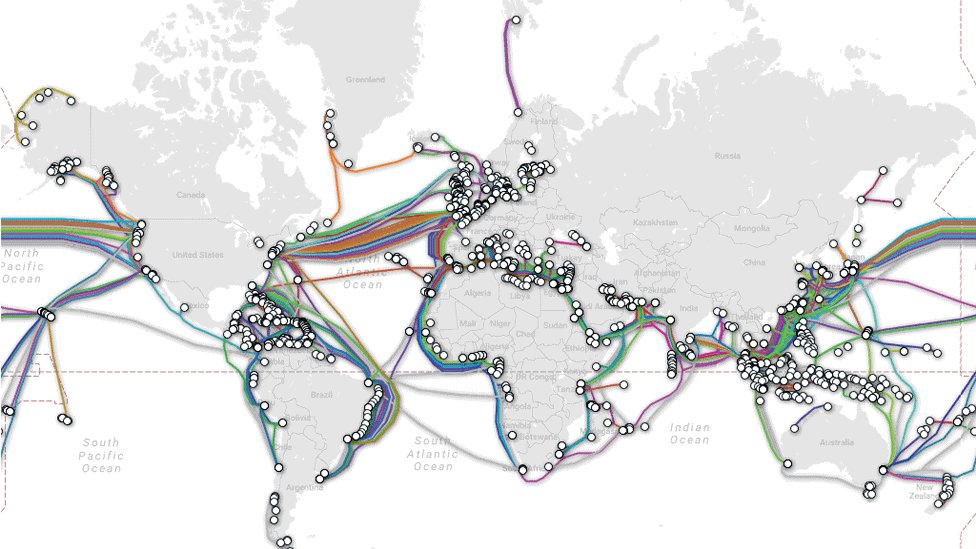
Photo Sources: https://www.bbc.com/news/technology-17340700
What are we missing?
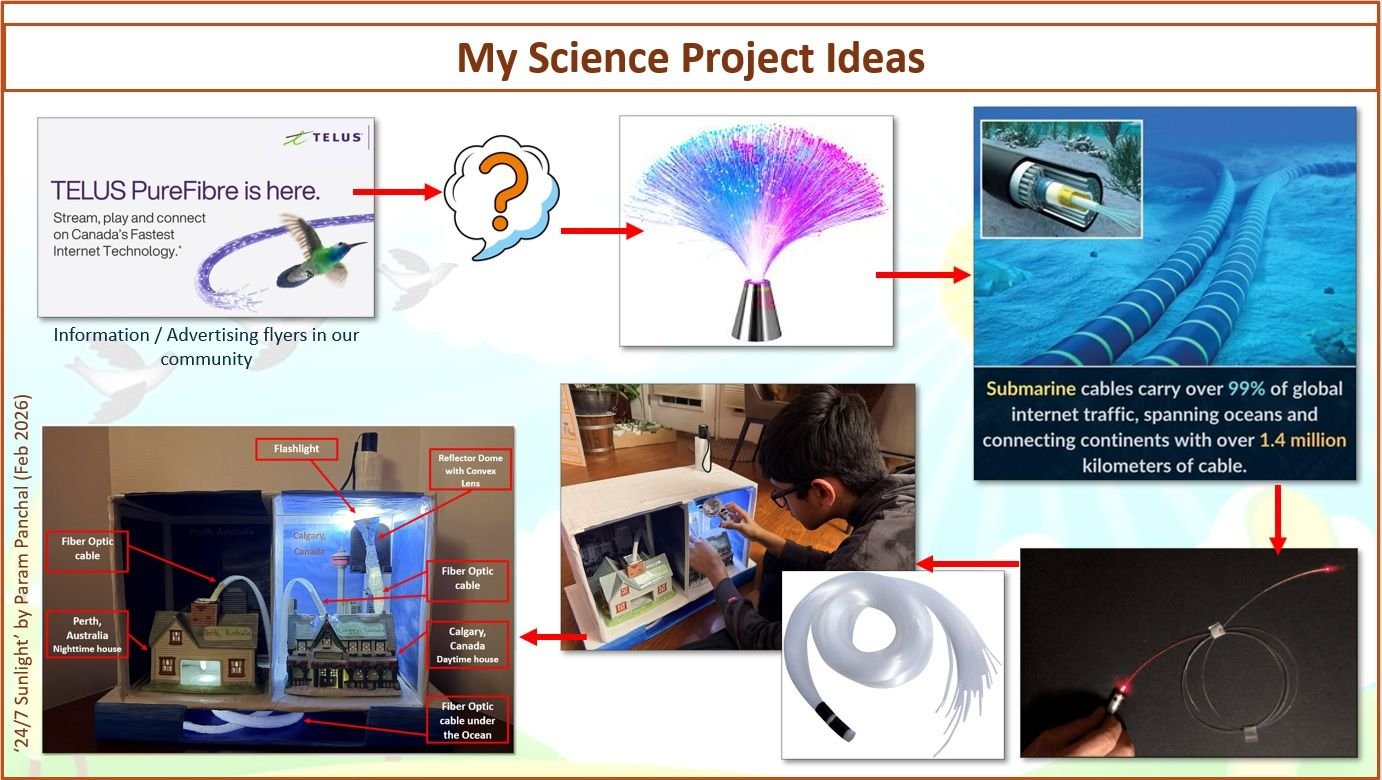
How do we get 24/7 Sunlight for illumination with the help of Fiber Optic cables in homes and workplaces, even during the nighttime?
How my topic solves a problem
- We can get Sunlight by transmitting it into the fiber optic cable.
- When one place in the world has Sunlight (Daytime), we can transmit it to other places which have no Sunlight (at the same time - Nighttime) and a dusk.
- Fiber optic cable is very efficient to transfer light very quickly without losing much of it.
Variables
Variables:
Independent Variable (What I change):
- Installing fiber optic cables with a reflector dome and convex lens on a house/building roof
- Passing fiber optic cables inside the house/building from the roof
Measured in numbers of Fiber Optic cables and number of reflector domes and a convex lens
Dependent Variables (What I observe):
- Illumination/Sunlight inside the house/building
Measured in Lux (Lumen per square meter)
- Temperature inside the house/building
Measured in Celsius
Controlled Variables (What I keep the same):
- Same Sunlight
- Same house/building
- Same roof of the house/building
Procedure
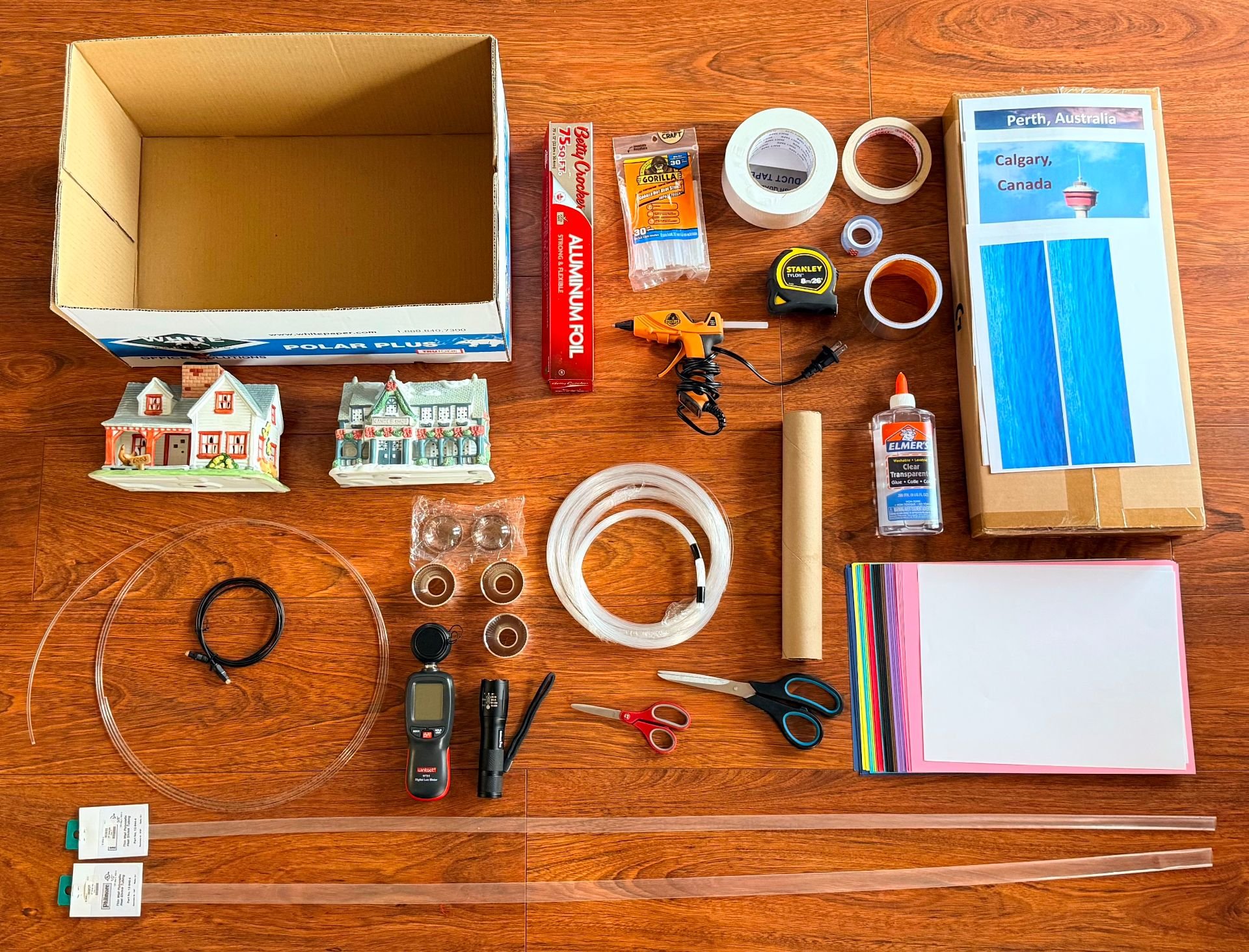
Material used for Working Model:
- Fiber Optic cable (approx. 6.5ft)
- Shrink tube (to protect fiber optic cables)
- Flashlight
- Light Meter, Temperature Meter
- Small toy houses (tealight houses) (2), Reflector Dome (3)
- Convex Lens (1), Aluminum Foil
- Hot Glue Gun and Sticks, & Glue (1 small bottle 266ml)
- Duct Tape (1-2 roll), Clear Tape (1-2 roll)
- Masking tape (1 roll), Aluminum Tap (1 roll)
- Measuring Tape, Paper, Cardboard box
- Cardboard, Scissors, Other Craft items
Procedure: (Experiment on a Working Model)
- First\, I set up two toy houses (tealight houses) inside a cardboard box\, with a partition dividing them to show different locations – one representing daytime and the other nighttime.
The houses are the controlled variables because they remain unchanged.
- Next. I installed fiber optic cables (about 6.5 ft long) along with a reflector dome and a convex lens near the roof of the daytime house to collect sunlight and transmit it through the cables.
The dome, convex lens, and fiber optic cables are independent variables that I changed, measured by the number of cables, the reflector dome, and the convex lens.
- Then\, half of the fiber optic cables are connected inside the daytime house\, ending in a reflector dome to distribute light throughout the house. The other half connect to the nighttime house\, also ending with a reflector dome for light distribution.
The fiber optic cables and reflector domes are the independent variables (what I changed), while the houses are the controlled variables (what I kept constant).
- We can test the model using a flashlight by shining light into the dome near the roof of the daytime house. The light will travel through the fiber optic cables and reach the reflector dome inside the house. The same setup applies to the nighttime house. The illumination inside both houses can be observed with a light meter\, measured in Lux (lumens per square meter).
- Finally\, we can test the model under sunlight and measure the illumination inside both houses with the light meter.
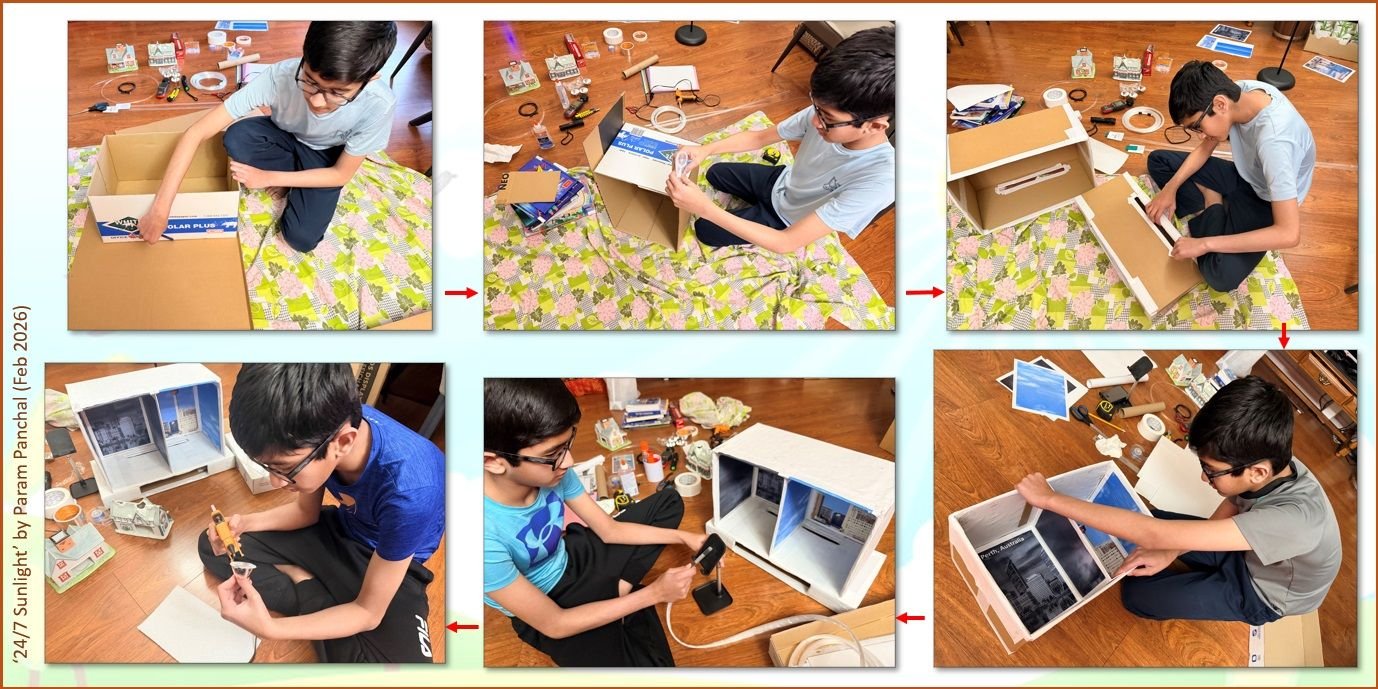
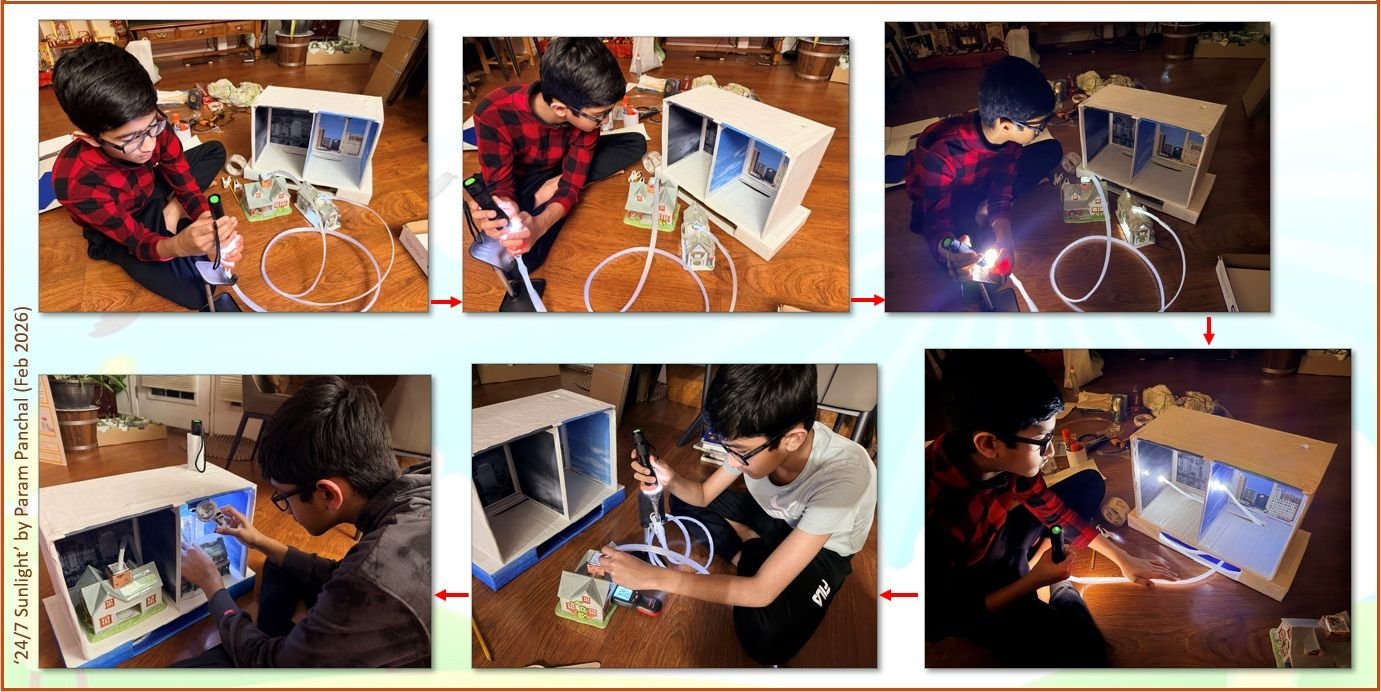
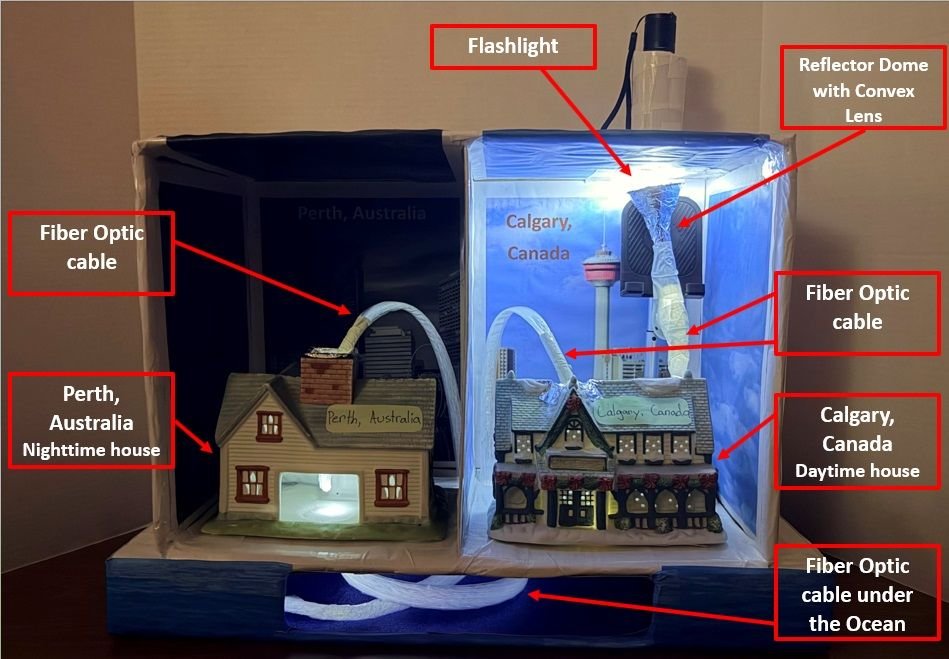
Diagram of the Working Model
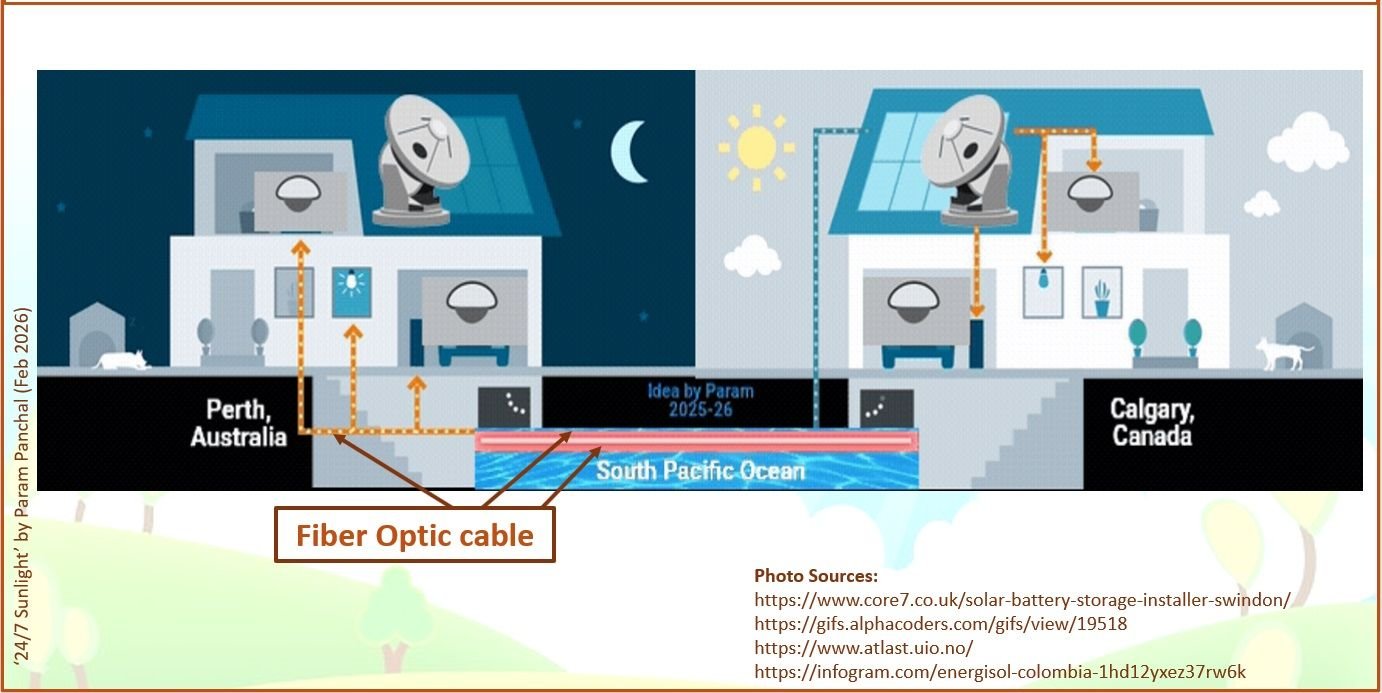
Observations
Observations:
Result: (Experiment on a Working Model)
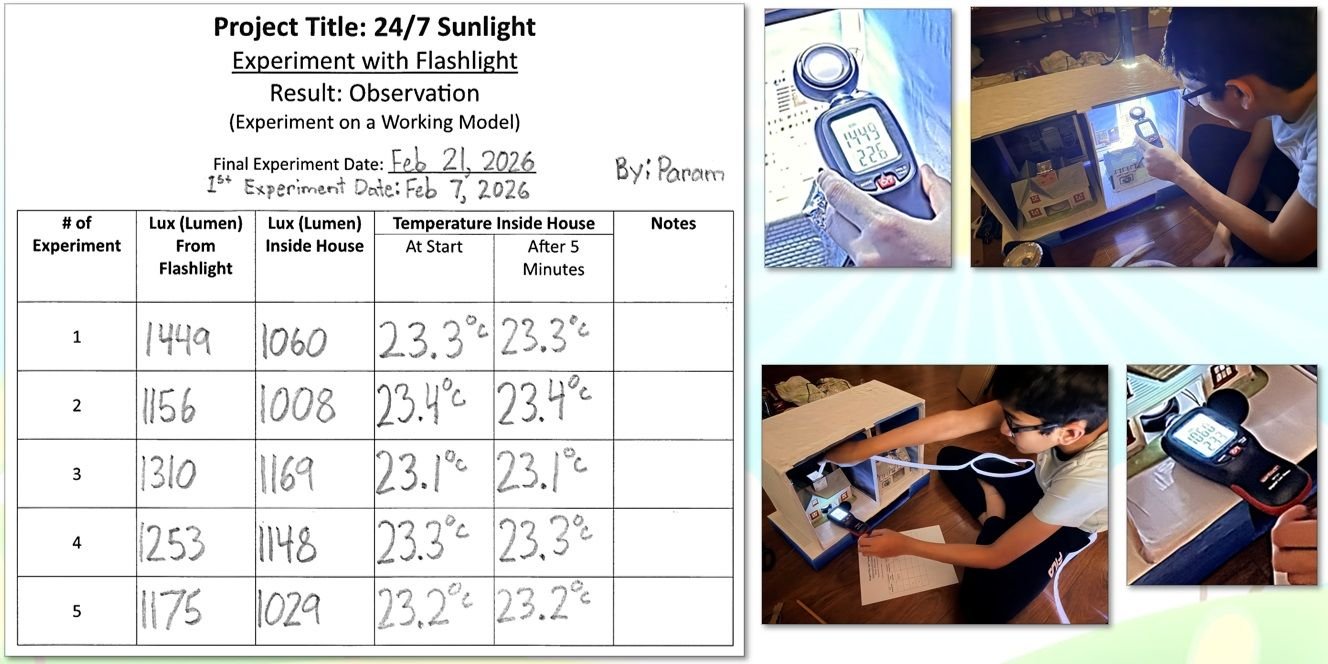
- I shined the flashlight into the dome a few times near the roof of the house.
- The light went into the fiber optic cables.
- The light continued going through the cables and ended in the house with a reflector dome.
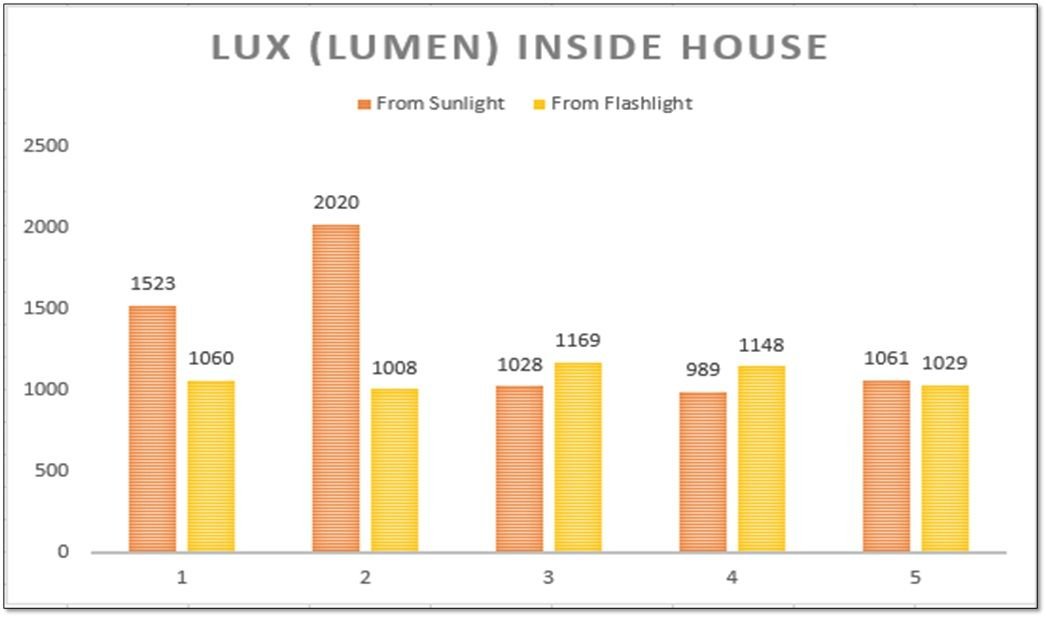
- First, I used a light meter to measure the light in Lux (Lumen per square meter) directly from the flashlight.
- I have done the same thing for measuring the light inside the house at the end of the reflector dome.
- Lastly, I used the same light meter to measure the temperature in Celsius from at the start of my experiment to after 5 minutes, to check if the fiber optic also transfers heat with the light.
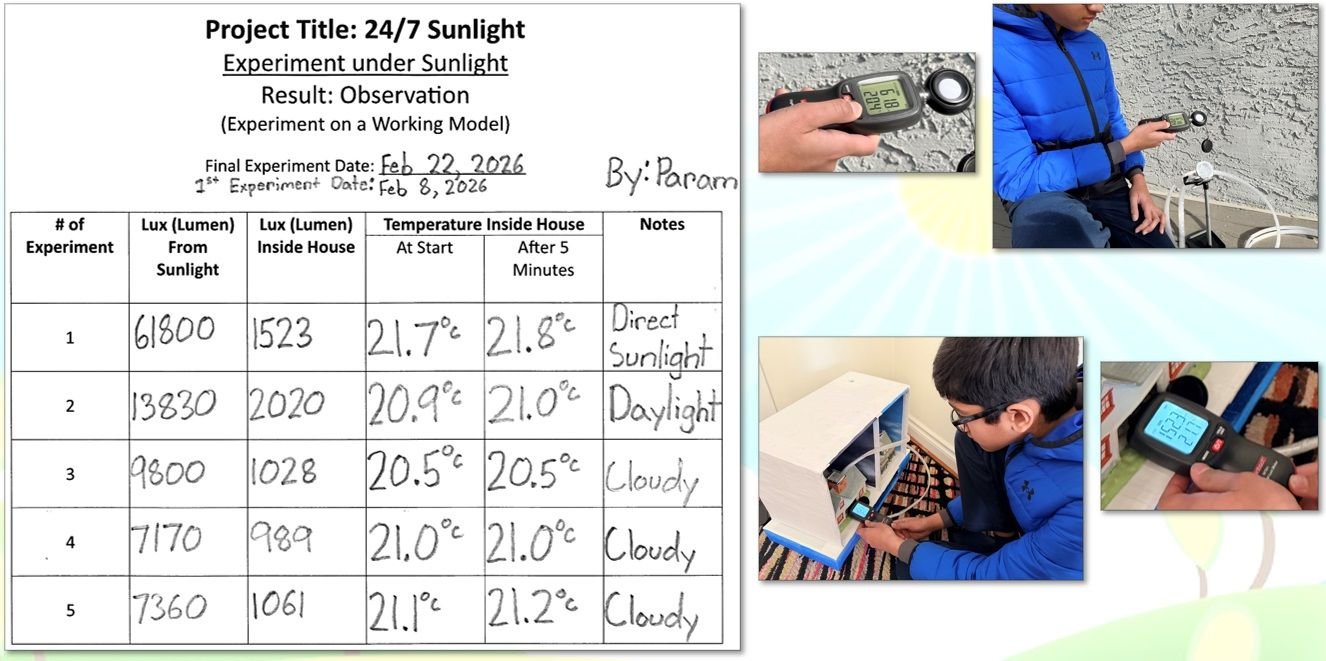
- I have also tested it under sunlight, and went through the same procedure.
- We can transfer light through the fiber optic cables inside the house with the help of speed of light.
- All my observations (in a table form) are recorded to show how much light is being transferred through the fiber optic cables.
Analysis
Analysis 1:
Lux (Lumen per square meter): Amount of Visible Light
- From direct sunlight, we can get between 32,000 to 100,000 Lux (Lumen per square meter)
- For daylight (in case sun is hiding behind the clouds), it provides 10,000 to 25,000 Lux (Lumen per square meter)
- In our house, normally we need about 100 to 500 Lux (Lumen per square meter) for our daily usage
- The maximum we would need is for small and detailed task, such as on Kitchen worktops. It would need to be between 500 to 700 Lux (Lumen per square meter)
- As per my experiment under Sunlight and with a Flashlight, I found that the light illuminates above 1,000 Lux (Lumen per square meter)
- 1,000 Lux (Lumen per square meter) is more than enough for all our daily illumination usage
- We can reduce the brightness of light by ‘Light Dimming Filters’ as per our illumination requirements
My project will provide an alternative solution instead of using the electricity for illumination. Instead, we will harness sunlight for 24/7 lighting all across the world.
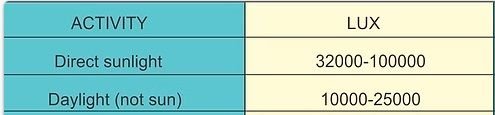
Photo Sources: https://www.lumenarts.net/manuals
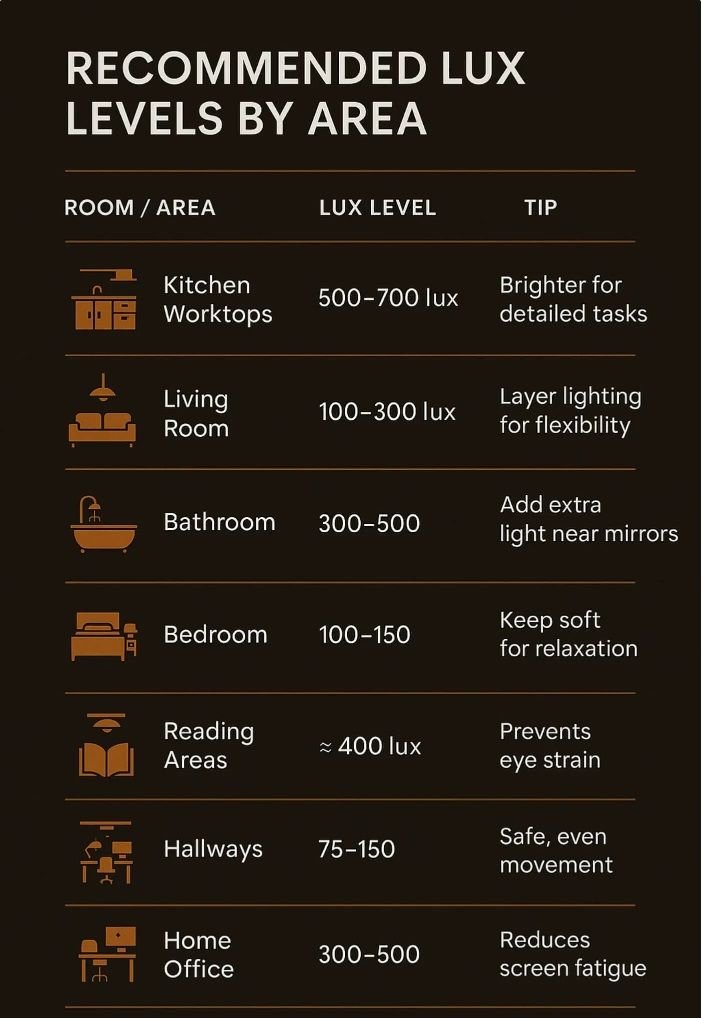
Photo Sources: https://leoralighting.co.uk/blogs/the-glow-guide/how-bright-your-light-should-be?srsltid=AfmBOopktNcmz8mZdfp-5qbIt_xmUPbP4EE2xGyYyHqhM3zc60o5KUJq
Analysis 2:
The speed of light
- The speed of light is very fast and efficient because it travels at 300,000,000 meters per second (300,000 km/s) in a vacuum
- In fiber optic cables (made with silica glass), the speed of light will be slower by 30%. The speed of light will be approximately 200,000 km/s in a fiber optic cable
Calculation:
n = c / v
n = Light refraction index / Electromagnetic waves
c = Speed of Light in a vacuum (300,000 km/s)
v = Speed of light in a material/medium
The refractive index of fiber optic cables (made with silica glass) n = 1.5
v = c / 1.5
v = 300,000 / 1.5
v = 200,000 km/s in a fiber optic cables
So, the speed of light is 200,000 km/s in a fiber optic cable.
As per my project, the speed of light is very fast and efficient. The fiber optic cable can transfer the light quickly from one place to the other without losing that much light.
Undersea fiber optic cables
Currently, there are 1.4 million kilometers of fiber optic cable that have spread across the ocean for global internet connectivity. And the amplifiers, sometimes called repeaters, are installed every 100 km to amplify the light signals.
I have prepared my working model on a small scale to show how the fiber optic cable can pass light from once location to the other. For the real-life project, amplifiers need to be required to strengthen the light that is being passed through it.
Conclusion
Conclusion:
My hypothesis is true:
We can maximize the use of natural sunlight (Controlled Variables) and transmit direct sunlight inside the house/ building (Controlled Variables) for illumination (Dependent Variables) from the roof of the house (Controlled Variables) through the fiber optic cable (Independent Variables).
Likewise, we can transmit sunlight from the daytime location to the nighttime antipodal location through the fiber optic cable (Independent Variables).
My experiment answers the missing piece of my background research:
Fiber optic cable is very efficient to transfer light very quickly and we can transmit the Sunlight in homes and workplaces, even from daytime location to the nighttime location.
Importance of energy to the world:
We found another way to harness 24/7 sunlight for illumination and reduce dependence on artificial lighting, even during nighttime.
Application
Application: Next Steps
Daytime Location
We can install the dome on the roof of the house and the big building with the fiber optic cable and end inside the house with the reflector dome for illumination during the daytime.
Daytime to Nighttime Location
- The distance between Calgary and Vancouver is 972 Kilometers by road, and Vancouver to Perth, Australia by cargo ship (by sea) distance is 16,862 kilometers
- In total, the distance is 17,834 kilometers between Calgary, Canada and Perth, Australia
- As per current undersea cable network, the cost for installing the cables under the sea is really high, from $6,000 to $20,000 per kilometer
- The cost depends on number of cables and the distance or amount of fiber optic cables
- The approximate cost for the real-life big scale project (From Calgary, CA to Perth, AU)
- Total cost may be: $10,000.00/kilometer for 18,000.00 km = $180 million
- Population of Canada is 41,549,366 currently (as on February 11, 2026)
- If each residence of Canada donates or gives $4.34, it will cover the whole cost of installing the fiber optic cable
- We can transmit sunlight for illumination from the daytime location to the nighttime antipodal location
- After installing the fiber optic cable network for illumination, there will not be No electricity bills for lighting
- Need more research and experiment for the real-life large-scale project and the expert engineers would study for the practicability of my project for the real-life large-scale project.
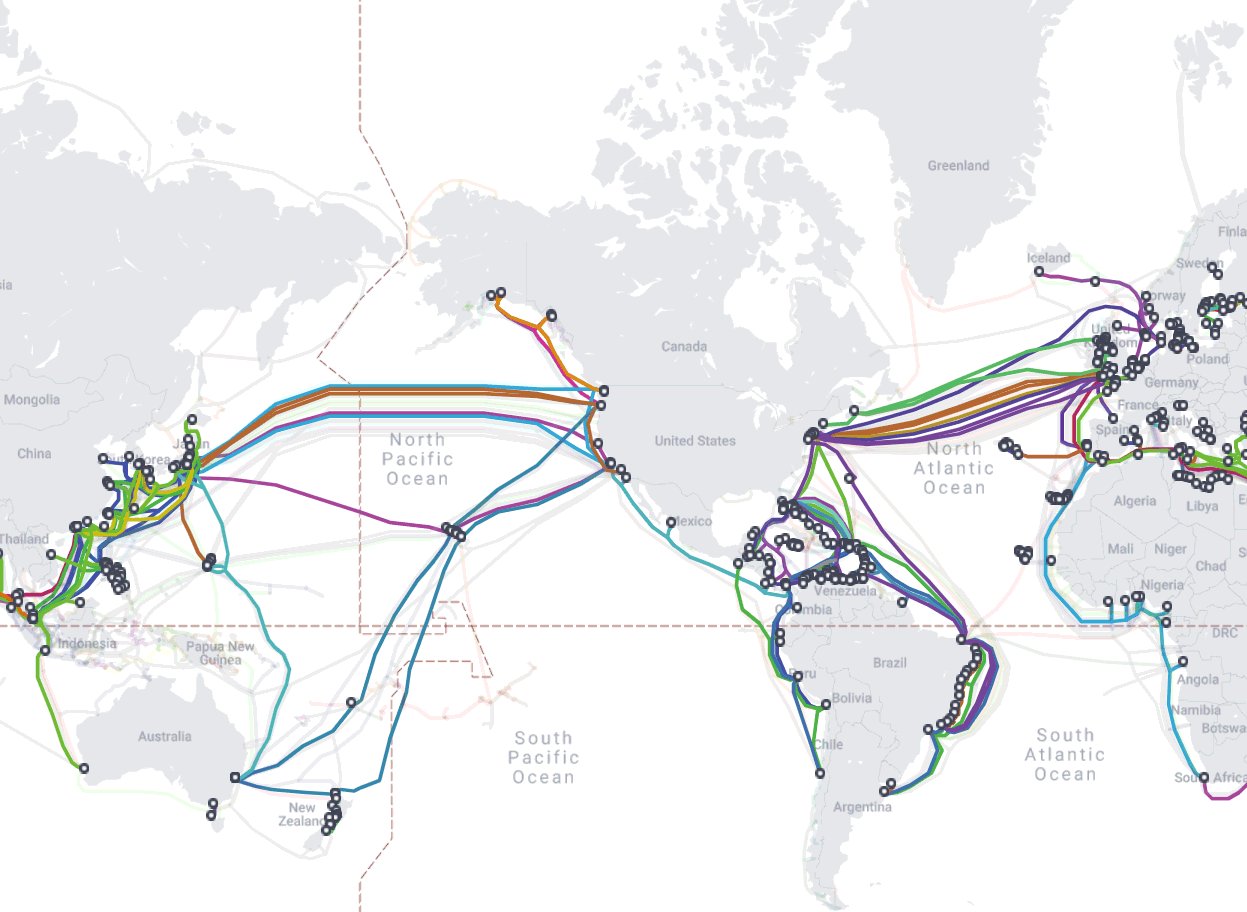
Photo Sources: https://www.theigc.org/blogs/can-internet-access-lead-improved-economic-outcomes
Sources Of Error
Sources of Error:
Measurement errors: (during conducting experiments)
During the observation of my working model, Sunlight strength is not constant during the day because of the clouds.
Machine / Mechanism errors:
- Light Meter is more sensitive and the readings to hit their maximum limit under direct sunlight
- Illuminance accuracy +/- 1000 Lux as per Light Meter description
- Temperature accuracy +/- 1 Celsius as per Light Meter description
Fiber optic cable:
- Plastic fiber optic cable with good quality (not the best quality) is used for my working model. The cable helps to reduce heat while transmitting light.
- There are different types of high-quality optic cable that can be used for real-life project and for underwater usage.
Citations
Sources: Citations
Websites: For Project Research
Light Energy
https://www.alliantenergykids.com/renewableenergy/renewableenergyhome
https://www.alliantenergykids.com/renewableenergy/solarenergy
https://www.lumenarts.net/manuals
https://leoralighting.co.uk/blogs/the-glow-guide/how-bright-your-light-should-be?srsltid=AfmBOopktNcmz8mZdfp-5qbIt_xmUPbP4EE2xGyYyHqhM3zc60o5KUJq
Fiber Optic Cable
https://www2.telegeography.com/submarine-cable-faqs-frequently-asked-questions#:\~:text=As%20of%20early%202025%2C%20we,kilometer%20Asia%20America%20Gateway%20cable.
https://www2.telegeography.com/submarine-cable-faqs-frequently-asked-questions
https://en.wikipedia.org/wiki/Submarine_communications_cable
https://www.kentik.com/blog/diving-deep-into-submarine-cables-undersea-lifelines-of-internet-connectivity/
https://resources.telegeography.com/the-economics-of-submarine-cables#:\~:text=Building%20these%20systems%20requires%20enormous,permitting%20processes%20across%20multiple%20jurisdictions.
https://www.subseacables.net/reports-and-coverage/world-oceans-day-2025-why-our-digital-future-depends-on-the-deep/
https://www.bbc.com/news/technology-17340700
https://www.aflhyperscale.com/articles/techsplainer-light-series-the-speed-of-light/
https://wecomfiber.com/fiber-optic-speed-internet-at-the-speed-of-light/
https://en.wikipedia.org/wiki/Fiber-optic_cable#:\~:text=Propagation%20speed%20and%20delay%20Optical%20cables%20transfer,for%201000%20km%20is%20around%2011%20milliseconds.
https://en.wikipedia.org/wiki/Speed_of_light#:\~:text=The%20speed%20at%20which%20light,/s)%20slower%20than%20c.
https://lightcolourvision.org/diagrams/refractive-index-explained/
Distance
https://www.fluentcargo.com/routes/vancouver-ca/perth-au
https://www.travelmath.com/distance/from/East+Perth,+Australia/to/Vancouver,+WA
https://www.travelmath.com/distance/from/Calgary,+Canada/to/Vancouver,+Canada
Statistics
https://www150.statcan.gc.ca/n1/pub/71-607-x/71-607-x2018005-eng.htm
YouTube
The Dr. Binocs Show:
https://www.youtube.com/watch?v=d7yTlp4gBTI
LaFountaine of Knowledge:
https://www.youtube.com/watch?v=wOpZz7NIgFY
Professor Dave Explains:
https://www.youtube.com/watch?v=pj_ya0e20vE
Techquickie:
https://www.youtube.com/watch?v=G1Ke-H8I1uk
VirtualBrain:
https://www.youtube.com/watch?v=zAVsTubdd_Q
Websites: For Image (including gif file) for ppt slides
https://www.thefoa.org/tech/sciproj.htm
https://www.thefoa.org/tech/sciproj.htm
https://www.bbc.com/news/technology-17340700
https://www.core7.co.uk/solar-battery-storage-installer-swindon/
https://gifs.alphacoders.com/gifs/view/19518
https://www.atlast.uio.no/
https://infogram.com/energisol-colombia-1hd12yxez37rw6k
https://www.lumenarts.net/manuals
https://leoralighting.co.uk/blogs/the-glow-guide/how-bright-your-light-should-be?srsltid=AfmBOopktNcmz8mZdfp-5qbIt_xmUPbP4EE2xGyYyHqhM3zc60o5KUJq
https://www.transparentpng.com/cats/sun-172.html
https://www.dreamstime.com/royalty-free-stock-photo-vector-farm-beautiful-sunrise-created-illustrator-image33120175
https://pngtree.com/freepng/fiber-optic-cable-on-transparent-background_21695848.html
https://www.freepnglogos.com/images/arrow-37897.html
https://creazilla.com/media/clipart/34224/house
https://www.bbc.com/news/technology-17340700
https://itopia.ca/telus-business-internet/
https://www.freepik.com/free-photos-vectors/question-clipart
https://www.facebook.com/groups/3137177053251945/posts/3485330281769952/
https://www.innoteck.co.uk/products/fibre-optic-led-lamp?srsltid=AfmBOoqMA4YPItKPNs7-q-Zih2_ZxZtHb5gxjZB81a5T30qpmn-drM9w
https://www.amazon.ca
Books from Calgary Public Library: For Project Research
- Fiber Optic Essentials by Thyagarajan\, K. Book, 2007
- The Undersea Network by Starosielski\, Nicole Book, 2015
- Fiber Optic Communications by Palais\, Joseph C. Book, 2005
- Fiber Optic Installer's Field Manual by Chomycz\, Bob Book, 2015 Second edition.
- Light - The Extraordinary Energy That Illuminates Our World by Wade\, Jess Book, 2025
- Light by Amson-Bradshaw\, Georgia Book, 2018
- The Science of Light Waves by Johnson\, Robin Book, 2017
- Light - The Visible Spectrum and Beyond by Arcand\, Kimberly K. Book, 2015
Acknowledgement
Acknowledgement:
First, I would like to thank my science fair coordinator, Mr. Patrick Howey, for continuous guidance and support on every step of my project.
Also, I am grateful to Mrs. Nietmann for motivating me for the project.
My parents inspired me to participate in the Science Fair and gave valuable suggestions and constructive feedback all the time.
Finally, I would like to thank all my teachers and all those who supported me during my project.