
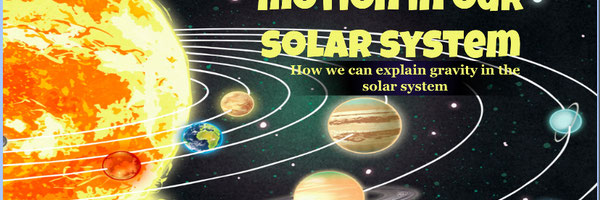
Gravity and motion in our solar system.
Kira Balva, Sophia Jock
Ranchlands School
Grade 5
Presentation
No video provided
Problem
If gravity is the force that pulls objects with mass towards each other, and motion keeps objects moving throughout space, then gravity and motion together will control how all objects in the solar system move. The sun, having the greatest mass should create the strongest gravitational force and therefore have the biggest influence on the planets. Objects closer to the sun should move faster because they experience a stronger gravitational pull. Objects farther from the sun experience a slightly weaker pull. The balance between gravity and forward motion should create stable orbits instead of objects falling inward or drifting away. So, gravity and motion together should explain the structure and stability of the solar system.
Method
To start off, we identified what we needed to research for our project by figuring out what are the main research points and branch it off from there. Using that, we started off researching about gravity, what it is and how it works, motion, what it is and how it works, about orbits, about planets, and more. We organized all of that information into different sections to understand and connect everything. We then gathered more information in sub-categories (like rotation and revolution, motion speed, other objects in the solar system, etc) and put that information into sections as well. We looked at scientific data to compare things such as orbital speed and distance from the sun, planet mass and gravitational strength. Once all of that was done, we started drawing conclusions and wrapping up the project. After doing all the research and organization, we polished it and fixed up most of the errors and mistakes. Once our slides were printed and ready, we painted and decorated the trifold and put our slides onto it. For our presentation, we wrote a colour coded script to ensure it’s not too long and not too short.
Research
Gravitational forces- The attraction of two objects with mass is called gravity, and it pulls objects towards each other. Every object in the universe that has mass has gravity, even people and animals, but bigger objects have much stronger gravity. The strength of the pull depends on how much mass the objects have, so objects with more create a stronger gravitational force. For example, the Earth has a lot of mass, so it’s gravity is strong enough to pull people, buildings, oceans, etc towards it. It is the reason we can jump and always come back down, life as we know right now would be impossible because everything would drift away. Gravity also plays a very important role in space, it keeps the moon moving around the Earth and keeps the planets “locked” in orbit around the sun. Gravity and motion work together to keep planets moving in stable orbits around the sun. Gravity pulls each planet towards the sun,while motion keeps the planets moving forwards through space. Because of this, the planets do not fall into the sun or fly away into to space. Instead, they follow a curved path called an orbit. The planet is always being pulled inward by gravity,but its forward motion makes it keep missing the sun. This balance between gravity and motion is what keeps the solar system organized and stable,and it is also what allows Earth to stay in the right place for life to exist, since it would go rogue and drift away from the habitable zone, as well as the solar system entirely. The planets also have their own individual gravitational forces, as everything does, it’s just less significant than the sun’s gravitational force. The sun plays a major role in the orbits of the planets. It has a very strong gravitational pull because it is very large. This strong gravity holds the planets in orbit so they don’t fly away and the planets move forward at the same time which makes a balance between gravity and motion. Without gravity, the solar system wouldn’t be the same as it is today, maybe not even at all since it is what's keeping the planets in a system. Planets wouldn’t stay in place, space objects wouldn’t orbit anything and everything would just drift away in different directions. This project matters because understanding gravity and motion helps us understand space as a whole. Centrifugal force- It’s the force that seems to push objects outwards when they move in a circle. When something spins, it feels like it is being pulled away from the centre. An example of centrifugal force is when you spin a ball on a string and it seems to be being pushed away from the centre when there’s no force actually pushing the ball away. The faster the object spins, the stronger the centrifugal force becomes. Centrifugal force works together with gravity. Gravity pulls objects inwards while centrifugal force moves outwards, so the exact opposite of the gravitational force. When these two forces are balanced, the objects move in a circle instead of flying away or falling inward. This balance is very important in space. Planets move around the sun because gravity pulls them to the sun but centrifugal force keeps the from falling straight into it. Planets and Solar system- Planets are very large celestial bodies, they are formed from the leftover gas, dust and rock after a new star is created. When a star forms, gravity pulls nearby material together, and after a long time, this material clumps into a planet. Planets can vary in size and shape and more. Some planets are small and rocky like the inner planets (Mercury, Venus, Earth, Mars,) and some can be made out of gas or ice like the outer planets (Jupiter, Saturn, Uranus, Neptune). Planets can have many interesting features, some can have rings made out of ice and rock like Saturn’s, many planets have moons that travel around them. Planets also have different temperatures and atmospheres. Scientists are always searching for planets that have signs and conditions of life, but so far, Earth is the only planet we know for sure has life. There are planets called exoplanets, which are planets found outside of our solar system orbiting other stars. There can also be rogue planets, which are also exoplanets but they do not orbit any stars. Scientists discover them using very powerful telescopes. Some are very hot, some are very cold, and some may be similar to Earth. The solar system is made up of eight planets that all orbit the sun. It also consists of asteroids (rocky objects mostly found in the space between Mars and Jupiter’s orbits) , dwarf planets (planets that do not meet the standards required to be a planet) and comets (objects made out of ice and dust that have a glowing tail when they travel close to the sun.) Motion, Orbit- Motion is the way an object moves from one place to another. Motion can happen in many ways, an object can move in a straight line, a circle, back and forth or even in a curved path. Motion can be fast or slow, and it can change over time. In space, motion is extremely important because almost everything is always moving. Planets move around stars, moons move around planets, and stars move around galaxies. For an object to start moving, you need force. When you kick a ball, for example, your foot applies a force that makes the ball move. When a rocket launches, the engines push it forward, creating motion. Without force, the object at rest will stay still. Objects in space can move very fast because they have very little friction. Speed is also very important because it affects how far an object travels and how its motion changes. Faster objects cover more distance in less time. Once an object in space starts moving, it will keep moving unless a force changes its motion. A force that can change the motion is gravity. It can make objects slow down, speed up, or change direction. Orbit- The planets move around the Sun in paths called orbit, which are shaped like ovals.they do not move in straight lines or stop in space.the sun has very strong gravity,which pulls the planets towards it, but the planets also keep moving forward at the same time. Because of this,the planets do not fall into the Sun and do not fly away into space. Instead they keep going around the Sun over and over again. Planets that are closer to the sun move faster than planets that are farther away. For example, Mercury moves very fast because it is close to the sun,while Neptune moves much more slowly, because it is very far away. One full trip around the Sun is called a year,and each planet's year is a different length since they have different speeds going around the sun, Earth’s year is 365 days (366 on leap years every 4 years) because it makes a full orbit every 365 days. Planetary orbits (Solar system)- The planets move around the Sun in paths called orbits, which are shaped like oval.they do not move in straight lines or stop in space.the sun has very strong gravity,which pulls the planets towards it, but the planets also keep moving forward at the same time. Because of this,the planets do not fall into the Sun and do not fly away into space. Instead they keep going around the Sun over and over again. Planets that are closer to the sun move faster than planets that are farther away. For example, Mercury moves very fast because it is close to the sun,while Neptune moves slower, because it is very far away. One full trip around the Sun is called a year,and each planet's year is a different length since they have different speeds going around the sun, Earth’s year is 365 days (366 on leap years every 4 years) because it makes a full orbit every 365 days. Rotation and revolution- Rotation and revolution are two important types of motion in our solar system. Rotation is when a planet spins on its axis, and this is what causes day and night. For example, Earth rotates every 24 hours, which makes 1 full day. Revolution is when a planet travels around the Sun, and this is what makes a year. Earth takes about 365 days to complete 1 revolution around the sun. Gravity plays a very important role because it keeps planets moving in their orbit instead of flying away into space. Some planets rotate faster or slower than Earth, which changes how long their days are. Other planets also take more or less time to rotate around the sun, which changes how long their year is. Rotation and revolution together help create the patterns of time we use like days, months, and years, this is why understanding these motions is important for learning how our solar system works.
Data
| Distance from sun (km) | Orbital speed (km/s) | Length of year | ||
|---|---|---|---|---|
| Mercury | 47 km/s | 88 Earth days | ||
| Earth | 29-30 km/s | 365 days (366 every 4 years) | ||
| Neptune | 5 km/s | 165 Earth years |
Conclusion
In this project, we explored how gravity and motion work together to control movement in the solar system. Our research showed that gravity pulls objects inward, while motion keeps them moving forward through space. We found that objects closer to the sun move faster while objects farther away move slower, which supports our hypothesis. The sun’s large mass gives it the strongest gravitational force, affecting the motion of planets, asteroids, comets, etc. The balance between gravity and motion stable orbits and stability throughout the solar system and universe. In summary, we found that gravity and motion are the reasons for everything in the solar system today.
For further research, we can research how planets’ gravitational forces affect each other, not just the sun affecting the planets. In the past, the Earth has actually been in a dual orbit, which is when two planets orbit each other, with a planet scientists call “Theia”. This planet got a bit too close and crashed with Earth, becoming part of the moon. This planet was one of the reasons Earth has life and is as we know it. Dual orbiting planets are rare, since they usually crash before long, but they do exist. In the future, we can also research how gravity works and is affected near extreme environments, like black holes or anything like that.
Citations
Scientific modelling-https://en.wikipedia.org/wiki/Scientific_modelling Planetary orbits-https://www.ebsco.com/research-starters/history/planetary-orbits Rotation and revolution-https://www.albert.io/blog/earths-rotation-and-revolution/, https://sos.noaa.gov/catalog/datasets/planet-rotations/
Acknowledgement
We would like to thank Mr. Z for his guidance and everything he helped us, along with everyone else with. We are extremely grateful for him, since his instructions helped very much with understanding this project. We’d also like to thank Kira’s mom for helping with formatting and making our trifold, as well as both of our parents for believing in this project and believing in us to make it this far.