
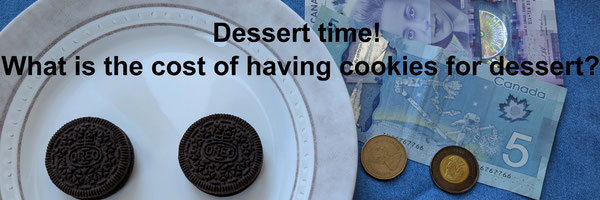
Dessert time! What is the cost of having cookies for dessert?
Jonathan Stephenson, William Cunningham
Melissa Craig
Grade 6
Presentation
No video provided
Hypothesis
Hypothesis 1: The Consumer Price Index for food purchased at stores rose 5.3% in Alberta in 2025. Since a year has 52 weeks and we are tracking the prices for 20 weeks, we hypothesize that cookie prices increased by 2% (5.3%/52 weeks *20 weeks).
Hypothesis 2: Cookie prices are different at different grocery stores. We expect some stores are more expensive than others based on what our parents said about the stores.
Research
Our parents have said that groceries are getting more expensive and it can be hard for families to buy enough food. Statistics Canada reported that the cost for food purchased at Alberta stores rose 5.3% during 2025.1 This means that it would take $105.3 to buy groceries that cost $100 in December 2024. Similarly, the Argi-Food Analytics Lab at Dalhousie University predicted that the food prices would increase by 4% to 6% in 2026.2
We notice that there are different grocery stores near our home, school, and our parents' work. However, our parents don't always go to the store closest to us. They said that some stores are more expensive than others. We found a news story from 2023 where the reporter compared the prices ingredients for a spaghetti dinner from 4 different stores. The story concluded that Real Canadian Superstore was the least expensive store.3 However, the news story only examined the prices for one week.
Since we like to have dessert with our dinner, we decided to track the prices of cookies at grocery stores near the places we go to during the week to find out (1) if it is getting more expensive to buy cookies from the grocery store, and (2) which stores provide less expensive options.
Variables
Hypothesis 1: Our independent variable: Date (20 Mondays from October 13, 2025 to February 23, 2026) Our dependent variable: Average price of cookies across the observed stores
Hypothesis 2: Our independent variable: Store (Calgary Co-op, FreshCo, No Frills, Real Canadian Superstore, Safeway, Save on Foods, Walmart) Our dependent variable: Total cost of buying 1 package of cookies each week
Procedure
Before we started the study, we went to grocery stores to see what types of cookies are available at the different stores. We found cookies in the bakery area, but the types and package sizes are not consistent between stores. We also found cookies in the packaged foods area. This is where we can find the name brand packages. We found that all stores carry 270g packages of regular Oreos. Therefore, we decided to track the cost of these Oreo packages.
At the start of the project, our parents created bookmarks for online shopping at 7 grocery stores in Calgary: Calgary Co-op, FreshCo, No Frills, Real Canadian Superstore, Safeway, Save on Foods, and Walmart. We chose these stores because they are close to places we visit during the week. We used these bookmarks every Monday to find out the prices and wrote the information on a piece of paper. If there was a "member only" price, we used that price because everyone could get a free membership at these stores.
After data collection was completed, our parents helped us enter the data into an Excel spreadsheet. They showed us how to create charts to help us look at the differences between stores and between weeks.
For hypothesis 1, we calculated the average prices for each week. We plotted the average prices over time to see if there is a trend. We also compared the average prices for week 1 and week 20 and see if it increased by 2%.
For hypothesis 2, we calculated the total cost for buying 1 package of cookies each week at each store. We plotted the total prices to see which stores are less expensive.
Observations
The cookie prices changed weekly. It was as high as $4.99 and as low as $2.25. The cookies went on sale quite often.
Hypothesis 1: Cost of cookies over time:

Hypothesis 2: Total cost of cookies per store

Analysis
Hypothesis 1: Cost of cookies over time
The average cost of the cookies at week 1 was $3.62 and the average cost at week 20 was $3.46. When we divided the week 20 cost by the week 1 cost, the result was 0.96. This means the average price decreased by 4%. Therefore, we need to reject our hypothesis that the cookies would increase in price by 2% over 20 weeks. Our hypothesis was based on the Consumer Price index which includes many types of foods. We might have seen an increase in price if we tracked a different item or if we tracked more items that our family eats. The average price went up and down during the 20 weeks and we did not see a trend. It could be because the average price can change based on how many stores put the cookies on sale. We may need to track the prices for longer to see any trends.
Hypothesis 2: Total cost to buy cookies
The total cost to buy 1 package of cookies each week ranged from $56.70 to $94.84. This means we would be spending $38.14 more over 20 weeks if we shopped at the most expensive store. The observation supported our hypothesis that some stores are more expensive than others. This means our parents are right! Like the news story, Real Canadian Superstore was the least expensive and Safeway was the most expensive.3 However, we don't know if this is true for other grocery items like vegetables, milk, meat, and bread. We may want to track the prices for more items that we eat before we decide which store we should be using for our groceries.
Limitations:
We only tracked the prices for a standard package size of Oreos. Our findings may be different if we tracked a different food, or even a different brand of cookies. We calculated our total cost based on buying a package of cookies a week. The total cost could be lower if we “stocked up” during the weeks that the cookies were on sale.
Conclusion
We found that the average price of Oreo cookies decreased a little bit over a 20-week period. This is different from our hypothesis 1.
We found that the total cost for buying 1 package of cookies each week was less at some stores than the others. This supported our hypothesis 2.
Application
While the overall cost of groceries may have gone up, the package of cookies got less expensive during the study period. We also noticed a large difference between the total cost of buying cookies between stores. We may be able to continue to have cookies as dessert if we choose to shop at the less expensive places!
Sources Of Error
We used the online shopping prices for the study. It is possible that the stores have a different "in store" price. In fact, one of our parents noticed that Walmart had a lower in-store price than the online price for at least one week.
We recorded the price for a single package of cookies. Safeway had a "buy 2 packages for $5" sale twice during the study period but their price for one package stayed at $4.99. A smart shopper likely would have bought the extra package for 1 cent more and skipped buying cookies the next week.
Citations
1. Statistics Canada (2026). Latest Snapshot of the CPI, December 2025. Retrieved February 16, 2026 from https://www150.statcan.gc.ca/n1/pub/71-607-x/2018016/cpi-ipc-eng.htm 2. Agri-Food Analytics Lab (2026). Canada’s Food Price Report 2026. Retrieved February 26\, 2026 from https://www.dal.ca/sites/agri-food/research/canada-s-food-price-report-2026.html 3. Offin\, S. (2023). Apples to Apples: Which Alberta grocery store is the cheapest? Retrieved February 26\, 2026 from https://globalnews.ca/news/9608480/which-calgary-grocery-store-cheapest/
Acknowledgement
We would like to thank Mrs. Melissa Craig at Twelve Mile Coulee School for supporting this project. Our parents helped with the project by bookmarking the store webpages, explaining the Consumer Price Index, and guiding us through the data analysis process.
In the spirit of reconciliation, we acknowledge that this project took place on the traditional territories of the peoples of Treaty 7. We respect and recognize Indigenous People’s knowledge and contributions to the land and we strive to live in harmony with all creations.