
The Case of the Invisible Intruder
Peyton Durupt
Our Lady of the Assumption School
Grade 7
Presentation
No video provided
Hypothesis
If radiation (Ra Em) levels are measured at different heights within a building, then lower levels (such as basements) will show higher radiation readings than upper floors because of increased radon concentration which gathers naturally in low lying spaces.
Research
Radon is a naturally occurring radioactive gas that forms when soil and rock breaks down. It is invisible, non-smelling, and can enter homes through cracks in the foundation, gaps around pipes, and basement floors. My research shows that radon is present in many homes, but also that there is radon everywhere. Specific locations have higher radon levels because of differences in soil composition.Some areas have a greater risk for higher levels of radon.
Variables
Controlled variables
- Cloud chamber design
- Type and amount of isopropanol
- Observation time
- Method of counting tracks
- Same temperature conditions
- Same lighting and viewing angle
- Same placement height
- Same time of day
Manipulated variables
- Different houses (3 different houses)
- Different levels in each house (basement vs. main‑floor)
Procedure
- Remove backing from self adhesive felt pad.
- Secure firmly to the bottom of the clear plastic container.
- Put on safety goggles and nitrile gloves.
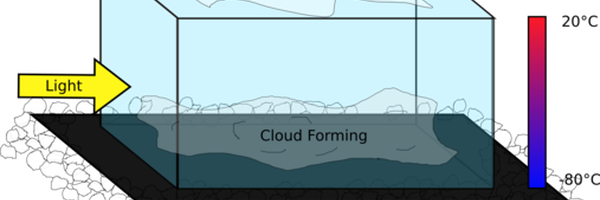
- Soak the felt with Isopropanol. TIP: You’ll know the felt is fully soaked when alcohol pools in the corner of the container. If there is excess isopropyl alcohol at the bottom of the container, carefully pour it into a separate container.
- Remove nitrile gloves and put on insulated gloves. Using tongs, place the dry ice bricks inside the metal baking tin. CAUTION: Dry Ice is -79°C and will cause an instant burn. Do not touch it without protective gloves.
- Once the dry ice bricks are in the metal pan, set the black plate to rest on the dry ice so that the bottom is in contact with the cold surface. NOTE: There may be a loud ‘groaning’ as the plate temperature rapidly drops.
- Set the clear container upside down on top of the metal plate. This will create a mostly sealed space.
- Turn off the lights to darken the room.
- Use a strong flashlight to shine light through the side of the container. Observe and record the visible tracks of radiation inside the cloud chamber.
Observations
After I created my cloud chamber, I observed and recorded the tracks of radiation and used that data to estimate radiation levels at each location. This exercise was very challenging; it is quite difficult to measure and count every instance of radiation. I conducted the experiment not only in my own house, but in two additional houses. The goal of my experiment was to test for the presence of a specific type of radiation called radon. In addition to using a cloud chamber to observe radiation tracks, after running my own experiment I used a store-bought radon test kit to measure and confirm radon levels. This allowed me to compare and validate my findings. I went to three different houses and tested two rooms in each house to compare radon levels. The first tests were done in my house, which was built in 2019. There were almost no traces of radon found there. The second house I tested was built in 2010. There were some traces of radiation detected, but not more than what would be considered average. The third house was built in 1970, and there were many traces of cosmic radiation and possibly radon found there, especially in rooms closer to the ground.
Analysis
By testing different homes and locations, I changed the independent variable and investigated the following questions:
- Do older houses have higher levels of radon than newer houses?
- Are there certain areas in Calgary that have higher radon concentrations?
- Are certain locations inside a house, such as basements, more likely to have higher radon levels?
The low radon levels in my house may be because newer houses are often built with better insulation and modern building materials that help prevent radon from entering. The foundation may also be better sealed, which can reduce the amount of radon gas that seeps in from the soil. The second house was still relatively modern, which may explain why the radon levels were low but slightly higher than in my home. The third house showed higher levels of radiation. Older houses may have more cracks in the foundation or weaker sealing, allowing more radon gas to enter from the ground. In addition, basements or lower levels that are closer to the soil may have higher concentrations of radon because the gas naturally rises from the ground. Based on my observations, it is possible that older houses and houses with rooms closer to the ground tend to have higher levels of radon. This suggests that the age of the house and the condition of its foundation may play an important role in radon exposure.
Conclusion
In conclusion, my hypothesis was correct. I was able to find more evidence of cosmic radiation and radon traces in older houses and in areas closer to the ground. The house built in 1970 showed the highest number of particle tracks in the cloud chamber, while my house, which was built four years ago, showed almost no traces.
Application
Through this investigation, I confirmed my hypothesis that older houses and areas closer to the ground tend to have higher radon levels. Using a cloud chamber, I observed more radon particle tracks in older homes, while newer homes showed almost none. This experience not only strengthened my understanding of radon and its risks but also enabled me to educate others on how to reduce exposure and stay safe in high-radon areas. By discovering this, I am now able to reduce people's exposure to radon and avoid areas with high radon levels.
Sources Of Error
I made a cloud chamber at home, and initially had a hard time assembling it. At first, I was worried that it wasn’t working because I couldn’t see any particle tracks. Later, I realized this was because it takes time for the chamber to reveal radiation (about 15 minutes) and my home had very low levels of radon. This experience taught me patience and careful observation, and it also showed me how environmental factors, like the age of a house, affect radon levels.
It is possible that not every instance of radiation was tracked during the experiment. With this in mind, there is a significant risk of margin of error. This was offset by using a store bought device to test for radon levels in each home over a period of time.
This experiment was only completed in three homes. Many more homes would need to be tested for these results to be statistically significant. While this was a good starting point, further research is required to validate my initial findings.
Citations
Acknowledgement
I acknowledge that I got help from family, teachers, friends and all of the people that I did my experiment in their homes. I thank my mom for helping at home. I thank my science teacher for hosting meetings at school and helping me with problems I faced. And because of the people who let me use their homes as part of my experiment I am able to do this today.
NOTE: This project used AI language models to edit drafted content for spelling, punctuation and grammar. The development of "the case" was also AI assisted to ensure there weren't conflicting ideas, although not entirely generated by AI.