
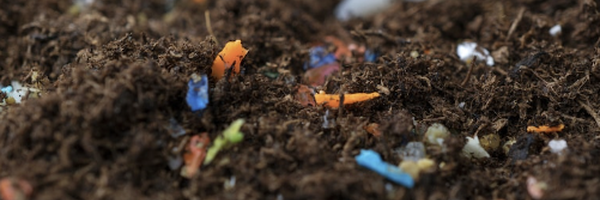
Microplastics in Soil
Owen Chen
Louis Riel School
Grade 7
Presentation
No video provided
Hypothesis
I believe that the plants with the highest concentration of ABS microplastics will grow to be the least healthy because the ABS is black and will block more sunlight and the higher concentration it is, the worse it will be. However, the microplastics could also not be small enough for the plant to absorb properly so there will be no effect at all. I also believe that the plants with lower or no concentration of plastic will grow the most because microplastics affect plant growth in a negative way.
Research
How do microplastics form in the first place? One method of how microplastics came about is if there is small plastic beads in hand sanitizer, toothpaste or beauty products. This is called primary microplastics and can easily make their way around because of their size. They are more common in the ocean but can still be found in soil. However, these beads have already been banned and products no longer contain them. The second way microplastics can form is a larger piece of plastic degrading into smaller pieces. Possible methods of degradation could include natural forces such as wind pushing it around and slowly degrading it that way. It could also be when a piece of plastic is constantly stepped on or disturbed by humans or animals and slowly degrade it. This method is referred to as secondary microplastics. Microplastics could also be released through plastic-coated fertilizers which is especially hazardous because some farms may use it which will result in microplastics in our food.
What effect does microplastic in soil have on plants? Researchers estimate that 4%-14% of the world’s staple crops were lost due to microplastic. In 2022, 700 million people were affected by hunger. The increase in microplastics could put another 400 million people at risk of starvation in the next two decades. There are multiple way that a plant’s growth and nutritional value can be affected by microplastics. The particles can block sunlight and hinder the plant’s ability to create food and nutrients for itself through photosynthesis. It can also damage the soil on which plants rely on and lower the amount of nutrients in the soil. When inside the plant, they can block water and nutrient tunnels to prevent the plant from circulating nutrients. They can also induce unstable chemicals that harm cells and release toxins which will harm the plant even more. When we consume these plants as food, these microplastics could also be injected into our body. Even though it can be flushed out through feces, there is still a significant health risk.
How many types of microplastics are there and which is the most common? There are two classifications of microplastics, the first is primary microplastics and the second is secondary microplastics. Primary microplastics are the small beads found in hand sanitizer or toothpaste. These microplastics can easily make their way around because of their small size. Secondary microplastics are formed from a larger piece of plastic being ground down. Basically every type of plastic can be found in the ocean or in soil as a microplastic. This includes acrylic, polycarbonate, polyethylene and many more. According to the Water Research Foundation, the most common type of microplastic are microfibers. Microfibers are from synthetic textiles and slough that are slowly degraded by a washing machine and make their way into the sewage system.
Variables
Controlled: Amount of water, amount and type of soil, brand of seeds, amount of light, pots.
Manipulated: Amount of microplastics.
Responding: How tall the plant grows, how many leaves it has, what color it is.
Procedure
- Grind the microplastics.
- Get out 7 containers and measure out 680 grams of soil to put into each one.
- Mix in the corresponding amount and type of microplastics: high=15 grams, medium=8 grams, low=2 grams.
- Put the coffee filters into the pots and put 170 grams of soil in each pot.
- There should be 4 pots with no microplastics, 4 with a high concentration of PVC, 4 with medium PVC, 4 with low PVC, 4 with high ABS, 4 with medium ABS and 4 with low ABs.
- Put three seeds into each pot, evenly spaced and 1 cm down, there should be 2 of each pot with radish seeds and 2 of each pot with pea seeds.
- Label the pots.
- Water each plant with 80 ml of water.
- Every other day, water the plants with about 20 ml of water.
- You can start recording their progress whenever you want.
Observations
January 1, 2026
January 5, 2026
January 9, 2026
January 13, 2026
Analysis
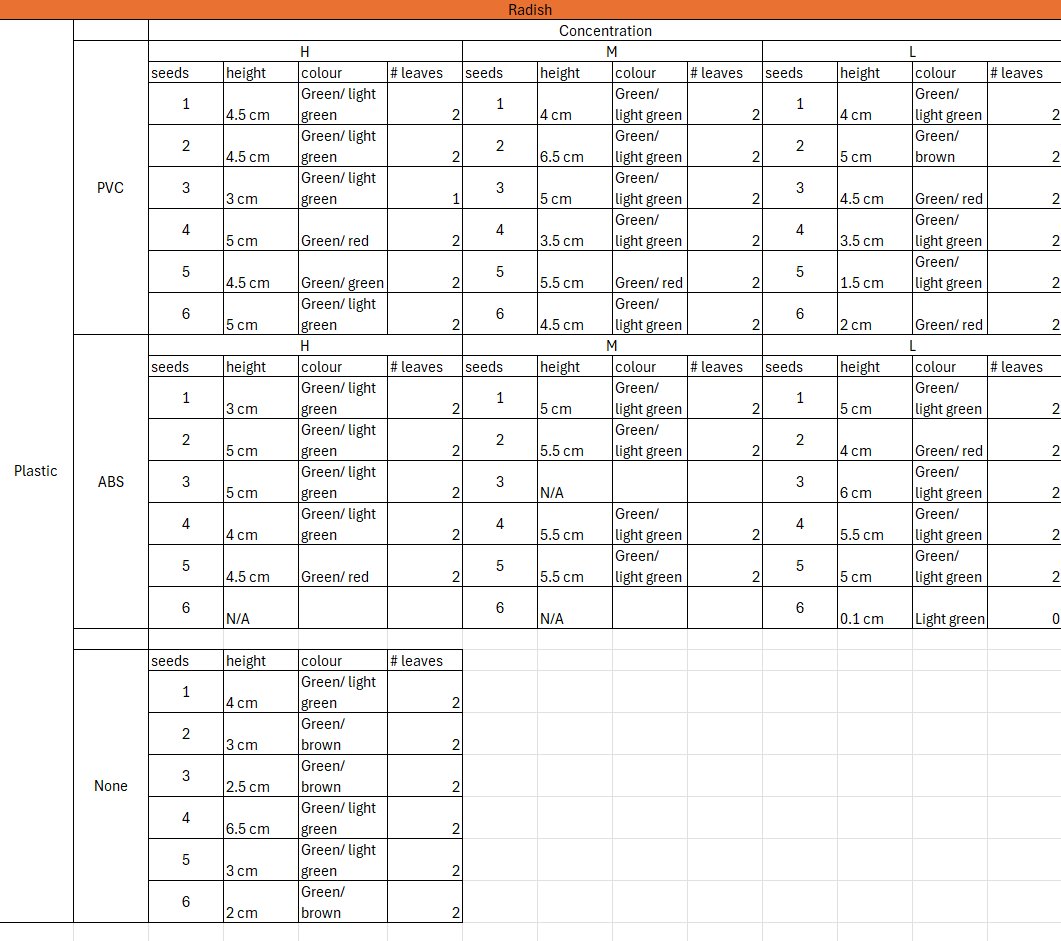
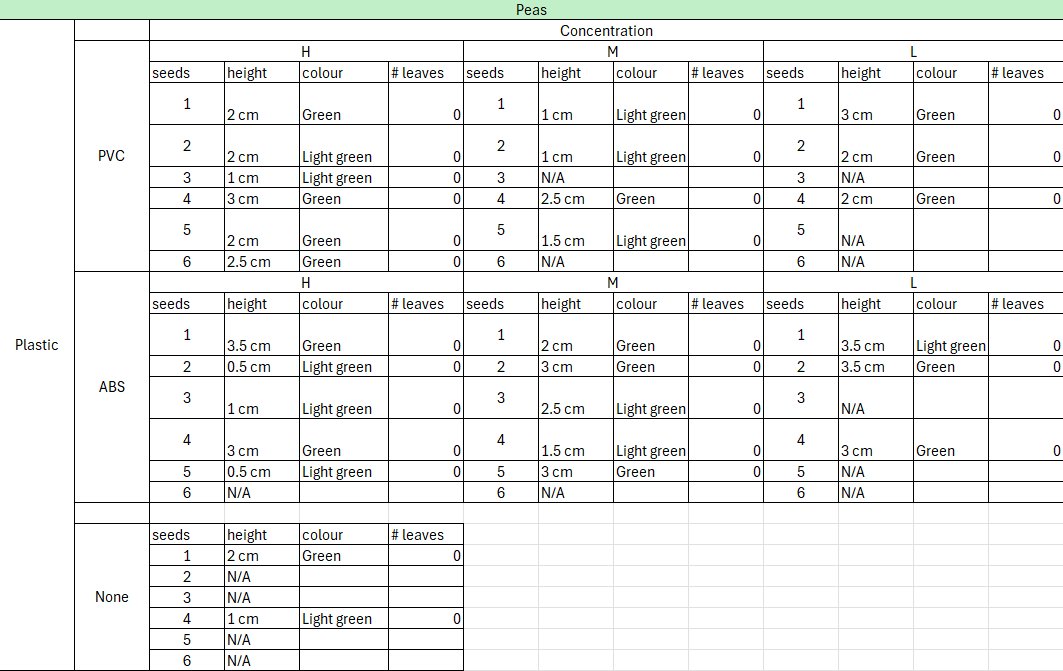
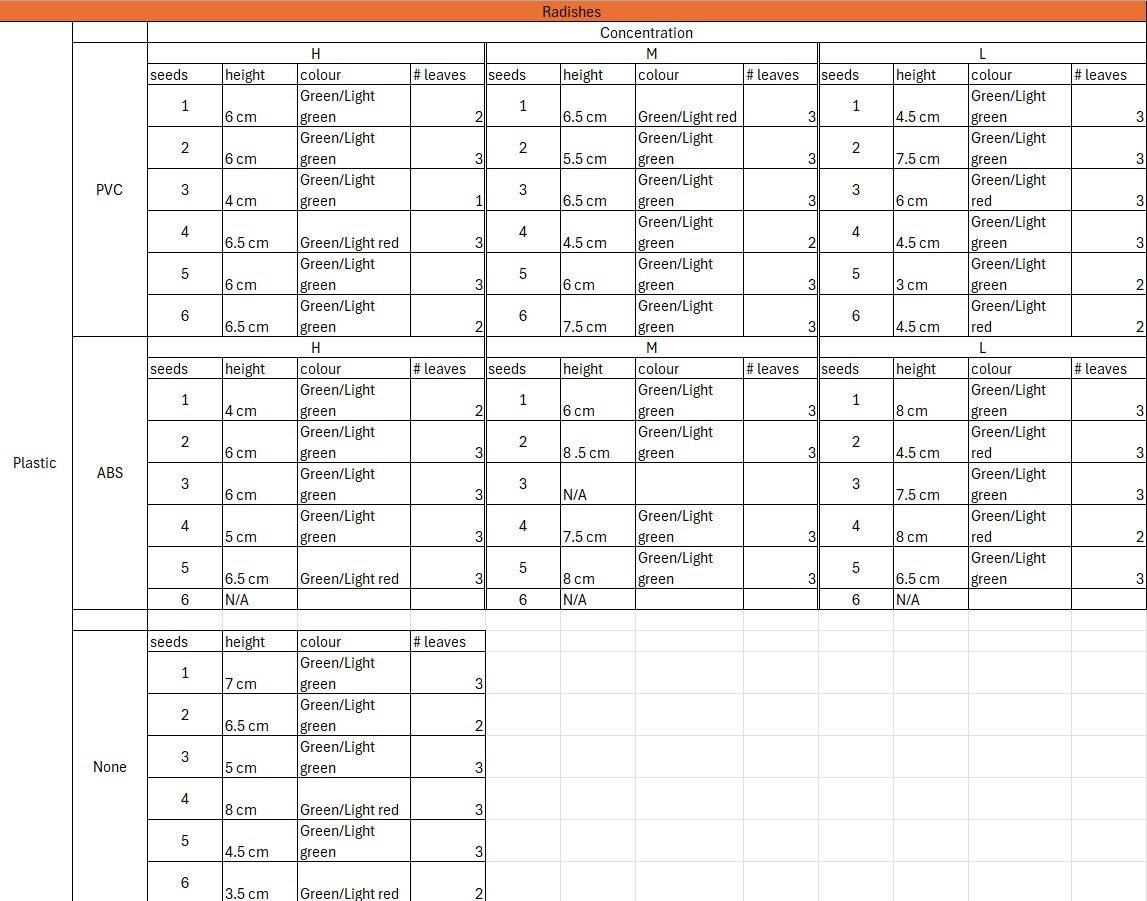
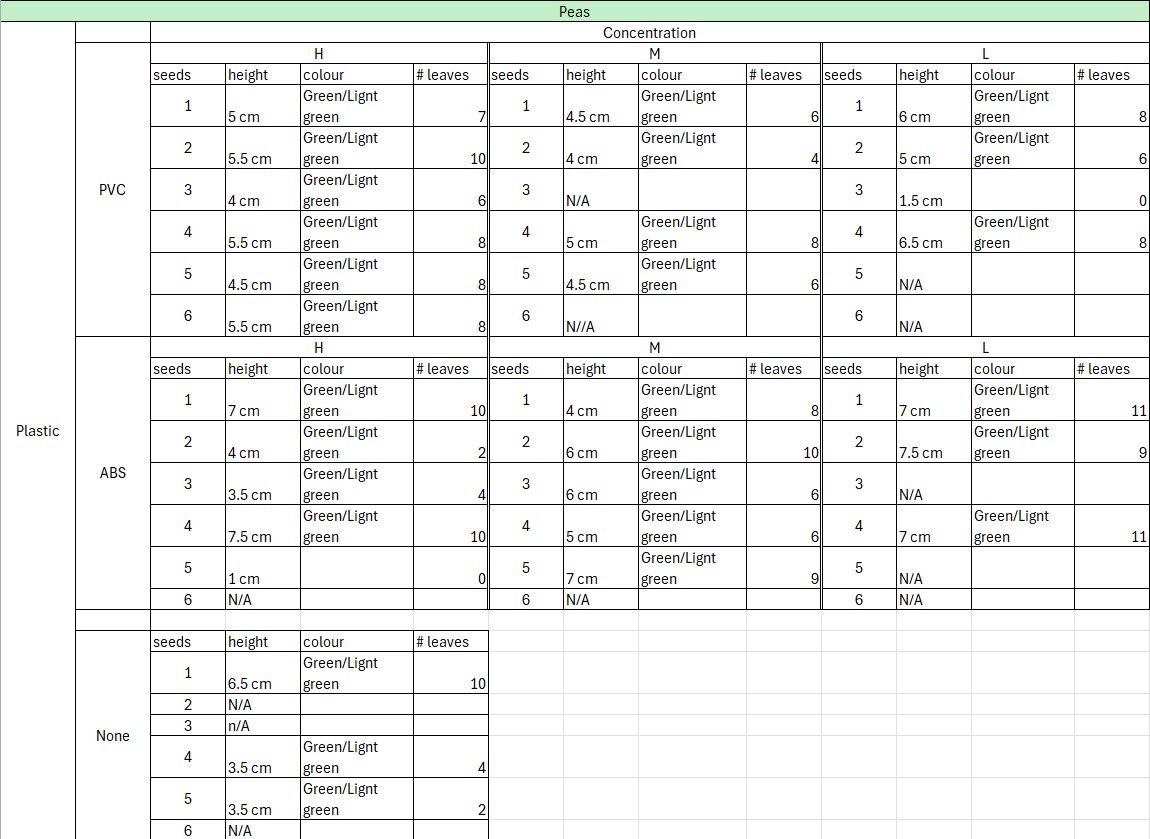
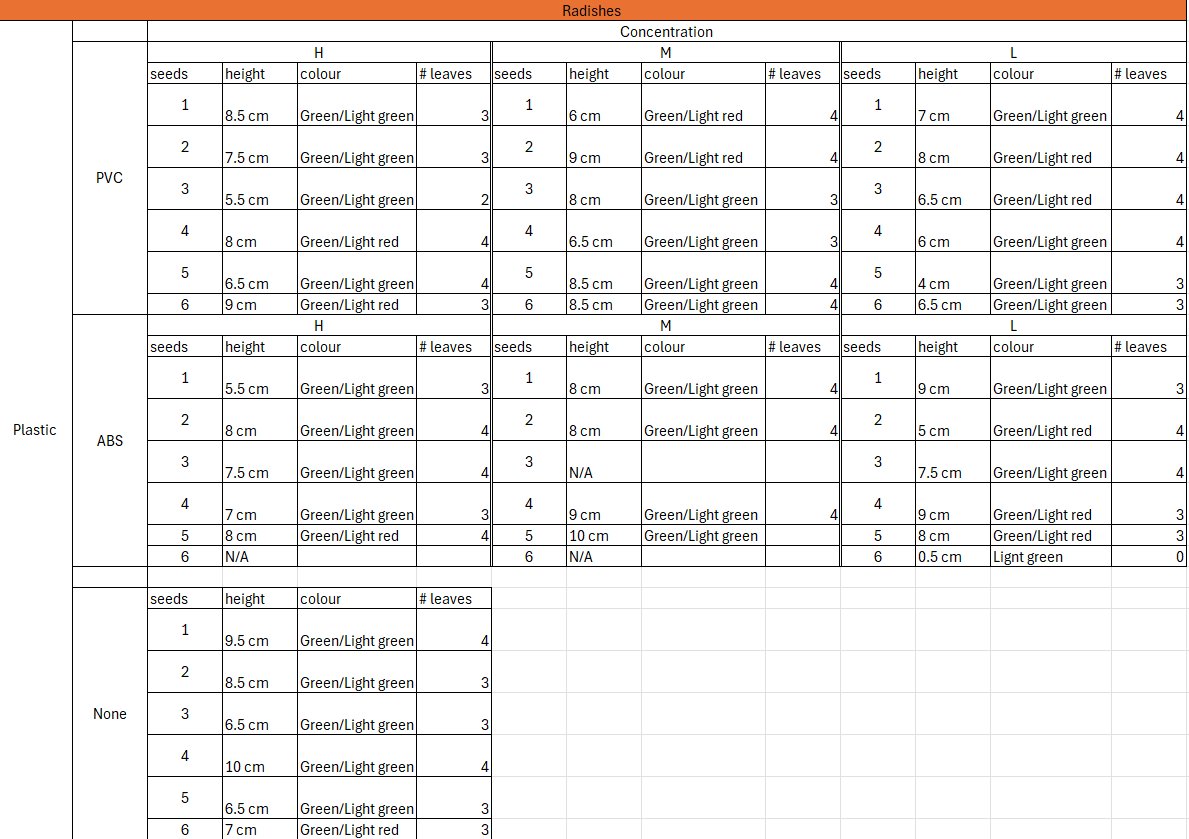
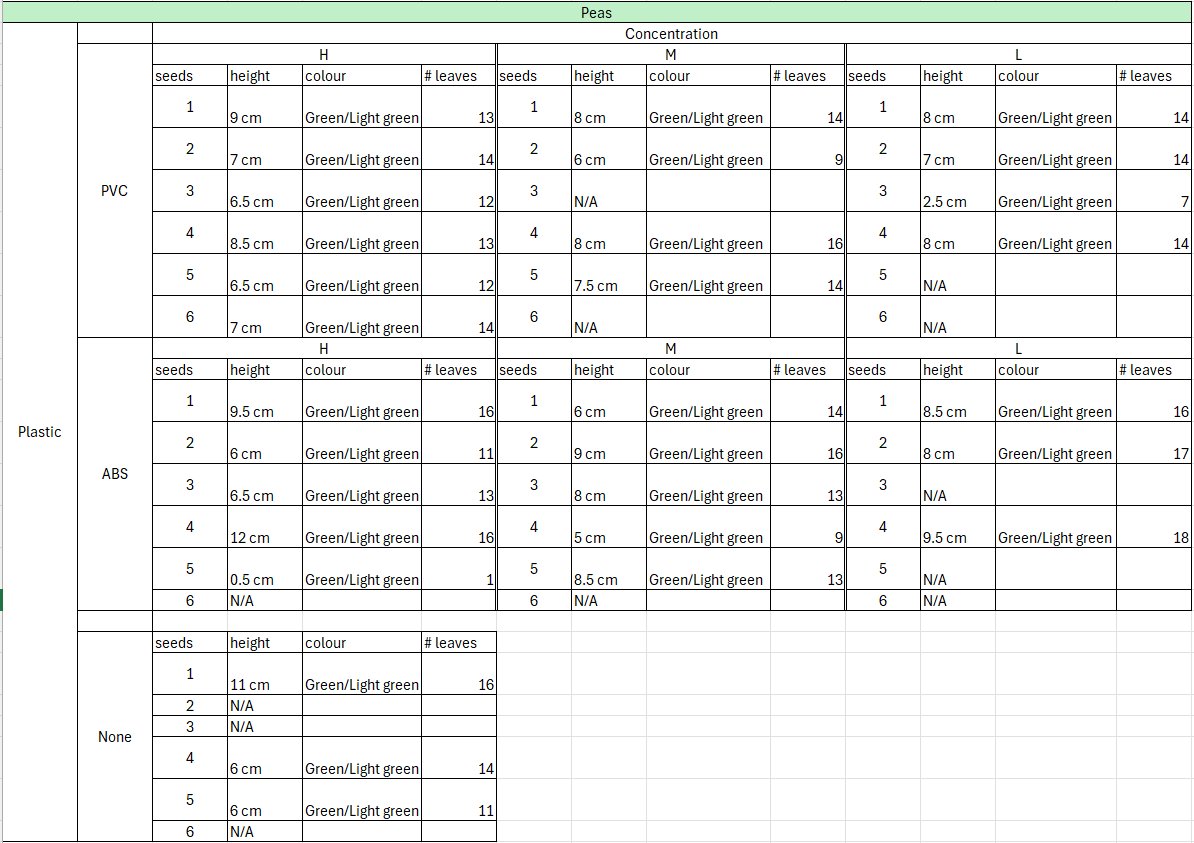
For the radishes, ABS low 6 grew the least over the period of time I recorded information, ended up the shortest and also had the least amount of leaves. It could have been dead because there was almost no growth. The nutrients and water could also have been taken by its neighbours. Overall, Control grew more over the period of time I recorded information for than the plants that had microplastics. For the peas, ABS high 5 did not grow at all over the period of time I recorded information, was the shortest by the end and had no leaves at all. However, the other plant in the pot could have taken most of the nutrients and water. For the radishes, the plants that were the tallest by the end were PVC medium 2 and Control 4. The plants that had the highest amount of leaves were PVC low 1, ABS low 2 and ABS low 3. The plant that grew the most for the period of time I recorded information for was Control 4. PVC medium 2 most likely sprouted earlier than Control 4. However, Control 4 grew faster which could be due to the lack of microplastics. For the peas, the plant that grew the tallest was ABS high 1. The plants that had the highest amount of leaves were PVC medium 4 and ABS low 4. The plants that grew the most during the period of time I recorded were PVC high 1 and Control 1.
Conclusion
For my first hypothesis, I was partially correct for the radishes. ABS low 6 had the worst scores out of all the plants and my hypothesis was that one of the ABS highs would get the worst. The results may have been skewed because the plant could already have been dead. For the peas, I was fully correct, ABS high 5 had the worst scores out of all the peas. For my second hypothesis, I was also partially correct for the radishes. The plants that grew the tallest were PVC medium 2 and Control 4. However Control 4 grew exponentially more than PVC medium 2. For the peas, my hypothesis was mostly wrong. ABS high 1 grew the tallest and PVC high 1 and Control 1 grew the most throughout the period of time I recorded for. However, many of the plants could have taken nutrients from its neighbors or have its water and nutrients taken and may have had nothing to do with the type and amount of microplastics.
Application
This experiments applies to the real world because many crops around the world are dying because of microplastics in soil. It also applies to most people because if the vegetables we are eating are contaminated with microplastics, it would obviously be bad for our health.
Sources Of Error
One of the biggest sources of error was that I was unable to grind my microplastics very small. This impacted the experiment because it would have been harder for the plants to absorb the microplastics. Another error was that for my first experiment I forgot to evenly space the seeds in every pot which could have affected the outcome.
Citations
https://www.theguardian.com/environment/2025/mar/10/microplastics-hinder-plant-photosynthesis-study-finds-threatening-millions-with-starvation https://med.stanford.edu/news/insights/2025/01/microplastics-in-body-polluted-tiny-plastic-fragments.html https://www.dfo-mpo.gc.ca/science/environmental-environnement/microplastics-microplastiques/index-eng.html https://oceanservice.noaa.gov/facts/microplastics.html#:~:text=Microplastics%20can%20come%20from%20a,in%20health%20and%20beauty%20products. https://www.plasticpollutioncoalition.org/blog/2025/12/5/dangerous-ground-what-you-need-to-know-about-microplastics-in-soil#:~:text=Microplastics%20in%20Soil%20Threaten%20Our%20Food&text=Plastic%20farm%20equipment%20and%20plastic,in%20plastics)%20polluting%20agricultural%20regions%20polluting%20agricultural%20regions).
Acknowledgement
I would like to acknowledge Mrs. Turner, Mrs. Fourie and Mrs. Davis who helped complete and improve my science fair. I would also like to thank my parents for assisting me with my experiments and background research. Finally, I want to thank all of my friends who encouraged me and congratulated me every step of the way.