
Rewriting Pain with CRISPR: Modelling Gene Therapy for HOXA10 Dysfunction in Endometriosis
Ayu Shale
Mountain View Academy
Grade 8
Presentation
No video provided
Hypothesis
Testable question:
How does increasing disease severity affect steady-state HOXA10 expression before and after CRISPR correction in a simulated inflammatory feedback model?
Hypothesis:
If disease severity increases, then steady-state HOXA10 expression will decrease because increased inflammation suppresses gene stabilization, even after CRISPR correction.
Research
Pathophysiology of Endometriosis
Endometriosis is a long-term condition that depends on estrogen and causes inflammation. It happens when tissue similar to the lining of the uterus grows outside the uterus. About 1 in 10 women of reproductive age suffer from endometriosis. The disease can cause chronic pelvic pain, fertility problems, and immune system changes. Unlike normal uterine tissue, these abnormal growths show higher local estrogen levels, changes in immune cell activity, and resistance to progesterone, which is crucial for the regulation of the uterine lining. These changes create a persistent inflammatory system. The idea of a feedback-driven system is the basis for the computational model used in this project.
Molecular Role of HOXA10 in Endometrial Function
HOXA10 is a gene that controls uterine development. It makes the uterine lining ready for implantation, helps cells in the lining grow and respond to progesterone, and keeps the immune system in balance. Studies show that HOXA10 levels are much lower in women with endometriosis (Zanatta et al., 2010), especially when implantation normally happens. Low HOXA10 is linked to: poor cell development in the lining, weaker progesterone response, increased inflammation, and lower chances of implantation. HOXA10 also helps control inflammation, so when it is reduced, inflammatory signals persist and allow lesions to survive. In other words, problems with HOXA10 are not just a symptom; they may help keep the disease going.
Inflammatory Feedback Mechanisms
Endometriotic lesions release inflammatory signals that cause new blood vessels to form, activate immune cells, and increase local estrogen production. This inflammation lowers progesterone response and may further reduce HOXA10 levels. This creates a vicious cycle: more inflammation → less HOXA10 → weaker immune control → more inflammation. Chronic feedback loops like this are common in long-term inflammatory diseases and are well-suited to computer-based modelling. My model in this project simulates how inflammation and HOXA10 interact over time.
Rationale for CRISPR-Based Gene Correction
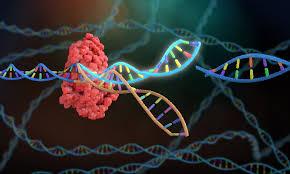
CRISPR-Cas9 acts as molecular scissors that edit DNA by using a custom-designed guide RNA (gRNA) to lead the Cas9 enzyme to a specific genomic location. The enzyme cuts both strands of the DNA, prompting the cell to repair the break, which researchers leverage to disable genes or insert new genetic material. CRISPR-Cas tools allow precise editing or regulation of genes. In theory, restoring HOXA10 in the uterine lining using CRISPR could improve progesterone response, reduce inflammation, and normalize cell development. Direct gene-editing in reproductive tissue is ethically and safely challenging, so computational modelling can help explore potential outcomes before moving to experiments. In this project, the model simulates higher HOXA10 levels to represent CRISPR correction and tests how the system behaves under inflammation.
Why a Computational Systems Approach is Appropriate
Endometriosis involves complex, interconnected processes, including hormonal signalling, immune responses, and gene activity. Simple cause-and-effect models cannot capture this complexity. Dynamic systems modelling allows us to simulate feedback loops, see how the system changes over time, adjust gene levels in a controlled way, and measure whether the system stabilizes. By modelling HOXA10 and inflammation as interacting factors, this project tests whether increasing HOXA10 can shift the system toward a healthier state.
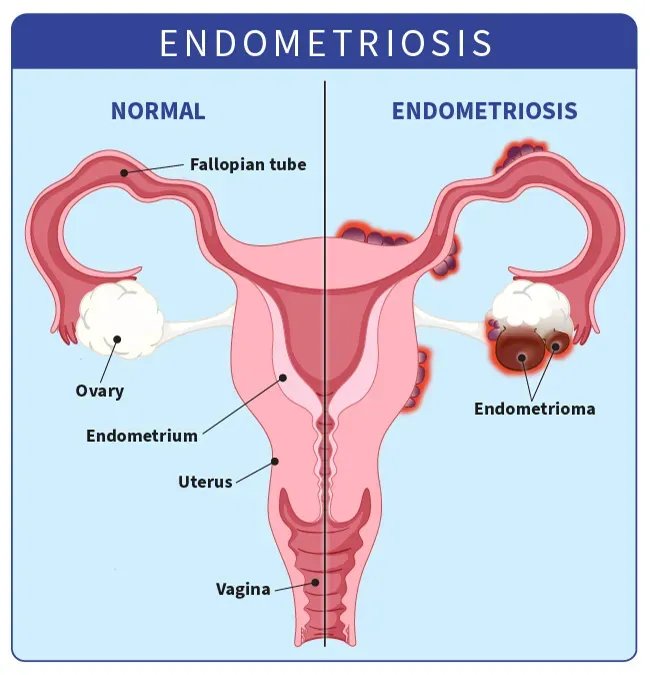 (Visual representation of a healthy uterus vs one with endometriosis)
Variables
Independent Variable: Disease severity (0.10–0.90), representing increasing inflammation levels.
Dependent Variable: Steady-state HOXA10 expression level at step 40.
Secondary Comparison: CRISPR condition (before vs after correction).
Controlled Variables:
- Initial HOXA10 before CRISPR (0.70)
- Initial HOXA10 after CRISPR (0.85)
- Optimal reference level (0.85)
- Number of simulation steps (40)
- Mathematical parameters in the inflammation model
Control Condition: HOXA10 expression before CRISPR at each severity level.
Procedure
1. I created a computational simulation to model HOXA10 gene expression and inflammation feedback in endometriosis. 2. The simulation tracks HOXA10 concentration over 40 time steps under different disease severities and calculates steady-state HOXA10 before and after CIRSPR\, and whether it improved or not. 3. I tested multiple severity levels: 0.10\, 0.30\, 0.50\, 0.70\, and 0.90 to observe how inflammation affects HOXA10 stabilization 4. For each severity\, I recorded:
- HOXA10 before CRISPR (constant at 0.70)
- HOXA10 after CRISPR correction (constant at 0.85)
- Optimal HOXA10 level (constant at 0.85)
5. The simulation produced dynamic graphs of HOXA10 over time\, showing differences between before and after CRISPR under varying severity and HOXA10 before and after CRISPR was analyzed visually from the graph.
Observations
Results
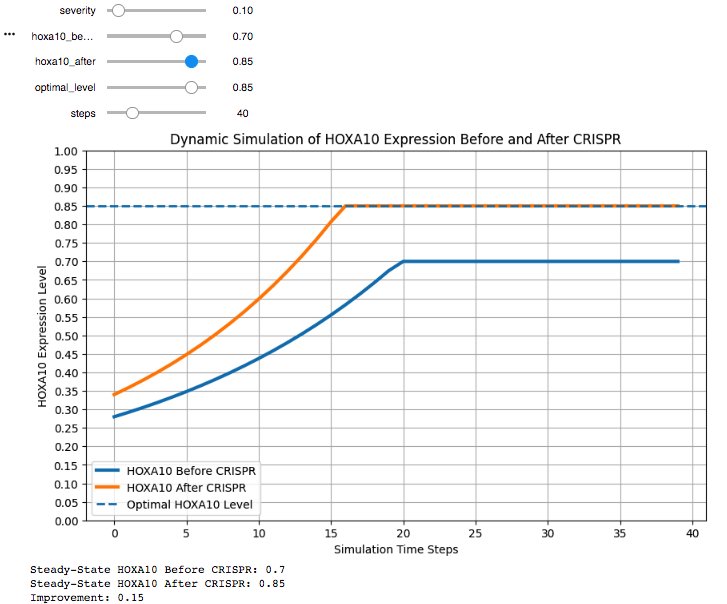
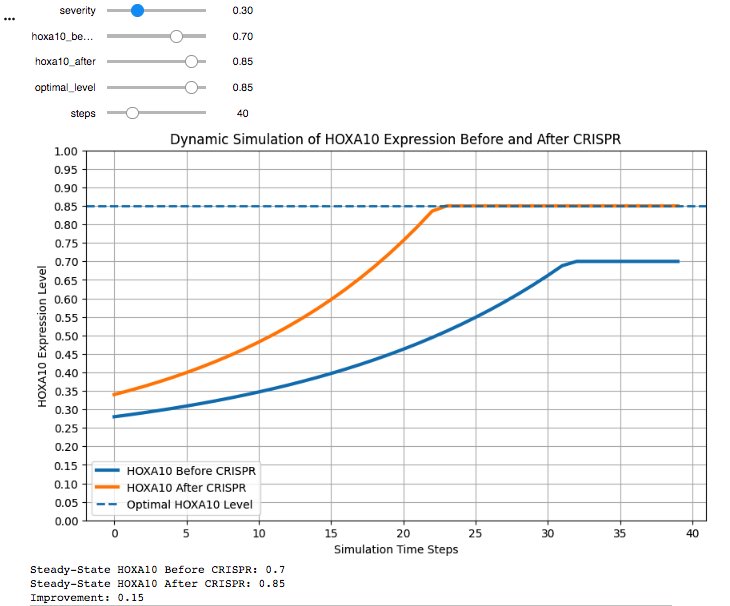
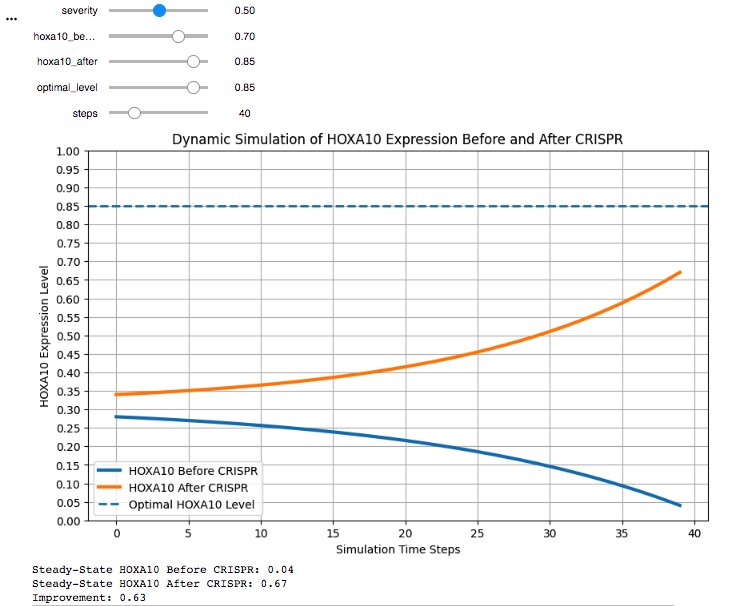
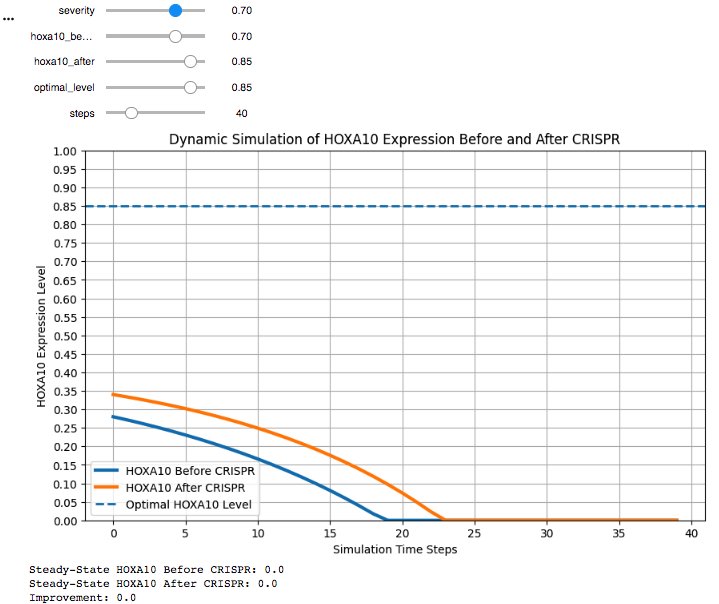
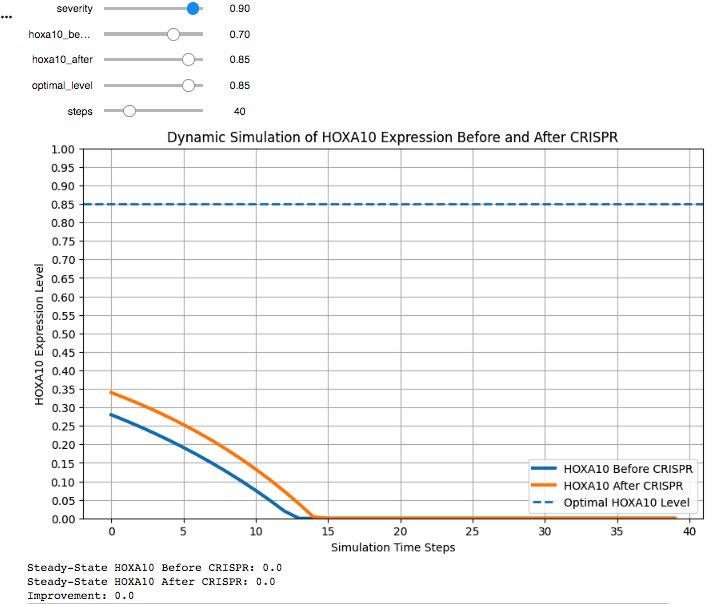
As disease severity increased, steady-state HOXA10 expression decreased due to stronger inflammatory suppression within the feedback model. CRISPR correction improved HOXA10 levels compared to the baseline condition; however, its effectiveness was reduced at higher severity levels. At severity values of 0.7 and above, HOXA10 correction struggled to restore expression to the optimal steady-state level, suggesting that overwhelming inflammatory feedback limits gene stabilization. Overall, the results demonstrate that inflammation is a dominant regulator of HOXA10 dynamics in the simulated system.
Analysis
HOXA10 expression patterns vary with disease severity. At low severity, CRISPR-corrected cells show an increase in expression, approaching optimal reference levels, while baseline (pre-CRISPR) levels remain slightly lower. As severity rises, both baseline and corrected expression gradually decline, reflecting stronger inflammation-suppressing gene activity. Notably, at a severity of 0.5, corrected HOXA10 initially increases while uncorrected levels decrease, diverging from the general trend. By the final time points, both corrected and uncorrected levels reach zero, with corrected cells taking longer to decline. These results indicate that CRISPR correction enhances HOXA10 expression but is progressively less effective under high-severity, highly inflamed conditions. These results suggest that inflammation plays a major regulatory role in determining whether corrected HOXA10 can maintain levels associated with healthy endometrial function. And in the real world, these results suggest that targeted HOXA10 correction could potentially improve endometrial health in patients with mild to moderate endometriosis, but additional interventions may be needed for severe cases. In future studies, the model could be extended by incorporating multiple genes, more detailed inflammatory pathways, or experimental validation, which would improve accuracy and better predict real-world therapeutic outcomes.
Graph Overview
X-axis: Simulation time steps (0 → 40, going up 5) Shows the progression of the simulation over time. Each step represents a “snapshot” of HOXA10 levels at that point. The graph shows how the system evolves dynamically, not just the final value. Y-axis: HOXA10 expression level (0 → 1, going up by 0.05) Indicates the relative concentration of HOXA10. Lower values = less gene expression (more risk of inflammation and abnormal tissue growth). Higher values = more gene expression (closer to optimal, healthier endometrium). Lines on the Graph Blue line: HOXA10 expression before CRISPR Shows how the gene behaves naturally under the given severity. Observe if it rises, stabilizes, or fails to reach the optimal level. Orange line: HOXA10 expression after CRISPR correction Shows the effect of gene therapy. Higher line = more effective correction. Compare it to the blue line to see improvement. Dashed line (Optimal HOXA10): Target level for healthy endometrial function. Serves as a reference to see how close the system is to the ideal state.
Conclusion
This project modelled how CRISPR-based correction of the HOXA10 gene could influence inflammation feedback and predicted abnormal tissue growth in endometriosis. The results showed that increasing HOXA10 expression through simulated correction improved steady-state gene levels and reduced predicted abnormal growth, particularly under low to moderate disease severity. However, at high severity levels, inflammation continued to suppress HOXA10 expression, limiting the effectiveness of correction. These findings suggest that gene therapy targeting HOXA10 may be most beneficial in earlier or less severe stages of endometriosis. Overall, this experiment demonstrates how computational modelling can provide insight into gene–inflammation interactions and potentially guide the development of more targeted and personalized treatments for chronic inflammatory reproductive disorders.
Application
This project shows how targeting one of the main root causes by correcting HOXA10 gene expression could potentially help reduce inflammation and abnormal tissue growth in endometriosis. The model helps predict which levels of disease severity might respond best to gene therapy. It also demonstrates how computer simulations can be used to test treatment ideas before doing real laboratory or clinical studies. In the future, this type of modelling could support the development of more targeted and personalized treatments for patients with endometriosis.
Sources Of Error
Since this project used a computer simulation, the main source of error comes from simplifying complex biology into mathematical equations. Real endometriosis involves many genes, hormones, and immune factors, but this model focused only on HOXA10 and inflammation. The simulation also assumes fixed starting values and consistent gene correction, while real gene expression can vary between cells and over time. In addition, only one trial was run for each severity level, which limits variability testing. Because of these factors, the results represent a theoretical prediction rather than exact real-life outcomes.
Citations
Zanatta, A., Rocha, A. M., Carvalho, F. M., Pereira, R. M., Taylor, H. S., Motta, E. L., Baracat, E. C., & Serafini, P. C. (2010). The role of the Hoxa10/HOXA10 gene in the etiology of endometriosis and its related infertility: a review. Journal of assisted reproduction and genetics, 27(12), 701–710. https://doi.org/10.1007/s10815-010-9471-y Altomara, D. (2016, November 14). Endometriosis. WebMD; WebMD. https://www.webmd.com/women/endometriosis/endometriosis-causes-symptoms-treatment
Endometriosis explained: A guide to managing pain and fertility Videos - Mayo Clinic. (2025). Mayoclinic.org. https://www.mayoclinic.org/medical-professionals/obstetrics-gynecology/videos/endometriosis-explained-a-guide-to-managing-pain-and-fertility/vid-20583468
Mishra, A., & Modi, D. (2024). Role of HOXA10 in pathologies of the endometrium. Reviews in Endocrine and Metabolic Disorders. https://doi.org/10.1007/s11154-024-09923-8
Maxmen, A. (2015, July 22). Easy DNA Editing Will Remake the World. Buckle Up. WIRED; WIRED. https://www.wired.com/2015/07/crispr-dna-editing-2/
Lazim, N., Elias, M. H., Sutaji, Z., Abdul Karim, A. K., Abu, M. A., Ugusman, A., Syafruddin, S. E., Mokhtar, M. H., & Ahmad, M. F. (2023). Expression of HOXA10 gene in women with endometriosis: A systematic review. International Journal of Molecular Sciences, 24(16), Article 12869. https://doi.org/10.3390/ijms241612869
Kim, J. J., Taylor, H. S., Lu, Z., Ladhani, O., Hastings, J. M., Jackson, K. S., Wu, Y., Guo, S. W., & Fazleabas, A. T. (2007). Altered expression of HOXA10 in endometriosis: Potential role in decidualization. Molecular Human Reproduction, 13(5), 323–332. https://doi.org/10.1093/molehr/gam005
Mishra, A., & Modi, D. (2025). Role of HOXA10 in pathologies of the endometrium. Reviews in Endocrine and Metabolic Disorders, 26(1), 81–96. https://doi.org/10.1007/s11154-024-09923-8
Marsala, L. et al. (2011). MicroRNA 135 regulates HOXA10 expression in endometriosis. The Journal of Clinical Endocrinology & Metabolism, 96(12), E1925–E1933. https://doi.org/10.1210/jc.2011-1231
Elias, M. H. et al. (2023). HOXA10 DNA methylation level in the endometrium of women with endometriosis: A systematic review. Biology, 12(3), 474. https://doi.org/10.3390/biology12030474
Some research, coding guidance, and project planning were provided with the assistance of ChatGPT
Acknowledgement
I would like to show great appreciation for my teachers for all the guidance and encouragement they provided me, specifically Miss. Hosemann, who was always available and quick to help and gave wonderful feedback, if it hadn't been for her great mentorship and encouragement, I wouldn't have been able to go through with this project. I would also like to thank my school and family for their ongoing support, and the scientists and research studies whose work helped me understand HOXA10, endometriosis, and gene therapy for this project. Thank you.