

Mapping Memory
Harpaavan Sahota
STEM Innovation Academy Jr. High SW
Grade 9
Presentation
Problem
Problem
Around the world, over 55 million individuals suffer from dementia, with 60-70% of that population experiencing Alzheimer's. Around a quarter of the population on the planet experience memory problems such as brain fog and other types of forgetfulness. Memory is vital for our learning and adaptations. It is what allows us to learn from our mistakes and adapt and grow as people. Memory is a significant part of learning and applying that knowledge to real world scenarios. When out memory starts to falter, it can give us problems in executing tasks in day to day life. It makes things which are otherwise very easy to do extremely hard, causing many to feel continuous frustration and fatigue over simple tasks. Sometimes, these problems fly by under the radar, and by the time someone starts to take action against it, the situation is already worse, potentially leading to fatal memory problems. Most of the time, people cannot identify and get these problems and get them diagnosed because of the current healthcare crisis and issues with EEG procedures in the lab. These reasons are listed below:
- The cost for lab EEGs can exceed $5,000 per day for certain tests, which is one reason people might feel that a few forgetful instances is not worth getting checked, as the majority of people do not have access to this kind of money.
- The wait times for EEG tests are extremely long, as many many hospitals do not have access to many EEG systems. Even after the test is done, it can take weeks for the participant to receive their results, which can lead to any underlying conditions worsening over that periods of time.
- During the test, many participants with thick, curly, or braided hair might be asked to cut or remove their hair, which is a main reason why many people might not want to participate in a EEG test, as some people naturally have hair that might not be able to work with an EEG.
- Hospitals and academic institutions which have EEGs might be far away or inaccessible for many people, especially those living in poor or rural areas. The process for applying and receiving EEG tests is long and complicated, taking a long time for application and selection. This might discourage many to not take these tests because of the inaccessibility.
- The test itself could take many hours and can be tedious and uncomfortable for many, and the stress of a lab environment might affect the results from the test, potentially leading to false results and misdiagnosis and treatment, which can worsen the problem, or cause healthy individuals to receive incorrect and possibly dangerous treatment.
My project aims to fix these problems and provide a cheap, fast, and low pressure test which can give participants accurate results and highlight their strengths and weaknesses in memory. It will make memory testing much more accessible and efficient to people who have low income and live in rural or poor areas.
It will also be able to provides strengths which individuals can utilize to further expand their memory and use techniques which will help them succeed academically and beyond in life.
Memory Areas
To understand how memory is formed and stored, and how it can be altered, the areas in which memory are involved in are extremely significant in identifying how a person's brain functions, especially for EEG electrode placement, and can provide vital information for memory function. 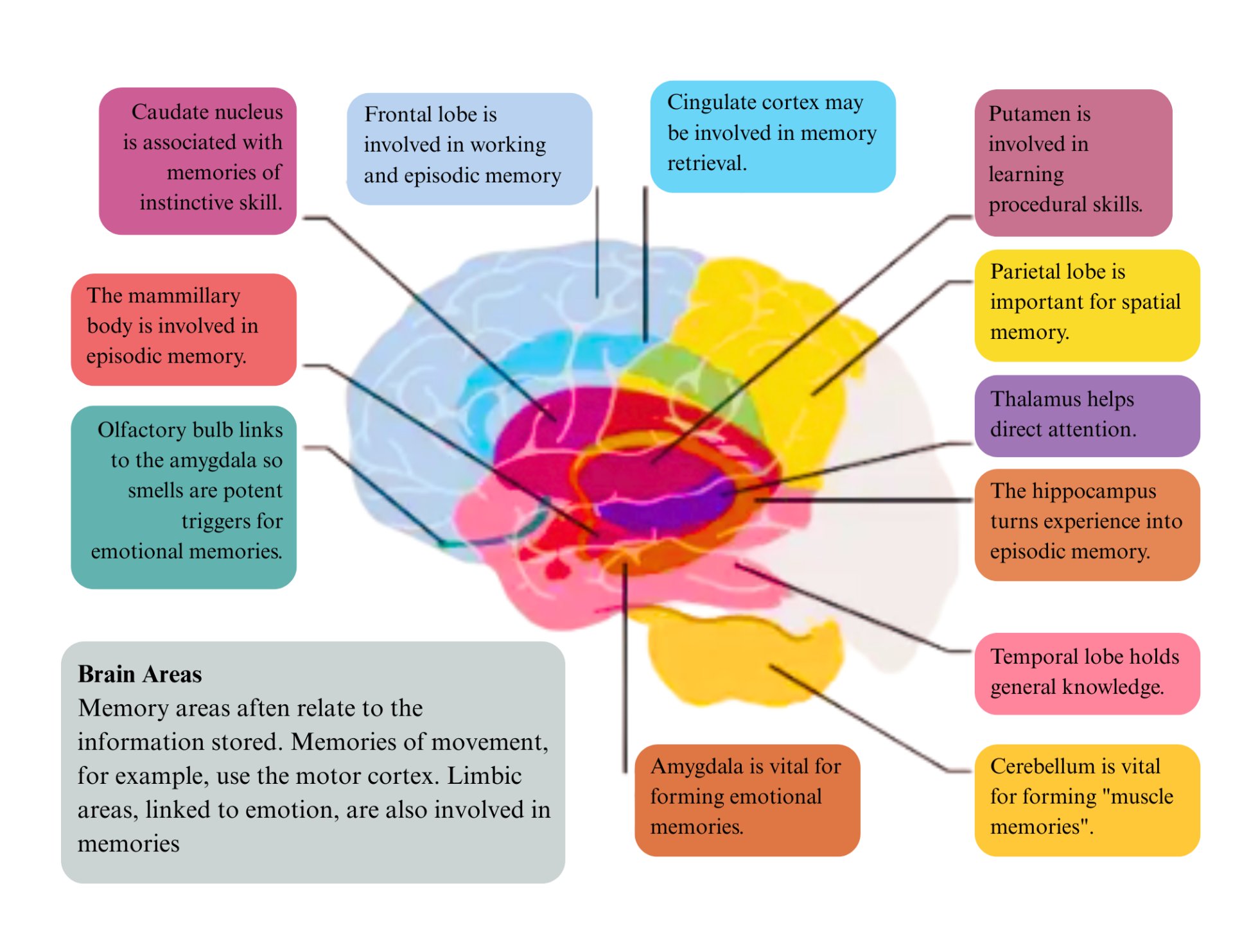 This shows some of the most significant areas of the brain involved in memory formation and processing and can be referred back to throughout the project to help with orientation of the areas.
Memory Systems
Memory is not a discrete function, but rather the basis for human adaptation and learning. There is not only one type of memory, but encompassing many different parts of the brain, each used for a different part, and each being more or less developed than another. This can highlight a person's strengths and signify how they might learn or remember better, and help identify memory disorders.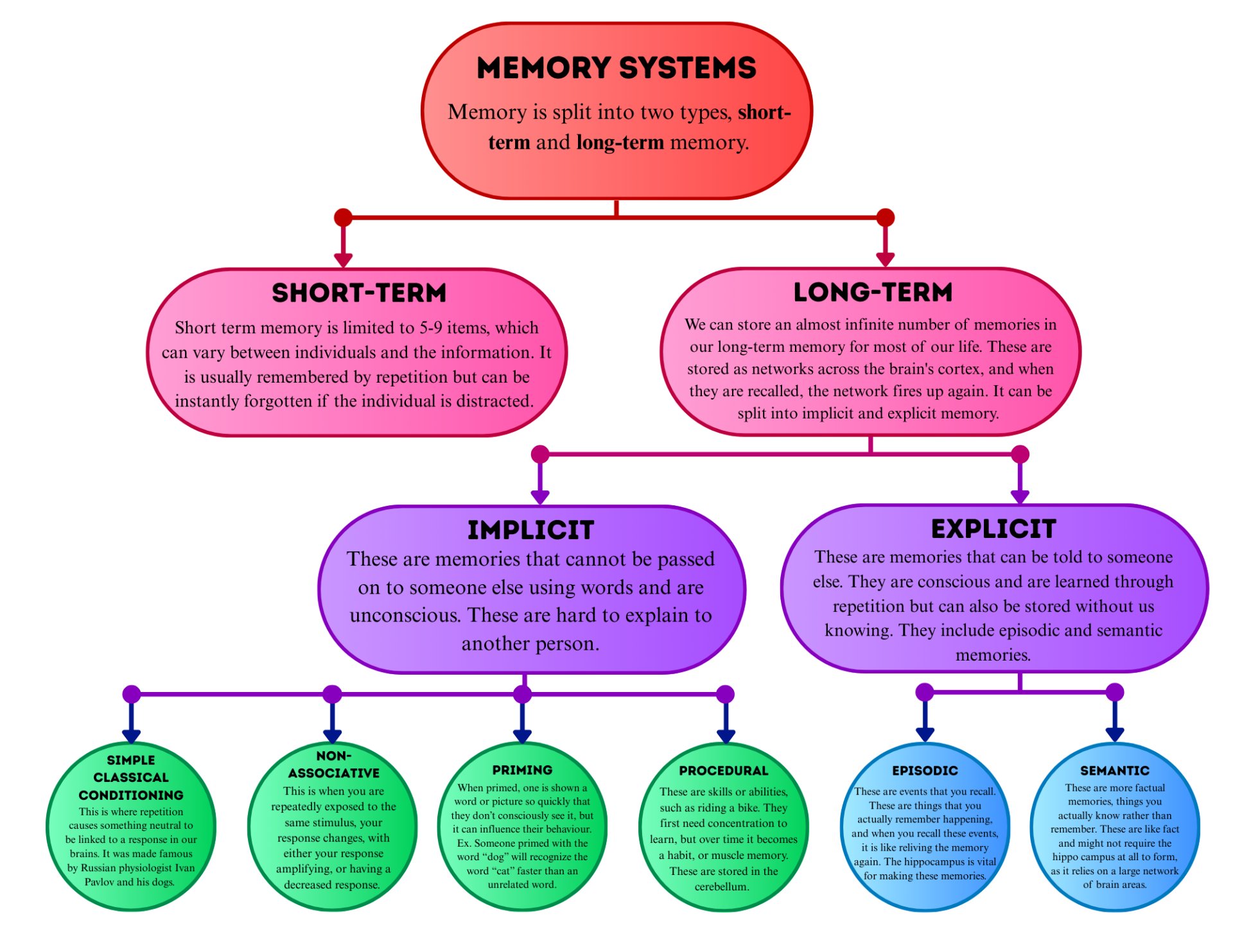 This shows some of the main areas of memory and their relation to long term and short term memory.
Memory Formation
When a group of neurons is repeatedly activated, such as when we practice a skill or revise facts, they begin to change. This is how long term memories are formed and consolidated in a process called long-term potentiation. At first there is a weak connection between the neurons for the specific skill of information. During learning, the presynaptic neuron releases a lot of neurotransmitters, and makes the postsynaptic neuron more sensitive to the neurotransmitter, causing more receptors to edge to the synapse. This makes the action potential strong, and makes the transmission at the synapse faster, which makes the task that we are learning easier. Over time, as we practice, more dendrites can form in the connection, making the connection faster and making the task more easier for us. The hippocampus in one of the main areas where almost all memory is formed. Being part of the limbic system, this makes emotional memories more easier to remember and help consolidate them more effectively. The neurotransmitters adrenaline and noradrenaline make the formation of emotional memories and surrounding connections much faster and efficient than ones that are not associated with memory. 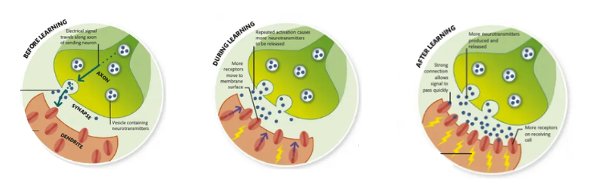
Memory Consolidation
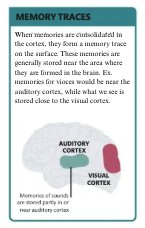
To transfer memories into long term storage, the hippocampus must repeatedly activate a network of connections in the neocortex. The more times that the neural pathway is activated, the stronger it becomes, until eventually it is strong enough to be stored solely in the cortex and forms a memory trace. A memory trace is the specific connections for a memory that is formed in the neocortex. This memory trace can form in the cortices in which the memory is involved in. This process is called consolidation, and it takes place while someone is sleeping, as the brain is not processing any information during that time. The pathways strengthen and the information that was taken is connected to previous memories to help consolidate it more effectively. 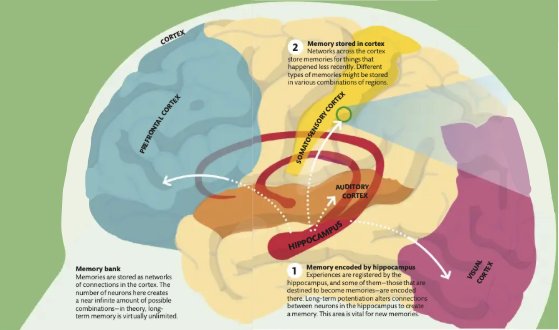
Memory Retrieval
When you recall a memory, the neural pathways fire up again. When this happens, the memory enters a labile state in which it can be easily altered. The introduction of new information can change how the memory is stored in the brain, sometimes leading to mistakes in the information and the creation of false memories, which is when someone remembers something which did not happen. Language use is a big factor which can affect how someone's memory is stored, which is why witnesses for crimes must be questioned carefully to avoid planting false memories. 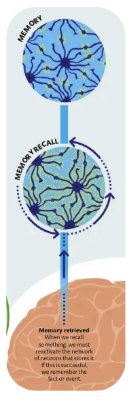
Memory Decline & Loss
A lot of things can lead to memory loss. The first theory was that the less we activate the neural pathways, the more it fades out until we lose that memory. However, new research has now shown that in some cases the memory is still stored in the cortex, but we are just unable to access it, which is why people sometimes feel that tip-of-the-tongue feeling when trying to remember something. Another reason we may forget simple things might be because we never really remembered it in the first place. An example of thi scould be when you lose your keys. You don't forget where you put them because it never registered in your head. You don't pay attention to where you put them, so you can't remember it. Regarding false memories, sometimes new memories interfere with old memories, leading to confusion between memories and forgetfulness of some. Amnesia is when the hippocampus or surrounding areas are damaged leading to memory loss. This can be of the past, or can lead to the inability to make new memories, or both. Amnesia can occur in a wide range of circumstances and can be caused by many different actions and substances. 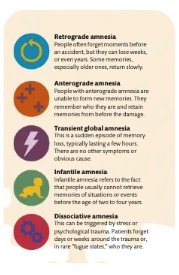
Memory Problems
Aging & Memory As we age, it is normal to experience memory lapses and encounter more difficulty learning new things. Focusing attention and ignoring distractions becomes harder.
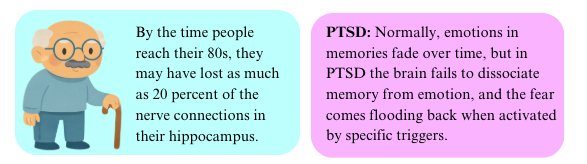 Stress, Anxiety, & Depression: moderate, short-term can make it easier to form memories, but it makes it harder to recall things we have already learned. This could be because the cortisol level rises, affecting our recall ability. Long-term anxiety can also damage the hippocampus and other memory structures of the brain, causing memory problems. Depression can impact the short-term memory and cause difficulty in remembering things we have experienced before. Negative experiences are better remembered in depression.
Overall, my project does a deep research on memory formation, consolidation, decline, and loss. It applies these concepts to solve the problem of people not receiving proper treatment for small memory issues which can progress into something that is much more worse. It aims to identify the growth of memory disorders early while making EEG technology more accessible and efficient. It also provides people with their strengths and weaknesses in memory, giving them self-awareness towards how they learn and remember better, allowing them to succeed academically and beyond in life.
Method
Brainwaves
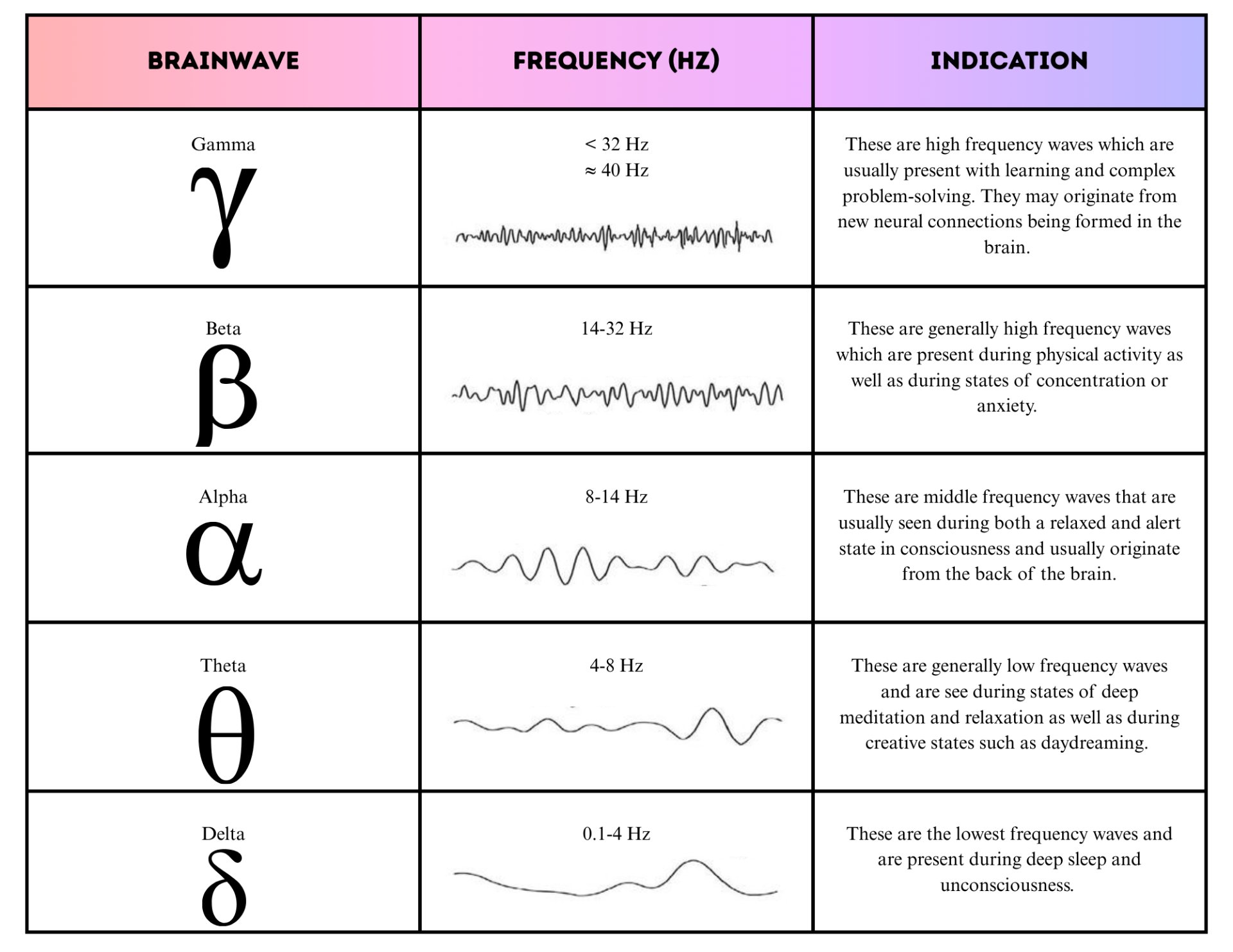
To be able to determine where a persons cognitive strengths lie, each brain wave and its indication in relation to the brain must be understood.
Memory Games
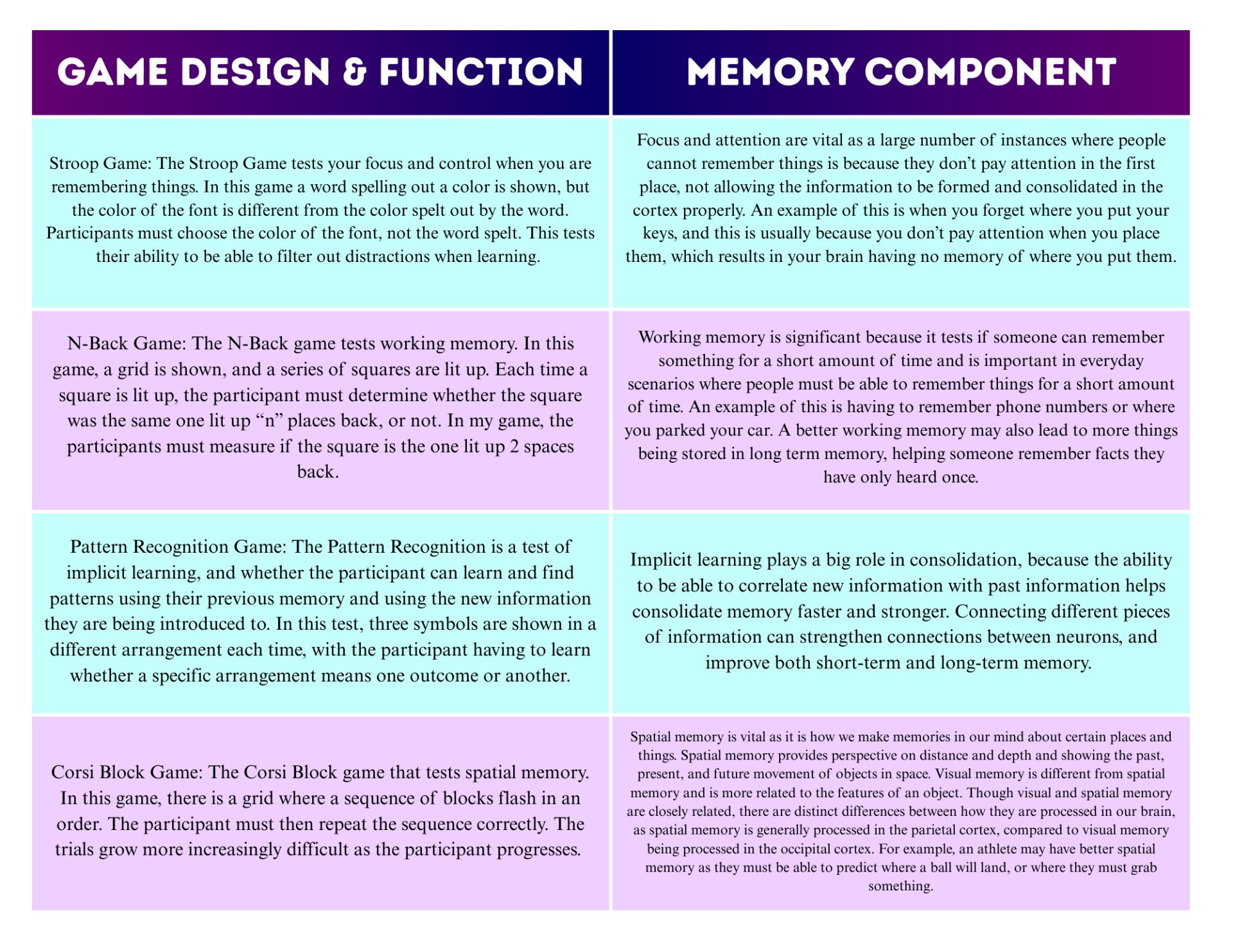
Each of the games made are based off of tests used in lab settings for professional memory assessments and other cognitive assessments, making them valid for the game that I have made and providing accurate data for the assessment. I made them as 2D games in Unity game engine.
- The Stroop Game that I have designed is based off of the Stroop Test. The difference in my game is that instead of verbally speaking out their response, the participant instead has to choose a button. Otherwise, the number of trials and the options are the exact same.
- The N-Back Game that I designed is based off the N-Back Test. In the N-Back test, participants are usually given a list of letters or numbers, and they must identify the if the current symbol in the list is the one shown n steps back. In my game, I instead use a grid, and the squares flash on the grid. I also make n = 2, so the participant must recall the square shown 2 steps back, and this stays constant throughout the test, with the difficulty staying the same.
- The Pattern Recognition Game is based of off research using symbols that are displayed in a specific pattern. My game uses this by showing 3 symbols shown in different patterns, and forces the participant to use trial and error to learn and use their past information to come to a conclusion of STORM or CLEAR.
- The Corsi Block Game that I designed is based off of the Corsi Block Test. In the Corsi Block Test, there are squares scattered around the area and are flashed in a sequence which the participant repeat again. In my game, the squares are instead arranged in a grid and the difficulty increases after each trial.
- These foundational tests make my project a gameified version of these lab grade tests, which encourages the mind to think while relieving the stress of a clincal setting from the participant, potentially making the results more accurate to the participants natural state of mind.
Materials
Muse 2
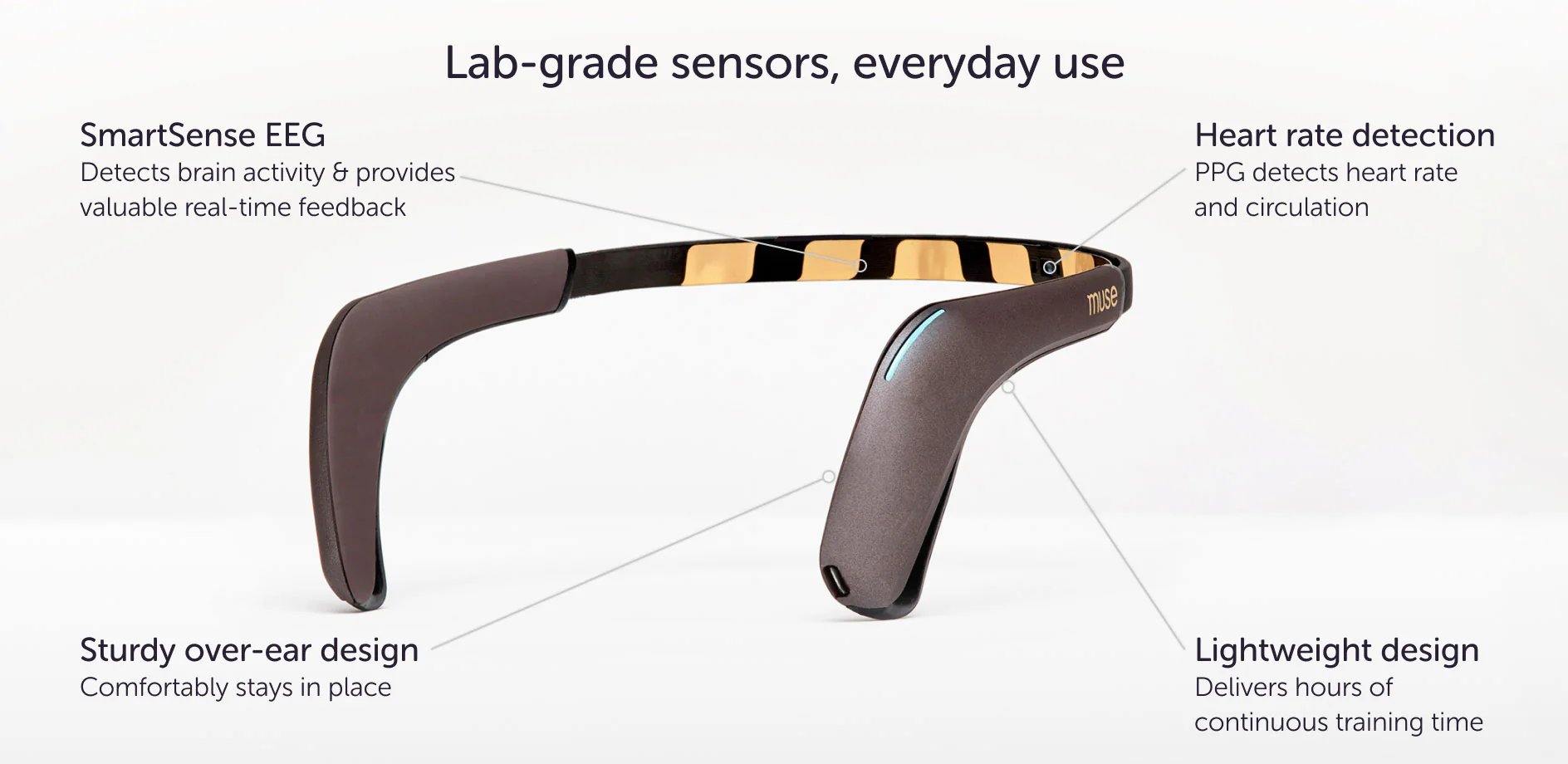
To measure EEG data, I am using the Muse 2 headset. This headset is equipped with an advanced EEG system, and other metrics, which makes it revolutionary for consumer use. It provides cheap, accurate consumer EEG data without the need for going through a lab procedure.
How Does Muse 2 Work?
- The headset is equipped with a 56 Hz 4-channel EEG system.
- The Muse 2 headset also has a photoplethysmography (PPG) heart sensor.
- It also has a gyroscope and accelerometer to sense posture and breathing.
With all these sensors working together in harmony, the Muse 2 is able to accurately measure the state of mind and initiate an effective neurofeedback cycle to ensure that a person can train their brain to reduce anxiety and improve sleep and overall quality of life.
56 Hz 4-Channel EEG System
The Muse 2 is equipped with two EEG sensors on the forehead at positions AF7 and AF8, as well as two behind the ears at positions TP9 and TP10. AF represents anterior frontal which in the area above the brows while TP represents temporal parietal which is the area behind your ears. This scalp localization system is called the 10-10 system. The sensors on the forehead have a conductive gold-plated layer to improve sensor quality rather than conductive gel or glue as used in lab EEGs. However, this limited span of electrodes cannot provide comprehensive values on all waves. For this reason, its main purpose is for relaxation and meditation, and mainly senses beta, alpha, and theta waves. Together, all the sensors have a sampling rate of 256 Hz, which means that they sense the voltage 256 per second, making it an advanced technology for consumer use.
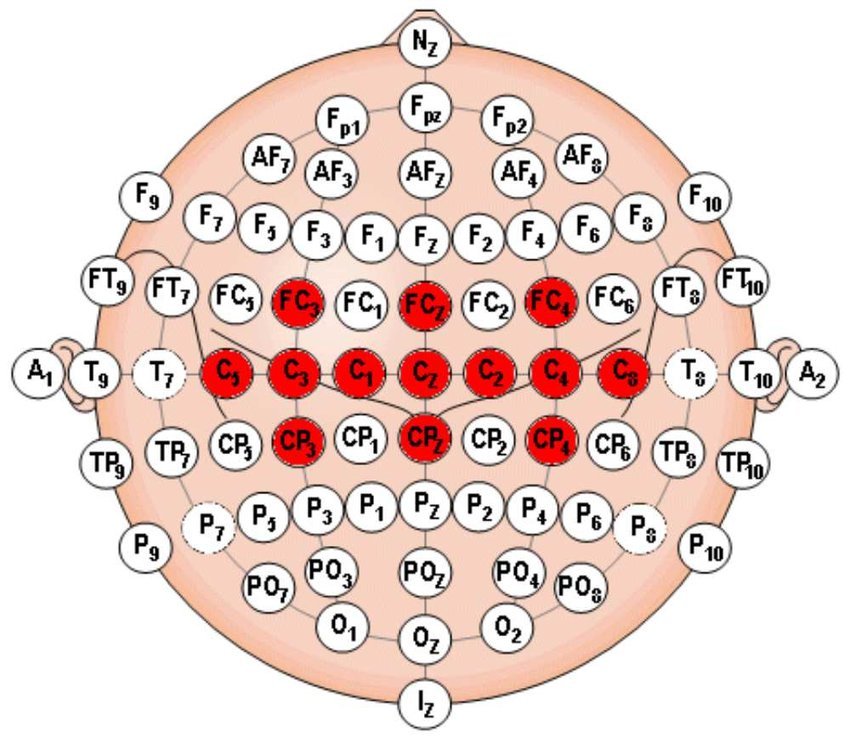 These are the positions of the electrodes using the 10-10 scalp localization system. You can see the AF7 and AF8 positions on the forehead and the TP9 and TP10 positions near the ears and the temple.
Photoplethysmography (PPG) Heart Sensor
A PPG heart sensor is a sensor which uses light and a photosensor to detect heart rate, heart rate variability, and oxidation levels in the blood. It does this usually using a green light, along with an infrared light. The light shines up to the microvascular level, and the photosensor measures how much light is absorbed and how much is reflected back. When blood flows through, the absorption increases, allowing the sensor to detect the heart rate in real-time depending on the amount of light which reflects back. It also uses an infrared light to detect the oxygen levels in the blood. The PPG heart sensor is an effective non-invasive way to accurately measure metrics concerning the heart, and is used in most wearable technology such as watches, rings, etc., proving that it is best for the Muse 2.
Gyroscope & Accelerometer
The Muse 2 also features a gyroscope and accelerometer sensor in it. The gyroscope allows to Muse 2 to sense where the headset is in space and accordingly judge the posture of the person wearing the headset, allowing it to detect whether the person is sitting, standing, or laying down, and adjust the environment based on that information. An accelerometer works by detecting slight motion and vibration from breathing. It detects electrical signals, using a bandpass filter, which usually has a low Hz, to filter non-respiratory signals out from the sensor. It allows the headset to detect breathing rate as a support to the heart rate sensor to ensure accuracy in the measurements from the sensor.
Software
To build the EEG pipeline I used a various number of programs to help stream and record EEG data to my laptop. As the Muse 2 is initially designed to stream to a phone, the use of third party apps are required to stream, record, and analyze the brainwaves collected from the headset.
Brainflow
Brainflow is able to connect to the Muse 2 using a Bluetooth Low Energy system (BLE) which bypasses the bluetooth of my laptop. While I am playing the game, I must keep track of the beginning and the end timestamps in correlation to the EEG recording. After I have obtained a raw CSV file for each game, I move onto analyzing it in MATLAB, using an internal program called EEGLAB.
MATLAB & EEGLAB
MATLAB allows me to analyze the raw CSV data efficiently and accurately. I use an internal program in MATLAB call EEGLAB which is designed specifically to filter and process EEG data from the Muse 2. I upload my files into EEGLAB, and insert the timestamps so my results are accurate. After, I begin to filter out the data, to remove any signals from muscle movement. I first filter it to only 1-40 Hz, because any extra signals would no longer be brainwaves. I then re-reference the data using all the electrodes to achieve an equal balance between the data. The last step is to identify what signals are from the eyes and remove those from the data using ICA component data grouping. After this is done, the data is properly filtered and processed.
Analysis Program
After, I calculate the band power of each brainwave using a script, which is the amount of activity of that brainwave in the EEG, and then input it into a program that orgainzes and compares them neatly to provide a final report. This report takes in all the bandpower for gamma, beta, alpha, and theta waves from each EEG channel on the headset. I provides a report on how efficiently the brain worked for each memory game, and givse a number which gives an index of how efficient your brain worked, showing stronger neural connections for that area, signalling the participants strengths and also their weaknesses. The higher the number, the more efficient the brain is in that area. 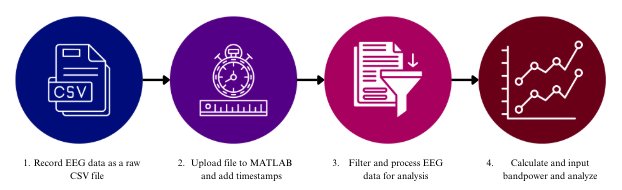 This shows the pipeline in a simplified flowchart.
Analysis
Analysis
- Overall, the project is able to analyze and provide the participant with a report of where their memory is stronger. The analysis provides information on where the participant performed more efficiently and effectively according to the power of their brainwaves. It does not just measure where the most brainpower was used, but rather where it was used the most efficiently, showing faster neural connections and therefore stronger memory in that area. It provides information on where the person’s strength was and where they need some improvement.
- The games used in the test are lab grade tests and are used as the baseline test in professional fields for the types of memory that I was testing for. The Muse 2 was able to provide accurate brainwave data for the project.
- Brainflow was able to create a raw CSV file of this data and let me access it on my laptop easily. MATLAB and EEGLAB were able to filter and process the data effectively, while the final program was able to analye it and compare and neatly organize it in a detailed report.
- Overall, the project had a lot of parts put together in a cohesive manner to get to the final outcome. It created a program which is able to analyze brainwave data while memory testing and help provide information on memory, and potentially help detect memory disorders early in the brain. It simplifies a lab process to a laptop program while retaining accuracy.
Limitations
- This project had some limitations to it.
- The first limitation is that the Muse 2 headset does not possess the same capability as a proper EEG cap, or EEGs used in labs. Though it has very reliable data, the limitation of the area of the electrodes makes some of the brainwaves not entirely accurate, especially for higher waves such as gamma waves as the headset is intially designed for relaxation.
- Also, though there is filteration, some signals from eyes and muscle movements can affect the data, as well as oil and hair between the electrodes can weaken the connection.
- The manual timestamps also pose limitations as only the beginning and ending timestamps are recorded, not allowing for any data comparision of anything during the game. The timestamps can also be inaccurate in some cases as they are manually recorded, and not automated.
- The participant also has external factors influencing them, potentially determining how they do on the game, and whether the brainwaves that are recorded are accurate to how their brain works.
- My laptop is also an old one, so many programs could not be installed or took up too much space, forcing me to find alternatives that maybe comprimised on a few aspects. Because the analysis is a very manual process, there is room for error and a lot of limitations.
- The project also does not measure long-term memory, which is very significant, and it does not happen over a long period of time.
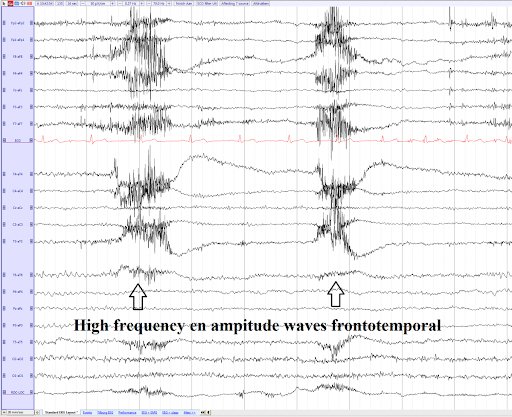 This shows how muscle movements and eye blinks can affect EEG data, potentially give inaccurate results.
Conclusion
Improvements
There are some improvements that I would like to make to this project.
- I would like to use a MuseLSL (Lab Streaming Layer) and connect it to my Unity game so that it can automatically input timestamps, as well as making the CSV file a bit more cleaner. This will help make the results more accurate during the analysis, and make it more faster to do.
- I would also like to try and automate the analysis process and attempt to make a more in-depth pipeline to give a deeper dive on someone’s performance. This would increase accuracy and provide more metrics to help a person understand their memory.
- To minimize the interference of external factors, a baseline test could be added to the beginning of the game so that the test will be accurate no matter who or when the test is taken. This would include the paritcipant doing nothing for a minute so that the headset can pick up the brains normal activity and compare the results to that.
- The program could be enhanced to give a deeper analysis, and potentially try and visual live data on a graph. This would provide more in depth data as well make it easier for people to understand what the results mean and how they can improve their memory.
- I would like to try and create one app or website which is able to encompass all of these features and launch a cohesive analysis process that is simple to operate and is stored in one place, instead of having to use many different softwares and websites. This would increase accessibility for everyone an would remove the steep learning curve from the process.
Overall, I would like to increase the accuracy and depth of the analysis and build a singular cohesive platform on which everything works together to provide an accurate, accessible, and efficient program to analyze their memory.
Future Applications
There are numeous applications for this project, especially in clinical settings as well as home settings. One thing that makes this project unique is that it can be operated in the comfort of one's home, making it accessible to and benefitting a much larger demographic of people.
- This program can be used durring cognitive assesments, such as IQ and ADHD tests, as it can measure how efficiently the brain is working and provide a supporting report to the assessment score. It is able to measure the level of engagement in a participant, especially younger participants as they can sometimes be unpredictable, and their test score can differ from their level of engagement.
- The Muse 2 can measure the P300 and N200 waves which are associated with how fast someone can process data being given to them, and can provide a measurement for someone's intelligence and memory using low cost materials at home, rather than having a thousands of dollars lab procedure being done for many hours over many days.
- This program can also be used as a screening tool in clinical settings, especially for an older demographic, as it is a fast, low cost procedure to determine any preliminary problems concerning memory. Should any problems be detected, the patient can be referred to a specialist for further diagnosis and treatment. It helps identify memory problems in advance and help achieve early intervention. It provides an accessible low cost program which anyone can use without long waiting times and advanced equipment.
- It can also be used as a a memory test for people who might experience long term stress of depression. It can also be used to track the improvement and progress of patients who might experience strokes or similar neurological conditions to see if their brain is recovering naturally or might require extra attention to make sure that their mind is in a healthy state. Unlike lab tests, this test takes 20 minutes to complete, with the analysis coming through right away, providing participants with results and feedback on the spot, rather than them having to wait for weeks just to get a report, potentially leading to any memory problems amplifying and getting worse. This not only degrades the individual's mental health, but also forces them to spend more money and go through many more procedures to get the required treatment.
Overall, this program is able to provide a comprehensive and accurate report on someone's memory in various aspects using advanced consumer EEG technology and lab grade analysis tools. The program is unique because it does not require formal technical training to operate. Furthermore, it can be operated from the comfort of one's home, and does not require any other equipment other than the Muse 2 headset. While lab EEG procedures cost thousands of dollars and take hours to complete, while the results take weeks to arrive, my project costs a fraction of that price, at $300 CAD, and the test takes 20 minutes to complete, and the analysis delivering results right at that moment, providing participants with instant feedback, without long wait times or having to break the bank for it. It can be used in many clinical settings and can hit a large demographic of people, providing them with a cheap and efficient solution to make sure that their brain is in good shape and their memory and cognitive function is intact.
Citations
Anush Mutyala. “Muse 101 — How to Start Developing with the Muse 2 Right Now.” Medium, Medium, 21 Aug. 2021, anushmutyala.medium.com/muse-101-how-to-start-developing-with-the-muse-2-right-now-a1b87119be5c.
Bisaz, Reto, et al. “The Neurobiological Bases of Memory Formation: From Physiological Conditions to Psychopathology.” Psychopathology, vol. 47, no. 6, 2014, pp. 347–356, www.ncbi.nlm.nih.gov/pmc/articles/PMC4246028/, https://doi.org/10.1159/000363702.
Cascella, Marco, and Yasir Al Khalili. “Short-Term Memory Impairment.” PubMed, StatPearls Publishing, 2024, www.ncbi.nlm.nih.gov/books/NBK545136/.
ChooseMuse. “Muse 2.” Muse: The Brain Sensing Headband, Muse® EEG Mental Fitness & Sleep Headband, 2026, choosemuse.com/products/muse-2?srsltid=AfmBOorbRhs8uZwWziPy5px4CWXQBR50BiV63m0sayp9vU5NAVoe70XJ. Accessed 20 Feb. 2026.
Lumen Learning. “Parts of the Brain Involved with Memory | Introduction to Psychology.” Lumenlearning.com\, 2010\, courses.lumenlearning.com/waymaker-psychology/chapter/parts-of-the-brain-involved-with-memory/.
Miller, Michael. “Inside the Science of Memory.” Hopkinsmedicine.org, 2019, www.hopkinsmedicine.org/health/wellness-and-prevention/inside-the-science-of-memory.
“Online EEGLAB Workshop.” EEGLAB Wiki, 2020, eeglab.org/workshops/Online_EEGLAB_Workshop.html. Rong, Carol. “Viewing Your Brain Activity with the Muse Headband.” Medium, Better Programming, 9 Jan. 2023, medium.com/better-programming/viewing-your-brain-activity-with-the-muse-headband-b03dde069ae4. Accessed 20 Feb. 2026.
Squire, Larry R., et al. “Memory Consolidation.” Cold Spring Harbor Perspectives in Biology, vol. 7, no. 8, Aug. 2015, p. a021766, pmc.ncbi.nlm.nih.gov/articles/PMC4526749/, https://doi.org/10.1101/cshperspect.a021766.
Thorup, Emilia. “The Neuroscience of Memory: How the Brain Stores and Retrieves Information.” Neuroscience and Psychiatry: Open Access, vol. 7, no. 6, 24 Dec. 2024, pp. 297–299, www.openaccessjournals.com/articles/the-neuroscience-of-memory-how-the-brain-stores-and-retrieves-information-18236.html, https://doi.org/10.47532/npoa.2024.7(6).297-299.
Acknowledgement
I would like to thank my science teacher, Mr. Joseph, and my science fair coordinator, Ms. Perez, for guiding me throughout this project and providing advice and feedback throughout the year. They worked very hard to organize and execute the school science fair, and help students with their projects.
I would like to give a big thanks to Mr. McWilliam, my options teacher for being able to order a Muse 2 headset for this project through the school. He contributed a lot to help make this project possible, and I feel very grateful for that.
I would like to thank my parents for helping and supporting me through out this project, while giving me meaningful advice and suggestions, as well as helping me make my project the best that it can be. Their support means a lot to me for this project.
I would like to give the biggest thanks to my sister, who helped me test and reiterate my project mulitple times. She put in a lot of time to help me with testing and gave me meaningful and honest feedback for my project. She made a lot of contributions and help make my project really good.