
Optic Vision Study: Is What we Believe a Reality?
Rachel Yuen
Griffith Woods School
Grade 7
Presentation
Problem
This generation is gradually becoming more and more dependent on technology use. I have noticed that people who have an eye condition have a lot of habits that require the use of technology. In this project I will explore and answer:
1. Is what we believe about our eyesight a reality?
2. What is the largest factor that can affect our eyesight?
Method
Background Research
- Anatomy of the eye
- Functions of parts of the eye
Hypothesis
I used what I learned from my background research to create a hypothesis.
Research
- Healthy eye habits
- Foods that may affect our eyes
- Nearsightedness, Farsightedness, and other eye conditions.
Conclusion and Applications and Extensions
I used the data collected to write a thorough conclusion and applications and extensions.
Research
-
Healthy Eye Habits
-
Balanced diet
- Protective eyewear
- Limited screen time
- Hand-eye coordination activities (vision-centered)
- Spending time outdoors
- Getting regular eye exams with an eye doctor
-
Getting enough sleep (9-12 hours)
-
Unhealthy Eye Habits
-
Unbalanced diet
- Not wearing protective eyewear
- Unlimited or lots of screen time
- Not doing vision centered activities (hand-eye coordination)
- Spending too much time indoors/not going outside
- Not getting regular eye exams with an eye doctor
-
Not getting enough sleep
-
Healthy Foods for our Eyes (a sample)
-
Vitamins (did not use in survey)
- Dairy (did not use in survey)
- Oranges (did not use in survey)
- Avocados (did not use in survey)
- Kale
- Dark Chocolate
- Eggs
-
Salmon
-
Unhealthy Foods for our Eyes (a sample)
-
French Fries
- White Bread
- Candy
- Cake
-
Soda
-
Nearsightedness
- Aka: Myopia, or Shortsightedness
- Can’t see things far away.
- This is when the eyeball is too long and light cannot reach the retina.
- Measured in diopters (-).
- More common than farsightedness.
- Almost 30% of Canadian school aged children ages 11-13 have nearsightedness.
- 81% of children ages 8-12 are at risk or have nearsightedness.
- Causes-genetics, and the environment.
- Farsightedness
- Aka: Hyperopia or Longsightedness
- Can’t see things close up.
- This is when the eyeball is too short or the cornea or lens is flatter than normal and light doesn’t bend correctly. Light focuses behind the retina instead.
- Measured in diopters (+).
- Genetics can contribute.
- Rarely caused by injuries, eye conditions, or another disease.
- Astigmatism
- A problem when the cornea or lens is shaped irregularly.
- When there are several light rays of focus.
- This creates blurry vision.
- Anisometropia
- When you have nearsightedness and farsightedness.
- When each eye has a different condition.
- One eye has nearsightedness and the other has farsightedness.
Data
https://drive.google.com/file/d/1uLFYH6LD6RXPpSCp2DfHbXQeAm2-tkFw/view?usp=drive_link
https://drive.google.com/file/d/199yoF80Y54HTnlPmLlUqfdq7IrO7hK7V/view?usp=sharing
https://drive.google.com/file/d/1xxfj1ah95JKQrOYMzFqUyoe7cFhJgyQP/view?usp=sharing
Conclusion
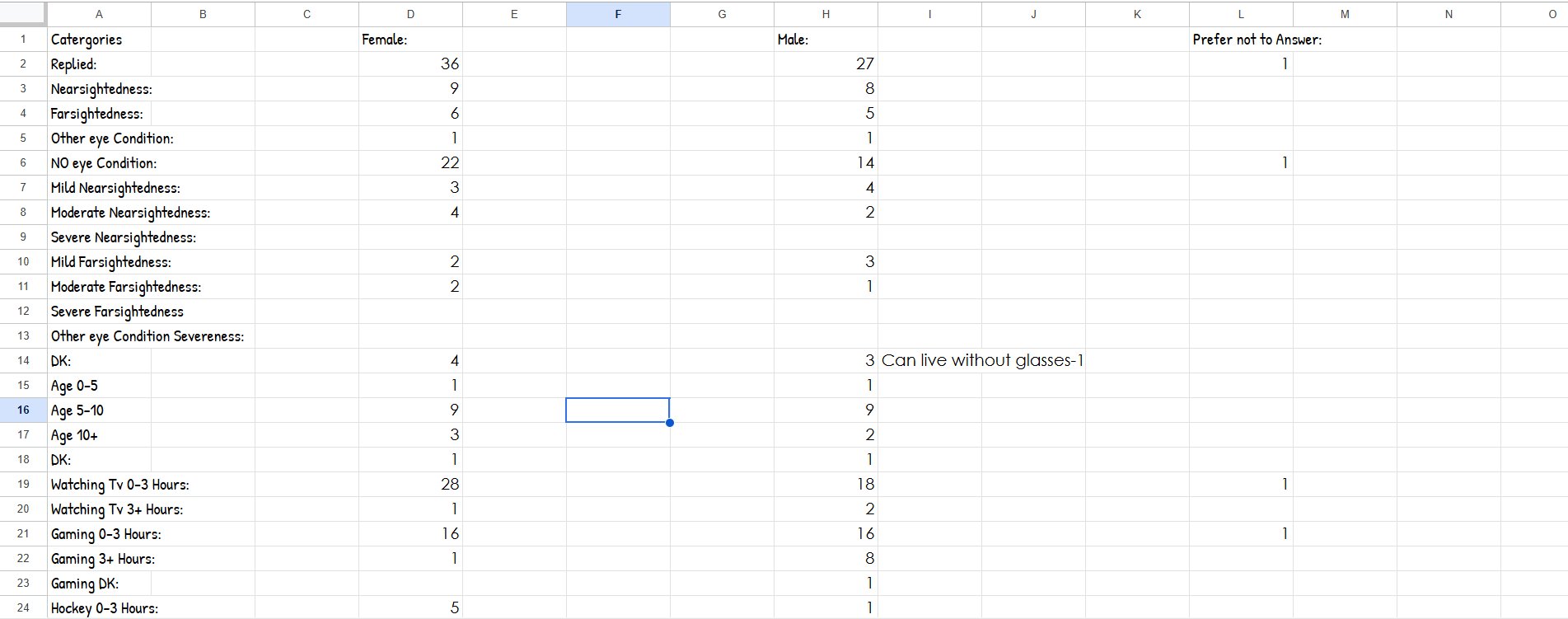
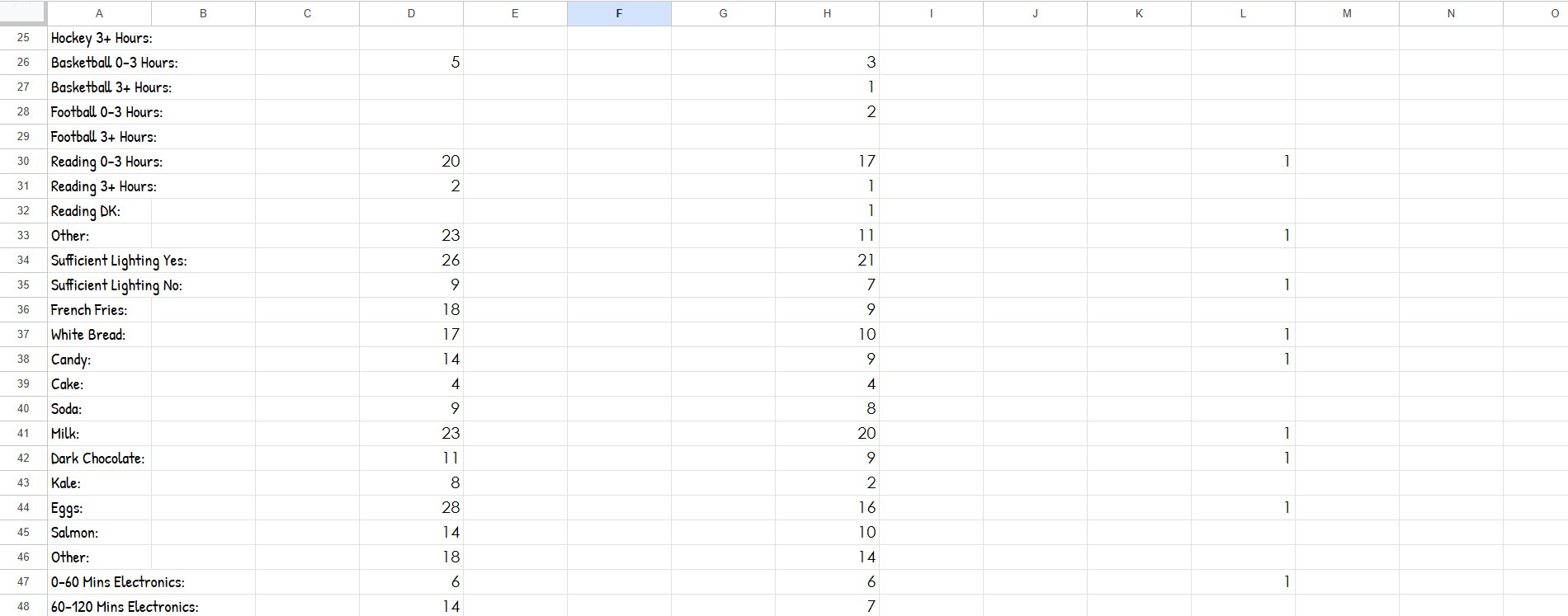
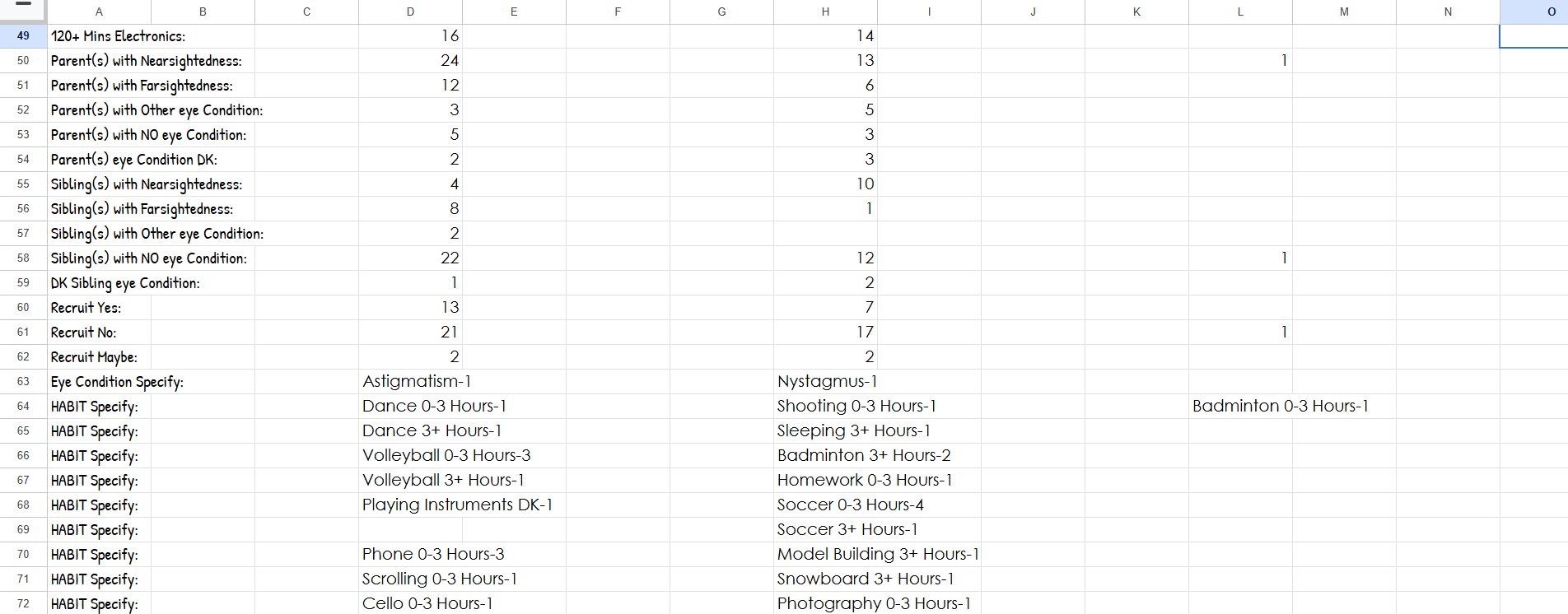
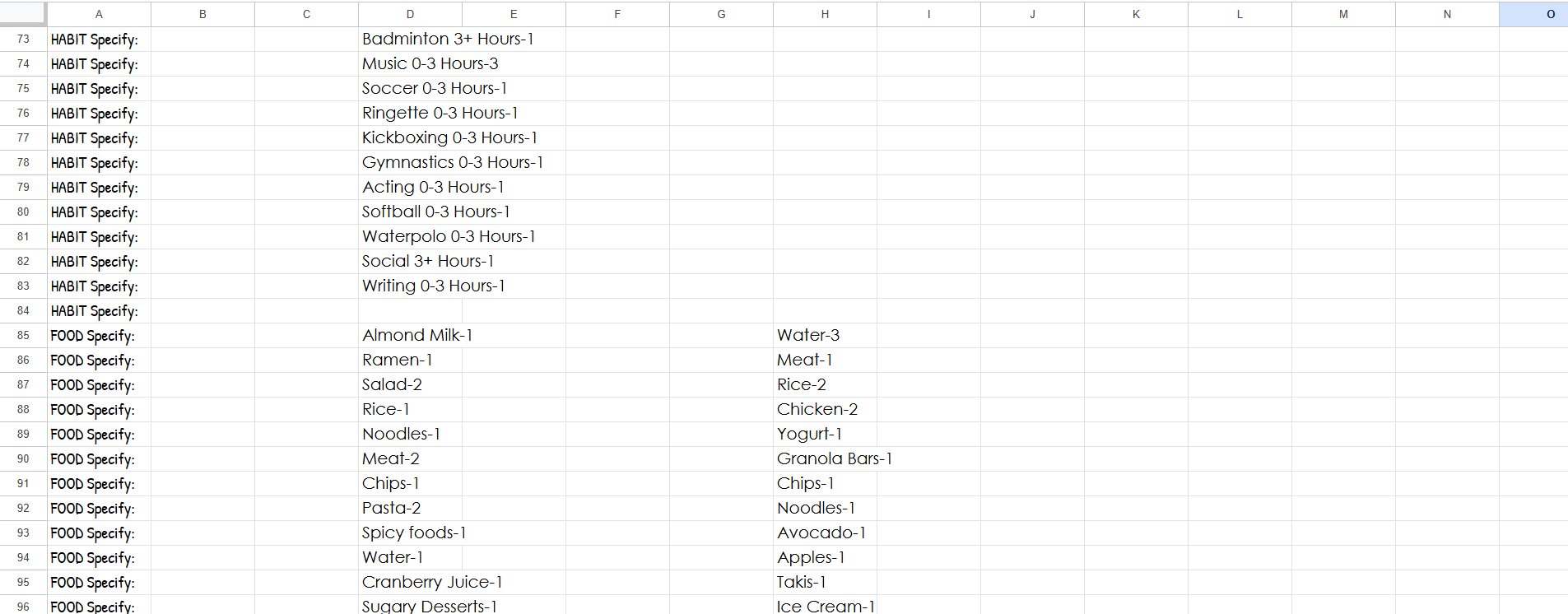
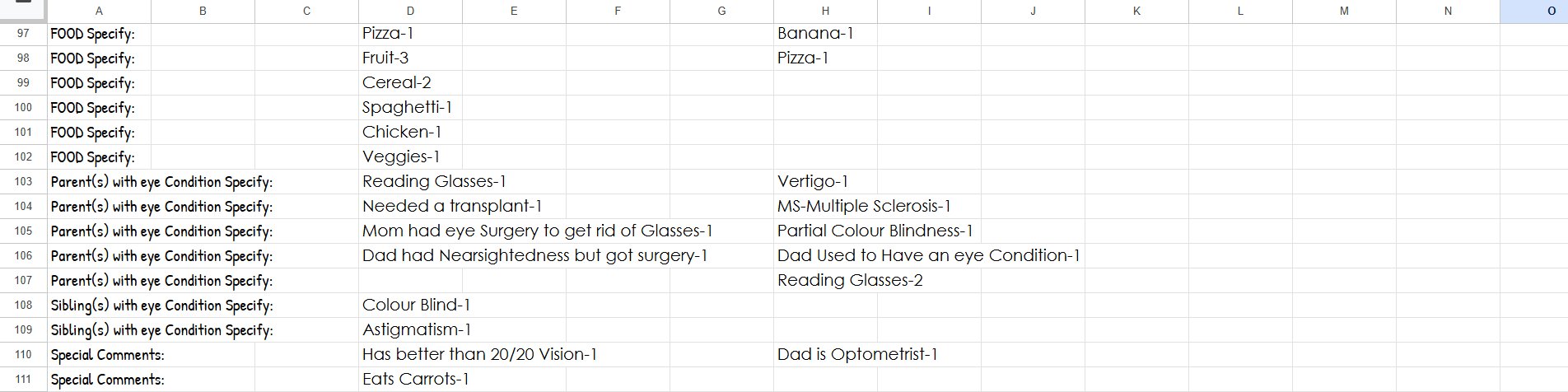
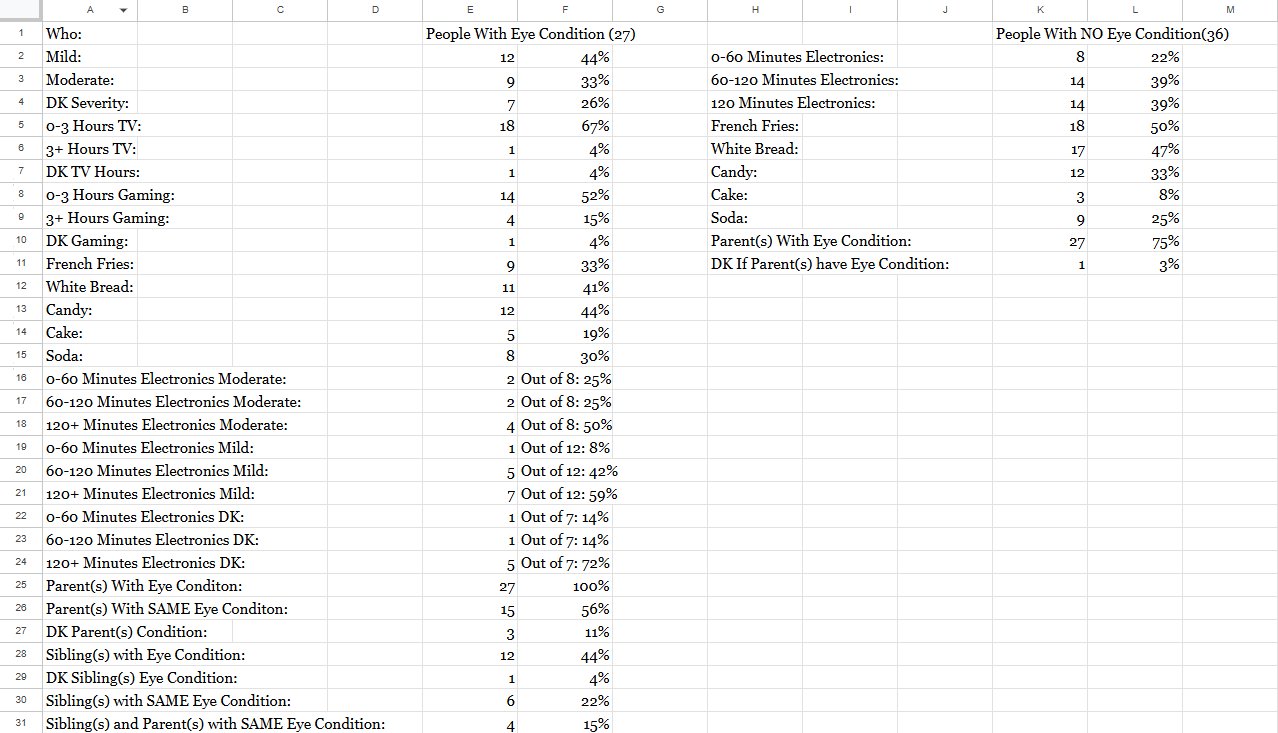
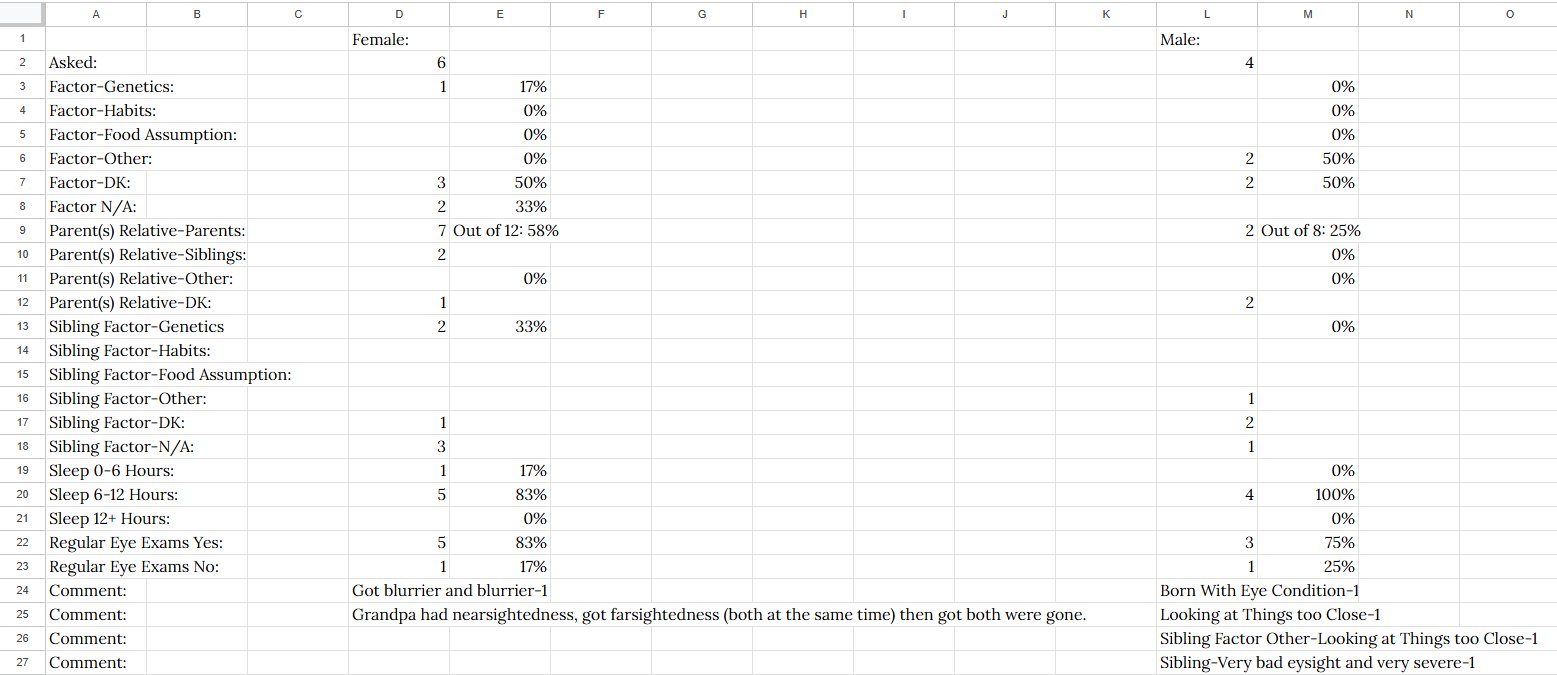
My hypothesis was accepted because based on the data collected genetics is the biggest factor that may affect our eyesight. 56% of people with an eye condition had the same eye condition as their parents, 22% of people with an eye condition had the same eye condition as their siblings and 15% of people with an eye condition had the same eye condition as their parents and siblings. Furthermore, when I asked participants about the cause of their eye condition, 1 person answered genetics. When participants were asked if their parents had any relatives with the same eye condition, 55% of participants answered that their parents had a relative with the same eye condition, and 20% of participants answered that their sibling(s) eye condition was because of genetics. For a deeper level of understanding I can research more about which factors specifically affect which different parts of the eye, and how an eye condition can get more severe. Some new questions that I am wondering is which eye condition is the most common to be passed down by genetics? Does the retina stretch out (nearsightedness) or shrink (farsightedness) even more when your eye condition gets more severe? Are there any other research studies that prove genetics is the biggest factor that can affect our eyesight? Experiments that I could try to support my conclusion are to ask peers that are not in my grade but are in my age group about their eyesight and see if genetics is an even stronger answer for why people have specific eye conditions. People should care because knowing what habits, what you eat, and genetics may affect your eyesight, you would want to be more cautious about what you are doing and would like to keep your eyes in good condition so an eye condition would not pass down on to the next generation. My results affect the world because others can use this information to support their research studies, and to deepen their understanding.
Citations
https://www.allaboutvision.com/eye-care/eye-anatomy/overview-of-anatomy/

https://www.allaboutvision.com/ https://www.allaboutvision.com/eye-care/eye-anatomy/eye-structure/conjunctiva/ https://my.clevelandclinic.org/health/body/21640-blood-vessels https://dictionary.cambridge.org/dictionary/english/syndrome https://www.allaboutvision.com/eye-care/eye-anatomy/eye-structure/sclera/ https://dictionary.cambridge.org/dictionary/english/fiber https://kidshealth.org/en/parents/collagen.htm https://kidshealth.org/en/teens/metabolism.html#:~:text=What%20Is%20Metabolism%3F,the%20chemical%20reactions%20of%20metabolism. https://www.merriam-webster.com/medical/episclera https://www.allaboutvision.com/eye-care/eye-anatomy/eye-structure/cornea/ https://www.cancer.gov/publications/dictionaries/cancer-terms/def/cell https://www.scribbr.com/commonly-confused-words/comprised-vs-composed/#:~:text=Comprise%20means%20%E2%80%9Cto%20be%20made,%E2%80%9Ccomprises%E2%80%9D%20on%20its%20own. https://www.allaboutvision.com/eye-care/eye-anatomy/eye-structure/uvea-iris-choroid/ https://www.allaboutvision.com/eye-care/eye-anatomy/eye-structure/pupil/ https://www.allaboutvision.com/eye-care/eye-anatomy/eye-structure/retina/ https://www.allaboutvision.com/eye-care/eye-exam/types/visual-acuity/ https://www.allaboutvision.com/eye-care/eye-anatomy/eye-structure/choroid/ https://www.dictionary.com/browse/situated#:~:text=located%3B%20placed.,inheritance%20leaves%20them%20well%20situated. https://www.cancer.gov/publications/dictionaries/cancer-terms/def/artery https://www.allaboutvision.com/eye-care/eye-anatomy/eye-structure/macula/ https://www.allaboutvision.com/conditions/computer-vision-syndrome/blue-light/overview-of-blue-light/ https://www.allaboutvision.com/eye-care/eye-exam/20-20-vision/ https://www.allaboutvision.com/eye-care/eye-tests/free-eye-chart/ https://www.allaboutvision.com/eye-care/parents-kids/childrens-healthy-eye-habits/ https://coopervision.ca/practitioner/myopia-management https://www.allaboutvision.com/conditions/hyperopia/overview/ https://brantfordoptometrist.ca/what-are-the-worst-foods-for-eye-health/ https://www.hopkinsmedicine.org/health/wellness-and-prevention/nutrition-and-eye-health https://www.healthline.com/health/eye-health/levels-of-nearsightedness#levels https://preventblindness.org/hyperopia-farsightedness/ https://www.allaboutvision.com/eyewear/eyeglasses/eye-prescription-good-or-bad/ https://www.allaboutvision.com/eye-care/eye-anatomy/eye-structure/lens-of-eye/ https://www.allaboutvision.com/eye-care/eye-anatomy/eye-structure/trabecular-meshwork/ https://newsinhealth.nih.gov/2023/08/breaking-down-food https://lmcoptometry.ca/sleep-and-eye-health/ https://health.clevelandclinic.org/recommended-amount-of-sleep-for-children https://opto.ca/eye-health-library/astigmatism https://opto.ca/eye-health-library/strabismus-crossed-eyes https://insightsoptical.com/can-you-be-nearsighted-farsighted/ https://www.aao.org/eye-health/anatomy/aqueous-humor
Acknowledgement
I would like to acknowledge my Science Fair Coordinator Mr. Downey, my mentor Logan White, my teacher Ms. Hardacre for letting me go room to room handing out surveys, using some class time for this project, and letting me use her classroom. Special thanks to the people that did my survey, the participants that spent some time with me for further information, and the participants in the CYSF Science Fair the year before for having amazing projects that I can look to as strong exemplars. Lastly, I am so grateful for my family. Thank you for encouraging me and providing me materials along the course of this project. Thank you so much to all of you mentioned above!!! Without any of you my project could not be what it is today.