
Is the 5 second rule safe?
Muhammad Ibrahim
Green Dome Islamic School
Grade 6
Presentation
No video provided
Hypothesis
I think that the wood will have the most bacteria, then the ceramic tile and carpet, because you walk with your slippers on wood, but they have been found to be the culprits for spreading bacteria between floors. Up to 93% of shoes or slippers have been shown to carry fecal contamination after 3 months of use.
Research
In 2016, Rutgers University looked at how bacteria transfer from surfaces to food, and what they found is that the bacteria transfer happens immediately, no matter how quick you are, and the longer the food stays on the ground, the more bacteria will build up. The researchers tested four surfaces—stainless steel, wood, carpet, and ceramic tile—and four different foods, such as watermelon, bread, bread and butter, and gummies. Their results were that the watermelon had the most contamination, while the gummies had the least. They said the transfer of bacteria from surfaces appears to be affected by the moisture. Surprisingly, the carpet had a very low transfer rate compared to the ceramic tiles and stainless steel. Fun fact: The Canadian Food Inspection Agency (CFIA) estimates that food poisoning affects approximately 4 million Canadians every year. Of the 4 million people, 11,500 are hospitalized, and sadly more than 230 people die.
Variables
Manipulated variables: -The type of surface Controlled variables: -Storage of petri dishes -All dropped for 5 seconds -Kind of food. Responding variables: -Which petri dish would have the most bacterial growth?
Procedure
- Wear gloves.
- Take a pear slice and place the pear on the wood floor for 5 seconds.
- Using a fork, pick up the pear slice after 5 seconds, swab the pear's surface, then swab it onto a clean petri dish and close the lid.
- Label the petri dish wood and tape the petri dish.
- Take another pear slice, and place the pear on a carpet for 5 seconds.
- Using a fork, pick up the pear slice after 5 seconds, swab the pear's surface, then swab it onto a clean petri dish and close the lid.
- Label the petri dish carpet and tape the petri dish.
- Take the third pear slice and place it on ceramic tile for 5 seconds.
- Using a fork, pick up the pear slice. After 5 seconds, swab the pear's surface, then swab it onto a clean petri dish and close the lid.
- Label the petri dish ceramic tile and tape the petri dish
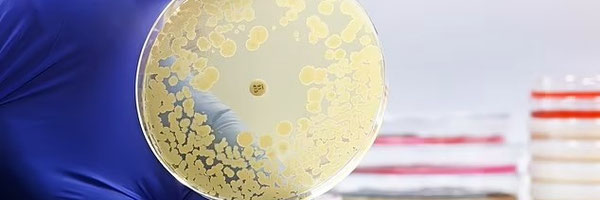
- Take pictures of the petri dishes and put them in a warm place for 7 days.
- take pictures of the petri dishes every day for 7 days (24 hours apart).
Observations
First experiment: Day #1: No growth in any petri dishes. Day #2: Still no growth observed in any of the petri dishes. Day #3 There is the tiniest amount of growth in all of the petri dishes, and the ceramic tile has the most bacteria growth. Day #4 The bacteria has grown bigger in all of the petri dishes; the ceramic tile and wood have an orange-colored colony growing. Day #5 All the petri dishes have bacteria; the ceramic tile has a lot of small bacteria compared to the wood and carpet, which have bigger bacteria but fewer colonies, and all of the petri dishes have orange bacteria. The wood and carpet have these white bacteria that have black spots in the middle, and there is also yellow bacteria in the ceramic tile petri dish. Day #6: There is no big change on the wood and carpet petri dishes other than some new white bacteria that has a black spot in the middle, but the ceramic tile petri dish has a red bacteria growing, and it's very tiny. Also, the ceramic tile looks like it has the most bacteria. Day #7 There are no other bacteria growing, just that the black spots have been darker and the ceramic tile petri dishes' red bacteria colony has not grown bigger than I expected it to grow.
Second experiment: Day #1: No bacterial growth in any of the petri dishes. Day #2: still no bacterial growth in all of the petri dishes. On day #3 there is bacteria growing in all the petri dishes, but the ceramic-tile petri dish already has a big colony that I didn't expect. Day #4 Further growth in all of the petri dishes. Also, the carpet has 1 yellow colony growing. Day #5 No big changes were observed in all of the petri dishes, and the wooden petri dish has an orange colony; the ceramic tile has gotten bigger than on day 3. Day #6 The wood petri dish has changed color in one colony that turned orange into red, and the carpet petri dish has a yellow colony; there are no changes in the ceramic tile petri dish. Day #7 There are no further changes in any of the petri dishes.
Analysis
First experiment:
| Days: | Wood petri dish: | Ceramic tile petri dish: | Carpet petri dish: |
|---|---|---|---|
| Day #1 | No growth | No growth | No growth |
| Day #2 | No growth | No growth | No growth |
| Day #3 | 2 colonies | 16 colonies | 6 colonies |
| Day #4 | 13 colonies | 29 colonies | 19 colonies |
| Day #5 | 21 colonies | 47 colonies | 36 colonies |
| Day #6 | 32 colonies | 65 colonies | 41 colonies |
| Day #7 | 39 colonies | Over 80 colonies | 50 colonies |
Second experiment:
| Days: | Wood petri dish: | Ceramic tile petri dish: | Carpet petri dish: |
|---|---|---|---|
| Day #1 | No growth | No growth | No growth |
| Day #2 | No growth | No growth | No growth |
| Day #3 | 1 colony | 6 colonies | 5 colonies |
| Day #4 | 13 colonies | 14 colonies | 9 colonies |
| Day #5 | 27 colonies | 22 colonies | 25 colonies |
| Day #6 | 41 colonies | 26 colonies | 28 colonies |
| Day #7 | 51 colonies | 39 colonies | 48 colonies |
Conclusion
Based on the data, my hypothesis was not correct because in the first experiment, ceramic tile had the most bacterial colonies and wood had the least. I think I know why ceramic tile had the most bacterial colonies: most houses have ceramic tile in the washrooms because of it being highly water-resistant, and washrooms are breeding grounds for bacteria. In my case, ceramic tiles were in the washrooms and where I dropped the pear slice, so the 5-second rule based on my project is not safe.
Application
I do not recommend buying pre-poured agar petri dishes because sometimes there might already be bacteria growing in them, and plus they're cheaper if you buy the agar and petri dishes separately.
Next time if I do this experiment, I will do multiple experiments with different foods and more different surfaces.
One of the challenges I faced was that some of the petri dishes already had bacteria in them, so they were not usable anymore, and keeping the right temperature for both of the experiments was challenging.
Sources Of Error
In the second experiment, ceramic tile had the least growth, and wood had the most bacterial growth. I think it could have been because I didn't put any tape on the second, so I did a mini experiment about whether the tape actually affected the bacterial growth. growth. What I found was that the petri dish with the tape on it had more bacterial growth; it could have been because it sealed all of the moisture inside, providing a warm, humid environment for rapid bacterial multiplication.
Citations
Acknowledgement
- My dad for ordering everything I needed to conduct the experiment.
- Mr. Abbasi for checking my work and giving me feedback.
- My family for encouraging me.
- My sister for giving me tips.
- My brother for helping me.