
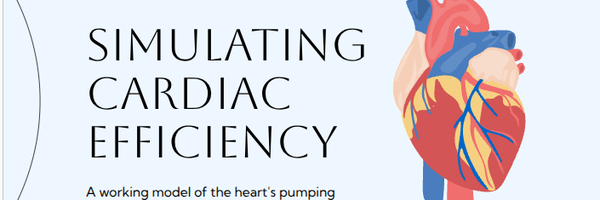
simulating Cardiac Efficiency a working model of the hearts pumping mechanism
Aleena Jomaa
Calgary Islamic School, Akram Jomaa Campus
Grade 8
Presentation
Problem
If the beats per minute increases, then will the total volume moved per minute will increase up to a point then become less efficient? I am trying to see if as the heart rate increases would the volume stroke increase up to a point where it becomes less efficient
Method
1.Sit quietly in a chair for 5 minutes to allow your heart rate to return its resting level. 2.Measure your pulse for 30 seconds and multiply by 2 to calculate beats per minute record the result 3.Run in place for 1 minute then immediately measure and record your pulse rate. 4.Rest for 5 minutes or until your pulse rate returns close to the resting rate 5.Perform jumping jacks for 1 minute then immediately measure and record your pulse rate. 6.Repeat the Experiment three times and calculate the average pulse rate for each activity
Research
The human heart is a strong and steady pump that moves blood throughout the body, delivering oxygen and nutrients to all our cells. -In this project, I created a simple working model of the heart to better understand how a real heart pumps -I also explored how changes in beat strength and heart rate affect the amount of fluid pumped, helping show what makes the heart work efficiently. -I will be explaining the main parts of the heart and the role each one plays in keeping the body alive and healthy.
Left ventricle - pumps oxygenated blood from the heart to the rest of the body through the aorta Right ventricle - Pumps deoxygenated blood from the heart to the lungs Left atrium - the left atrium stores, receives, and passes on oxygenated blood so the rest of the body can get the oxygen it needs. Right atrium - the right atrium receives, holds, and sends deoxygenated blood to the right ventricle. Septum - The septum is a thick wall of muscle that separated the left and right ventricles. Coronary sinus - The coronary sinus is a large vein on the back of the heart that collects blood from the heart. Tricuspid valve - Valve located between the right atrium and right ventricle. Bicuspid valve - Valve located between the left atrium and left ventricle.
Arteries - Carry oxygen rich blood away from the heart. Arterioles - Tiny branches of arteries that control blood flow into capillaries. Capillaries - Microscopic vessels where oxygen, nutrients, and waste are exchanged between blood and tissue. Venules - Small vessels that collect the blood from the capillaries. Veins - Carries deoxygenated blood back to the heart.
How does stroke volume affect the amount of blood pumped with each heartbeat in the human heart?
Every time your heart beats, it contracts to push blood throughout your body. The amount of blood moved with each beat depends on how strong the contraction is. This is called stroke volume. When the heart contracts with more force, more blood is pumped in one beat. When the contraction is weaker, less blood moves through the body. This is easy to notice while being active. When you run or play sports, your muscles need more oxygen. To meet this request, your heart responds by pumping more strongly, sending a larger amount of blood to the muscles with each beat. This helps your body keep up with activities without getting tired as quickly. Stroke volume is important because it allows the heart to adjust to different situations. A healthy heart can change how powerfully it pumps to maintain steady blood flow and support the body’s needs.
Lub and dub are the sounds of the heart. Lub (S1) happens when the bicuspid and tricuspid valves close. While dub (S2) is the sound of the aortic and the pulmonary valves closing. Lub occurs at the start of the heart's contraction. Lub prevents blood from flowing backward into the atria. Dub occurs at the end of the heart's contraction. This stops blood from flowing back into the ventricles from the arteries.Lub-Snapping shut of the av valves. Lub-systole sound created when the ventricles are contracting. Dub- snapping shut of the semilunar valves. Dub-is a diastole sound created when the ventricles relax.
Heart Failure is a fatal heart disease that's caused when the heart isn't pumping efficiently,which causes fluid buildup, and a lack of oxygen to the body. The common symptoms of heart failure are,shortness of breath, fatigue, swelling, rapid or irregular heartbeat, continuous cough, sudden weight gain.The causes of heart failure are heart attack, Coronary heart disease, high blood pressure, heart valve issues, diabetes, infections or other heart diseases.
Data
I wanted to check cardiac efficiency with 3 different body movements.Stationary,running, and while doing jumping jacks. I concluded from this experiment that while stationary my heart didn't need to work as hard . The lower flow of blood from the body's veins back the hearts right atrium, leads to an impermanent decrease in the heart's stroke volume and,continuously, a decline in cardiac output .
| ACTION | ATTEMPT 1
BPM | ATTEMPT 2
BPM | ATTEMPT 3
BPM | AVERAGE |
| ------ | ------------ | ------------ | ------------ | -------- |
| STATIONARY | 70 | 72 | 74 | 72 |
| RUNNING | 108 | 112 | 110 | 110 |
| JUMPING JACKS | 136 | 140 | 138 |
138 |
Resting: (72 + 70 + 74) ÷ 3 = 72 bpm Running: (108 + 112 + 110) ÷ 3 = 110 bpm
Jumping jacks: (136 + 140 + 138) ÷ 3 = 138 bpm

Conclusion
In this experiment, raising the pump strength resulted in an increase in regards to the amount of fluid being pumped. This shows that stronger contractions move more fluid, similar to how a real heart pumps more blood with stronger beats. The results do support the hypothesis and help explain how heart strength affects the blood flow.
Citations
information for lub and dub from inquiry into biology textbook information on stroke volume from Study.com information on parts of the heart and their functions from https://my.clevelandclinic.org/health/body/21704-heart reference for model from Human Heart working model _ 3d model #science #biology #medical project_NakulSahuArt and https://www.youtube.com/watch?v=HRSheC1IgRU
Acknowledgement
My cousin Leah helped me assemble my slides and show me information My science teacher Mrs.Nambiar helped me start up my slides My mom helped me assemble the model