
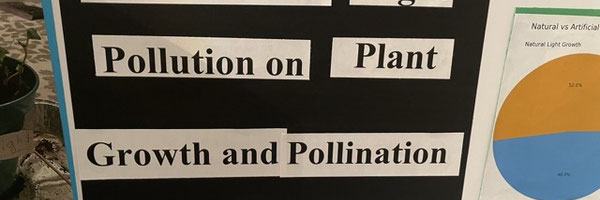
The effect of light pollution on plant growth and pollination
Celine Alia
Al-Amal Academy
Grade 6
Presentation
No video provided
Hypothesis
I think the plants that get light all the time will grow faster and taller at first than the plants that have normal day light. Plants use light to make food through photosynthesis, so I think more light might mean more food and faster growth. I think the plants that get natural light will look the healthiest and grow as expected. The plants with artificial lights will maybe grow faster but I don’t believe they will win, because they have no time to rest/recover. This experiment can help us understand how city lights at night (light pollution) might change how real plants grow in nature. I am experimenting with various light source, for example I purchased a light that can make it self-soft white or bright yellow to imitate the sun. I am also experimenting with one plant that is getting no light at all. Another plant will get light from the ceiling and not concentrated light that is right on top of it. My prediction is the plants that get artificial light that is right on top of them, will grow the fastest but not the healthiest and the plant that is getting no light will do the least amount of growing. I believe near the end they will grow almost the same with an edge to natural light plants, because they get rest at night.
Research
First I researched what type of seeds grow the fastest, because I wanted enough time to plant several seeds in various pots and experiment with various light sources. And the winner was radish seeds. Also I researched artificial light and it's effect on plants and the plants cycle. It was important to understand the real issue so I researched how much of a problem is artificial or light pollution on plants. The fact that if a light is constantly on near the plant interrupts the plant cycle, because plants don't get to rest and sleep. The vegetables and fruits we buy, are they really only growing using natural light? I mean can a cucumber really grow that big? I researched and was very interested to learn many things about the effect of light pollution on plant growth.
Variables
For manipulated variable, this is the type of light each plant gets. And each one has a different type of light. One plant gets artificial light, one gets natural light, one gets yellow light, one gets soft white light, one gets no light, and finally one gets both artificial light and natural light meaning during day it is given natural light and during night it is given artificial light. For responding variable, I watched how the plants grow meaning I checked how tall they got, how many leaves they grew, what colour the leaves were, and how healthy each plant looked and the plant that did the best was the natural light as it had green leaves, it grew tall, and it looked very healthy as it stayed up and had green leaves. For controlled variables, I made sure everything was the same and that no other plant got more water or more soil to ensure a predictable answer. I used the same amount of water for each plant using a measuring cup, I used the same type of soil for each plant, I used the same type of seeds for each plant and the same amount of seeds for each plant (15), I used the same amount of soil in each pot, the same size pots, and I planted the plants at the same depth. Making sure you have the same type of items for each plant is important so that it is fair.
Procedure
The procedure for this project is that firstly I went to the store with my parents to grab all the supplies such as pots, radish seeds ( you can get any), batteries for the light, a light that you can use for a while, and lastly I got pots that are all the same size for the plants. Next I labeled all the plants using a label maker you can also just write it after that was done I put the soil, in all of the pots, next I put the seeds not too deep but not too high, I then put water for all the plants one that was done I put the plants in all of their spots. I put the artificial light under the light in which I put batteries in, I put the natural light next to the window so that sunlight could reach the plant, I put the no light one in a closet with no light, I put the yellow light under a yellow light, I put the white light under a white light. Would all of these procedures I also watered each one every day about a cup of water and make sure all of your supplies are the same, same type, and same amount.
Observations
During my project, I noticed that towards the beginning the artificial light was growing a lot faster and taller than the others and the natural light was growing slower although the artificial light was growing tall and fast the leaves of it were yellow and didn’t look quite healthy while the natural light looked a lot healthier and the leaves of it looked green. Another thing I noticed was that the artificial light and the yellow light were growing towards the light thinking that the light is actually the sun.
Analysis
In my experiment, I tested how different kinds of light affect how radish plants grow. I had plants in natural, artificial, yellow, soft white, and no light.
I noticed that the plant in natural light grew a little taller the one under artificial light. The plant with both lights also did very well. The yellow light worked better than the soft white light. The plant with n light grew the least and looked weak.
This shows that plants need light to grow properly. Natural light seemed to work the best in my project. Artificial light plants did grow but they are not the healthiest. Nothing beats natural rest and natural plant cycle versus forced growth.
Conclusion
In this experiment I learned that light effects your plants on what light you use or how long you give the plant, light.Towards the beginning the artificial light did the best but later on the leaves started to turn yellow while the natural light had green leaves and grew tall and healthy scoring 1st on the pie chart with 25.0%. The artificial light grew tall but as I said had yellow leaves the artificial light scored 2nd on the pie chart with 23.0%. The plant with artificial plus natural light although it grew tall it did not look as tall or healthy as the natural light but it scored 3rd on the pie chart with 20.0 as it got light all the time natural light during the day and artificial light at night. The plant that got yellow light grew tall as the light acted as if it were the sun since the sun is yellow it scored 4th on the pie chart with 15.0%. The plant with white bulb did not grow that well and stayed low all the time scoring 5th on the pie chart with 12.0%. The plant with no light did not do well and scored lowest on the pie chart with 5.0% it also stayed weak and pale. My conclusion supports my hypothesis as I predicted that the natural light would do the best and it did and had green leaves. Using artificial light may make your plants grow faster they are not the best for plants and we should try to use natural light to grow our plants.
Application
This project can help people understand how important light is for plant growth. Gardeners and farmers can use this information to choose the best lighting for their plants. If someone is growing plants indoors, they can know which type of light may help plants grow better.
This experiment also shows that natural light is very important. People who grow plants inside homes or greenhouses can use the right kind of light to help their plants stay healthy.
My project shows that light affects how plants grow, and this can be useful in real life.
Sources Of Error
A few mistakes that you can make are, not putting the same amount of water, soil, seeds, same size pots, and not the same type. Another mistake is not being careful with the light source, meaning not moving the plants when it's a cloudy day. Another source of error might come from the soil or the seed type. From my experience good quality potting soil works better than cheap soil. Not keeping track of the results or recording them frequently can be another error.
If I did this experiment again, I would measure the plants more carefully and make sure all light distances are exactly the same.
Citations
Frontiers for Young Minds. (2023). Light Pollution: Why We Need to Turn Off the Lights. — Explains how artificial light at night affects plants and animals. Frontiers for Young Minds National Geographic. Streetlights are influencing nature — from how leaves grow to how insects eat. — Shows how streetlights change the way plant leaves grow and how insects eat them. National Geographic Encyclopedia of the Environment. Impact of Light Pollution on Plants. — Simple explanation of how light pollution messes with the “night time” that plants need. Encyclopédie de l'environnement Down to Earth. Switch it off!: How light pollution disorients ecosystems. — Talks about how artificial light at night changes how plants behave (flower, grow leaves, etc.). Down To Earth Biology Insights. How Does Light Pollution Affect Plants? — A clear overview of how light pollution changes plant growth cycles and their “sleep.” Biology Insights Royal Astronomical Society of Canada / Calgary Centre. Light Pollution Abatement – Plants. — Explains how too much night light disrupts plant hormone cycles and growth. calgary.rasc.ca Think Global Health. Light Pollution Reshapes Growing Seasons. — Very understandable: says that extra night light makes plants start growing earlier in spring and stay green later in fall. Think Global Health
Acknowledgement
I acknowledge the research I did and my family who helped me purchase material needed. Also, for reminding me to take care of the plants and water them. I acknowledge my science teacher for her feedback and support. Thank you to everyone who supported me and encouraged me while I worked on this project.