
Car Engines Inside Out
Aahil Mohammad
Calgary Islamic School, Akram Jomaa Campus
Grade 9
Presentation
Problem
Internal combustion engines are expensive and complex machines, yet they are highly vulnerable to environmental factors like water and heat. Many car owners do not understand how a single event like driving through a deep puddle (hydrolock) or neglecting coolant—can lead to total engine failure. This project investigates the specific mechanics of engine failure to determine how these machines can be better maintained and protected.
How do the design and fuel type of internal combustion engines affect their performance, environmental impact, and risk of failure from water damage and overheating? How do car engines work?
Method
This research project was completed using a combination of secondary research and real-world observation. Information was collected from educational websites, automotive resources, and government energy sources to understand how internal combustion engines work, their parts, fuel types, efficiency, and environmental impact. The research focused on: How internal combustion engines operate Differences between gasoline, diesel, hybrid, and electric engines Causes of engine failure such as water damage and overheating The role of cooling systems, maintenance, and safety systems Performance features such as turbochargers, superchargers, and horsepower In addition to online research, hands-on observations were made at an auto repair shop, where engine parts were examined and real examples of engine damage (including water damage and overheating) were observed. This helped connect theoretical research with real-world mechanical evidence.
Research
Purpose & Main Research Question How do the design and fuel type of internal combustion engines affect their performance, environmental impact, and risk of failure from water damage and overheating? How do car engines work ?
A car has two main components: the engine and the transmission.[1] Wikipedia A car engine works through internal combustion, where a mixture of fuel and air is compressed in a cylinder, ignited by a spark plug, and the explosion pushes a piston to create power.[2] HowStuffWorks Pistons are connected to a crankshaft, which turns this motion into rotation that spins the wheels.[2] science.howstuffworks.com Valves control air and fuel flow, spark plugs ignite the mixture, and oil and coolant keep the engine running smoothly and prevent overheating.[3] Engines can have 4, 6, 8, 10, 12, or 16 cylinders, with 16 being the largest.[4]Wikipedia
Why do we need car engine We need car engines because they provide the power that allows cars to move. The engine converts fuel into energy, which turns the transmission then it turns the wheels and helps the car travel from one place to another. Car engines make transportation faster, easier, and more efficient for people and goods. What makes car engine go bad Water Damage Water damage can cause serious problems in a car engine when water enters through flooding or deep puddles. If water reaches the engine cylinders, it can cause hydrolock, which happens because water cannot be compressed like air, leading to bent or broken engine parts (Car and Driver, n.d.; HowStuffWorks, n.d.). Water can also mix with engine oil, reducing lubrication and increasing friction, which causes faster wear on engine components (Explain That Stuff, n.d.; Mechanical Booster, 2017). In addition, moisture inside the engine can lead to rust and corrosion and may damage electrical parts such as spark plugs and sensors (Britannica, n.d.; AutoUpkeep, n.d.). Hands-on observations from an auto repair shop and direct examination of engine parts further supported how water damage often results in severe engine failure and costly repairs (personal communication, 2026). Types of car engine
There are several types of car engines, based on how they work and what fuel they use. Some common types include:
- petrol (gasoline) engine – uses gasoline as fuel and is very common in cars.
- diesel engine – uses diesel fuel and is more fuel-efficient, often used in trucks and buses.
- hybrid engine – combines a petrol/diesel engine with an electric motor for better fuel efficiency.
- hybrid engine – combines a petrol/diesel engine with an electric motor for better fuel efficiency.
Parts of a car engine
A car engine is made up of several important parts that work together to make a vehicle move. The cylinder is where air and fuel mix and burn, while the piston moves up and down to create power from combustion (How a Car Works, n.d.; ScienceABC, n.d.). This motion is transferred to the crankshaft, which converts the up-and-down movement into rotational motion that helps turn the wheels (Explain That Stuff, n.d.). Valves control the intake of air and fuel and the release of exhaust gases, while spark plugs ignite the fuel mixture at the correct time (Khan Academy, n.d.; Mechanical Booster, 2017). The camshaft ensures the valves open and close at the proper moments, engine oil reduces friction between moving parts, and coolant prevents the engine from overheating (Britannica, n.d.; AutoUpkeep, n.d.). All of these components are housed within the engine block and connected by a timing belt or chain to keep the engine working in sync (U.S. Department of Energy, n.d.).
Engine System Comparison Table

Advantages
Car engines allow vehicles to move and transport people and goods easily.
They save time by helping people travel long distances faster.
Car engines provide power to carry heavy loads.
They make daily activities like going to school, work, or shopping more convenient.
Modern car engines are more fuel-efficient and reliable than older ones.
Engines help emergency services like ambulances and fire trucks reach places quickly.
Disadvantages
Pollution: Most car engines burn fuel, which releases harmful gases like carbon dioxide and nitrogen oxides. These gases cause air pollution and contribute to climate change.
Fuel Costs: Gasoline and diesel engines need fuel to run, and fuel can be expensive, especially when prices go up.
Maintenance and Repairs: Car engines have many moving parts that wear out over time. Oil changes, repairs, and part replacements can cost a lot of money.
Noise: Engines can be loud, especially older or poorly maintained ones, which adds to noise pollution.
Environmental Damage: Oil leaks, fuel spills, and exhaust emissions can harm soil, water, animals, and plants.
Fun Facts
The first car engine was built in 1885 by Karl Benz.
A typical car engine has over 200 moving parts working together.
Car engines can spin at the max revolutions per minute (RPM) or more.
A Formula 1 engine can cost over $10 million.
Most engines waste more than half of their fuel energy as heat.
Some car engines are small but powerful—modern 1.0L engines can be stronger than older big engines
How much is it to fix a car engine
Fixing a car engine can be very expensive, and the total cost depends on how serious the damage is and the type of vehicle. Minor engine repairs, such as replacing sensors or small components, are usually the least expensive, while medium repairs like fixing belts or gaskets cost more because of added labor and parts (AutoUpkeep, n.d.; Cars24, n.d.). Major engine problems, including timing issues or head gasket failure, can cost several thousand dollars due to the complexity of the repair (Car and Driver, n.d.). In cases of severe damage, the engine may need to be rebuilt or replaced, which is one of the most costly options for vehicle repair (HowStuffWorks, n.d.). Because engine repairs can quickly become expensive, regular maintenance is important to help prevent serious engine damage and reduce long-term repair costs (AutoUpkeep, n.d.). Gas vs diesel Gasoline and diesel engines both power vehicles, but they have important differences in performance, efficiency, and cost. Gasoline engines are generally quieter, lighter, less expensive to purchase, and easier to maintain, which makes them more suitable for everyday driving (Explain That Stuff, n.d.; The Kids Point, n.d.). However, gasoline engines usually use more fuel and produce higher carbon dioxide emissions, which contributes to air pollution (U.S. Department of Energy, n.d.). Diesel engines use diesel fuel and are more fuel-efficient and powerful, producing higher torque, which makes them better suited for trucks and heavy-duty vehicles (Britannica, n.d.; ScienceABC, n.d.). Although diesel engines often last longer, they are typically louder, heavier, more expensive to buy, and can cost more to repair, and they also produce harmful emissions (Car and Driver, n.d.).
Gas vs Electric
Gasoline-powered cars use gasoline as fuel to run an internal combustion engine, which allows them to travel long distances and be refueled quickly at gas stations; however, they produce exhaust emissions that contribute to air pollution (Encyclopaedia Britannica, n.d.; Explain That Stuff, n.d.). In contrast, electric cars use electricity stored in batteries to power an electric motor and do not produce exhaust emissions while driving, which helps reduce air pollution and improve air quality (U.S. Department of Energy, n.d.). Electric vehicles are also much quieter than gasoline cars, but they require time to recharge and depend on access to charging stations (Car and Driver, n.d.). Overall, electric cars are considered more environmentally friendly, while gasoline cars remain more convenient for quick refueling and long-distance travel (Energy.gov, n.d.).


Engine efficiency Engine efficiency refers to how effectively an engine converts fuel into usable power to move a vehicle. When fuel burns inside the engine, only a portion of the energy is used to propel the car, while the rest is lost as heat and noise (ScienceABC, n.d.; Mechanical Booster, 2017). More efficient engines consume less fuel to travel the same distance, which helps save money and reduces harmful emissions (How a Car Works, n.d.; Explain That Stuff, n.d.). Modern engines improve efficiency through fuel injection, advanced cooling systems, lighter materials, and computer controls. Hybrid and electric vehicles are even more efficient because they waste less energy and rely less on traditional fuel (AutoUpkeep, n.d.; U.S. Department of Energy, n.d.).
Engine maintenance Other important maintenance for a car engine includes replacing the timing belt every 60,000–100,000 km to prevent engine damage and changing the fuel filter every 40,000–80,000 km to keep fuel clean. The battery should also be checked or replaced every 50,000–100,000 km to ensure the car starts reliably (AutoUpkeep, n.d.; How a Car Works, n.d.). Performing these routine maintenance tasks helps prevent breakdowns, saves money, and keeps the engine running efficiently for a long time (Cars24, n.d.; ScienceABC, n.d.). Regular maintenance, along with other care tasks, is essential for the long-term performance and safety of the vehicle (Mechanical Booster, 2017).
Engine safety Engine safety involves features that protect the engine and help keep the car and passengers safe. Warning lights alert drivers to potential issues, such as low oil levels or overheating, and some vehicles have automatic engine shut-off systems to prevent damage or fires (How a Car Works, n.d.; AutoUpkeep, n.d.). Cooling systems prevent the engine from getting too hot, while traction control, stability control, and ABS brakes help the car maintain control and stop safely (ScienceABC, n.d.; Cars24, n.d.). Together, these safety systems work to protect the engine and enhance overall vehicle safety (Mechanical Booster, 2017). Some parts and meanings
Piston: Moves up and down inside the engine cylinder to create power.
Cylinder: The space where the piston moves and fuel is burned.
Crankshaft: Turns the up-and-down motion of the pistons into spinning motion.
Connecting Rod: Connects the piston to the crankshaft.
Camshaft: Controls when the engine valves open and close.
Valves: Let air and fuel in and exhaust gases out of the engine.
Spark Plug: Creates a spark to ignite fuel in gas engines.

“Why Car Engines Fail: From Tiny Problems to Big Breakdowns” Car engines can wear out or fail if they are not properly maintained. Issues such as water entering the engine, dirty or old oil, worn-out parts, or overheating can gradually damage even the strongest engines (ScienceABC, n.d.; Mechanical Booster, 2017). Because engines contain hundreds of moving parts, small problems can quickly escalate into major breakdowns (How a Car Works, n.d.; AutoUpkeep, n.d.). Regular maintenance, including oil changes, checking coolant, replacing worn components, and keeping the engine clean, helps engines last longer, run smoothly, and prevent costly repairs (Cars24, n.d.; Explain That Stuff, n.d.). Understanding how engines fail and how to care for them is essential for keeping vehicles reliable and safe.
“Turbochargers & Superchargers: How Car Engines Get Extra Power” Car engines generate power by burning fuel in cylinders, which moves pistons and turns the crankshaft (How a Car Works, n.d.; ScienceABC, n.d.). Turbochargers use exhaust gases to force more air into the engine, while superchargers are connected directly to the engine to provide an immediate boost (Explain That Stuff, n.d.; Mechanical Booster, 2017). Both systems enable engines to produce significantly more horsepower without increasing engine size. High-performance supercars, such as the Bugatti Chiron, use these technologies to safely achieve extreme power and speed, effectively turning even a small engine into a high-performance machine (AutoUpkeep, n.d.; Cars24, n.d.)..
How is horsepower created? Horsepower in car engines is produced by controlled explosions inside the cylinders. When fuel and air ignite, the pistons move and turn the crankshaft, sending power to the wheels (HowStuffWorks, n.d.; Britannica, n.d.). Engines with more cylinders and faster combustion cycles generate more horsepower. Engineers can increase engine power using turbochargers, superchargers, fuel injection, and higher compression ratios (Khan Academy, n.d.; Learning Corner, n.d.). High-performance supercars, such as the Bugatti Chiron W16, use advanced materials, precise assembly, and specialized cooling systems to manage extreme heat and pressure, converting thousands of small explosions into smooth, powerful motion (Wright’s Car Care, n.d.; The Kids Point, n.d.).
Colling systems
Car engines produce a significant amount of heat from thousands of small explosions per minute, so a cooling system is essential to prevent overheating (Wikipedia, n.d.; How a Car Works, n.d.). Most vehicles use a liquid cooling system, in which coolant flows through the engine, absorbs heat, and passes through the radiator to release it. Key components of this system include the water pump, thermostat, radiator, and cooling fan (ScienceABC, n.d.; AutoUpkeep, n.d.). High-performance engines, such as those in the Bugatti Chiron, often use additional radiators and advanced cooling technology to manage extreme horsepower, ensuring the engine operates safely and efficiently (Cars24, n.d.; Mechanical Booster, 2017). Internal Combustion Engines
Internal combustion engines produce power by burning fuel inside the engine’s cylinders. A mixture of fuel and air is compressed and ignited, creating an explosion that pushes the pistons. This motion turns the crankshaft, converting up-and-down movement into rotational motion that moves the vehicle. Gasoline and diesel engines are the two main types of internal combustion engines, and they use key parts such as cylinders, pistons, valves, spark plugs, oil, and coolant to work properly. These engines are widely used because they provide reliable power and quick refueling, but they also produce emissions and can fail due to problems like overheating or water damage.
“Alternator and Battery: Powering Your Car” The car battery stores electricity to start the engine and power electronic systems, while the alternator generates electricity once the engine is running to keep the battery charged and all systems functioning properly (HowStuffWorks, n.d.; Britannica, n.d.). Without a working alternator, the battery would quickly drain, and the vehicle’s electronics would fail (ScienceABC, n.d.; AutoUpkeep, n.d.). High-performance cars, such as the Bugatti Chiron, feature alternators specifically designed to handle the additional electrical load while the engine produces extreme power (Wright’s Car Care, n.d.; The Kids Point, n.d.). Conclusion In conclusion, car engines are amazing machines that turn fuel into power, move cars, and keep the battery charged through the alternator. Learning how engines work—from pistons and cylinders to turbochargers and cooling systems—helps us understand both everyday cars and supercars like the Bugatti Chiron. I would like to thank my teachers for their guidance and support in helping me complete this project.
Recourses

Data
| Engine Design & Fuel Type ComparisonCategory | Gasoline Engine | Diesel Engine | Electric Vehicle | High-Performance Engine (Turbo/Supercharged) |
|---|---|---|---|---|
| How It Works | Burns gasoline with spark plug ignition | Compresses diesel fuel (no spark plug) | Uses battery-powered electric motor | Uses forced air (turbo/supercharger) to increase power |
| Fuel Efficiency | Moderate | High (better mileage) | Very high (no fuel combustion) | Lower due to high power output |
| Power Output | Good for everyday driving | High torque (good for trucks) | Instant torque | Extremely high horsepower |
| Environmental Impact | Produces CO₂ and emissions | Produces NOx and diesel emissions | No exhaust emissions while driving | Higher emissions due to fuel consumption |
| Noise Level | Quieter | Louder | Very quiet | Loud under boost |
| Refueling/Charging | Quick refueling | Quick refueling | Requires charging time | Quick refueling |
| Example | Common family cars | Trucks and buses | EV vehicles | Bugatti Chiron |
|
Conclusion
In conclusion, car engines are complex machines that turn fuel into power and help run important systems like the alternator. Through this project, I learned how engine parts such as pistons, cylinders, and turbochargers work together to affect performance and efficiency. I also learned that the best engine depends on its purpose: smaller or hybrid engines are better for fuel efficiency and the environment, while larger or turbocharged engines are better for high performance, like in supercars. I would like to thank my teachers for their guidance and support in completing this project.
Citations
here are my resources 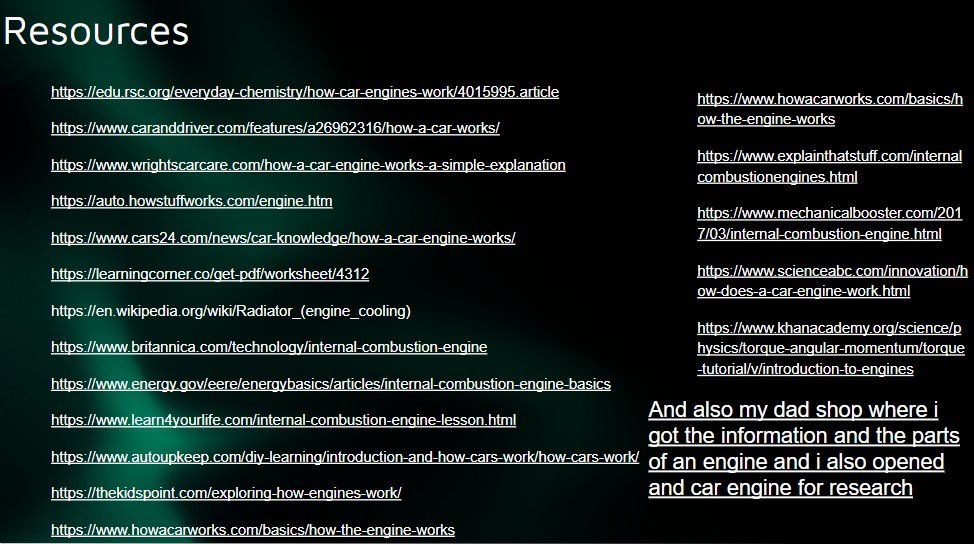
Acknowledgement
I would like to sincerely thank my teacher for providing guidance, support, and helpful feedback throughout this project. Their explanations and encouragement helped me better understand how internal combustion engines work and how fuel type and engine design affect performance and environmental impact. I would also like to thank the authors and educational resources that provided detailed information about engine systems, maintenance, cooling systems, and engine safety. These sources helped me gather accurate and reliable information for my research. In addition, I appreciate the opportunity to observe real engine components and engine repairs in an auto repair shop, which helped me connect my research to real-world mechanical applications. Finally, I am grateful to my family for their support and encouragement while I completed this project.