

Step to the beat: A musical journey into movement and motivation.
Deshna Anand
Mount Royal School
Grade 9
Presentation
No video provided
Problem
Introduction
Public transit stations play an important role in day to day transportation. In Calgary, the system had about 261,000 commuters on an average weekday as of the third quarter of 2024. The number of people using the transit is higher particularly during peak hours in the morning and evening. These conditions promote faster and safer transportation but mostly ignores the emotional impact and human experience. Research in environmental psychology has continuously shown the impact of environmental stressors on our mental health. The mental health impact on commuters due to public transit is shaped by urban design, social interactions and their background. Even though these experiences are short term, they can have a profound impact on commuters. My project explores a simple question, could staircases create a short but positive experience for people instead of contributing to the existing stress?
Problem Statement
Transit stations fail to use kinetic energy produced by commuters while also lacking environmental features which help in reducing short term stress.
Method
Prototype Design and Construction
A miniature prototype of a staircase which consists of 5 steps was built to simulate the staircase in a transit station. Each step was designed to sense the pressure from my finger tap and play a music note and light up the LED bulb simultaneously.
Materials used for building
- 1 Arduino Nano microcontroller
- 1 bread board
- 5 Piezoelectric disks
- 5 1MΩ resistors
- 5 0.1μF capacitors
- 1 buzzer
- 5 LEDs
- 5 330Ω resistors
- Jumper wires
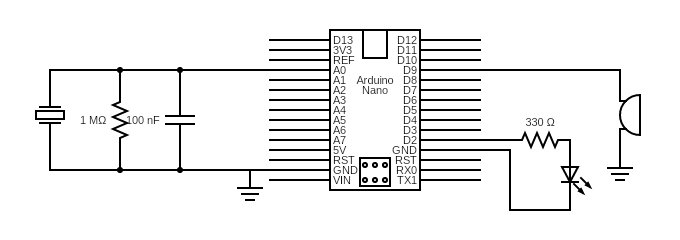 Figure 1- Circuit diagram of one step on the prototype.
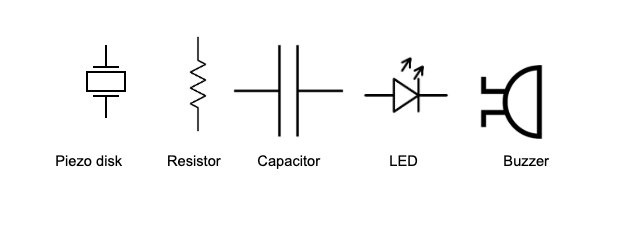 Figure 2- Legend of electronics in circuit diagram
Electrical energy: Each step contains one piezoelectric disk which is parallel to a 1MΩ and a capacitor to stabilize the signal. When pressure is applied to the disk (finger tap), the mechanical stress caused the piezoelectric material to deform which creates a small alternating voltage (AC- Alternating Current). The resistor prevents excessive current buildup and the capacitor stores the electrical charge and releases it smoothly which prevents false triggers and provides a clean signal.
I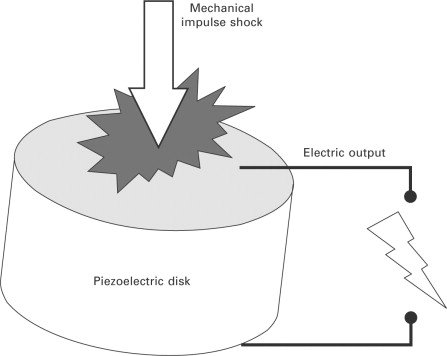 Figure 3- Mechanics of a piezoelectric disc
Musical output: The output voltage from the piezo disk is connected to the analog input pin of the Arduino Nano. When the voltage exceeds the programmed threshold, it will produce the specific note frequency. A corresponding LED will light up simultaneously. Each step has a different note frequency programmed which will produce a melody.
Testing the effects of music
To test the effects of music on motivation, I conducted an experiment at my school and this is how I did it.
Before starting I asked the participant how they feel based on the Likert scale from 1 to 5, one meaning super tired and five meaning super energetic. Then I asked them to climb the stairs in my school two times, first without music and the second time with music, I time their walking speed in both conditions. Then I asked them the same question as before using the same scale and recorded their response. To mitigate bias, I asked them the question one on one and I do not tell them if I am testing the positive effects of music, I tell them I am testing the effects of music.
Analysis
Energy Analysis of Musical Staircase
Using a multimeter, I measured how much electricity one piezo disk produced and the average I got was 0.48V. The capacitor I used was 0.1 μF, which converts to 0.0000001 F using the formula: Formula for capacitance - (Capacitance in Farads) = Capacitance in micro Farads x 10^-6. Capacitance is the capability of an electrical circuit to hold energy.
To calculate the energy one step produced I used another formula and multiplied that by the number of steps which is 5 and got 58nJ after converting Joules to nano Joules. Formula for energy - Energy= 1/2 x Capacitance x Voltage squared. Converting Joules to Nano Joules - Joules x 10^9.
The prototype I built generates 58nJ of energy. Scaling this idea for an actual train station using PAVEGEN's technology of electromagnetic generators, there will be significantly more energy. These generators produce 3 to 5 J of energy per step, so a 50 step staircase climbed by one person will produce 150 to 250 J of energy. In the third quarter of 2024, an average of 261,000 commuters used the 45 C train stations across Calgary, which is about 5800 commuters per station daily. If 40% of the commuters use the stairs, we will get 2320 people using the stairs. Then the number of people and multiplied by 150J equals to 348,000J. 1Wh = 3600J To convert to Watt hour I divided the energy in joules by 3600 and I got 97 Wh. This energy can be used to light up the LED signs in the station or it can be stored used later.
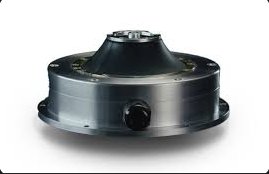 Figure 4- Electromagnetic generator developed by PAVEGEN.
Psychology Analysis
While public transit helps people to move around, it can also introduce short term stressors such as boredom, social isolation and frustration. My prototype plays a musical note every time the piezo disk is tapped and lights an LED bulb simultaneously, which provides an engaging experience for commuters. Researchers at the Holland Bloorview Kids Rehabilitation Hospital in Toronto, Ontario conducted a research on seventeen children age 4 to 7 to investigate the impact of auditory feedback such as music on the achievement on specific therapeutic goals.
They used stair climbing therapy sessions with music and without music and they compared the results. The results showed a 5.7% (p=0.007) increase in a constant and stable stride and levels of participant enjoyment increased significantly (p=0.031) and the participants reported feeling more motivated when the audio feedback was provided.
The probability of the stable stride being random was 0.7% and the chance of the increase in participant motivation being random was 3.1%. My musical staircase applies this idea in a public transit setting which is proven to reduce stress and motivate commuters according to the results provided in this research.
I also consulted Jane Proctor, a certified music therapist based in Toronto, to gain expert insight on the psychological effects of music. She explained that music therapy can influence heart rate, stimulate cognition and memory, and increase endorphin production. She also stated the ISO principle where the music is matched with the person's mood and it is slowly modified to bring the person's mood to the desired state. In addition, she mentioned the speed or tempo of the beat can influence the walking pace. A faster beat tends to increase the walking speed and a slower beat leads to a slower speed but, in both cases the person's walking will be stable.
My musical staircase applies this by converting footsteps into rhythmic beats which entrain heart rate and walking tempo. This promotes calmness in commuters.
Staircase experiment data
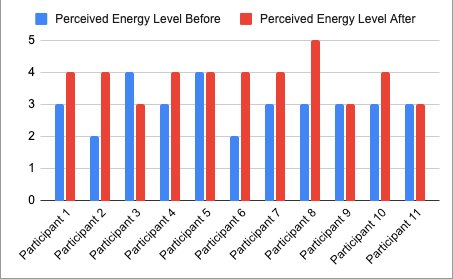
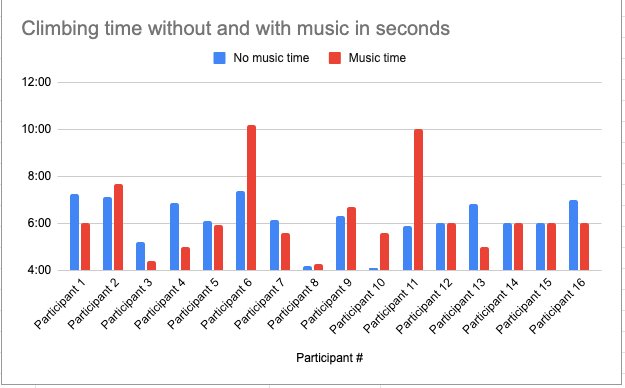
I conducted an experiment in my school which involved students climbing the stairs in my school two times, once without music and another time with music. Before and after they climbed the stairs, I measured their self reported energy levels on a scale 1 to 5, 1 means super tired and 5 means super excited. Along with their energy levels, I measured the time they took to climb the stairs in seconds, first without music and the second time with music and I calculated the average time they took. Note: Some students did not have a perceived energy level from before the experiment. Their data has been included in the time they took in climbing the stairs instead.
 Graph 1, Perceived energy levels before and after:
In this graph the x axis is the participant number and the y axis is the level of self reported energy. Most participants have a energy level of 3 before climbing the stairs and after climbing the stairs two times, first without music and another time with music, most participants reported their energy level to be a 4.
This shows that the music made them feel more energetic when they had mild physical activity along with music.
Graph 1, Perceived energy levels before and after:
In this graph the x axis is the participant number and the y axis is the level of self reported energy. Most participants have a energy level of 3 before climbing the stairs and after climbing the stairs two times, first without music and another time with music, most participants reported their energy level to be a 4.
This shows that the music made them feel more energetic when they had mild physical activity along with music.
 Graph 2, Stair climbing time with and without music:
In this graph the x axis is the participant number and the y axis has the time they took in seconds. Most of the students climbed the stairs faster with music compared to without music since they were actually faster with the music or they took two steps on every tap/ beat of the music. The students who climbed the stairs slower with music than without music were more on beat with the music.
This shows that music can increase the speed of climbing or automatically make us walk on beat.
Graph 2, Stair climbing time with and without music:
In this graph the x axis is the participant number and the y axis has the time they took in seconds. Most of the students climbed the stairs faster with music compared to without music since they were actually faster with the music or they took two steps on every tap/ beat of the music. The students who climbed the stairs slower with music than without music were more on beat with the music.
This shows that music can increase the speed of climbing or automatically make us walk on beat.
 Graph 3, Average perceived energy with and without music:
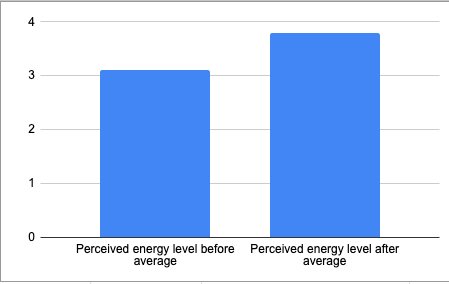
The average perceived energy levels without music was 3.1 whereas the average perceived energy with music was 3.8. This shows music can make us feel more energetic.
Graph 3, Average perceived energy with and without music:
The average perceived energy levels without music was 3.1 whereas the average perceived energy with music was 3.8. This shows music can make us feel more energetic.
 Graph 4, Average climbing speed without and with music:
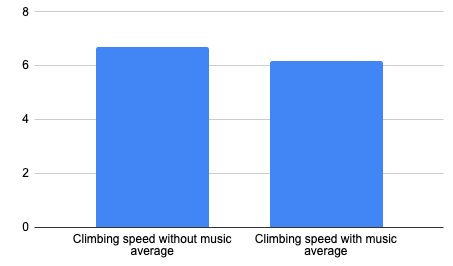
The average climbing speed without music in seconds was 6.7 seconds whereas the average climbing speed with music was 6.19 seconds. This shows that music can help us climb faster.
Graph 4, Average climbing speed without and with music:
The average climbing speed without music in seconds was 6.7 seconds whereas the average climbing speed with music was 6.19 seconds. This shows that music can help us climb faster.
My observations in this experiment are that music positively impacts our energy levels and speed on normal circumstances.
Limitations in a musical staircase
Even though there are many benefits from musical staircases, there are some limitations such as technical issues. Constant usage of the staircase can lead to the degeneration of the pressure sensors or other elements. Another challenge could be related to the costs of installation. On a large scale at first the installation costs could be high but in a long term it could save energy and money from reduced electricity consumption. Lastly, another potential limitation could be the music distracting some of the commuters or the musical notes could be too loud which ends up causing noise pollution. With routine maintenance checks and controlling the volume of the music the musical staircase can be a positive experience for all.
Conclusion
Potential use cases
- Transit stations
Installed in transit stations to reduce short term stress and generate electricity for LED signage.
- Commercial buildings
Used to encourage movement and power interior and exterior lights
- Educational institutions
Installed in schools to demonstrate related concepts and increase student participation.
- Hospital integration
Used in hospitals to encourage better health and provide musical relief.
Alternative implementation
If staircases are unavailable, the same technology can be modified for pedestrian pathways.
Design modification Instead of vertical staircases pressure sensing tiles can be embedded into the side walk and repeated usage can harvest energy
Operation Pressure is sensed by the tiles and mechanical energy triggers the sensors and generates electricity and produces music. The generated energy is stored in a battery for later use.
Advantages Some advantages are it is suitable for high traffic areas, flexible installation, gathers energy from larger population groups since some people may not be able to use stairs. Not only that, it can be scalable to city centres and used in multiple places.
Conclusion
This project demonstrates a hybrid technology which merges renewable energy harvesting with psychological engagement techniques. Although the prototype's energy production is minimal, scaling this using industrial level kinetic technology enables practical energy generation.Experimental data suggests auditory feedback such as music does have a positive impact on commuters motivation and mental health during usage. The musical staircase presents a scalable and practical approach to transforming passive transit station infrastructure into an interactive and enjoyable experience for commuters while providing sustainable urban technology.
Citations
Websites used
2024-Q3-Ridership-APTA
- https://www.apta.com/wp-content/uploads/2024-Q3-Ridership-APTA.pdf
How Does Public Transit Affect Mental Health?
-
https://lifestyle.sustainability-directory.com/question/how-does-public-transit-affect-mental-
The Effects of Music Tempo on Arithmetic Cognition Testing, Heart Rate, and Perceived Stress * https://spark.bethel.edu/cgi/viewcontent.cgi?article=1010&context=human-kinetics-students
PAVEGEN
- https://www.pavegen.com/how-it-works
City of Calgary newsroom
- https://newsroom.calgary.ca/calgarys-light-rail-transit-system-past-present-and-future/#:\~:text=The%20inaugural%20line%2C%20built%20in,connecting%20Calgarians%20like%20never%20before.&text=Construction%20resumed%20in%20the%20early,make%20travel%20even%20more%20efficient.
Psychology Today
- https://www.psychologytoday.com/ca/blog/urban-survival/201501/commuting-the-stress-that-doesnt-pay
Musical stairs: the impact of audio feedback during stair-climbing physical therapies for children
- https://www.tandfonline.com/doi/full/10.3109/17483107.2014.886085#:\~:text=All%20reports%20(child%2C%20therapist%2C,warrants%20further%20development%20and%20evaluation.
Let’s Talk About Iso-Principle: The Introduction
- https://musictherapytime.com/blog/lets-talk-about-iso-principle-the-introduction
Hospital installs ‘piano staircase’ to boost exercise
- https://www.classicfm.com/music-news/taiwan-hospital-piano-staircase-boost-exercise/
Science Direct
- https://www.sciencedirect.com/topics/engineering/piezoelectric-disk#chapters-articles
Science direct
- https://www.sciencedirect.com/topics/materials-science/capacitance
Stock Cake
- https://stockcake.com/i/musical-stairway-ascending_2038805_1296501
Super Simple Psychology
Acknowledgement
I personally thank Mr. Webster, Ms Easton and Ms Teasdale in supporting and guiding me throughout my project, my family for their assistance and encouragement during the entire duration of this project. A special thanks to Jane Proctor for providing very helpful insights on music therapy and all the students who volunteered to participate in my experiment. I once again thank all these people for providing all the support to make this project happen.