
Swing or be Swung
Ashely Wang, Sophia Mathews
Bearspaw Christian School & College
Grade 8
Presentation
Problem
Hypothesis:
If I change how the pendulums are attached to the model then it will make no difference because resonance should still take place because the pendulums are connected to the bar.
Question:
How does the way the pendulums are connected to each other affect the response to the forcing pendulum?
Method
Variables
When we were first testing, we had many unsolved variables which didn’t help us prove our point. This time around we have learned from our mistakes, and have tried to make some changes - some are not able to be changed
Independent, Dependent, Controlled variables CONTROLLED VARIABLES
- Length of strings,
- weights of other masses on strings,
- height of framework,
- string material
- Force applied to pendulum
- Framework material
- Table of which the framework sits on
- Height of which the pendulum is dropped
- Speed of releasing the pendulum
- Number of Pendulums
- Starting positions of pendulums
- Method of measurement
- Air conditions while doing the experiment
- Where the camera sits
- How the camera sits
- Where it sits
- What is mounted on top
- How the tripod is attached to the table
- Where the tripod stands
- Measurement system
- What units we measure in
- Where the measuring point starts
- How we measure
- Attaching the framework to the table
- Where the framework sits
INDEPENDENT VARIABLES
- Connection of the pendulums
RESPONDING VARIABLES
- How far the responding pendulum swings
How we changed variables
- Place two more weights onto one pendulum, then repeat steps 11-14
- Remove extra pipe from step 3, attaching the pendulums directly to the framework
- Remove supports at the base of the framework
Procedure
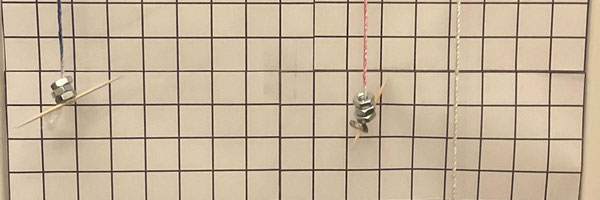
1. We set up a frame from which we could swing pendulums. The frame allowed us to vary how we attached the pendulums an stable the frame was. 2. Next we connected four pendulums; two of equal length\, one much shorter\, and one much longer. Each pendulum was weighted the same using steel nuts. 3. We set up a 2 centimetre grid perpendicular to the frame which allowed us to measure the swing of each pendulum. 4. Our first set of trials consisted of the pendulums being attached to a bar which was suspended from the frame. 5. For the next set of trials the kept everything the same except we removed the stabilizing feet of the framework\, causing the frame to shake more. 6. In the next set of trials we removed the suspended bar and attached the pendulums to the frame\, keeping the stabilizing feet off. 7. In our last trials the pendulums were attached directly to the frame\, but this time the stabilizing feet were attached. 8. For each trial we pulled the forcing pendulum back using a tower mechanism to keep everything consistent. 9. We recored the set up using a phone. 10. Afterwards we measured the swing of the responding pendulum and recored the data
Research
Background Information:
| We wanted to do a resonance based science project because we think it's cool and no one will do it. This means we have no competition doing the same project. We wanted to do a pendulum model to explain resonance and understand it better by making this model. |
|---|
What is resonance?
The reinforcement or prolongation of sound by reflection from a surface or by the synchronous vibration of a neighboring object.” - Oxford Languages Dictionary
When something is forced to vibrate, if that vibration is at the natural frequency of the object being vibrated, then energy is most efficiently transferred. This is called resonance.
Examples
Guitars
As Charlie Loach on “Sandiego Troubadours”, Acoustic instruments are designed to resonate.
Swings
When you get on a swing, your first motion is to pump your legs (once you get it going of course). When swinging, you only drive your legs at a certain point, and straighten them at another - You know that if you swing your legs at the wrong time, the swing will not gain energy, but may even slow down. This is an example of resonance! The swing had a natural frequency which it gravitates to. You match this frequency when you swing at a certain time, making the swing go higher with the combination of resonance and motion.
Bridges
When resonant vibrations destroyed the Tacoma Bridge in Washington no one knew why. It was surprising at the time as the structure was supposed to withstand wind speeds up to 120 mph but collapsed within a mere 40 mph. It is believed that the wind that day just so happened to be just right and hitting the bridge at just the right angle. This caused a deadly vibration that eventually grew so large that the bridge broke.Just like a child swinging on a swing, the more the bridge swung the higher the resonance. The bridge eventually collapsed.
Microwaves
Most microwave ovens have a frequency of 2.45 Ghz, which is the same rotational frequency of water molecules. When you heat up something in the microwave, the water molecules will vibrate and spin (rotate). The microwaves match the frequency of the molecules, which is resonance. The vibrating molecules hit and collide with molecules next to them, which transfers the energy Serway, R. A., & Jewett, J. W. (2018). Physics for Scientists and Engineers (10th ed.). Cengage Learning. Halliday, D., Resnick, R., & Walker, J. (2014). Fundamentals of Physics (10th ed.). Wiley. U.S. Department of Energy (2023). How Do Microwaves Cook Food? Energy.gov. https://www.energy.gov NASA Glenn Research Center. Microwave Heating Explained. NASA.gov.
Head Massagers
We learned that head massagers also have there own natural frequencies. The individual strings in the head massagers all have its own natural frequency, and becasue of that, when you pull back one of the strings and let go, all of the strings vibrate. This is because by resonance, it will excite all of the strings around it and cause them to vibrate.
Data
Graphs


Conclusion
Conclusion and Hindsight
Compared to our hypothesis, we were incorrect. Resonance takes effect when the pendulums can move freely. When we tested with the swinging bar attached to the frame, the responding pendulum moved further compared to other attempts. But once we linked the pendulums directly onto the frame, the responding pendulum barely moved. After we took the stabilizing legs off the frame, the pendulums started to move because the frame could rock freely, causing resonance to occur.
As a result we took the sturdiest set up we could and started to rock the table of which it was sitting on. After a few attempts we started to rock the table at the frequency that the shortest pendulum responded to. This is the best representation of the boy on the swing.
If we had four more months and an unlimited budget, we would most likely take advantage of the extra time, and not so much the money. We would take many more tests, creating a better average. One other concept that interested us was the change of weight on the pendulums. As we already did some experimenting, we found that the pendulum with extra weight didn’t travel as far, but pushed the responding pendulum extra high, which was quite fascinating.(Note: we are referring to two pendulums of equal length hanging off something that would allow enough rocking space for resonance to occur) I would also enjoy going into exploring all the possibilities of how weight and distance would affect how the resonance took place, and also what would stop resonance from acting.
Pivots
Our experiment consisted of many mistakes or adjustments made along the way. At first we had to change our set up for the experiment, originally hanging off a table. The results of this were uneven swinging and the pendulums clumping together. Another mishap that occurred during testing was the fact that we couldn’t see the ruler, which we were going to use for measuring how far the pendulums swung. Other issues such as the camera shifting, causing irregular calculations and the pipes not being fully inserted into the joints.
Successes/Solutions
We first resolved the experiment issue. By building a frame out of pipes with a sturdy bar that wouldn’t cause drooping, we have solved the issue of uneven swaying. Once we built the frame, we started our testing, which revealed that the pipes had not been fully attached to the linking mechanism, meaning the frame couldn’t rock, defeating the purpose of the design, and therefore ruining our testing. Of course, once we noticed we pushed the pipes in further, and the issue was only a mild setback! Next, we adapted to the fact that we couldn’t see the ruler. During testing we assumed the ruler was in sight of the camera, when it actually wasn’t causing us this problem. The testing had already taken so long, so redoing it wasn’t an option. Instead we used an image processing app to measure using their units. Although it took a while to figure out how we were going to measure, this fix made the rest easy. When reviewing the recordings of the experiments, we found that the camera had shifted slightly, causing our measurements to be off. We actually thought of this scenario, and had placed tape down to mark where the tripod sat. Somehow either the tripod moved or the frame migrated. As a result we had to take in the camera angles and figure how to best change the measurement system. In the end we did solve this, but the measurements are still slightly off (not by much though).
Citations
BYJU’S. (n.d.). Resonance. BYJU’S. https://byjus.com/physics/resonance/
Encyclopaedia Britannica. (n.d.). Resonance (vibration). https://www.britannica.com/science/resonance-vibration
HowStuffWorks. (n.d.). More bridge forces: Resonance. https://science.howstuffworks.com/engineering/civil/bridge10.htm
HowStuffWorks. (n.d.). What is resonance? https://science.howstuffworks.com/resonance-info.htm
IC-Components. (n.d.). Exploring resonance and its applications. https://www.ic-components.com/blog/exploring-resonance-and-its-applications.jsp
Merriam-Webster. (n.d.). Resonance. In Merriam-Webster.com Dictionary. https://www.merriam-webster.com/dictionary/resonance
San Diego Troubadour. (n.d.). Ask Charlie. https://sandiegotroubadour.com/ask-charlie/
Science4All. (n.d.). Resonance. https://www.science4all.org/article/resonance/
The Thrilling Physics of Head Massagers Hoang, L. N. (2015, June 16). The thrilling physics of head massagers [Video]. YouTube. https://www.youtube.com/watch?v=oBzaCUFiF_s
Acknowledgement
We would like to start by thanking our CYSF coordinator, Mr. Nathan Oostenbrink. Without him, we would not have been able to be a part of this. We would like to thank all our family members who supported us, and our school who inspired us to be a part of the CYSF.