
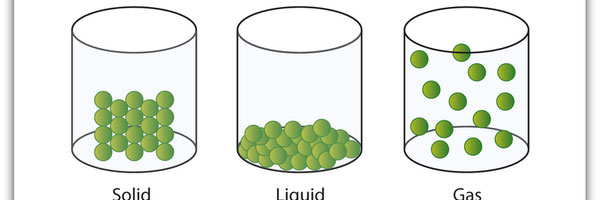
Molecules On The Move! How does matter change state?
Sonja Polanski
John Costello Catholic School
Grade 5
Presentation
No video provided
Hypothesis
1) State of Matter: Liquid to Liquid (Acid Based Reaction)
Butterfly Pea Powder Lemonade I'm going to prove that the pH level of my liquid will change when I add another liquid. To prove this I will show my base tea without the acid (lemonade) is a certain pH before. Without the acid the color of the tea with just water and the butterfly pea powder would be dark blue, WITH the lemonade I think the pH will change because I know the color changes. To also prove this I will use a pH strip, the pH strip will tell me what the pH level is in the lemonade.
2) State of Matter: Liquid to Solid ( Spherification )
Juice to gel Bubbles I'm going to mix the juice with a chemical compound called Sodium Alginate. Then drop the liquid mixture into a bowl, with water and another chemical called Calcium Chloride ( this is all edible and food safe by the way :D), I think this will cause the liquid mixture to change to a solid gel.
Research
Properties of a liquid relative to pH:
- high density relative to gases
- fluidity (ability to flow)
- surface tension and viscosity
- diffusion (acid spreading)
- solubility (pigments dissolving)
- pH sensitivity (indicator chemistry)
Properties of a solid:
- fixed volume and shape
- high density
- strong intermolecular forces
Properties of a gas:
- variable shape and volume
- high compressibility
- low density
- particles far apart
- particle behavior
Experiment 1:
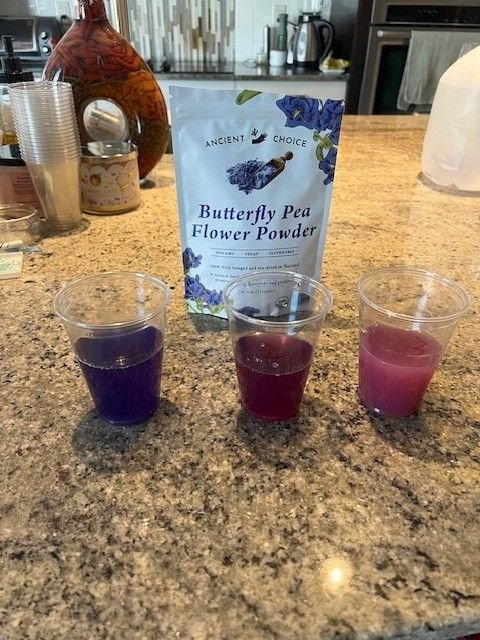
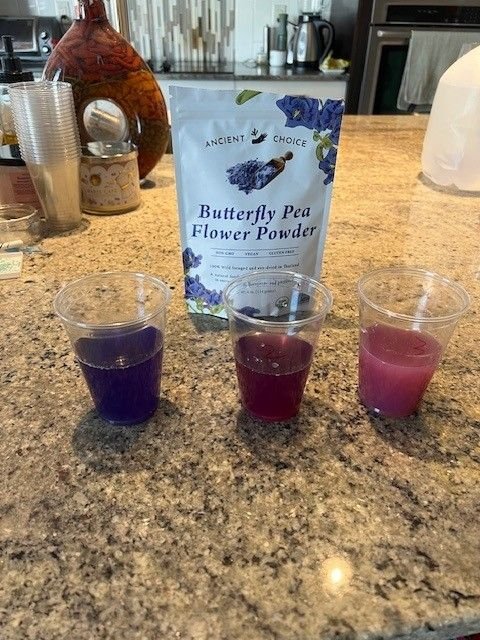
For my 1 experiment, i'm going to change the color and pH of a drink called butterfly pea powder using lemonade. When the acid is added to the controlled mixture ( which is neutral ) the color will change from a dark blue to a purple, if you add even more acid the color will change from a purple to a light pink. when the color changes this happens because the acid changes the level of pH in the cup which has a great effect on the color.
What is Butterfly Pea Powder? ( Experiment 1 ) :
Butterfly Pea Powder is a natural blue powder made from dried flowers. It's commonly used as natural food coloring, herbal tea, cosmetic ingredient. Butterfly Pea powder is famous for being very pH sensitive, when it's neutral it turns deep blue, when it's acidic it turns purple, wen even more acid gets put into it it turns light pink. it's intense blue color comes from natural pigments called anthocyanins, the same class of antioxidants found in blueberries.
What is pH? ( Experiment 2 ) :
PH is the scale of how acidic or how basic a liquid can be. The scale for pH typically is from 0 to 14, pH levels from 0 to 6 is acidic, pH levels of 7 is neutral, and 8 to m14 is basic.
What are Anthocyanins? ( Experiment 1 ) :
Anthocyanins is a natural plant pigment that gives many fruits, flowers, and vegetables their red, purple, and blue color. Anthocyanins change color because they are pH sensitive , which means they change color depending on the acidity. The more acidic it is the color changes to a red, when it's neutral the color changes to a purple, when it's basic, the color can change to a blue-ish green. This happens because the molecular structure changes.
Experiment 2:
For my 2 experiment, i'm going to turn apple juice into liquid gel. When a liquid turns into a gel using sodium alginate and calcium chloride, this happens because of how the molecules move and connect, i'm going to prove that by changing the state of the matter ( property ) of the liquid.
What is Sodium Alginate? ( Experiment 2 ) :
Sodium Alginate is made from seaweed and it's pretty much the same as another substances called Agar Agar. Agar Agar and Sodium Alginate are both used in foods like, ice cream, sauces, vegan desserts, cheeses, and the most important thing based on my project fruit jellies of fruit spheres! When Sodium Alginate mixes it forms a liquid solution, the molecules from the Sodium Alginate float freely in the water like long strands. In this state, this mixture behaves like a liquid because the molecules can move past each other with ease so the solution flows freely.
What is Calcium Chloride? ( Experiment 2 ) :
Calcium Chloride dissolves in water and releases Calcium ions, these Calcium ions are the key to turn the liquid into a gel. Calcium Chloride is used in the foods, pickles, canned tomatoes, fruit caviar spheres ( with sodium alginate ), milk, sports drinks, and packaged tofu!
FUN FACT!!! : Calcium Chloride is actually used to make stretchy mozzarella! it's used in mozzarelle because it really helps the milk proteins bind together!
What happens when the two meet? ( Experiment 2 ) :
The Calcium ions mixes with the Alginate solution ( apple juice and Sodium Alginate ) then the Calcium ions connect the Alginate chains together. This is what makes the liquid apple juice into a gel!
Variables
Controlled Variable ( Experiment 1 )
- size of the cups,
- amount of butterfly pea powder
- amount of distilled water in each cup
- my base mixture
Independent Variable ( Experiment 1 )
- How much acid ( lemonade ) is put in each cup
Dependent Variable ( Experiment 1 )
- How the pH level changes in each cup
Controlled Variable ( Experiment 2 )
- how much sodium alginate to apple juice I used
- type of juice I use
- how much distilled water to calcium chloride
Independent Variable ( Experiment 2 )
- the length of the polymer bonds
Dependant Variable ( Experiment 2 )
- the contiontrate of each of the chemicals
Procedure
Experiment 1 ( liquid to liquid )
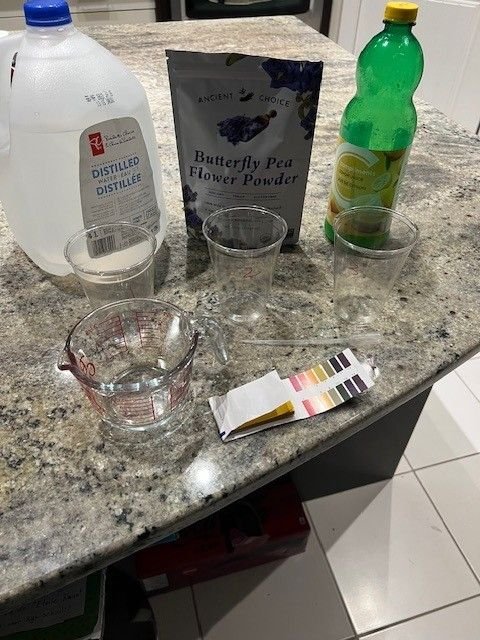
1. I prepared distilled water 3/4 cup of water
2. 1/4 teaspoon of butterfly pea powder\, dissolved it till it was mixed completely
3. I poured a quarter of the solution into 3 seperate cups
4. I labeled the cups 1\, 2\, and 3
5. Next I made my acid solution
6. I prepared a quarter cup of lemon juice and 1/4 distilled water to make my acid liquid ( lemonade )
7. Cup 1 will be my base mixture\, cup 2 will be my first acid mixture\, cup 3 will be my second acid mixture
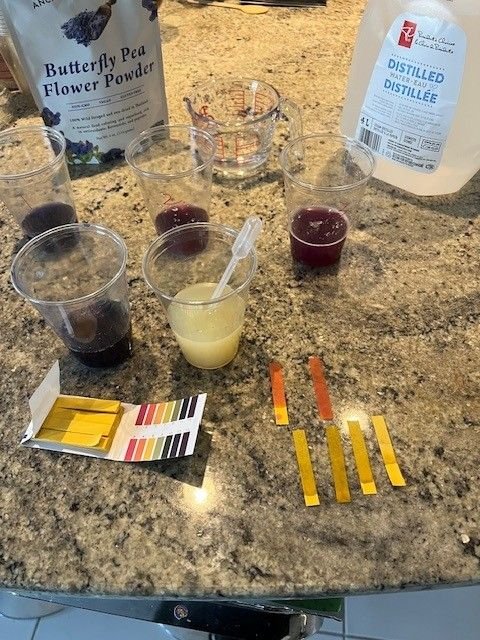
8. I'm going to measure the pH of my base using indicator paper ( pH strips )
9. I'm going to measure the pH of my acid mixture using once again the indicator paper ( pH strips )
10. I observed that my base tea was a 7 and my acid mixture tea was a 3
11. I tested if the pH for my base was the same in cup 1 and it was still a 7
12. I tested cups 2 & 3 to confirm and yep it's still the same
13. Put 1 teaspoon of my acid solution into cup 2\, and it turned pink
14. I tested the pH and it changed from a 7 to a 4
15. I put 5 teaspoons of my acid solution into cup 3 and it turned light pink
16. I tested the pH and it changed again from a 7 to a 3
17. I added 1/2 of the distilled water to each mixture and I can visually see the change of the color!
Experiment 2 ( liquid to solid )
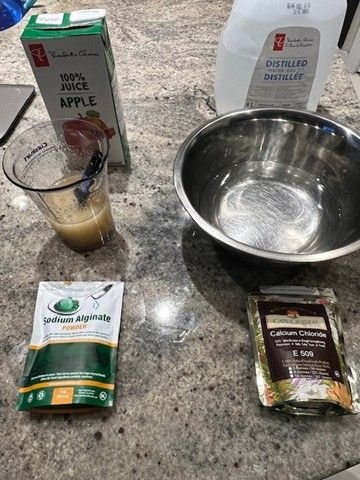
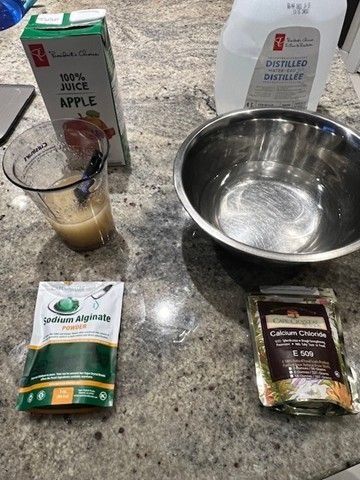
1. I got 250 ml of apple juice and 1.25g of sodium alginate
2. Then I used an immersion blender and blended it for 30 seconds until it was fully blended together
3. I chilled the solution in the fridge for 1 hour\, this will allow the sodium alginate to hydrate and create the polymer bonds
4. I then prepared the calcium chloride mixture
5. I poured 500g of distilled water into a bowl
6. And mixed in 3g of calcium chloride
7. Then I blended it all together with a whisk until it was all dissolved
8. Water & calcium chloride solution will now separate the calcium ions out in the solution this will be what will bond the polymer chains together
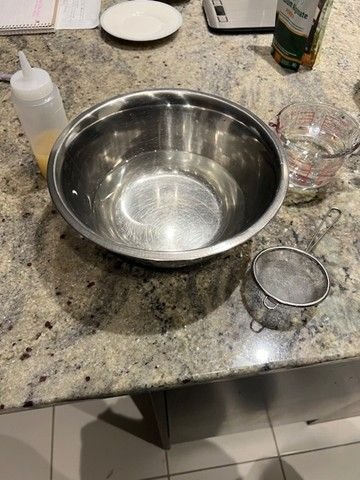
9. I poured the chilled solution ( apple juice & sodium alginate ) into a squeeze bottle
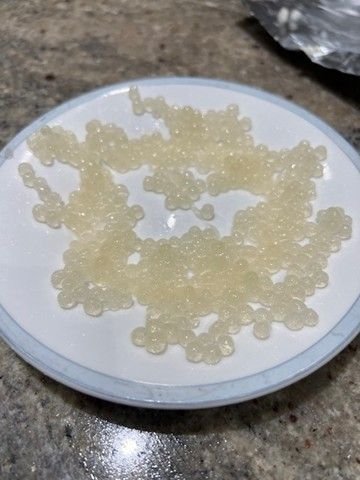
10. Then I dropped little droplets of the chilled solution into the water & calcium chloride solution
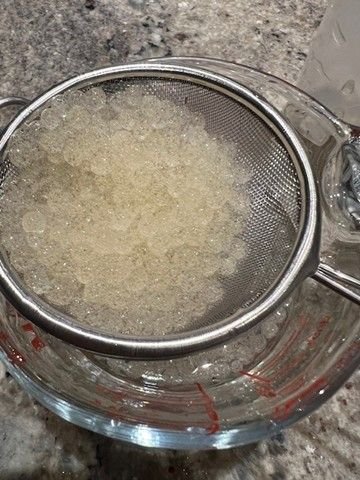
11. Then I used the strainer and took the fruit caviar out of the water & calcium chloride solution and dropped them back into distilled water to wash it
12. Then I used the strainer again to take the fruit caviar out of the water and put it on a napkin
13. Then the last step is to.... Enjoy the lovely taste of the fruit caviar!
Observations
Experiment 1 ( Observations )
I tested the pH of my base mixture and the pH was 7 ( cup 1 ), I tested the pH for cup 2 and 3 and they all were 7 before I put in the acid, but after I put in the acid ( lemonade ) cup 1 was still 7 because it's my base, cup 2 went from 7 to 4 on the pH scale, and cup 3 went from 7 to 3 so there was drastic change of the pH after the acid had been added. When I added the 1 teaspoon of acid ( lemonade ) to cup 2, I noticed how it changed it's blue color to a little bit lighter pink. The color of cup 2 was visible different from my base cup ( cup 1 ) and my other cup that had no acid in it just yet ( cup 3 ). But when I added 5 teaspoons of acid into cup number 3 I was in awe at the beautiful pink color of the lemonade in the cup. I also noticed when I tested the pH using the pH strips the ones with more acid had a higher reading of pH in the cups.
Experiment 2 ( Observations )
One of the first things I noticed about this was how the mixture of sodium alginate and apple juice became more thick after it chilled in the fridge for an hour, this happened because when you put the sodium alginate and apple juice into the fridge it allows the sodium alginate to hydrate and create the polymer bonds. But what stood out to me the most is when I dropped the solution of sodium alginate and apple juice into the bowl with the calcium chloride, how it immediately turned from a liquid to solid zero hesitation. The reason this happened is because when the polymer bonds from the sodium alginate and the calcium ions from the calcium chloride meet, the calcium ions and the polymer bonds link together forming the jellies.
Analysis
Analysis ( Experiment 1 )
Based on my hypothesis I believed that the level of pH in my liquid would change when I added another liquid, and based on my observations I was right. I was right because when I tested the level of pH in the cups after I added the acid ( lemonade ) my pH level had changed in cup 2 from 7 to 4, and the pH in cup 3 had changed from 7 to 3.
Analysis ( Experiment 2 )
Based on my hypothesis I believed that when the sodium alginate and apple juice mixed with the calcium chloride solution the sodium alginate and apple juice would turn into a solid gel. I was right for this experiment too! I was right because when I took the sodium alginate and apple juice solution and dropped it into the calcium chloride solution it turned into a solid.
Conclusion
Conclusion
For my conclusion, I proved that I was successfully able to change the state and property of matter.How I proved that matter can change state and property by simply manipulating the molecules either by concentration of a solution or by molecular bonding. So that means molecules are always on the move!
Application
Application ( Experiment 1 )
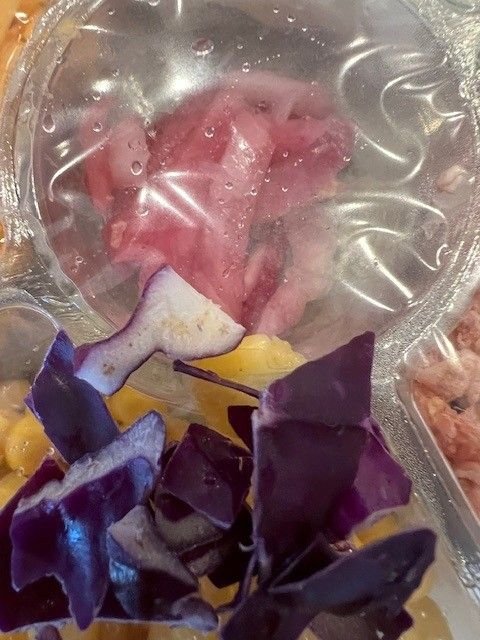
I found out in this experiment that other foods that do the same pH color change include red cabbage, blueberries, purple sweet potato, purple corn, hibiscus, grape skins, red wine, and pickled red onions! this all happens because these all contain anthocyanins too, so they act like natural pH indicators.
Picture Of Pickled Red Onions
Application ( Experiment 2 )
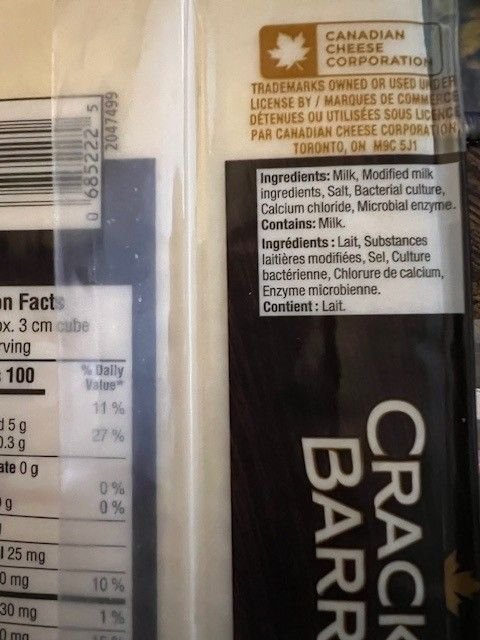
I found out in this experiment that calcium chloride is used to make mozzarella and cheese! Calcium chloride is used in popular cheese brand called Cracker Barrel. It's also used in other brands that are not for cheese, for example it's used in Gatorade, Kraft, Del Monte ( Brined products brand ), and Boost Nutritional Pudding.
Picture Of Cracker Barrel Cheese ( look at ingredients for calcium chloride )
Sources Of Error
Experiment 1
For my sources of error I strangely didn't have many which is a good thing, but for my one source of error I did have was that when I did the base mixture for the butterfly pea powder the mixture was a bit too concentrated so I just had to add a little less butterfly pea powder or add some more distilled water.
Experiment 2
For my sources of error for experiment 2 I actually didn't have any sources of error everything was done correctly and everything was perfect. :D
Citations
I would also like to reference this show on Netflix that helped with a part of my project :
Emily's Wonder Lab: Episode 6 Season 1 :Slime Time 12m A pool filled with glue helps the gang learn all about cross-linking polymers. (Hint: They’re making slime!) At-home experiment: meteorite slime.
Website Citations :
https://en.wikipedia.org/wiki/Clitoria_ternatea?
https://www.sciencedirect.com/science/article/abs/pii/S0141813097000408
https://cheesescientist.com/science/calcium-chloride/
https://www.britannica.com/science/anthocyanin
Youtube Citations:
https://youtu.be/w87mKr7X3kM?si=zd92YwSwh5kn9-y8
https://youtu.be/KvKyWiT9fcY?si=2zelFD1RAYtaOfgZ
Acknowledgement
For my acknowledgements I would like to thank my mom who helped me when I was stuck and needed help on any parts that I didn't understand. And to my dad who would encourage me with my project through the whole science fair. Also I would like to thank Google for helping me with my research.