

From Wheels to Watts: Capturing Energy from Everyday Traffic
Emer Geng
Louis Riel School
Grade 8
Presentation
Problem
Across continents and societies, governments, cooperations, research groups and individuals alike are all joined by one pressing problem: how to produce energy that is both reliable AND sustainable. In the day and age of our modern civilization today, humanity is at an insatiable demand for power and energy, whether it's electricity to power our cities, fuel to keep cars running, or energy used to charge digital infrastructure, energy is needed to sustain our daily life in the technological era. According to the International Energy Agency (IEA), the global electricity demand surpassed 25,000 terawatt-hours in recent years and it continues to grow by 2-3% per year, driven by population growth, urbanization, industrial expansion and most importantly, the rapid growing demand for fueling transportation.
The urgency and demand for this type of sustainable and reliable energy production is at its peak in the modern day and age. Traditional energy production sources such as coal, oil, and gas, have historically led to industrial revolutions and provided reliable and large-scalable power that in turn affected and caused economical growth. However, unrecognized before were their environmental costs, as more than 75% of the worlds global green house gas emissions are and were caused by unsustainable fuel production practices. These newly discovered climate affects are what drive and force policy makers and innovators to reconsider our long standing dependencies.
Though certain, more reliable sources such as solar and wind energy do exist, they introduce new challenges. The sun does not always shine and in certain regions, almost never at all, and the wind doesn't always blow - especially in places like Canada or the United States that are covered and sheltered almost completely by infrastructure. Alongside that, places that are more urban and industrially developed often are also the ones who require and have a higher demand for energy and fuel.
Modern transportation infrastructure represents one of the most environmentally disruptive and energy intensive systems ever created. Still, around 95% of the worlds transportation energy still comes from fossil fuels. While depended on heavily by modern civilization, these system produce around a quarter of the worlds energy related green house gas emissions, largely from the practices used to produce energy to fuel transportation and from the emissions vehicles themselves release into the atmosphere. Meanwhile, alongside these vehicles burning energy is the streetlights that guide them in the night. Millions of streetlights consume electricity every night across the world, increasing overall energy demand and placing additional strain on power systems.
Piezoelectric tiles offer us an encouraging remedy as they allow for electricity to be produced with any kind of pressure, in our case, mechanical. By integrating them into our worlds road systems, we can take advantage of wasted mechanical energy from heavy transportation vehicles and collect it to power energy dependent systems across the world today with the possibility of large scale and small scale implementation.
So, how can piezoelectric tiles integrated into high traffic road surfaces convert the pressure from everyday vehicle movement into a reliable source of sustainable energy?
Method
Pre-Project Plan
Below is a table of the tasks I must complete to complete and guide this project successfully
| Step | Task | Description |
|---|---|---|
| 1 | Learn | I will do extensive research and learn about the internal structure of piezoelectric tiles, how they work, and about why reliable and sustainable fuels compare better to traditional fuel practices. I will demonstrate my understanding through a presentation. |
| 2 | Design goals | I will apply my research and newfound understanding into designing a system where piezoelectric tiles can be layered and integrated into roadways for optimal success and reliability. |
| 3 | Explain | I will justify and explain why this first design is a good starter and basic structure for my design. I will find the strengths and limitations/possible problems of my first design. |
| 4 | Compare | I will compare my model and design to pre-existing structures and designs that generate sustainable and reliable sources of energy (with and without piezoelectric tiles). I will identify the strengths and weaknesses of pre-existing innovations and use this information to improve my design further. |
| 5 | Re-design | I will improve my old design with newly improved elements gained from comparing it to pre-existing implementations. I will justify and explain why my newly innovated design is best for a government or region (in this case Canada) to implement into their roadways. I will also explain how each element of this design works and why I chose the specific materials used. |
| Step | Task | Description (mini prototype design) |
|---|---|---|
| 6 | Sketch | I will sketch out my new design of my mini prototype of a piece of a piezoelectric road. |
| 7 | Create | I will use bought materials and make a real life version of my design. |
| 8 | Evaluate | I will evaluate the strengths and limitations of my prototype and how it can be enhanced/changed when implemented in a large-scale. |
| 9 | Explain and Assess | I will explain why this design meets/doesn't meet my goals and I will assess what regions it would work most optimally in and how it can be changed to adapt to other regions. I will also determine and discover new ways piezoelectric tiles can be implemented into structures outside of roadways. |
For this project I included and designed a mini, real life prototype to go with extensive research of large-scale implementation of this innovation and design.
Design goal: Use the weight and mechanical pressure produced by vehicles on high traffic highways and convert it into electricity with the help of piezoelectric tiles. Then, collect this electricity in an empty lithium ion battery which can be used to effectively power traffic or street lights that surround the roads.
Hypothesis: If we install piezoelectric tiles beneath high traffic roadways such as highways, then we can capture the electrical energy created by the pressure of moving vehicles and convert it into useable electricity because piezoelectric materials generate an electrical charge when they are subjected to compression or vibration and by trapping and storing that energy we can use the otherwise daily wasted mechanical energy onto a new more sustainable and reliable source of power for modern infrastructure.
Step 1: Research
(includes some slides from my presentation crafted from my research)
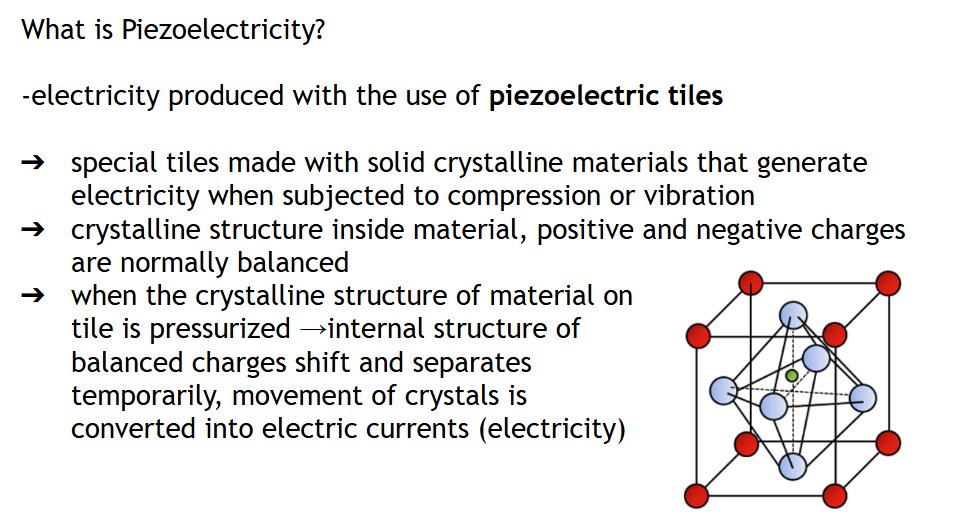 Piezoelectric materials are not only effective when subjected to compression, but also react when subjected to vibrations
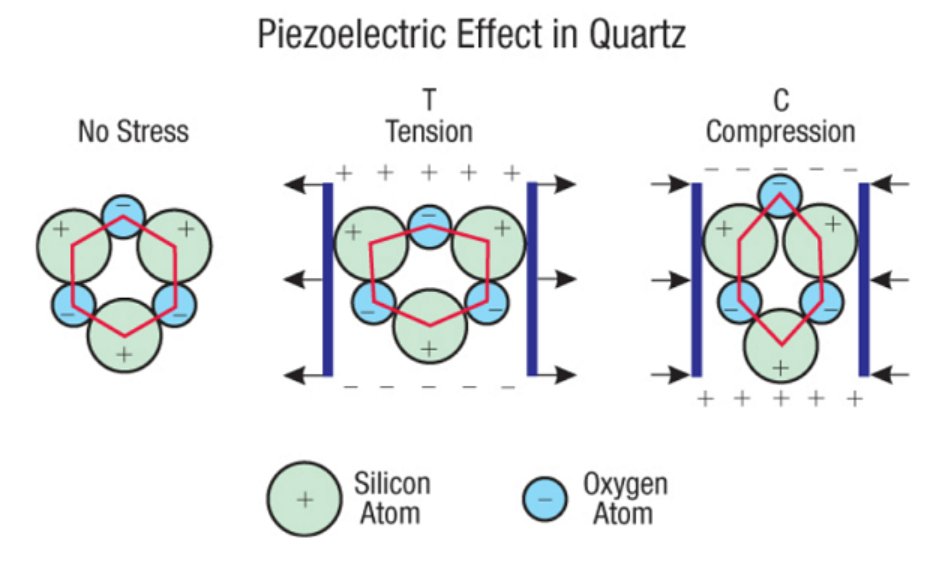 (The internal structure of the crystals inside a piezoelectric tile)
Typically when not subjected to compression, the internal structure is balanced, so no electrical charge is generated. However, when the crystalline structure, in this case quartz, is compressed or vibrated, the internal structure shifts out of place which generates an electric charge.
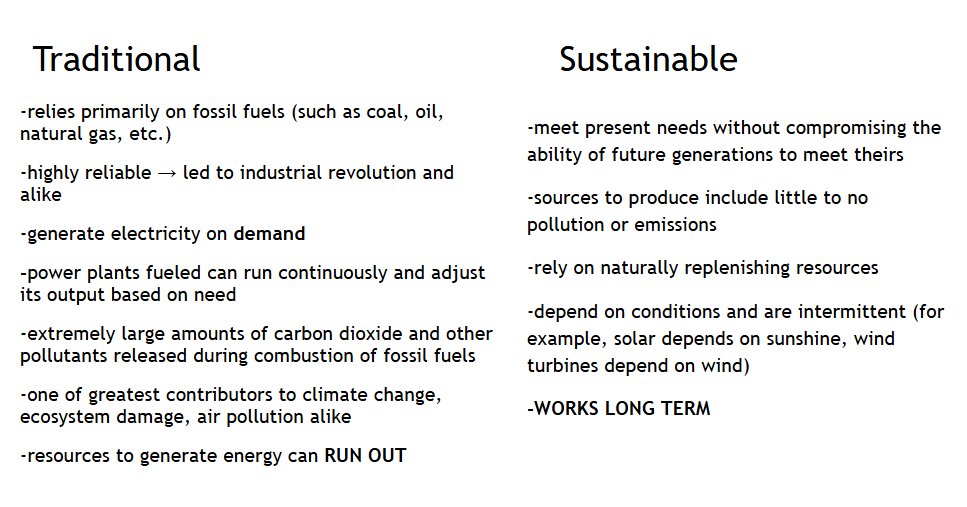
(An infographic on data and approximate costs of piezoelectric roads and types of streetlights)
Step 2 & 3: Design first version of prototype
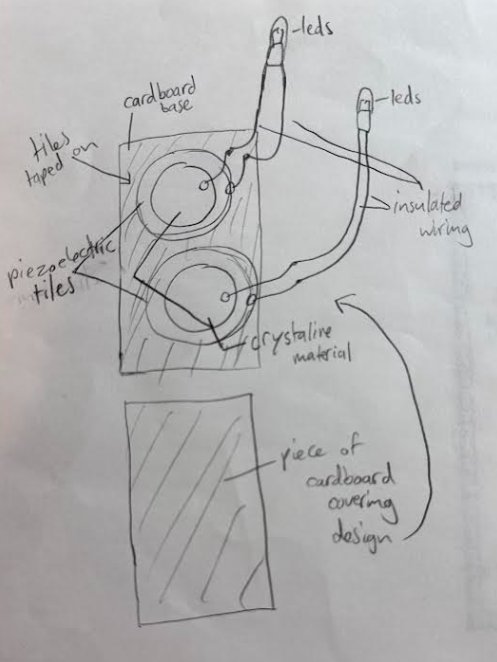
- The piezoelectric tiles are laid out one ahead of the other because cars drive in straight lines which will be able to weigh down on each tile one by one in order to power each corresponding streetlight
- The piezoelectric tiles are connected to the streetlights (LEDs) which will power the LEDs when the car drives over the piezoelectric tile
- The wiring to the streetlights will be insulated to ensure no electricity is lost from transportation of currents
Considerations:
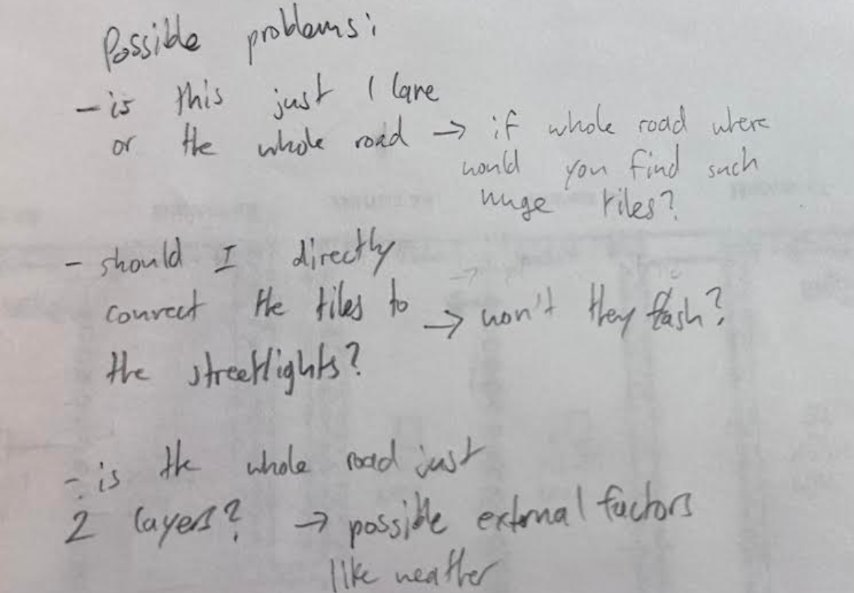
Step 4: What already exists?
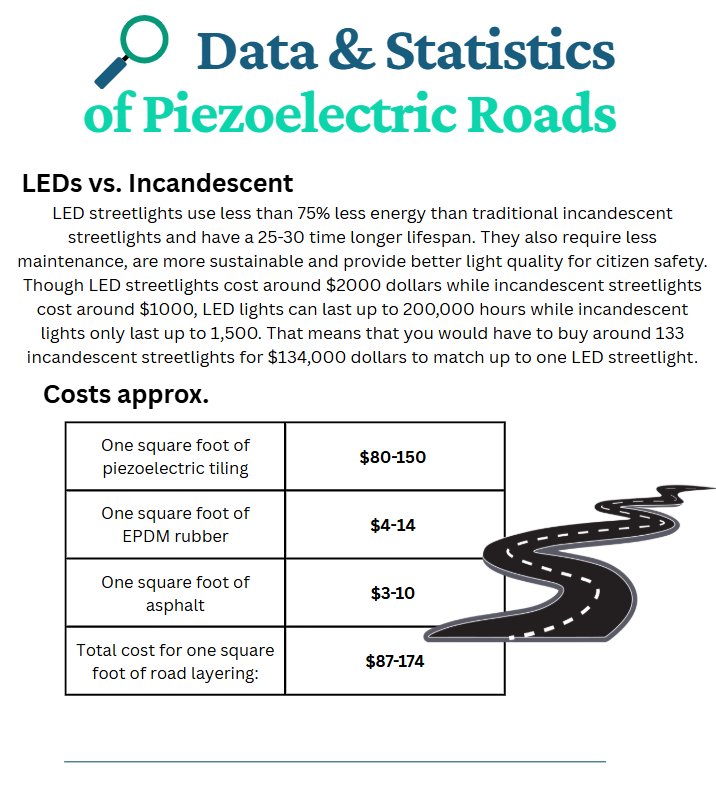
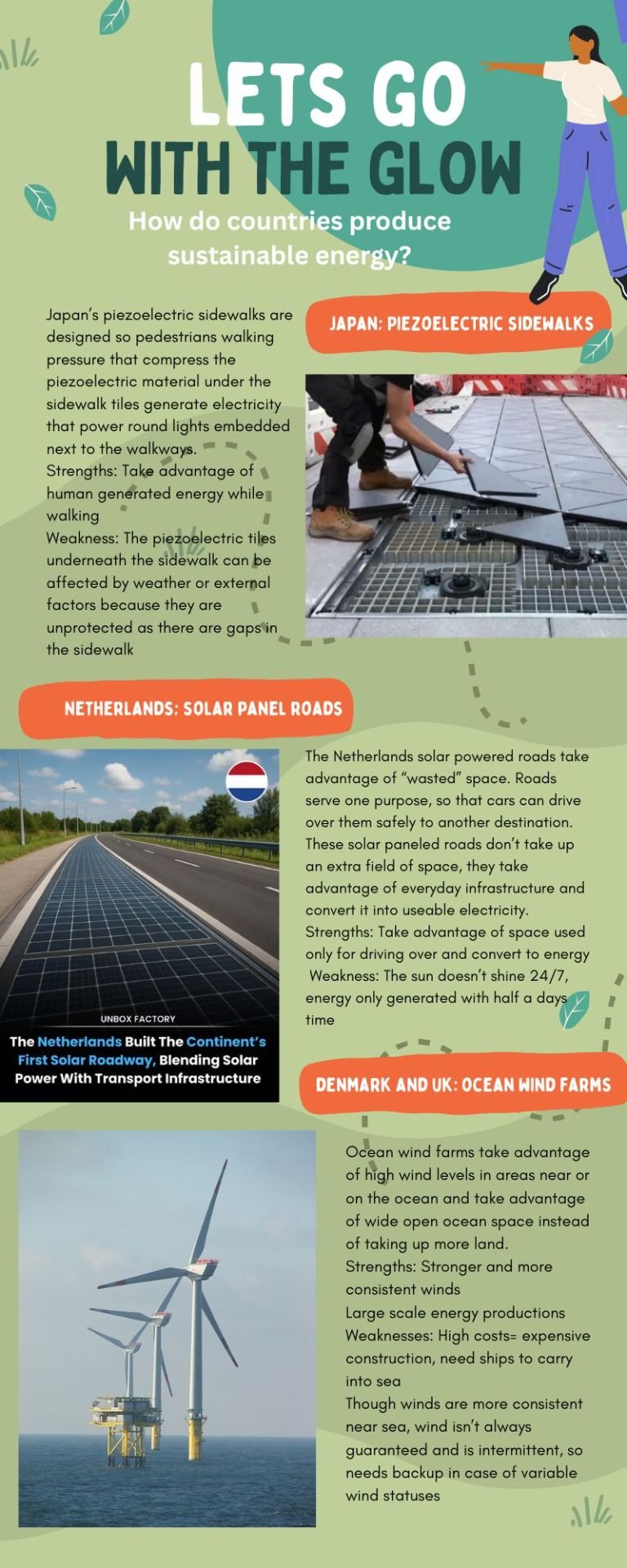
I designed an infographic to represent some of the interesting ways that different countries produce reliable and sustainable energy, as well as the advantages and disadvantages of production and implementation
Step 5: Improve Old Design
From my research of pre-existing sustainable energy producing sources and further thinking, I have determined problems that my design must solve and goals + solutions that my design must meet.
| Problem | Problem, Reasoning, Solution |
|---|---|
| The current generated by the piezoelectric tiles to the surrounding infrastructure must be steady and stable. | If we were to directly connect the piezoelectric tiles to the streetlights or other things that it is powering, the lights will flash. Since cars are not directly driving extremely close up to each other and there are gaps between them on roads, the current would be in short bursts, especially on high ways. Instead of direct connection, the piezoelectric tiles can be connected to power a battery. |
| The tiles are unprotected and are prone to weather damage and chemical spills on the road. | Because piezoelectric tiles are made of metal material that can react badly to extreme weather, they are prone to cracking and oxidizing from runoff through cracks in concrete. To prevent this, we can add a layer of EPDM rubber to insulate and protect the system. |
| Concrete cannot be directly poured on top of the wiring and piezoelectric system in the road. | Because of the material piezoelectric tiles are made from, pouring concrete directly on them would cause them to break with the mechanical pressure of cars on the road. This would interfere with how the technology works and also greatly damage the system. Instead, we can use asphalt. (see below) |
| Concrete is rigid, not flexible and hard to remove for road maintenance. | Because concrete is like a liquid stone that hardens into a certain mold when it is poured into, it is extremely hard to move or change out concrete for road maintenance. Instead, we would use asphalt as though asphalt is made of fossil fuels, 99% of all asphalt in roads is RECYCLED. Asphalt is also more flexible than concrete and better than transferring surface pressure down to embedded systems. Plus, it is easier to cut and patch for road maintenance and expands and contracts gradually with temperature changes. |
| It costs a lot of money for governments to buy piezoelectric tiles to cover entire highways. | Because one piezoelectric tile costs a lot of money, it may cost governments more to replace concrete with piezoelectric tiles. However, many governments (like Canada's) have dedicated a certain amount of monetary funding that focus on climate resilience, greener urban living, and low carbon materials. Federal programs have budgets with almost 2.4 billion dollars going towards greener transportation, so my design can apply into this category. Also, my design is scalable to fit different government budgets. |
| There are less cars at night than in the daytime | People need to sleep. Because there is less traffic activity at night time on roads than in the day, the production of electricity by piezoelectric tiles will decrease. However, like stated before, to produce a stable current we will connect the electricity produced BY piezoelectric tiles to a battery instead of directly to the streetlights or traffic lights. |
Step 6: Sketch out a new prototype
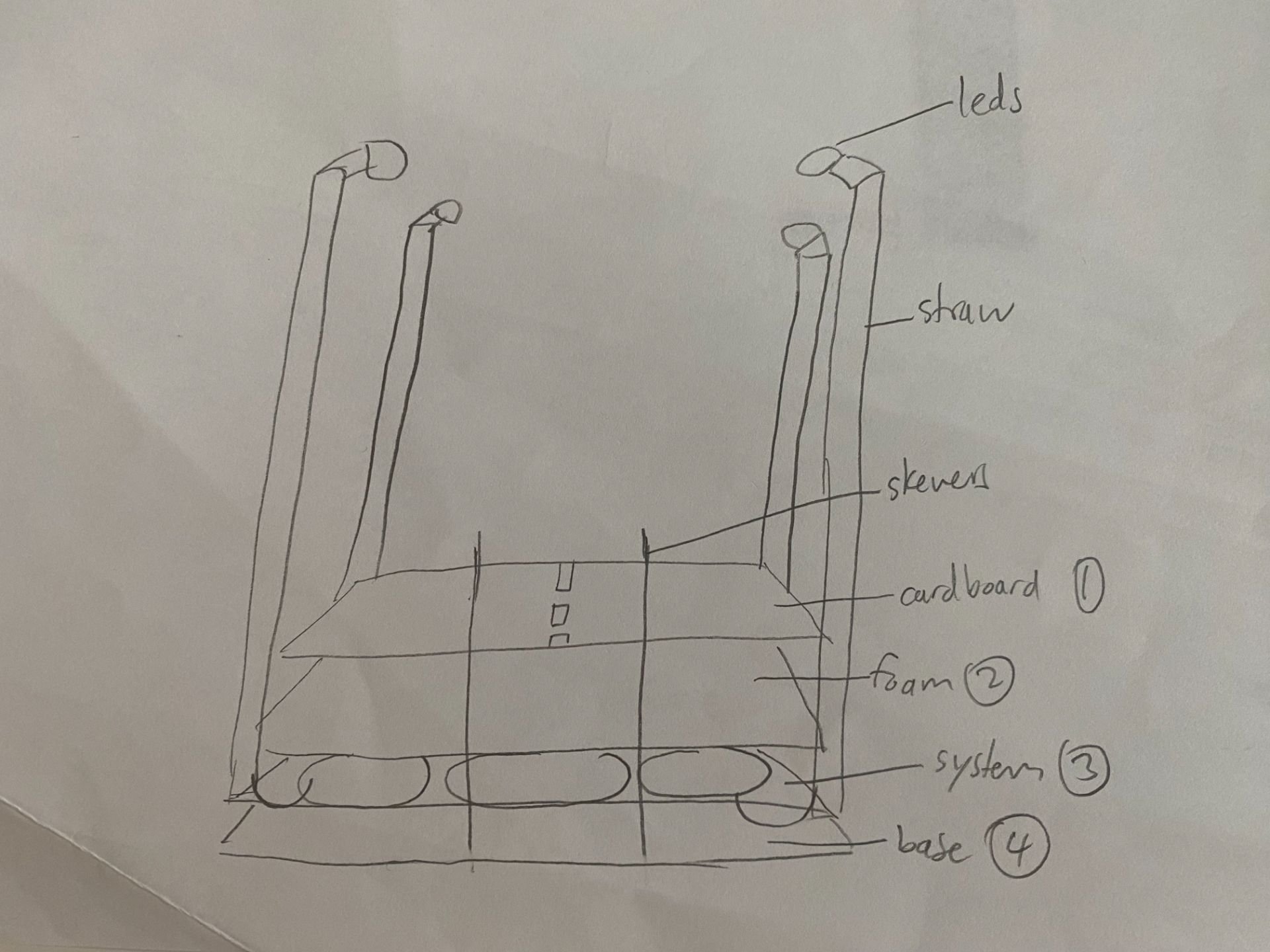
Step 7: Create a real life mini-prototype
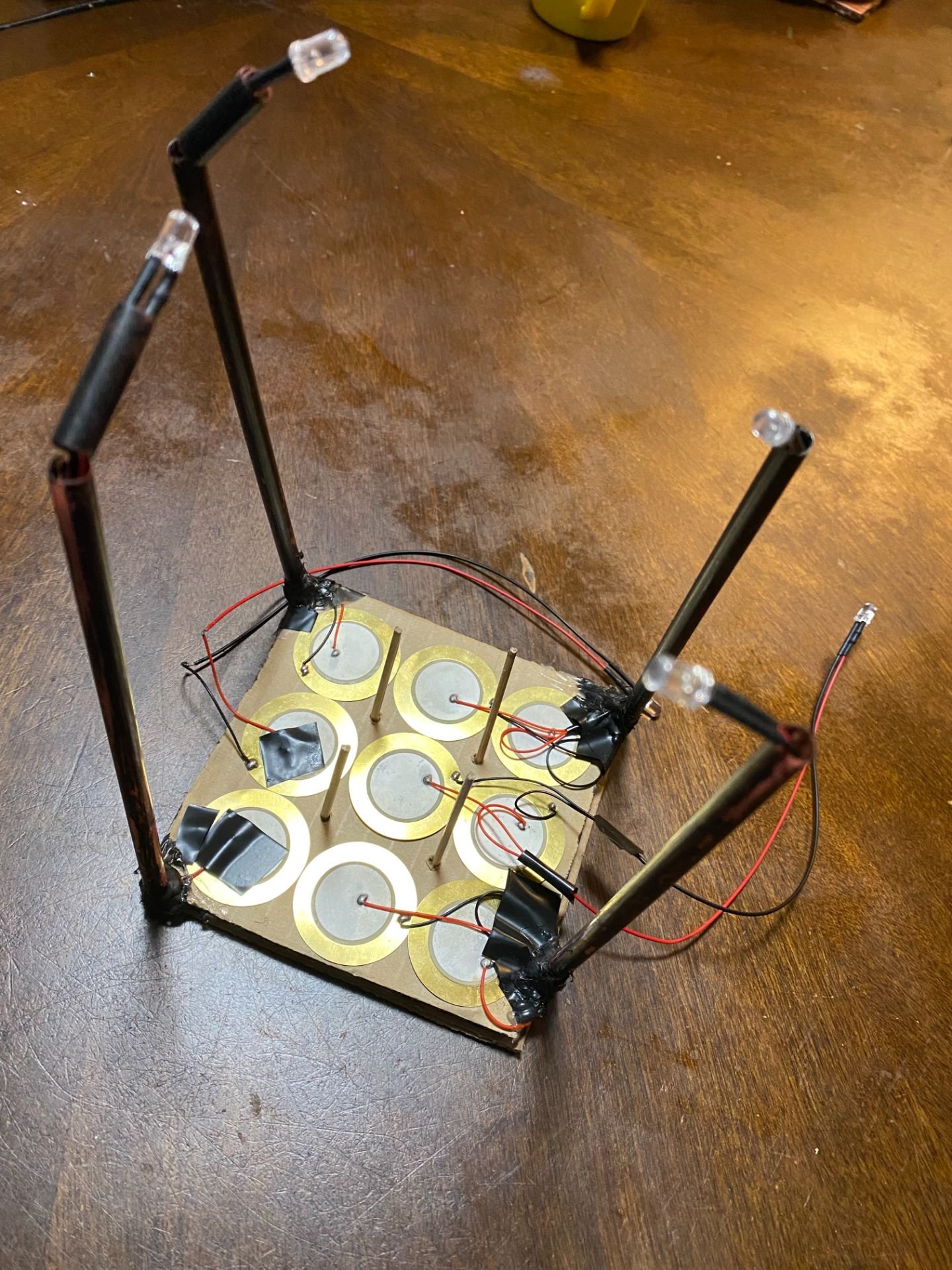
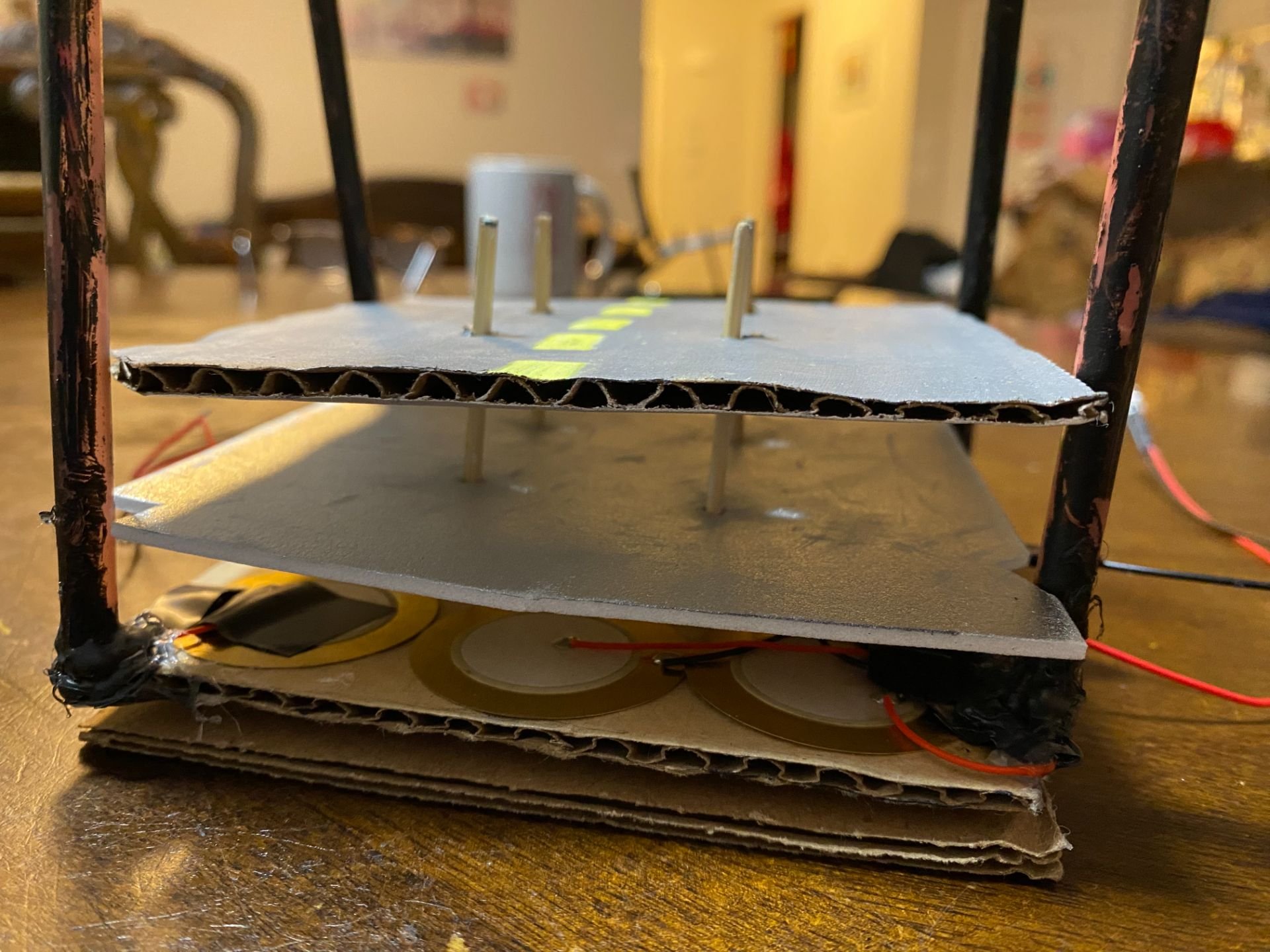
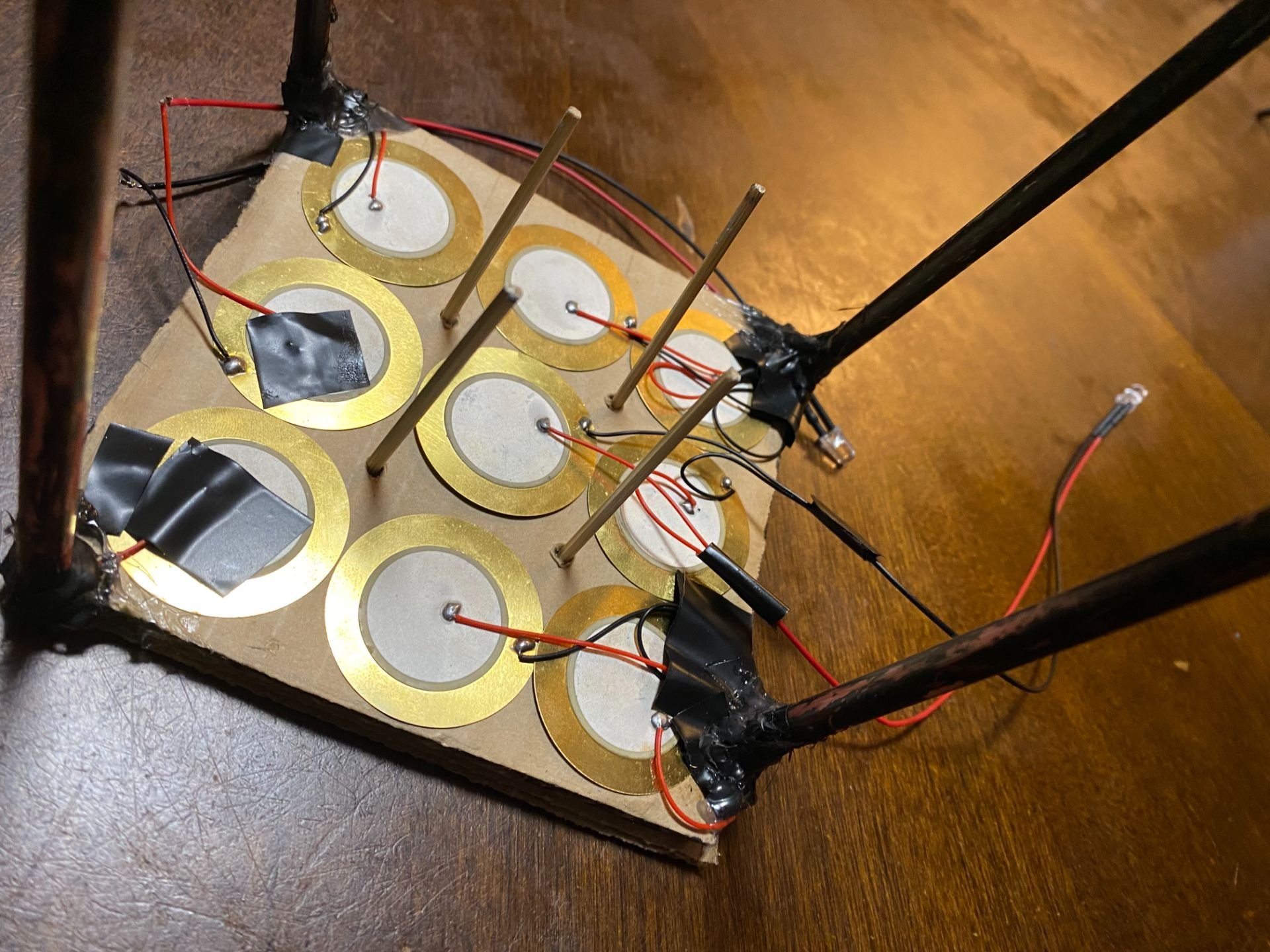
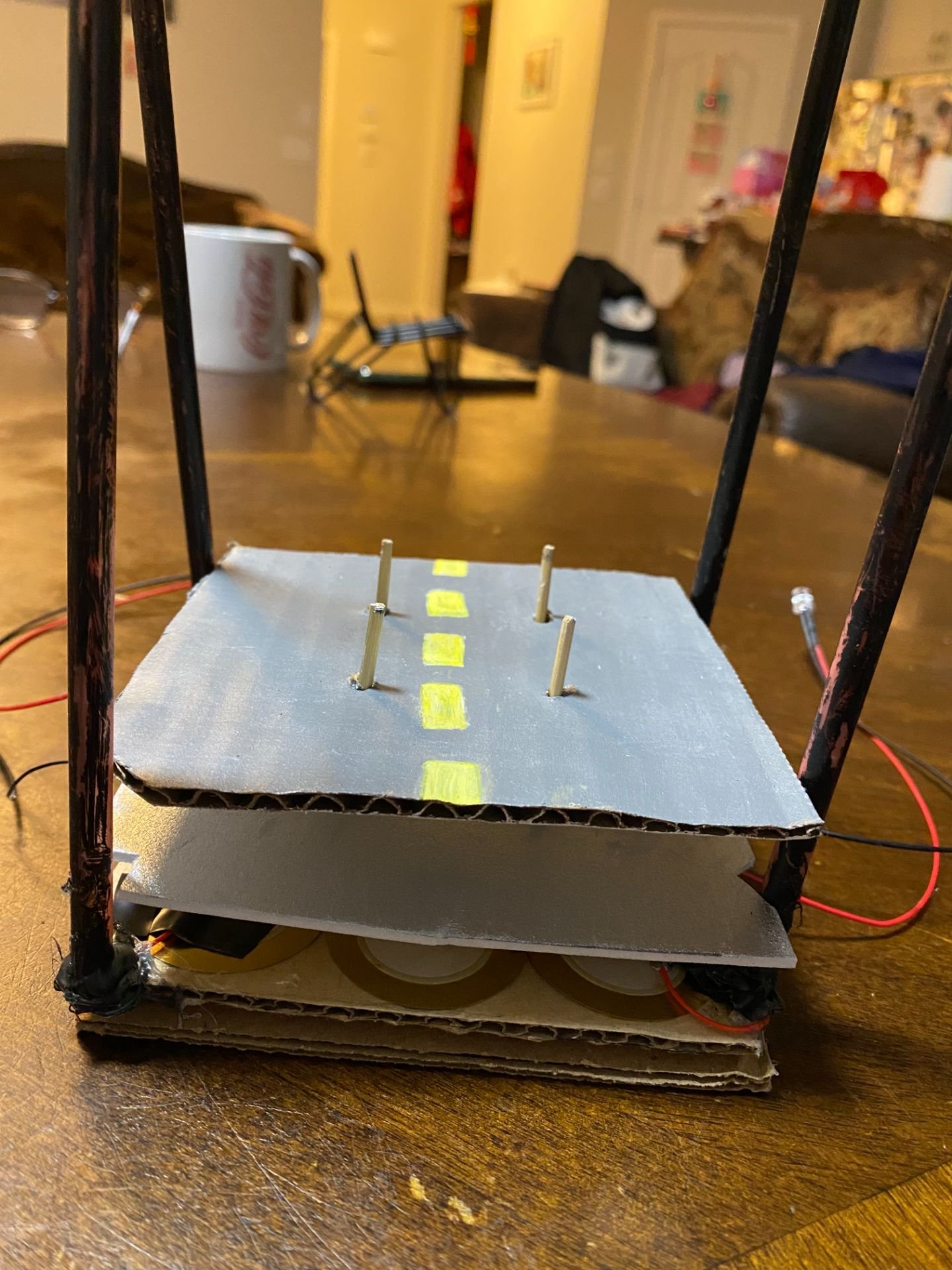 (This prototype represents what a section of the roadway would look like)
Analysis
Step 8 & 9: Evaluation
My design incorporates multiple well developed and carefully considered components that strengthen its overall effectiveness and practicality
| Benefits | Material | Description |
|---|---|---|
| Durable and good weight distribution | Asphalt | Asphalt is a durable and flexible material that slightly bends under weight, which can handle the constant pressure from vehicles and is less likely to crack as it has less sharp pressure points. |
| Easy road maintenance and replacement | Layered design | The layered structure of the roadway allows for targeted repairs as asphalt can be easily cut and removed section by section, which means repairs do not require demolishing any other parts of the roadway other than the parts that need maintenance. The EPDM rubber is easily lifted and the piezoelectric tiles can be removed tile by tile and replaced simply with a new tile and new rewiring. |
| Protective and insulative | EPDM Rubber | EPDM rubber’s properties make it so that it can absorb sudden shocks, which prevents damage to the tiles underneath it. It’s also elastic, which means it compresses under pressure, improving weight transfer to the piezoelectric tiles. One of the most important properties of EPDM rubber is its resistance to weather related factors as it is waterproof and handles extreme hot and cold temperatures. This improves the life span of the whole underground system and reduces costs on repair for the government. |
| Effective and sustainable | Piezoelectric tiles | The star of the show, the piezoelectric tiles, are the most important element of this entire design. They take the wasted mechanical energy from everyday traffic and convert it into a resource that is vital to modern infrastructure and high in demand. Piezoelectric tiles also compare better to traditional energy production practices as they do not produce any emissions or damage the environment when producing electricity and operate without fuel. |
| Stable, practical and reliable | Battery storage system | The battery that stores the currents produced by the piezoelectric tiles makes this design practical as batteries output the bursts of electricity from the tile in stable and controllable currents. It improves the reliability of this design and most importantly stores energy to be used when it is needed the most; at night time, making roads safe for everyone. |
| Scalable and adaptable | Design | All together, all elements that work together to make this innovation allow it to be extremely adaptable to different settings, whether its highways, traffic lights, bus lanes, or even parking lots. Because of its structure and materials, this design can be adjusted to a government's budget, climate, or traffic conditions, making it suitable to the most dense cities and small towns. |
Overall, the carefully chosen materials and design makes this innovation an extremely practical way to generate reliable, sustainable, and clean energy while maintaining durability, safety considerations, cost efficiency, and long term feasibility in modern transportation infrastructure.
In this section I analyzed the key challenges my design needed to address and evaluated whether those challenges were successfully resolved
| Problem | Solved? Yes, no, partially | Explanation |
|---|---|---|
| Current must be steady and stable | Yes | Instead of directly connecting the piezoelectric tiles to the infrastructure that they are powering, we can integrate a battery storage system so that the electricity produced by the piezoelectric tiles can be collected and the output current can be converted and stabilized into a steady and usable power supplier. |
| Tiles are unprotected and prone to external damage | Yes | The tiles are covered by a layer dividing the road layer from the wiring and tile system, aka the EPDM rubber. Because of its properties, the EPDM rubber insulates and protects the system underneath it from extreme weather and external damages, preventing cracking of the tiles and electrical failure. |
| Concrete cannot be directly poured onto wiring system | Yes | The layer of EPDM rubber separates the concrete layer from the tiled design and encloses the entire system underneath, therefore still protecting it while maintaining the safety of drivers. Also, instead of concrete, my design uses asphalt, which is made of 99% recycled fossil fuels and is more versatile and distributes the weight and mechanical pressure of vehicles more efficiently. |
| Concrete is rigid and inflexible | Yes | My design replaces concrete with asphalt, and asphalt proves to be the superior material as it has flexible and weight-distributing properties, is more durable under pressure, is good for the environment, and is easier to repair and work maintenance on. |
| It costs a lot of money for governments to implement, especially in small cities or developing countries | Partially | Though this design can cost more than straight up filling roads with concrete, it has numerous more benefits for governments who would want to include it in their transportation systems. Federal governments like Canada even have more recent projects with millions and even billions of dollars used to fund more sustainable and reliable ways to produce energy. Also, my design is extremely scalable as instead of adding it into full size highways, governments can size it down to any place that fits their budget, like traffic lights, commercial districts, bus lanes or braking zones. The scalability of the piezoelectric tile system allows governments to implement it gradually based on budget capacity and the ability to start small and grow big makes it more adaptable for developing countries or small cities. However, truly implementing this design really depends mostly on a government's monetary funding and budget. |
| Less cars in night time than daytime | Yes | This problem is solved through energy storage systems who collect any amount of electricity produced by the piezoelectric tiles at any time and use it to stably and reliably power infrastructure and other things that require electricity to be powered at night. |
My design has met the goals I set out to accomplish and has successfully solved and overcome the problems and challenges that I identified at the start of the project. Overall, this innovation can become an effective part of daily life and a sustainable and reliable way to produce energy.
Conclusion
Our world depends heavily on energy, yet much of the energy we use and need is not sustainably or reliably produced. Piezoelectric roads are a reliable source of energy production that takes advantage of wasted mechanical energy produced EVERYDAY, making it a powerful technology for generating clean and effective energy that can be used like any other form of electricity. By installing piezoelectric tiles into high traffic areas like roads, we can generate power without burning excess fuel or increasing pollution. While this model is small, it represents a real life solution with the true potential to reduce energy waste and support a more sustainable future. With further development, piezoelectric roads could become a new part of how we produce renewable energy and protect the environment. The combination between engineering practicality and environmental responsibility transforms the way that governments can convert transportation into treasure without the use of practices that damage the environment rather than help and sustain it. With every passing car, we turn your daily Starbucks run into new potential, and we pave the way toward a smarter, cleaner, and more sustainable future.
Citations
 I used the help of ChatGPT to create an image of my roads design (prompt was written by me)
Acknowledgement
Ms. Sleiman - Mentor and Advisor
Ms. Davis - Mentor and Science Fair Supervisor for LRS
Mr.Stone - Technical support
Mr.Pelayo - Advisor
I am especially thankful to my mom who patiently listened to me and supported my project the whole time! Her unwavering support both emotionally and physically, through the late nights she spent by my side while I worked, have made this project possible.