
Volcano Eruptions
Benjamin Wanotch, Grayson Boland
Ecole St. Pius X School
Grade 5
Presentation
No video provided
Hypothesis
We think the temperature of the vinegar will change how fast our volcano reacts and how high it erupts. We think warmer vinegar will react faster and have a higher eruption than colder vinegar. We think this because warmer temperatures will make the molecules move faster which makes the reaction happen faster and the eruption will go higher.
Research
Volcanoes form when magma (hot rock) comes up to the earth’s surface and erupts. Lava is very hot, and after it cools, it turns into a layer of rock. Over time the volcano will erupt more and the layers of rock build up and the volcano gets bigger. Volcanoes can be dangerous because lava and magma are extremely hot and can destroy land, plants and buildings.
Temperature plays an important part in how real volcanoes erupt. Hotter magma has faster‑moving molecules, so it flows more easily. Cooler magma has slower‑moving molecules, so it becomes thicker and moves more slowly. These differences can change how fast an eruption happens and how powerful it is.
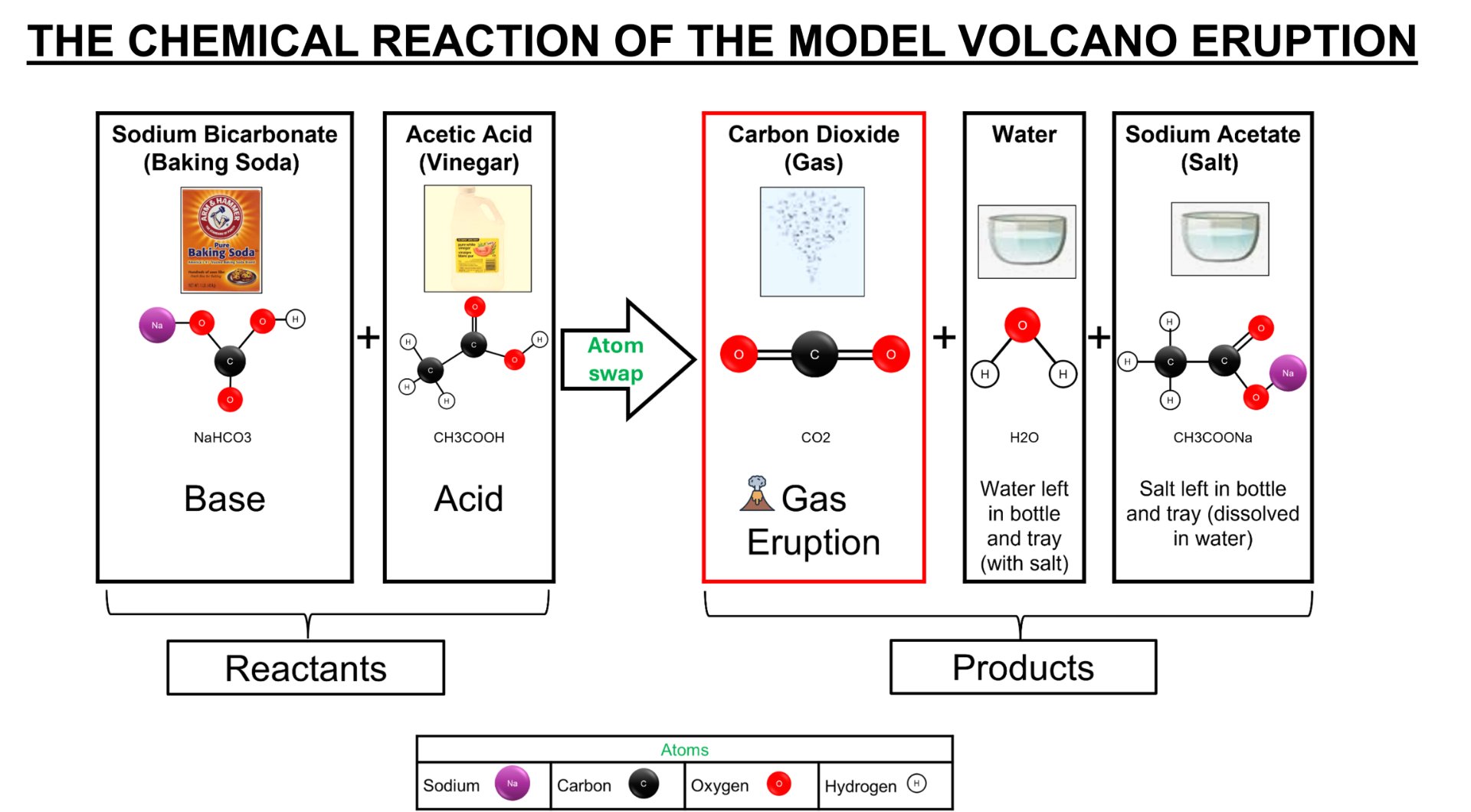
A model volcano eruption is made from using baking soda as the base and vinegar which is an acid. Mixing them makes carbon dioxide that forms bubbles and foam that push to the surface and erupts, like a volcano. The temperature of the chemical reaction can change how fast the reaction is and how powerful it is.
Variables
Independent Variable (what we will change)
- Temperature of vinegar (cold, room temperature, warm)
Dependent Variables (what we will measure)
- How high the eruption goes
- How long the eruption will bubble
Controlled Variables (what will stay the same)
- The same amount of vinegar
- The same amount of baking soda
- The same model volcano and bottle
Procedure
- Build a volcano around the cup using clay.
- Prepare three temperatures of vinegar.
- Cold
- Room temperature
- Warm
- Add 125 ml baking soda, 2 squirts of dish soap and 6 drops food coloring to the bottle.
- Put 250 ml of vinegar into a beaker and take the temperature of the vinegar.
- Get the timer ready.
- Pour 250 ml of vinegar into the bottle.
- Measure the speed of the reaction.
- Time from when the vinegar is poured until the bubbling stops.
- Measure the height of the eruption.
- Take a video of the eruption. Pause the video at the height of the eruption and measure.
- Record the data.
- Repeat three times for each temperature.
Observations
| Trial | Vinegar Temperature | Exact Temp (°C) | Eruption height (cm) | Time bubbling (seconds) |
|---|---|---|---|---|
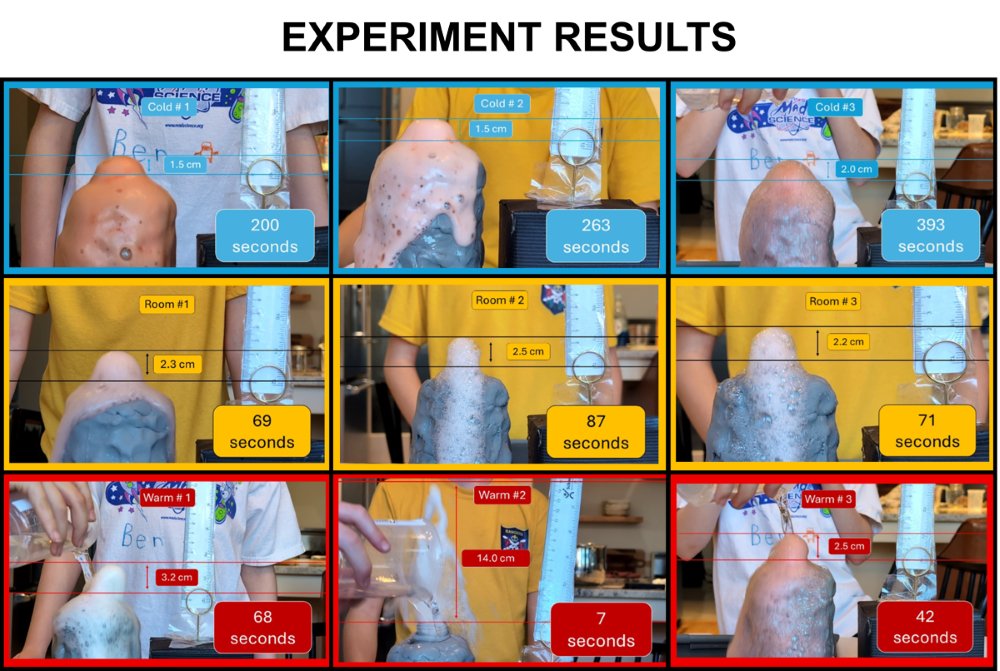
| 1 | Cold | 4.1 °C | 1.5 cm | 200 seconds |
| 2 | Cold | 5.8 °C | 1.5 cm | 263 seconds |
| 3 | Cold | 5.0 °C | 2.0 cm | 393 seconds |
| 1 | Room | 18.9 °C | 2.3 cm | 69 seconds |
| 2 | Room | 22.8 °C | 2.5 cm | 87 seconds |
| 3 | Room | 22.6 °C | 2.2 cm | 71 seconds |
| 1 | Warm | 50.9 °C | 3.2 cm | 68 seconds |
| 2 | Warm | 53.0 °C | 14.0 cm | 7 seconds |
| 3 | Warm | 50.0 °C | 2.5 cm | 42 seconds |
Analysis
EXPERIMENT AVERAGES
| Vinegar temperature | Eruption height (cm) | Time bubbling (seconds) |
|---|---|---|
| Cold | 1.67 cm | 285.3 seconds |
| Room | 2.33 cm | 75.7 seconds |
| Warm | 6.57 cm | 39.0 seconds |
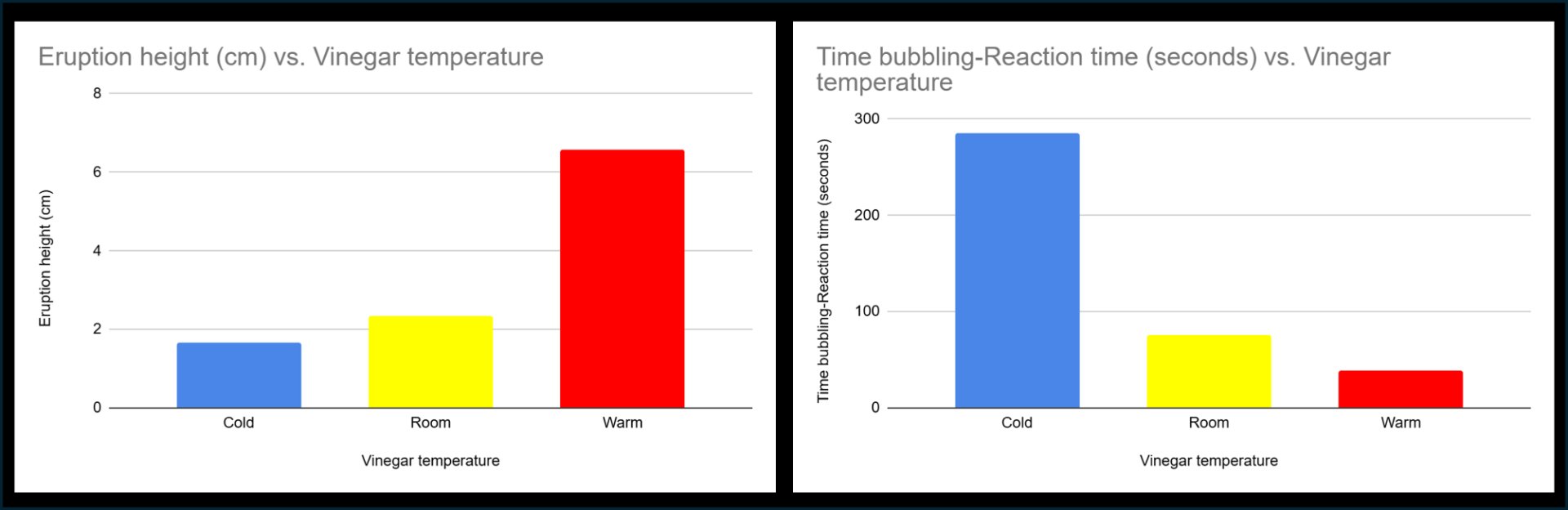
The data shows that the warmer the vinegar, the faster the reaction (shortest bubbling time) and the higher the eruption. The colder vinegar, the slower the reaction time (longest bubbling time) and the shorter the eruption height.
On average the warm vinegar’s reaction speed was 246.3 seconds faster and eruption height was 4.9cm higher than the cold vinegar.
The warm vinegar caused the molecules to move quickly. This made the reaction happen fast (the atoms swapped fast), so it made lots of carbon dioxide gas fast. This made the gas push the “lava” up more quickly and made a taller eruption.
When the vinegar was cold, the molecules moved slowly. This means reaction was slower (the atoms swapped slowly), so it took longer to start bubbling and bubbled for a longer time. Gas was released slowly and the eruption didn’t go very high.
One of the warm trials had one eruption that was a lot bigger than the other two trials, and we think that happened because the vinegar was poured faster. Overall, we think our results are reliable because we did 3 trials for each temperature.
Conclusion
Our results support our hypothesis that temperature affects how the volcano erupts. Warm vinegar made the reaction happen faster and created taller eruptions, just like we expected from our research about how heat speeds up the chemical reaction. Cold vinegar reacted slowly and didn’t go very high, which also matched what we thought would happen.
Just like real volcanoes, our volcano erupts faster and higher when it's hot because heat gives the gases more energy to explode the lava out, just like how magma under the Earth stays super hot so it can keep moving and building up pressure.
For future experiments we want to test different bottle shapes to see how they affect the height and speed of the reaction.
Application
Our experiment showed that warm vinegar made the volcano erupt higher and react faster. This happens because chemical reactions speed up when they are hotter. This idea is important in real life because many reactions can get stronger or happen too fast if they get warm, so people need to be careful when using or storing chemicals. Our project helps show why temperature matters when doing science experiments.
Sources Of Error
One of the warm trials had one eruption that was a lot bigger than the other two trials, and we think that happened because the vinegar was poured faster. Overall, we think our results are reliable because we did 3 trials for each temperature.
Citations
British Geological Survey. “Volcanoes”. https://www.bgs.ac.uk/discovering-geology/earth-hazards/volcanoes/. Accessed January 13, 2026.
BBC Earth Science. Volcanoes: Earth's Fiery Wonders. https://www.youtube.com/watch?v=tqlC_JGPSlk&t=8s. April 27, 2025.
CBC Kids News. What are volcanoes, how do they form and why do they erupt? https://www.youtube.com/watch?v=zBM9-5dvdhw&t=115s. May 27, 2024.
Elevation Handmade. “How to make a volcano with clay.” https://www.youtube.com/watch?v=LUtEIZmY9y4. November 17, 2023.
Science Fun. Volcano Science Experiment. https://www.sciencefun.org/kidszone/experiments/how-to-make-a-volcano. Accessed January 17, 2026.
Thought Co. “Baking Soda & Vinegar Exploding Chemical Volcano.”https://www.thoughtco.com/baking-soda-and-vinegar-chemical-volcano-604100. Accessed January 17, 2026.
Acknowledgement
We would like to acknowledge our past and present teachers for telling us information about science experiments ( like this one ).
We would also want to acknowledge our parents for giving us instruction when we were confused or needed help understanding something.