
Dreams
Alveira Bhandohal, Pawanreet Kaur Sandhu
Gobind Sarvar School Guru Nanak Gate Campus
Grade 6
Presentation
No video provided
Hypothesis
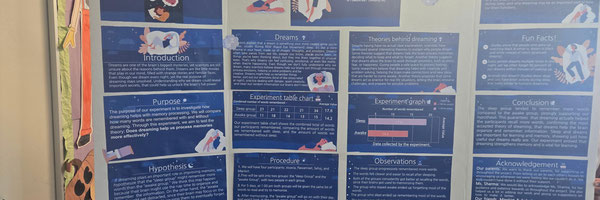
If dreaming plays an important role in improving memory, we hypothesize that the “sleep group” might remember more words than the “awake group.” We think this may happen because their brain might use the nap time to organize and remember the information. On the other hand, the “awake group” might get distracted, since their brain may focus on the other activities that they do causing them to eventually forget.
Research
Despite having no actual clear explanation, scientists have developed several interesting theories to explain why people dream. Some theories suggest that dreams help the brain process memories, deciding what to keep and what to forget. Another theory suggests that dreams allow the brain to work through emotions, such as stress, fear, or happiness. Giving people a safe space to process feelings. Some researchers believe that dreaming helps with creativity and problem solving, helping the brain make connections and new ideas that are harder to come awake. Another theory proposes that some dreams act as practice for real life situations, letting the brain rehearse challenges, and prepare for possible problems.
Scientists explain that a dream is something your mind creates while you’re asleep, usually during REM (Rapid Eye Movement) sleep. It’s like a story playing in your head, made up of images, thoughts, and emotions. Dreams often take pieces from real life, people you know, places you’ve been, or things you’ve been thinking about, but they mix them together in unusual ways. That’s why dreams can feel confusing, emotional, or even like reality, when they’re happening. Even though we don’t fully understand why we dream, many scientists believe dreams help our brains sort through memories, process emotions, helping us solve problems and be creative. Dreams might help us remember things better, sort out our emotions (kind of like stress-relief at night), practice dealing with danger, spark creativity, and clean out random information our brains don't need.
Variables
Responding Variable: The number of words the participants memorize.
Manipulated Variable: Time of Sleep.
Controlled Variable: Same list of words, same time given to study the words, same time gap between studying and recalling (3 hours), same recall time (4:00 p.m.),same instructions for all participants.
Procedure
1. We will have four participants: Alveria\, Pawanreet\, Sehaj\, and Mankirt.
2.They will be split into two groups: the “sleep Group” and the “awake Group”, with two people in each group.
3. For 5 days\, at 1:00 pm both groups will be given the same list of words to read and try to memorize.
4. After memorizing\, the “awake group” will go on with their day\, and won’t look at the words again. Likewise\, the “sleep group” will also study the same list of words. And they will take a nap for 3 hours ( from 1 to 4 pm).
5. Immediately after waking up at 4:00 p.m\, they will write down as many words as they remember. The awake group will also write down the amount of words they can recall at 4:00 pm.
6. Everyday the participants will record their results in a sleep journal.
7. After completing the experiment the participants will switch their group\, and they will record the results.
8. At the end of the experiment\, we will collect and compare the data. And we will a make a chart showing the results and conclusion of the experiment.
Observations
- The sleep group progressively remembered more words.
- The words felt clearer and easier to recall after sleeping.
- Both of the groups consistently got better at recalling the words, since their brains got used to memorizing them.
- The group who stayed awake ended up forgetting most of the words.
- The group who slept ended up remembering most of the words.
- The “awake group” mostly remembered the words they learned on the first day and only added a few more.
Analysis
The results show that the sleep group gradually remembered more words over time. After sleeping, the words felt clearer and easier for them to recall. This suggests that sleep may help the brain organize and strengthen memories.
Both groups improved at first because their brains became more practiced at memorizing the words. However, as the experiment continued, the awake group began to forget many of the words. They mostly remembered the words they learned on the first day and only added a few new ones. This may have happened because their brains were busy with other activities, which made it harder to store the information.
In contrast, the sleep group remembered most of the words by the end of the experiment. This supports the idea that sleep and dreaming can help improve memory by allowing the brain to process and organize information more effectively.
Conclusion
The sleep group tended to remember more words compared to the awake group, strongly supporting our hypothesis. This guarantees that dreaming actually helped the participants recall more words, confirming the most accepted theory of dreaming, that dreams help the brain organize and remember information. Sleep and dreams are important for learning and memory, showing just how useful our dreams really are. Our experiment proved that dreaming strengthens memory and is vital for learning.
Application
- Helps students improve studying by showing sleep improves memory.
- Can help schools adjust homework schedules.
- Supports the importance of healthy sleep habits.
- Useful for doctors studying memory and brain function.
- Can help athletes or performers improve learning and focus.
Sources Of Error
- A problem we faced was, was not having enough participants to perform the experiment, fortunately our friends Mankirt and Sehaj agreed to participate last minute.
- Sleep was different for each person. If someone didn’t sleep well or woke up a lot, it might have made it harder for them to remember, we solved that problem by asking every participant to write down important information and data about the experiment in a sleep journal.
- People slept in different places and conditions, so their sleep quality wasn’t the same, and that could change the results, but we made sure that wouldn't happen by telling the participants to sleep in a room with no sunlight, and waking up to an alarm on exactly 4 pm .
Citations
Acknowledgement
Our parents : We want to thank our parents for supporting us throughout the project. From letting us go to each others houses, to uplifting us whenever we felt like we couldn't do it. We truly couldn't have done it without their support.
Ms. Sharma: We would like to acknowledge Ms. Sharma, for her guidance and patience towards us throughout the project. She has also helped us a lot in editing our work, and giving us suggestions on how to make it better.
Our friends, Mankirt & Sehaj: We would like to thank our friends, Mankirt and Sehaj, for agreeing to be a part of our experiment last minute, when no one else would agree. We are truly very grateful for them.