

Sweet Substitutions: a cookie case study
Elliott Herbst
Olympic Heights School
Grade 6
Presentation
No video provided
Hypothesis
Hypothesis
If you change granulated sugar to a sugar substitute then I think the following will happen:
- Bake time: they will take less time to bake because the sugar substitutes will brown faster.
- Colour: they will be darker than cookies with granulated sugar because sugar substitutes react sooner (maillard reaction).
- Texture: the texture will be more firm and cracked because the chemical reaction with the sugar substitute happens sooner.
- Taste: they will be a lot sweeter because many sugar substitutes are a lot sweeter than granulated sugar.
- Size: they will be taller and narrower because they cook faster and have less time to spread.
Research
Research on sweeteners: Monk Fruit
Did you know Monk fruit is medicine for constipation, coughing,and sore throats? It is also used as a sugar substitute. This little fruit is native to southern China, but be warned it is very sweet; it's 100-250 times sweeter than granulated sugar! This calorie free sweetener has another name, its other name is lo han gua. Two positives to this fruit is that it has little to no after taste, unlike other sugar substitutes and it doesn't affect your blood sugar! If you are baking with monk fruit remember that it browns faster, and sometimes has different structure or texture. One downside of Monk fruit is that it's very expensive. This fruit is small, about the size of a lime, and it looks like a kiwi. One other good thing about monk fruit is unlike real sugars it doesn't cause cavities! Now you know more about magnificent monk fruit!
Allulose
Have you ever heard of a sugar substitute called Allulose? If you're baking with this rare sweetener then you probably should know some things, it's 70% less sweet than granulated sugar so you should use more. Another baking tip is it browns faster and may change the texture. Two positives to this sweetener is its calorie free and it has no effect on your blood sugar! Another other good thing about Allulose is that it actually tastes like sugar! But for all those positives there is a negative, which is it may cause problems in the washroom. Now you have heard about Awesome Allulose!
Stevia
This low calorie sweetener is native to south america and has been around a while being used to sweeten drinks. If you are baking with Stevia you are in luck because Stevia is great for optimal results! Stevia is also approximately 200-400 hundred times sweeter than your average granulated sugar. One thing about this sweetener is it has no carbohydrates, calories, and artificial ingredients. Stevia the sweetener we use today is not from the stem of a stevia plant it is actually in the leaves! This sweetener can come in powder or liquid form. One other interesting fact is to some people it's bitter and to other people it tastes like menthol. Two not so great things about Stevia are it can affect healthy stomach bacteria and can cause gas. Now, you know about Super Stevia!
Xylitol
Xylitol sweetener is a natural sugar alcohol, but don't worry it doesn't have real alcohol! One odd fact is that Xylitol acts against bacteria that causes ear infections! Did you know that Xylitol does not cause tooth decay? One thing your dog might want to know before chomping something that has this sweetener is that Xylitol is TOXIC to dogs! Did you know this low calorie sweetener is often found in candy, gum, and mints that have low sugar? One other fact is this sugar substitute has 40% fewer calories than other sugars. This substitute tastes and dissolves in water like real sugar and has zero affect on your blood sugar! Now you know that eXtrodinary Xylitol is a fine choice of a sugar substitute.
Granulated Sugar
Did you know granulated sugar is the most used sweetener in baking? Also did you know that it has many names, some that are included are refined sugar, table sugar, white sugar, or just sugar. This multi-purpose highly refined product is made up of small crystals! This cheap sugar is used in lots and lots of recipes all around the world! Now you know about the Great Granulated sugar!
Erythritol
Erythritol is a relatively new sugar alcohol that tastes similar to granulated sugar. This non nutritive sugar alcohol is made from plants and then made by fermentation. It also can be made by chemicals but fermentation is preferred. This sugar substitute is considered a natural sweetener. It also doesn't have a lot of calories. Erythritol is usually mixed with other sweeteners because it has about the same volume and texture as granulated sugar! Those are some facts about Extraordinary Erythiritol.
Research of Chemistry of Baking Cookies:
Important Ingredients for chemical reactions in cookies:
Butter (emulsion) = fat/water Egg = protein Leavening Agent = Baking Soda flour= good for structure
When you add heat to dough a series of chemical reactions begin!
92°F - Butter melts, trapped water is released and as the steam tries to escape the dough rises.
144°F - egg becomes more solid as it's cooked. 212°F- water boils away and makes cookies flatter, dryer, harder and cracks appear on the surface.
310°F - Maillard Reactions
Protein and sugars break down and rearrange themselves into ring-like structures. These structures reflect like and help the cookies turn a rich brown colour and create complex tastes and smells.
Evaporated water leaves airy pockets and makes cookies light and fluffy. Baking soda reacts with acid in the dough (but not in my recipe!)
356 - 390°F caramelization occurs (but not in my recipe - we baked at 350!)
Variables
In my project the controlled variables were: -unsalted butter, softened -egg - vanilla extract - all-purpose flour - baking soda - salt In my project the manipulated variables were the different types of sugar including: -Xylitol -Monk fruit -Allulose -Stevia -Granulated sugar Inmy project the responding variable was: - bake time until cookies were brown - the hieght - the width - colour - dough texture -baked texture
Procedure
Procedure
- Bake 5 batches of cookies, using the same recipe, but with the different sweeteners.
- All the ingredients except the sweeteners stayed the same so they are the controls.
- The sweetener is the variable (xylitol, allulose, stevia/erythritol, monk fruit/erythritol, granulated sugar).
- Adjust the amount of sweetener based on package directions (only needed for allulose)
- Make sure dough balls are always the same size
- Record observations in the 5 areas (see chart)
Recipe
- (½ cup) unsalted butter, softened
- 1/2 sugar or sweetener equivalent
- 1 large egg, room temperature
- 1 tsp vanilla extract
- 1½ cups all-purpose flour
- ½ tsp baking soda
- ¼ tsp salt
Directions:
- Cream butter and sweetener together for 2 minutes.
- Add egg and vanilla; mix until just combined.
- In a separate bowl, whisk together all dry ingredients.
- Add dry ingredients to wet ingredients; mix until just combined.
- Chill dough for 30 minutes.
- Scoop dough into 25 g balls.
- Bake at 175°C (350°F) for 10–12 minutes.
- Cool cookies for 5 minutes on a tray, then transfer to a rack.
Observations
The chart below this shows how recorded my results of my experiment. The areas I was monitoring were: bake time, height, width, colour, dough texture, and baked texture.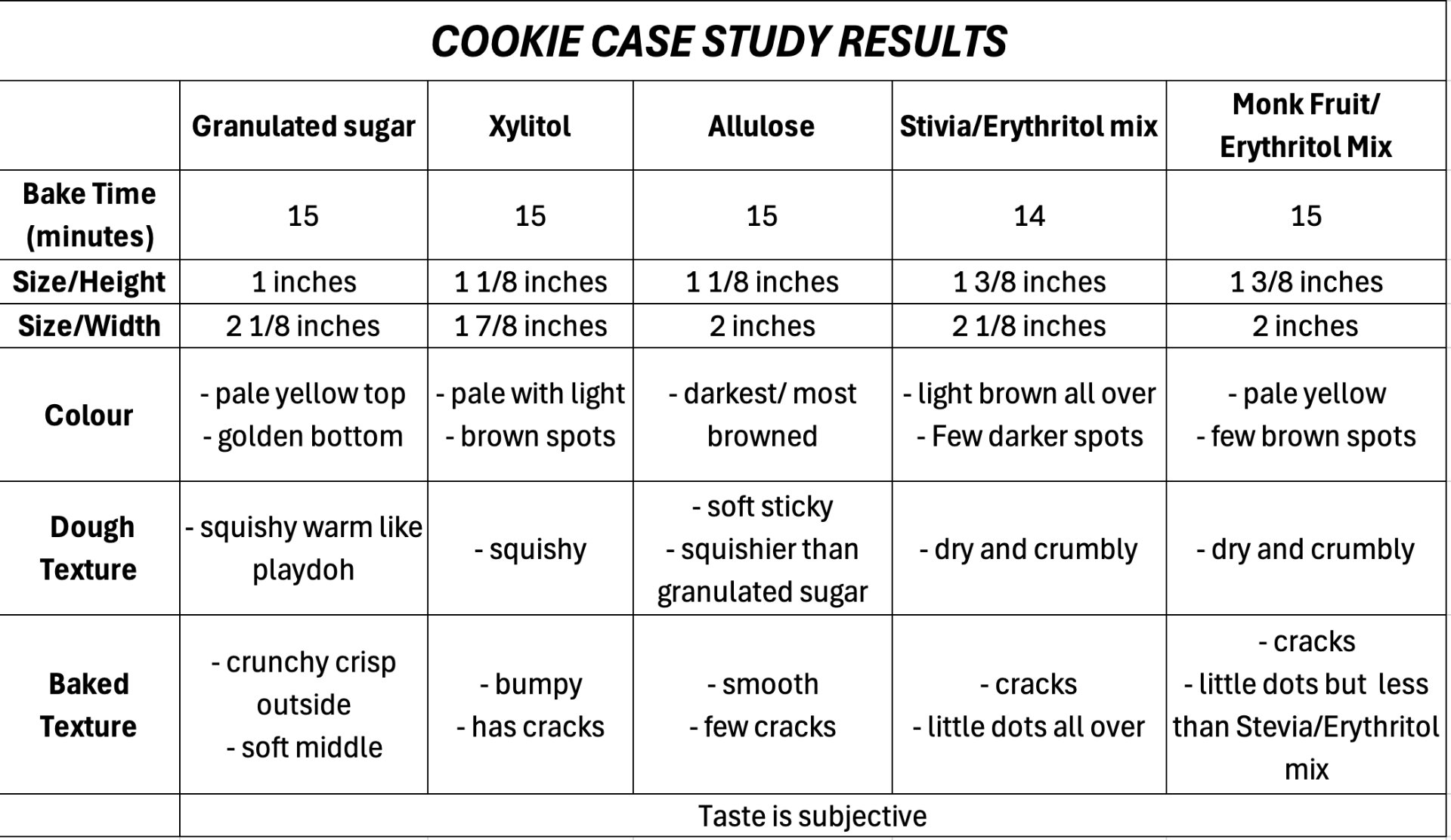
Analysis
-In my project all of the bake times were the same except the Stevia/erythritol mix. -In my project the height of the cookies varied granulated sugar was one inch, Xylitol and allulose were both 1 1/8 inches tall, and monk fruit/erythritol mix and stevia/erythritol mix were both 1 3/8 inches high. - For the width of the cookies the width varied but some were the same including: Allulose and monk fruit/erythritol mix were both 2 inches wide\, Xylitol was 1 7/8 inches wide\, and Granulated sugar and stevia were both 2 1/8 inches wide. - For the colour they all were basically the same and were all pretty light coloured except Allulose. -Most of the dough textures had one thing in common, they were all squishy except for two that were dry and crumbly: Stevia/erythritol mix and Monk fruit/erythritol mix. -For the baked texture they were all basically had one thing in commen, cracks! - Taste is subjective everyone thinks something else.
Conclusion
Conclusions
In conclusion I was correct and incorrect. Below I will describe what happened in each category:
Bake time:
- I was not correct; they all took about the same time to bake.
Colour:
- The colour was very different. For example, granulated sugar cookies were very light while the Allulose ones were very dark.
Texture:
- I was correct because the cookies all had some cracks even if they were not the biggest.
Taste:
- They were very scattered, some were not sweet and some were very sweet.
- Taste was the area that was most affected by the type of sweetener used.
Size:
- all of them were very similar in size so they did rise and spread similarly despite using different sweeteners.
- I learned that there was no acid in the recipe for the baking soda to react with. It was interesting that all the cookies still rose.
Application
Future applications of my project could be: -what one is the best for the enviroment -what one is easyest to get or create -the one that is the healthiest one for people in genarel or for people that cant have sugar
Sources Of Error
In my project Some things that could of messed up the whole thing could of been: - Wrong measurement of an ingriedent or a mix of wrong amounts - wrong oven tempature that could lead to burnt cookies and wrong results on bake time
Citations
Benisek, A. (2023, April 13). Allulose: What to know. WebMD. https://www.webmd.com/diet/features/what-is-allulose Bonvissuto, D. (2025, August 5). Erythritol: Uses, benefits, and risks. WebMD. https://www.webmd.com/diet/what-is-erythritol The chemistry of Cookies, a TED-ed video. The Kids Should See This. (2016). https://thekidshouldseethis.com/post/cookie-chemistry-teded-video deMontalk, J. (2022, June 10). Is Stevia good for baking?. Healthy Food Guide. https://www.healthyfood.com/advice/is-stevia-good-for-baking/ Eggleston, K. (2020, January 14). Baking with xylitol as a sugar substitute. The Spruce Eats. https://www.thespruceeats.com/can-i-bake-with-xylitol-2238359 Foster, K., & Rivera Wawrzyn, A. (2024, November 1). A guide to 10 different types of sugar and how to use them. the Kitchn. https://www.thekitchn.com/a-complete-visual-guide-to-sugar-ingredient-intelligence-213715 The Hershey Company. (2024, August 30). How to replace sugar in baking recipes. Hersheyland. https://www.hersheyland.com/stories/6-sweet-sugar-substitutes-for-baking.html Krampf, M. (2022, August 20). Keto sweetener conversion chart for erythritol, Monk Fruit, stevia, & more. Wholesome Yum. https://www.wholesomeyum.com/natural-low-carb-sweeteners-guide-conversion-chart/ Laguaite, M. (2025, October 23). What Is Monk Fruit Sweetener?. WebMD. https://www.webmd.com/diet/what-to-know-about-monk-fruit-sugar Mazi, T. A., & Stanhope, K. L. (2023, January 1). Erythritol: An in-depth discussion of its potential to be a beneficial dietary component. Nutrients. https://pmc.ncbi.nlm.nih.gov/articles/PMC9824470/#sec1-nutrients-15-00204 Milbrand, L. (2025, December 5). What is granulated sugar-and is it the same thing as cane sugar?. Real Simple. https://www.realsimple.com/what-is-granulated-sugar-and-is-it-the-same-thing-as-cane-sugar-8548211 Oten, M. (2022, January 21). Allulose in baking and cooking. GOALZ. https://www.thegoalz.com/blogs/allulose/allulose-in-baking-cooking?srsltid=AfmBOopbVEhTMCK2OS7ilCW5w1YNAFCwKC_DEBnwovTHMqdPiPreOHIz Reiff Ellis, R., & Mitchell, K. (2023, October 19). Stevia: Health benefits and risks. WebMD. https://www.webmd.com/food-recipes/what-is-stevia Therapeutic Research Center, LLC. (2026). Xylitol: Overview, uses, side effects, precautions, interactions, dosing and reviews. WebMD. https://www.webmd.com/vitamins/ai/ingredientmono-996/xylitol chat GPT for title.
Acknowledgement
Thanks to my mom for helping me bake, and both my parents for helping me make my tri fold. I also want to thank Ms. Marshell for getting me started. Also I want to thank Ms. McNeil for accepting me to the school science fair and helping me with the process.