
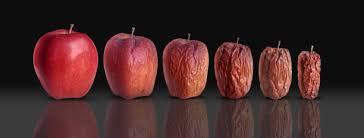
Comparing the Effectiveness of Preservatives: Natural vs Artificial
Vivaan Suryavanshi
STEM Innovation Academy High School
Grade 10
Presentation
No video provided
Hypothesis
If the control variable (apple slices) are manipulated by being coated with six natural preservatives ( Salt, Sugar, Honey, Vinegar, Lemon Juice, and Citric Acid) and two coated with artificial preservatives (Sodium Benzoate, and Potassium Sorbate) over a two week period, then salt will yield the best results out of the natural preservatives, and potassium sorbate the best out of the artificial preservatives. This is because the salt will dehydrate the apple slice earlier on in the experiment through osmosis therefore inhibiting microbial growth. Potassium sorbate will outperform sodium benzoate due to its increased efficiency at lower pH levels, making it an ideal candidate for preserving an acidic fruit like apple. The overall best performer will be the artificial preservative potassium sorbate, over salt because it will yield more consistent results over the 14 day timeframe, distinctly due to its ability to enter a cell and disrupt the Krebs Cycle.
Research
Food Spoilage and Preservation
Food spoilage is the process through which a multitude of external factors such as biochemical reactions and microbial contamination, cause an alteration in a food's visible appearance, standard taste or odor, all of which make consumption unappealing and/or harmful to consumers. Food spoilage can be reduced through the usage of preservation methods, all of which intend to inhibit microbial growth and appeal to customers. Prolonging shelf life allows companies to stand out against competitors promote their brand, and increase profits. Foods are classified into three major categories determined by shelf life: perishable (Meats, dairy, seafood, and poultry), semi-perishable (Starches, dried fruits, and cheeses), and non-perishable (Canned goods, nuts, and dry pasta). As previously mentioned, the determining factor which decides what category each food item is placed in is shelf life. Perishable items tend to last \~3 days to 3 weeks, semi-perishable items \~3-6 months, and non-perishable foods lasting \~2-4 years.
Causes of Spoilage
There are several factors affecting food spoilage all of which decrease the shelf-life of foods.
Microorganisms
- Bacteria, mold, and yeast are examples of microorganisms.
- Optimal growth at room temperature.
- Primarily result in undesired odors, taste, and appearance.
Enzymes
- Naturally present in most foods.
- Responsible for the ripening of fruits and vegetables
- Initially allow for fruits and vegetables to become desirable however over time they cause discoloration. E.g. banana peel starting off green, transitioning to yellow when ripe, and eventually to brown.
Air
- Presence of oxygen allows for oxidation
- Oxidation heavily influence discoloration, particularly among fruits and vegetables.
Light
- Exposure to sunlight results in slight discoloration
Pests/Physical Damage
- Rodents, insects, and parasite are example of pests.
- Pests often damage foods allowing easier access for microorganism growth.
Temperature
- One of the major factors influencing shelf-life.
- Higher temperature storage areas result in faster food spoilage and deterioration.
- Storage in lower temperature climates, such as in a fridge, prohibits microorganism growth.
- Lower temperatures also reduce the speed of enzymatic and oxidation processes.
Time
- Microorganism require time to grow and reproduce
- Time is also an influential factor in the development of the enzymatic process.
Preventative Measures
In order to combat the aforementioned influences on shelf-life, two types of preservatives are used. Antimicrobial preservatives, as the name suggests, prevent fungal and microbial growth on foods by removing their access to the water needed for them to survive. Often times this involves the process known as osmosis. The presence of preservatives used in this experiment such as salt and sugar (solutes) creates a concentration gradient between the solute concentration in the apple and outside of the apple, therefore resulting in the water being drawn out, water following solute. Antioxidant preservatives function by slowing down the naturally occurring enzymatic and oxidation processes. All of the natural and artificial preservatives being used in this experiment fall under at least one of the two categories.
| Preservative Name | Antimicrobial | Antioxidants and Antimicrobial |
|---|---|---|
| Sodium Benzoate | Yes | |
| Potassium Sorbate | Yes | |
| Citric Acid | Yes | |
| Lemon Juice | Yes | |
| Honey | Yes | |
| Vinegar | Yes | |
| Sugar | Yes | |
| Salt | Yes |
How do these Artificial Preservatives Work?
The artificial preservative sodium benzoate becomes benzoic acid when it is diluted in water. This acidic compound is most effectively used in environment with a pH level of under 4.5. It specifically works by disrupting the efficiency of enzymes in charge of microbial metabolism, therefore cutting off the food source of microorganisms. Sodium benzoate also works by disrupting the pH levels of the environment, causing the environment to be unsuitable to the microorganism's needs. Potassium sorbate works on a similar basis, and is most efficient up to a pH level of 6.5, making it suitable for the experiment, with the apple having a pH level of around 4. The effectiveness and efficiency of potassium sorbate increases the lower the pH is, making it even more suitable for my purpose. Like sodium benzoate, potassium sorbate works against the growth of yeast, mold and bacteria by disrupting their energy source. The enzymes that are disrupted are from cellular respiration, particularly from Krebs cycle and are known as: malate dehydrogenase, succinate dehydrogenase, fumarase.
| Enzyme Name | Basic Function | How It's Disrupted |
|---|---|---|
| Malate Dehydrogenase | Changes Malate to Oxaloacetate (Produces NADH) | Enzyme denatures + Cycle Slows |
| Succinate Dehydrogenase | Changes Succinate to Fumarate (Produces FADH2) | Membrane it is Fused to Denatures |
| Fumarase | Changes Fumarate back into Malate (Repeat Cycle) | Lack of Purpose |
When artificial preservatives such as potassium sorbate and sodium benzoate make contact with microorganisms, they are able to enter their cells because they are lipophilic, and able to pass the phospholipid bilayer of the cell's membrane. Once inside the microorganism's cells, they disassociate and release hydrogen ions, causing the pH levels of the cytoplasm to drop. The acidic pH levels of the cytoplasm causes the enzyme malate dehydrogenase to denature, resulting in its inability to perform its function of converting malate to oxaloacetate, and inhibiting the production of NADH. NADH is an electron transporter. FADH2 is also an electron transporter made when succinate dehydrogenase converts succinate to fumarate. This enzyme is attached to the membrane which is disrupted by the same hydrogen ions disassociated when the preservatives entered the cell. The hydrogen ions cause the membrane to become leaky and because the succinate dehydrogenase is membrane bound, its function also get effected. At this point both NADH and FADH2 electron transporters aren't being produced, therefore ATP cannot be produced through the electron transport chain. This also stops the conversion between succinate and fumarate. Without any fumarate to convert back to malate, the fumarase is left without function, and the cycle remains unrepeatable.
Variables
Control Variables
Pre-added pesticides and preservatives
- All apple slices used in the experiment originated from the same organic apple bought the day of the experiment.
Temperature
- All nine apple slices remained in the same room at the exact same temperature from start to finish
Sunlight
- All nine slices were placed in a room where all received equal amounts of exposure to the sun.
Time
- All the apple slices entered the preservative solution coating at the same time and were observed during the same observational period.
Pests/Air/Breakage
- Slices were placed in a petri dish all sealed by four pieces of tape in order to inhibit breakage from external factors such as pests or accidental damage during handling.
SA:Vol
- All nine apple slices were measured and cut to the same size in order to ensure the rate at which preservatives and water entered and exited the apple slice were the same.
Manipulated Variable
Preservative Coating
- The type of preservative coating differed between all nine apple slices.
Responding Variable
Mass of Apple Slices (Quantitative) - The mass of apples slices helped determine the rate at which an apple was breaking down\, depending on the preservative used in the coating process
Visual Browning and Shrinkage (Qualitative) - If an apple slice was coated in an antimicrobial preservative shrinkage would be expected due to osmosis.
Procedure
Materials
| Regular Plastic Petri Dish x9 | Litmus Paper x9 | Food Weighing Scale x1 |
|---|---|---|
| Organic Apple x1 | Salt 5g | Sugar 5g |
| Lemon Juice 5 tbsp | Vinegar 5 tbsp | Sodium Benzoate 0.1g |
| Potassium Sorbate 0.1g | Citric Acid 1g | Honey 5 tbsp |
| Kitchen Knife x1 | Sharpie/Marker x1 | Water 5 tbsp |
| Bowls and Spoons x8 | Stop Watch/Phone x1 | Tape x1 roll |
Procedure
1. Open all the petri dishes and label each one using a piece of tape and the sharpie. Label them Salt\, Sugar\, Honey\, Lemon Juice\, Vinegar\, Citric Acid\, Potassium Benzoate\, Sodium Sorbate\, and Control.
2. Place one pH strip inside each of the petri dishes.
3. Set out 8 bowls and label each one with a piece of tape and sharpie. Label them Salt\, Sugar\, Honey\, Lemon Juice\, Vinegar\, Citric Acid\, Potassium Benzoate\, and Sodium Benzoate.
4. Pour 100 mL of water in the bowls labeled Salt\, Sugar\, Citric Acid\, Potassium Benzoate\, and Sodium Benzoate.
5. Use the food weighing scale to measure out 5 g of salt and pour it into the bowl of water labeled salt.
6. Use the food weighing scale to measure out 5 g of sugar and pour it into the bowl of water labeled sugar.
7. Use the food weighing scale to measure out 1 g of citric acid and pour it into the bowl of water labeled citric acid.
8. Use the food weighing scale to measure out 0.1 g of sodium benzoate and pour it into the bowl of water labeled sodium benzoate
9. Use the food weighing scale to measure out 0.1 g of potassium sorbate and pour it into the bowl of water labeled potassium sorbate.
10. Take 5 tablespoons of honey and 5 tablespoons of water and pour them into the empty bowl labeled honey.
11. Take 5 tablespoons of vinegar and pour it into the empty bowl labeled vinegar.
12. Take 5 tablespoons of lemon juice and pour it into the empty bowl labeled lemon juice.
13. Place one spoon into each of the bowls and mix them. For the bowls of water that had solute placed within them\, stir until the solute is completely dissolved.
14. Stir the honey bowl until the water and honey are no longer separated and the viscosity is lowered.
15. Stir the other bowls as well.
16. Take an apple and cut it into 9 different 3 cm x 1 cm x 0.5 cm pieces.
17. Take 8 pieces of the apples you had cut and put one of them into each of the 8 bowls. Keep them in the bowls for 3 minutes. Use a stopwatch or phone to track the time.
18. Once the time is up\, place the apples into the petri dish that corresponds with the label of the bowl they were placed in. Ensure that there is at least a 2 cm gap between the apple and the pH strip so that the solution that the apple was placed in doesn’t come in contact with it.
19. Place the piece of apple that hasn’t been coated with any solution into the petri dish labeled control.
20. Take 4 pieces of tape per petri dish and seal each dish.
21. Place every petri dish in the same spot in the same room for the rest of the duration of the experiment.
22. Weigh and record the mass of each dish after they are sealed.
23. Continue to record the mass of each dish every day at the same time using the kitchen scale for the next two weeks.
24. Dispose of the petri dishes after two weeks time based on your municipal guidelines.
Observations
Day 1:
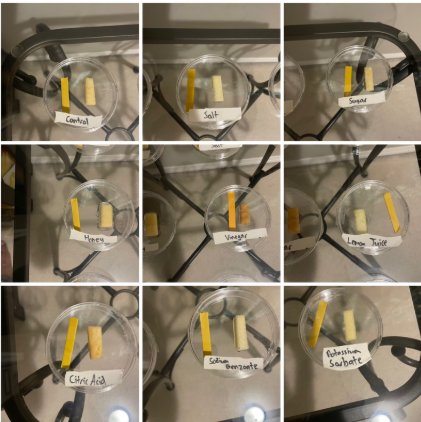
| Preservative Name | Control | Salt | Sugar | Honey | Vinegar | Lemon Juice | Citric Acid | Sodium Benzoate | Potassium Sorbate |
|---|---|---|---|---|---|---|---|---|---|
| Mass (g) | 18 | 18 | 19 | 18 | 18 | 18 | 18 | 18 | 18 |
Day 2:
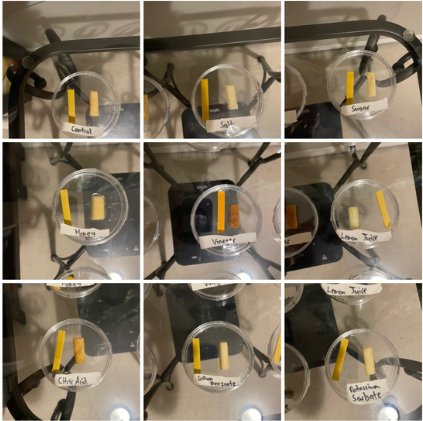
| Preservative Name | Control | Salt | Sugar | Honey | Vinegar | Lemon Juice | Citric Acid | Sodium Benzoate | Potassium Sorbate |
|---|---|---|---|---|---|---|---|---|---|
| Mass (g) | 18 | 17 | 18 | 19 | 18 | 18 | 18 | 18 | 18 |
Day 3:
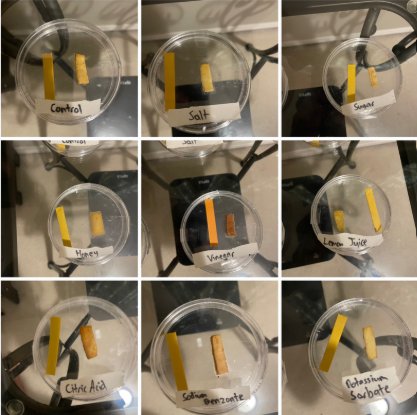
| Preservative Name | Control | Salt | Sugar | Honey | Vinegar | Lemon Juice | Citric Acid | Sodium Benzoate | Potassium Sorbate |
|---|---|---|---|---|---|---|---|---|---|
| Mass (g) | 17 | 17 | 17 | 19 | 18 | 18 | 18 | 18 | 18 |
Day 4:
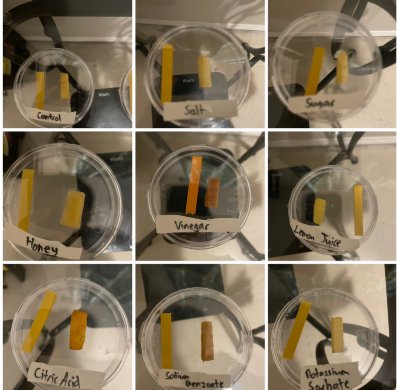
| Preservative Name | Control | Salt | Sugar | Honey | Vinegar | Lemon Juice | Citric Acid | Sodium Benzoate | Potassium Sorbate |
|---|---|---|---|---|---|---|---|---|---|
| Mass (g) | 17 | 17 | 17 | 18 | 17 | 17 | 18 | 18 | 18 |
Day 5:
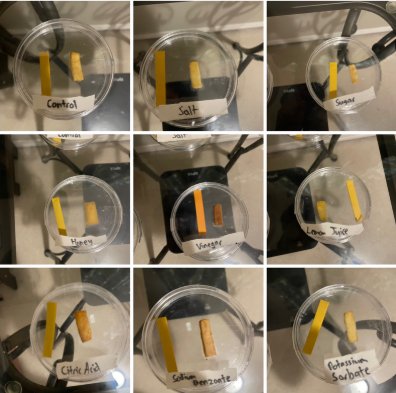
| Preservative Name | Control | Salt | Sugar | Honey | Vinegar | Lemon Juice | Citric Acid | Sodium Benzoate | Potassium Sorbate |
|---|---|---|---|---|---|---|---|---|---|
| Mass (g) | 17 | 16.5 | 16.5 | 18 | 17 | 17 | 18 | 18 | 18 |
Day: 6
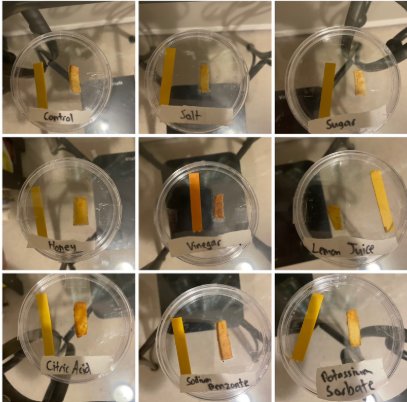
| Preservative Name | Control | Salt | Sugar | Honey | Vinegar | Lemon Juice | Citric Acid | Sodium Benzoate | Potassium Sorbate |
|---|---|---|---|---|---|---|---|---|---|
| Mass (g) | 17 | 16 | 16 | 18 | 17 | 17 | 17 | 17 | 17 |
Day 7:
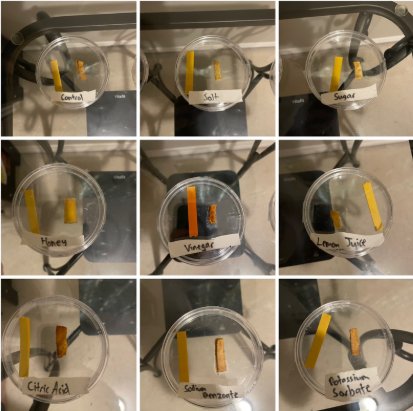
| Preservative Name | Control | Salt | Sugar | Honey | Vinegar | Lemon Juice | Citric Acid | Sodium Benzoate | Potassium Sorbate |
|---|---|---|---|---|---|---|---|---|---|
| Mass (g) | 17 | 16 | 16 | 17 | 16 | 16 | 17 | 17 | 17 |
Day 8:
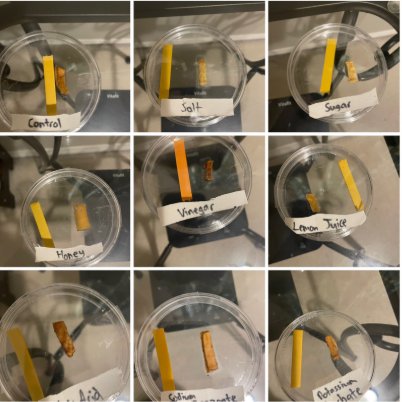
| Preservative Name | Control | Salt | Sugar | Honey | Vinegar | Lemon Juice | Citric Acid | Sodium Benzoate | Potassium Sorbate |
|---|---|---|---|---|---|---|---|---|---|
| Mass (g) | 16 | 16 | 16 | 17 | 16 | 16 | 17 | 17 | 17 |
Day 9:
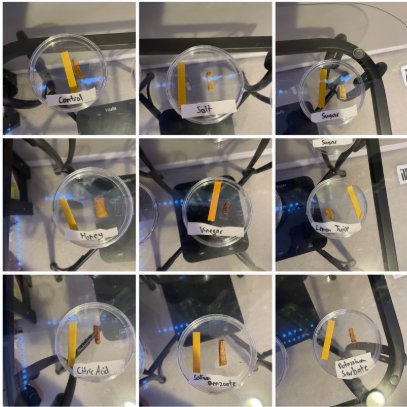
| Preservative Name | Control | Salt | Sugar | Honey | Vinegar | Lemon Juice: | Citric Acid | Sodium Benzoate | Potassium Sorbate |
|---|---|---|---|---|---|---|---|---|---|
| Mass (g) | 16 | 16 | 16 | 17 | 16 | 16 | 16 | 17 | 17 |
Day 10:
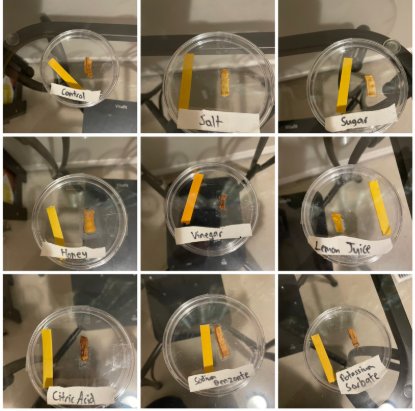
| Preservative Name | Control | Salt | Sugar | Honey | Vinegar | Lemon Juice | Citric Acid | Sodium Benzoate | Potassium Sorbate |
|---|---|---|---|---|---|---|---|---|---|
| Mass (g) | 16 | 16 | 16 | 17 | 16 | 16 | 16 | 16.5 | 17 |
Day 11:
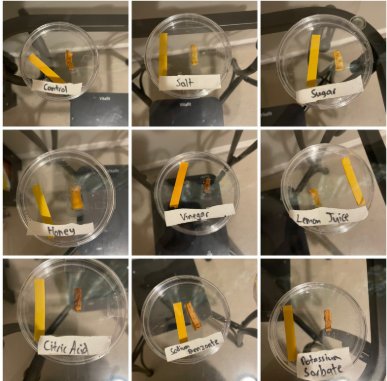
| Preservative Name | Control | Salt | Sugar | Honey | Vinegar | Lemon Juice | Citric Acid | Sodium Benzoate | Potassium Sorbate |
|---|---|---|---|---|---|---|---|---|---|
| Mass (g) | 16 | 16 | 16 | 17 | 16 | 16 | 16 | 16.5 | 17 |
Day 12:
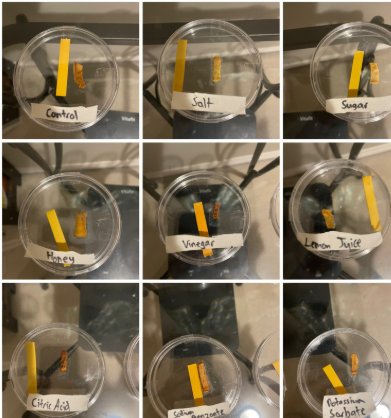
| Preservative Name | Control | Salt | Sugar | Honey | Vinegar | Lemon Juice | Citric Acid | Sodium Benzoate | Potassium Sorbate |
|---|---|---|---|---|---|---|---|---|---|
| Mass (g) | 16 | 16 | 16 | 17 | 16 | 16 | 16 | 16.5 | 17 |
Day 13:
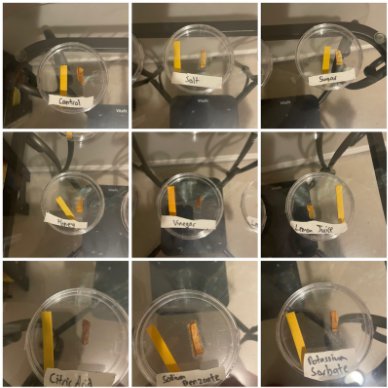
| Preservative Name | Control | Salt | Sugar | Honey | Vinegar | Lemon Juice | Citric Acid | Sodium Benzoate | Potassium Sorbate |
|---|---|---|---|---|---|---|---|---|---|
| Mass (g) | 16 | 16 | 16 | 17 | 16 | 16 | 16 | 16.5 | 17 |
Day 14:
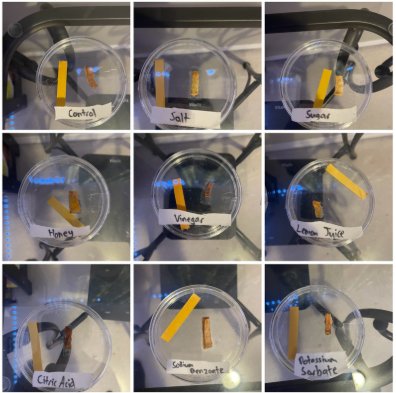
| Preservative Name | Control | Salt | Sugar | Honey | Vinegar | Lemon Juice | Citric Acid | Sodium Benzoate | Potassium Sorbate |
|---|---|---|---|---|---|---|---|---|---|
| Mass (g) | 16 | 16 | 16 | 17 | 16 | 16 | 16 | 16.5 | 16.5 |
Preservative Performance
Salt
- Small amounts of browning.
- Visible shrinkage.
- Overall shape remained the same.
- Mass saw decrease at start then stabilized near the end.
Sugar
- Similar to salt in it's shrinkage and browning.
- Shape of apple slice changed with a bend toward the left.
- Mass saw decrease at start then stabilized near the end.
Honey
- Apple slice took on a translucent appearance (Makes product unappealing to consumers).
- Slight shrinkage.
- Maintained similar shape.
- Instantaneous drop in mass in the first three days, but plateaued after that.
Vinegar
- Visible browning could be observed within a half hour of being placed in vinegar.
- Browning continued to worsen over the course of the experiment.
- Significant shrinkage and malformation occurred half way through the experiment.
- Mass decreased slowly at first then remained constant from day seven onwards.
Lemon Juice
- Surface initially looked crystal studded and pale, before eventually following a similar browning pattern compared to salt.
- Size shrunk a little bit.
- Shape curved to the right similar to sugar.
- Mass followed the same pattern as vinegar, dropping in the first week before staying consistent for the second week.
Citric Acid
- Browning, shape and size remained evenly spread across the piece of apple for the primary stages of the experiment.
- 1 week into the experiment, all three observational factors were significantly affected with the apple slice shriveling much faster than it had in the first week.
- Mass, like the other two natural acids, decreased relatively the same with the only exception being the shift from 17g to 16g occurring a day later.
Sodium Benzoate
- Browning occurred the slowest.
- Major shrinkage did not occur until about half way through the duration of the experiment.
- Shape remained most similar to the first day, compared to any of the other apple slices.
- Mass remained most stable, maintaining 17g for 9 days.
Potassium Sorbate
- Less browning initially but the rate at which browning occurred increased as the experiment progressed
- Shrinkage could be observed, however the overall shape remained similar to the original piece.
Analysis
Preservative Performance
Over the course of the two week experiment, both qualitative and quantitative data was recorded. Consideration of the mass (qualitative data) shows us that most of the natural preservatives performed similar to the control apple slice displaying no real increase of mass preservation. Factoring in the qualitative data allows us to get a better understanding as to which preservatives would perform better in the market, and most reasonable in daily usage, for both consumers and manufacturers. Natural preservatives that were acidic like vinegar, lemon juice, and citric acid showed early browning and changes in shape. This paired with the fact that all three of the apple slices coated in those acids saw significant shrinkage tell us that they would not be ideal preservatives for everyday use. Preservative solutions composed of the solutes sugar and salt did a great job preventing browning of the apple slice. Visible shrinkage could also be seen in both as expected, due to the higher concentration of solute within the solution, which eventually evened out. The reasoning for the shrinkage being halted was due to the fact that the process of osmosis had been completed, with the water being drawn across the concentration gradient toward the solute in the the earlier stages of the experiment. From the lack of browning we can understand that salt and sugar are good short term preservatives, however from the shrinkage of both slices, and the slight deformation of the sugar coated slice, it can be understood that they wouldn't last the lengthy time people tend to leave fruits in their fridge. Honey was the highest performing preservative based solely on quantitative data however the translucent appearance it took on would make it highly unappealing to consumers resulting in wastage. Another reason as to why honey would not be a suitable preservative is due to its influence on taste. Although taste was not an observed factor in this experiment, due to safety issues, honey has a very potent sweet taste, which would overbear the apple's desired taste. This would be the largest factor in determining honey's unsuitability. This very concept can also be applicable to vinegar and lemon juice. Potassium sorbate and sodium benzoate were fairly close throughout the length of the experiment on a qualitative basis, however after day 7 clear differences began to emerge, distinguishing one as a clear choice. Both preservatives showed a good amount of browning prevention however as the experiment neared its end, the apple slice coated in potassium sorbate began to show significant shrinkage compared to that of the sodium benzoate which retained its shape and size the best out of all preservatives.
Conclusion
Best Short Term Preservative
The best preservative to be used for short durations to avoid browning throughout the course of a day would be Salt. Salt as a preservative yielded the least browning, particularly in the first week of the experiment. Although it dropped off near the end, its ability to hold its original colour, and shape, without impacting taste significantly is what makes it the best in this category. This supports my earlier hypothesis, that salt would perform the best under the browning category, despite losing out in mass due to its early shrinkage.
Best Long Term and Overall Preservative
The preservative that yielded the best results across both qualitative and quantitative measures was the Sodium Benzoate. The sodium benzoate sample maintained its overall original shape the best from day one to fourteen displaying the least deformation and only shrinking to around half the length of the pH strip. The next closest preservative was honey, being a little less than half the length of the pH strip. Sodium benzoate also yielded a slow and consistent increase in browning, making it the ideal preservative to avoid food wastage. In relation to taste, research shows that sodium benzoate results in a next to none noticeable taste difference, adding to the reasons as to why it outperforms the likes of salt and honey. My earlier hypothesis is disproven by the collected data, and the conclusions drawn from them. Evidence of my hypothesis being disproven can be seen when comparing the displacement in size of the two artificial preservatives. Potassium sorbate ended being only a quarter of the size of the pH strip as well as shriveling upwards near the ends of the slice.
Application
Overarching Problem
Reports from mid 2024 show that 46.5% of the food produced in Canada, and on average 25% of food purchased within a household is wasted. This translates to 21.1 million tonnes per year. Food being wasted like this is harmful to everyone. Consumers lost financial value in the items they purchased that were spoilt as well as the obvious wastage of foods that could've provided nutrition. With food being wasted, municipalities often choose to establish a composting system which also costs money. In 2024 the City of Calgary committed $89.6 million to expand composting facilities in order to accommodate the increasing pressure at local composting facilities. In addition to the financial drawbacks, food wastage in Canada also contributes to 25 million metric tonnes of CO2 emissions being put out into our atmosphere.
How Can Preservatives Help?
The usage of preservatives may not be the only factor in reducing food wastage, however it can influence and prevent the driving habits. By adding preservatives, such as sodium benzoate, fresh fruits (which make up 45% of the food wasted across Canada) stay longer in pantries and fridges. As seen in the experiment, sodium benzoate effectively reduced browning over a two week period, which is roughly around the time non-perishable items last, as well as maintaining its desired shape. When a food item such as an apple slice, looks fresher, and absent of abnormalities, we are more likely to consume the fruit rather than composting it due to bruising and browning. Canadian citizens would also see a reduction in their weekly expenditures if all the food they purchased lasted longer and was consumed, also resulting in them spending less time and money in trips to the grocery store. Sodium benzoate requires very little concentration for it to be effective, and as a result usage of it on food products would increase their shelf-life, and a reduced cost for the grocers.
Sources Of Error
Preservative Solution
When coating the apple slices with the preservative solutions I placed and kept the apple slices within the solution for an equal amount of time. Keeping all apple slices in their unique solutions for the same time might've skewed the results of the acids negatively because the prolonged exposure might've allowed too much of the acid to be absorbed, therefore causing early browning. Not accounting for the added weight the honey added to the apple slice, may have caused honey to appear as a better preservative comparative to other preservatives.
Weighing Scale and pH Strips
Due to budget constraints the weighing scale I bought for this experiment wasn't the most sensitive, particularly when measuring decimal places. This made gathering accurate measurements of the mass of the apple slices difficult, and decreased the precision of data collection. The concentration required to create the preservative solutions for the artificial solutions required measurements of small amounts less than 1, which resulted in me having to retake the measurements multiple times before I could yield somewhat consistent results. The pH strips that had been placed alongside the apple slices were done in an effort to detect microbial growth as microorganisms often results in a change in pH often dropping the pH level in it's environment. However as no major microbial growth occurred, most likely due to the fact that agar petri dishes were not used, the pH strips only became useful to compare the size of the apple slice to its original slice. Even this aspect of the pH strips did not serve their purpose to the fullest extent. This was because when the petri dishes were being moved onto the weighing scale, the strips shifted out of position making the intended comparison difficult to draw.
Citations
Canadian Institute of Food Safety. “Perishable Foods and Food Spoilage.” Blog.foodsafety.ca, 29 July 2017, blog.foodsafety.ca/perishable-foods-and-food-spoilage.
Fifield, Karen. “Get to Know the Causes of Food Spoilage.” MSU Extension, 23 Nov. 2016, www.canr.msu.edu/news/get_to_know_the_causes_of_food_spoilage.
“How Food Spoils | UNL Food | Nebraska.” Unl.edu, 2024, food.unl.edu/article/how-food-spoils/. Sridhar, Adithya, et al. “Food Preservation Techniques and Nanotechnology for Increased Shelf Life of Fruits, Vegetables, Beverages and Spices: A Review.” Environmental Chemistry Letters, vol. 19, no. 2, 9 Nov. 2020, link.springer.com/article/10.1007/s10311-020-01126-2, https://doi.org/10.1007/s10311-020-01126-2.
“2025 Budget.” Https://Www.calgary.ca, 2025, www.calgary.ca/our-finances/2025-budget.html.
Ibrahim, Osama. EC NUTRITION EC NUTRITION Review Article Thermal and Nonthermal Food Processing Technologies for Food Preservation and Their Effects on Food Chemistry and Nutritional Values Citation: Osama O Ibrahim. "Thermal and Nonthermal Food Processing Technologies for Food Preservation and Their Effects on Food. 30 June 2020. https://ecronicon.net/assets/ecnu/pdf/ECNU-15-00850.pdf#:\~:text=Oxygen%20can%20cause%20food%20to%20spoil%20by,in%20off%20flavor%20and%20bad%20odors%20%5B6%5D.
“Seven Food Preservation Methods to Cut Food Waste.” David Suzuki Foundation, 2025, davidsuzuki.org/living-green/seven-food-preservation-methods-to-cut-food-waste/.
Awaad, Shimaa S, et al. “A Comparative Study on the Antifungal Effect of Potassium Sorbate, Chitosan, and Nano-Chitosan against Rhodotorula Mucilaginosa and Candida Albicans in Skim Milk Acid-Coagulated (Karish) Cheese.” Veterinary World/Veterinary World, 1 Sept. 2023, pp. 1991–2001, www.ncbi.nlm.nih.gov/pmc/articles/PMC10583870/, https://doi.org/10.14202/vetworld.2023.1991-2001.
Talib, Ambreen, et al. “Modern Trends and Techniques for Food Preservation.” Food and Life, vol. 2024, no. 1, 30 Mar. 2024, pp. 19–32, https://doi.org/10.5851/fl.2024.e6.
Fedor, Tyson. “Nearly Half of the Food Produced in Canada Is Wasted Annually: Report.” CTVNews, 22 Oct. 2024, www.ctvnews.ca/calgary/article/nearly-half-of-the-food-produced-in-canada-is-wasted-annually-report/.
“Salt Usage by Native Americans - Peach State Archaeological Society.” Peach State Archaeological Society, 30 June 2024, peachstatearchaeologicalsociety.org/primitive-skills/salt-usage-by-native-americans/.
---. “Biochemistry\, Citric Acid Cycle.” National Library of Medicine, StatPearls Publishing, 1 May 2023, www.ncbi.nlm.nih.gov/books/NBK541072/.
“Fruit and Vegetable Preserving and Specialty Foods: 2024 FCC Food and Beverage Report | FCC.” Www.fcc-Fac.ca, www.fcc-fac.ca/en/knowledge/2024-food-beverage-report-fruit-vegetable-speciality-foods.
Elchemy. “Sorbic Acid vs Potassium Sorbate: Understanding Their Role in Extending Food Preservative Shelf Life.” Elchemy.com, Elchemy, 27 Oct. 2025, elchemy.com/blogs/food-nutrition/sorbic-acid-vs-potassium-sorbate-in-extending-food-preservative-shelf-life.
“What Is the Mechanism of Sodium Benzoate?” Patsnap.com, 18 July 2024, synapse.patsnap.com/article/what-is-the-mechanism-of-sodium-benzoate.
Euphoria Yang, et al. “Investigation on Bacterial Growth and PH in Milk after the Expiration Date.” The Scientific World Journal, vol. 2023, 26 Oct. 2023, pp. 1–9, www.ncbi.nlm.nih.gov/pmc/articles/PMC10622597/, https://doi.org/10.1155/2023/9982886.
Khan Academy India - English. “Krebs Cycle (Citric Acid Cycle) | Respiration in Plants | Biology | Khan Academy.” YouTube, 31 July 2024, www.youtube.com/watch?v=J-jcA43r8xw. Accessed 9 Dec. 2025.
2 Minute Classroom. “Cellular Respiration Overview | Glycolysis\, Krebs Cycle & Electron Transport Chain.” YouTube, 15 Jan. 2021, www.youtube.com/watch?v=3Hxwzf7Alcw.
“Role of Preservatives in Food Safety and Shelf Life Extension • Food Safety Institute.” Food Safety and Quality Institute, 16 Jan. 2024, foodsafety.institute/food-fundamentals-chemistry/role-of-preservatives-in-food-safety/.
BioMan Biology. “The Krebs Cycle Explained (Aerobic Respiration).” YouTube, 17 Feb. 2021, www.youtube.com/watch?v=UZlmm-yzWrQ.
CO., BIOTECH. “The Truth about Preservatives: Separating Fact from Fiction - XI’AN AOGU BIOTECH CO., LTD.” Aogubio Natural, XI’AN AOGU BIOTECH CO., LTD, 15 Apr. 2025, www.aogubio.com/news/the-truth-about-preservatives-separating-fact-from-fiction/. Accessed 2 Mar. 2026.
“What Are Food Preservatives and How Do They Work? - Mondstar.” Mondstar, 9 Jan. 2025, www.mondstar.com/what-are-food-preservatives-and-how-do-they-work/. Accessed 2 Mar. 2026.
City of Calgary. “Calgary Composting Facility Breaks Ground: Celebrating New Construction and Funders.” Calgary Composting Facility Breaks Ground: Celebrating New Construction and Funders , City of Calgary, 27 May 2024, newsroom.calgary.ca/calgary-composting-facility-breaks-ground-celebrating-new-construction-and-funders/?utm_source=chatgpt.com. Accessed 4 Mar. 2026.
MyBib Contributors. “MyBib Citation Manager.” MyBib.
Acknowledgement
I would like to thank my science fair coordinator, Ms. O'Keefe, for guiding me in the right direction whenever I had questions, and always checking in to provide feedback on my project. I would also like to thank my dad for ordering in several of the supplies needed for the completion of the project, as well as thanking him for all the advice and feedback he gave to me.