
"Plant Problems" How does a Plants Enviourment Affect Its Health?
Tabarak Al Hachami
Dr. Gordon Higgins School
Grade 8
Presentation
No video provided
Hypothesis
With Humidity: The humidity will cover the leaves and stem in humidity, especially since it's an in closed area, letting it lose less of its water amount since less water will leave when the stomata open for gas exchange with carbon dioxide. They won’t need to absorb as much water from the soil anymore, making it moist and damp. Because of this, the stomata can stay open for longer, allowing more photosynthesis than before. However, some problems can still happen with excess water in the closed environment. Mold can grow and happen in the soil and roots if it stays damp for too long, due to the living organisms already in the soil. Moss can form and grow on the base of the soil since it has what it needs to survive and thrives in damp areas. The water droplets could add up and weigh down the leaves, making it droop and seem “sad”.
With Incense Stick (Smoke): With the smoke covering the leaves, they wouldn't be able to do transpiration properly which is heavily needed for the plant to thrive, making the plant's leaves and overall health in a worse condition. Second, the smoke might be gray or black, which can make a cloud in its atmosphere. This causes for less sunlight to enter for the plant to do photosynthesis, and this is extremely needed for the plant to grow and live. The essence stick will damage the leaves and disrupt the water absorption. The density in the smoke and herbs could cause a clog in the stomata, making water vapor and condensation more difficult to happen. With the stomata blocked, the plant will absorb less water from the roots, making the water intake more difficult for the plant used. Lastly, it will make the air inside the closed environment mixed into the smoke, this can damage the air and carbon dioxide the plants need. Overall, this might cause the biggest impact.
No hypothesis was done for the regular growing plant, as there were no manipulated variables.
Research
What is photosynthesis? Photosynthesis is a process where plants, algae, and certain bacteria convert sunlight into their own energy in the form of sugar. During this process, chloroplasts absorb the light's energy. The process starts with the stomata, when it opens to collect carbon dioxide. This is called photorespiration. The roots then absorb water while chloroplasts absorb the sun’s energy. The energized electrons then get converted through a chemical reaction. The plant uses carbon dioxide with ATP (the cell's energy currency) and NADPH (an electron carrier) to make glucose. Roots then supply the water needed for the chemical reactions to make the plant’s food.
What Does the Roots do? Plants grow down into the soil of a plant. The roots spread out, helping to anchor the plant and giving it stability when it grows. Their primary use is to absorb water and nutrients collected from the soil. They can also store these minerals, nutrients, and water in their roots. They then send this to the stem so the process of photosynthesis can occur. Depending on the type of plant, they could be tap roots or fibrous roots. Tap roots penetrate deep into the soil to collect as much water as possible for the plant. It's one main thick root with other thin roots spreading. Fibrous roots are shallow, and they branch more widely, thriving in areas with more nutrients towards the top of the soil just below the surface. The soil used for the plant will depend on its roots.
What does the Stomata do for the plant and during photosynthesis? Each stomata is a tiny cell on the plant’s surface. It has guard cells on the sides that open and close. In photosynthesis, it opens to collect carbon dioxide, but small amounts of water are also released. When the plant is dehydrated, the stomata stays closed to retain water. When the carbon dioxide levels in the plant decrease by even 0.05, the stomata will open again to collect carbon dioxide for photosynthesis.
How does the Stomata and Guard cells look like? The stomata is a small, circular cell with two guard cells on each side. The guard cells are more kidney bean shape with other cells on the border of the stomata.
How Does the Stomata Open and Close? The basic function of them to open and close is through signal, contracting, and stretching open. To close the stomata, the guard cells contract to close them, not allowing any air to come in or out. When the stomata open, the guard cells stretch out, sometimes giving it an oval shape depending on the plant species. Signals of a high concentration with carbon dioxide cause it to open, as well as the night where it is more frequent for the stomata to open.
What is the Role of Guard Cells and what do they do? Guard cells control large water loss and close during hot, dry or extremely windy days to keep too much water from leaving the plant. They open when the weather is more suitable for gas exchange. Guard cells also respond to the environment, if CO2 levels are high, the guard cells will most likey open to get a higher concentration of carbon dioxide. They open by contracting to bring both guard cells together, and open by stretching out to create a gap for gas exchange. If water levels in the plant are low, they remain closed to prevent even more water loss. When there is plenty of water, they open. These factors all help maintain the plant’s hydration levels. They are found in the stems or leaves, usually in pairs on each side of an opening on a stoma.
What are chloroplasts and What Role do they play in Photosynthesis? They are a round shaped oval. The chloroplast's structure starts with an enclosed double outer membrane. It’s the site for photosynthesis. Chloroplasts are organelles that contain the pigment chlorophyll, which captures the sun's energy to transform water and carbon dioxide into glucose, which is their source of food. The plant then uses this for energy and growth, and they release oxygen as a natural byproduct (made automatically during the process of making food for itself).
What happens in a closed environment for a plant? The plant first starts to do photosynthesis regularly, but the carbon dioxide level drops as there isn’t a strong sustainable source to collect carbon dioxide from. If no carbon dioxide is being cycled, the plant will start to die. If there is enough carbon dioxide and photosynthesis is happening and transpiration is occurring normally, this will lead to humidity building up. This means a very humid environment with moist soil since the water can not escape. The air spaces in the soil meant for oxygen will be filled with water, and the plant may struggle to “breathe”. Over time, this can lead to root rot and mold or fungus building up on the soil’s surface.
How do plants get CO2 in a closed environment? They get the carbon dioxide they need by using the air trapped inside the container. While photosynthesis is also taking place, they release a small amount of carbon dioxide, especially at night. If part of the plant dies, tiny amounts of carbon dioxide can be released by the chemical breakdown of the dead leaves or roots. In conclusion, the plant only gets carbon dioxide from the air trapped at the start, the plant's only source of transpiration (mostly at night), and the chemical breakdown of dead tissue. Eventually, the carbon dioxide becomes too low and unhealthy for long term growth for the plant.
What is Smoke? How does it affect Plants? Smoke is a combination of certain gases, pollutants, and water vapor. The smoke can build up and block the sun’s energy from reaching plants properly. This can reduce photosynthesis and overall cause a significant decrease in a plant’s growth. If the smoke covers a leaf’s surface, it can block the stomata, making the ability to take in carbon dioxide and water to change, leading the plant to turn brown and causing it to die. It makes the plant weaker, making it more vulnerable to pests and diseases that can harm them.
What is Smoke density? It tells you how many particles are packed into a certain amount of smoke. For example, a high smoke density tells you there are many “particles/atoms” packed into the smoke. It matters in this experiment because a high smoke density can block the sunlight that can come through more than a low smoke density. For my experiment, we will need to know the smoke density to have a better prediction on how it will affect the plant.
What is Transpiration? It is a plants loss of water, mostly from the stomata found on the leaf of the plant. It’s the evaporation of water from the plant. Since plants get water mostly form its roots, it leaves the plant through transpiration. This is an extremely important cycle to maintain the moisture levels in the environment. Plants actually take in more water they need; transpiration is a way of getting rid of the excess water and then can easily access the Carbon Dioxide it uses for photosynthesis at the same time. The water is collected from the roots, brought up the stem, and evaporated from diffusion (gas exchange). The water being let out during transpiration is also why the condensation forms on the side of its enclosed environment.
Why is Transpiration Important for Cooling the Plant and Moving Nutrients? It helps regulate the inside temperature of the plant. Transpiration absorbs heat from the leaf’s surfaces. This is called evaporative cooling and removes excess heat. Then the water evaporates, letting the plant stay cool. As the water evaporates from the surface of the leaf, Transpiration also moves water from the roots to other parts of the plant. This helps nutrients cycle around. With transpiration moving nutrients and water, it helps gather them to places like the leaf where they are needed.
Why does Light Matter? It helps every living organism on Earth and starts the photosynthesis process. Without light, the temperature would be -18C, causing almost every plant to die. They need it to help make their source of food. Different wavelengths could trigger responses. With blue light, it promotes strong root development. With red light, it is effective for photosynthesis.
Variables
Manipulated Variables: The surrounding environment/atmosphere of the plant Incense Stick (representing smoke) Humidity (steam)
Responding variables: The Jar, Plant, and environment Plant's responding variables: Soil (Moisture), leaves, roots, stem Jar's Responding Variables: Opacity, Glass Environment's Responding variables: Temperature, air, atmosphere
Controlled Variables: The Plants (Species, how fully grown they are) Soil (How much watered, amount of soil) Water used and amount Amount of sunlight given Jar sizes and opacity/ size of controlled environment How long before observing each plant
Procedure
 Procedure
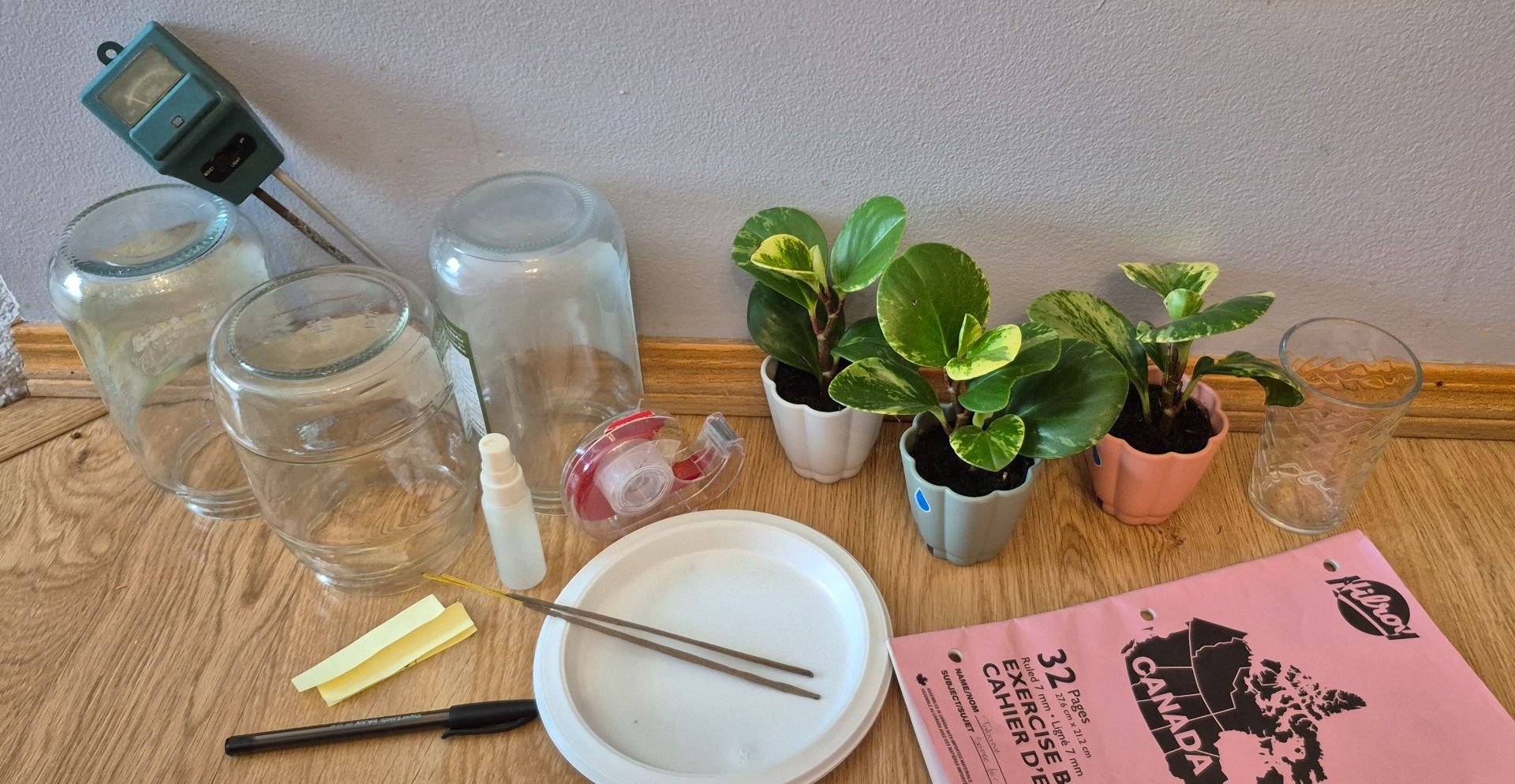
- Gather all the materials
- Place a paper plate under each plant
- Label Each Plant on paper
- Tape labels on paper plate
- Water each Plant with 6 sprays
- Write observations in logbook on plant conditions before experiment
- Place similar sized clear jars over each plant
- Pour hot water into a cup (not boiling).
- Grab the humidity jar and place over the cup.
- Wait until a thick layer of condensation forms on the jar.
- Quickly place jar back over the plant.
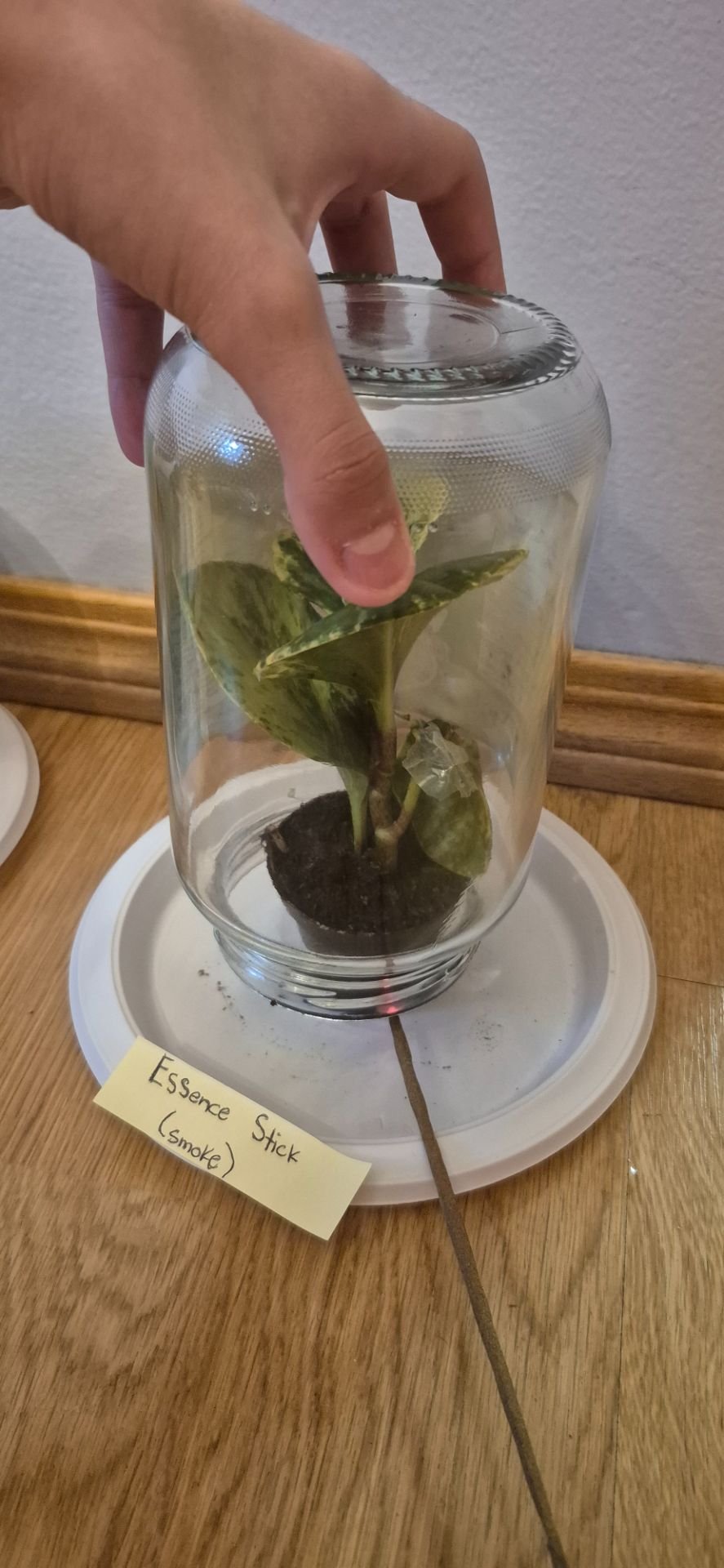
- Lift the incense stick jar slightly.
- Light the incense stick and allow it to fill up in the jar
- Place jar back onto plant
- Write observations on plant conditions and environment immediately after experiment
- Wait 8-10 hours to see a noticeable change and write observations
- Wait until the next day
- Open jars and water plants with 6 sprays
- Open humidity jar and add steam
- Open essence stick jar and burn essence stick
- Write observations
- Repeat over a total of 5 days.
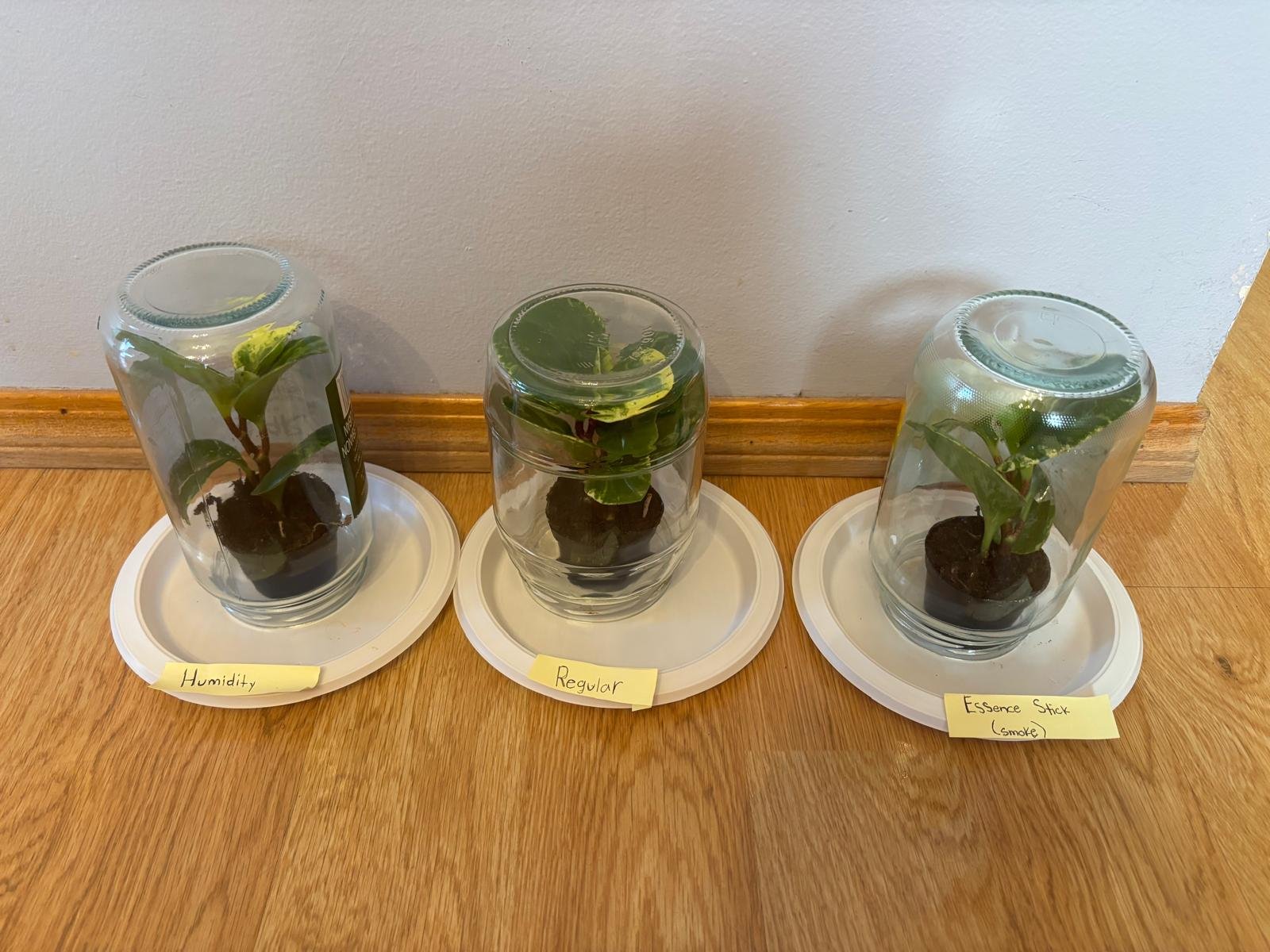
Observations
-Before Experiment- February 27, 2:30pm
| -Before Experiment- February 27, 2:30pm |
|---|
| Observing | Humidity plant | Regular plant | Incense stick plant |
|---|---|---|---|
| Height | 12.5cm | 13.6cm | 12.0cm |
| Plant species | Peperomia Obstuifolia | Peperomia Obstuifolia | Peperomia Obstuifolia |
| Habit/Shape | Slightly tilted to the right side | ||
| Regular plant's Habit/shape: Standing up tall, branching upwards into other stems | |||
| Incense Plant's Habit/shape: One main stem branching upwards | |||
| Air | Oxygenated Air | Oxygenated Air | Oxygenated Air |
| Atmosphere | Open environment, Room temperature | Open environment, Room temperature | Open environment, Room temperature |
| Soil | Damp rich soil | Damp rich soil | Damp soil |
| Leaves | Thick smooth green leaves, yellow smaller leaves (6 leaves total) | Waxy, yellow spots towards outside edge (8 leaves total, one extremely small leaf) | Green leaves with a lighter color towards the edge. Medium sized (6 leaves total) |
| Roots | Good condition, fibrous roots | Healthy, fibrous roots | Healthy, fibrous roots |
| Stem | Redish brown with spots | Redish brown with spots, one main stem branching upwards | Redish stem with spots, small stem standing up |
-During Experiment- Right After Experiment started, February 27, 3:00pm
| Observing | Humidity plant | Regular plant | Incense stick plant |
|---|---|---|---|
| Opacity (Jar) | translucent | transparent | translucent |
| Glass (Jar) | Water droplets, condensation forming | Clear | Smoke covering, fog, greyish tint |
| Temperature | Warm | Room Temperature | Lukewarm |
| Air | Humid | Not humid nor dry | Smokey/low oxygen |
| Atmosphere | Enclosed space, trapped humidity | Enclosed space, trapped air | Enclosed space, smoke trapped |
| Soil | Damp, rich (3 on moisture meter) | Damp, rich (3 on moisture meter) | Damp, rich (3 on moisture meter) |
| Leaves | Covered in humidity | Nothing changed yet | Covered in cloud of smoke |
| Roots | Nothing changed yet | Nothing changed yet | Nothing changed yet |
| Stem | Nothing changed yet | Nothing changed yet | Nothing changed yet |
-During Experiemt- 9 Hours after experiment began, February 27, 11pm
| Observing | Humidity plant | Regular plant | Incense stick plant |
|---|---|---|---|
| Opacity (Jar) | Transparent | Transparent | Translucent |
| Glass (Jar) | Water droplets | Clear | Light Grey tint |
| Temperature | Room Temperature- cool | Room Temperature | Warm |
| Air | Humid, | Similar to room air | Some smoke escaped |
| Atmosphere | Enclosed, no air circulation | Enclosed, no air circulation | Enclosed, No air circulation |
| Soil | Moist (3 on moisture meter) | Damp (2 on moisture meter) | Damp (2 on moisture meter) |
| Leaves | Covered in condensation | Waxy, smooth, vibrant green | Smooth plant leaves |
| Roots | Nothing changed yet | Nothing changed yet | Nothing changed yet |
| Stem | Wet | Feels drier | Nothing changed yet |
-During Experiment- February 28, 10pm (2nd day)
| Observing | Humidity plant | Regular plant | Incense stick plant |
|---|---|---|---|
| Opacity (Jar) | Translucent | Transparent | Translucent |
| Glass (Jar) | Foggy, Condensation | Very little condensation forming | Fog, slight tint |
| Temperature | Warm | Room Temperature to cool | Slightly warmer |
| Air | Extremely humid | Room air to slightly damp | Light smoke |
| Atmosphere | Enclosed, no air circulation | Enclosed, no air circulation | Enclosed, no air circulating |
| Soil | Really Moist (4 on moisture meter) | Damp (3 on moisture meter) | Dry (1.5 on Moisture meter) |
| Leaves | Stiff, feels like leather | Drier than before | Dry and warping slightly |
| Roots | Unnoticeable change | Unnoticeable change | Unnoticeable change |
| Stem | Flexible and moist | More greenish, healthy | Darker |
-During Experiment- March 1, 7pm (3rd day)
| Observing | Humidity plant | Regular plant | Incense stick plant |
|---|---|---|---|
| Opacity (Jar) | Translucent | Transparent | Translucent |
| Glass (Jar) | Moisture buildup | Little condensation, noticeable transpiration | Grey tint, haze of smoke |
| Temperature | Room Temperature | Room Temperature | Room Temperature - warm |
| Air | Humid | Damp Air | Light smoke combined with air |
| Atmosphere | Enclosed, no air circulation | Enclosed, no air circulation | Enclosed, no air circulation, cloud of smoke, smoke and air combined |
| Soil | Wet (5 on moisture meter) | Damp (3 on moisture meter) | Dry (1 on moisture meter) |
| Leaves | Stiff, slightly more yellow | Healthy, green, little condensation | Dull leaves, more yellow |
| Roots | Unnoticeable Change | Unnoticeable change | Unnoticeable Change |
| Stem | Dark reddish, flexible | Spotted, standing up tall | Bent and darker stems |
-During Experiment- March 2, 6pm, (4th day)
| Observing | Humidity plant | Regular plant | Incense stick plant |
|---|---|---|---|
| Opacity (Jar) | Translucent | Transparent, clear | Translucent, |
| Glass (Jar) | Layers of moisture buildup, water droplets | Water dripping | Not much light goes through, fog buildup, grey |
| Temperature | Lukewarm | Somewhat warm | Warm |
| Air | Steamy from hot water, high humidity concentration | Little more humid from closed environment, air can’t circulate | More smoke than air now, low humidity |
| Atmosphere | Air is closed in, no air circulation | No air circulation, enclosed area | Enclosed, no air circulation, smoke concentration is getting higher by each day |
| Soil | Moist/wet soil (4.5 on moisture meter) | Moist (4 on moisture meter) | Dry (1.5 on moisture meter) |
| Leaves | Stiff, almost “crunchy” at stem, pointed down leaves | Leaves look thick, less vibrant colors, stem is more brown | Few leaves died and turned brown at edges |
| Roots | Roots appear thicker | Roots look brighter than previous days | Look normal and appear similar to previous days |
| Stem | Branching stem, slightly tilted | More brown, somewhat less spots | Appears darker and weaker |
-During Experiment- March 3, 7pm (5th day)
| Observing | Humidity plant | Regular plant | Incense stick plant |
|---|---|---|---|
| Opacity (Jar) | Translucent | Translucent, little condensation made it less clear | Translucent/ almost opaque from more incense stick burning time |
| Glass (Jar) | Layers of steam and moisture building up over time, water dripping down | Water droplet, very little condensation, obvious transpiration took place | Smog, burned wood smell |
| Temperature | Warm/ more hot | Warm | Room Temperature |
| Air | Misty | Slightly increased moisture | High smoke concentration |
| Atmosphere | Enclosed, No air circulation, higher humidity in the jar’s air | Similar to room air but with extra dampness | Closed, No air circulation, some smoke escapes daily though |
| Soil | Drenched (5 on moisture meter) | Moist (4 on moisture meter) | Dry, top is flaky (1 on moisture meter) |
| Leaves | Dull leaves slightly tilted | Look mostly healthy, some brown edges on very few leaves | More leaves died/welted |
| Roots | Same as previous day | Same as previous day | Slightly orange/darker than before |
| Stem | Appears taller compared to last few days | Stayed same as previous day | |
-After Experiment- March 3 10:30pm
| Observing | Humidity plant | Regular plant | Incense stick plant |
|---|---|---|---|
| Height | 13cm | 13.8cm | 11cm |
| Plant species | Peperomia Obstuifolia | Peperomia Obstuifolia | Peperomia Obstuifolia |
| Habit/Shape | Tilted to right side | Stand up tall, bigger leaves tilted to right | Drooping downwards, all leaves somewhat tilted down |
| Air | Very humid | Room air, slightly damper and oxygen rose | Foggy air with high concentration of smoke. |
| Atmosphere | Enclosed, no air circulation | Enclosed, no air circulation | Enclosed, no air circulation |
| Soil | Extremely moist (between 4-5 on moisture meter) | Moist (4 on moisture meter) | Dry (between 1-2 on moisture meter) |
| Leaves | Dull, slightly tilted (6 leaves total) | Healthy, waxy, green, smooth, some lighter patches of green (8 leaves total, one about to sprout) | Most wilted and withered, some leaved died and had black or brown towards edges (4 leaves total) |
| Roots | Appear thicker | Became brighter | Appear slightly more orange/brown |
| Stem | Appears taller | More brown than red now | Darker and weaker, broke at some areas. |
Analysis
Humidity As the experiment continued, I noticed a trend with the soil in the humidity plant became wetter each day. This happened because the high humidity inside the closed jar caused the hot water to evaporate, hit the sides of the jar, and drip back into the soil. Since no air could escape, the moisture kept building up. This extra humidity also reduced the plant’s ability to do gas exchange, because the air was already full of water vapor, so the plant couldn’t release as much water through its leaves. Over time, the leaves began to droop and feel stiff or “crunchy,” especially near the stem. The plant did get increase water with helped with the photosynthesis process. Some quantity observations can be its height before and after, which I found a very slight increase that I was surprised with. The moisture meter numbers which slowly increased form the higher condensation of the steam/water. The jar was mainly translucent and transparent. It didn't get much sunlight, and I think is caused an impact on the plants leaves and photosynthesis process.
Regular Growing Plant: Throughout the experiment, the Regular growing plant maintained the healthiest due to its balanced environment. Without the smoke and humidity like the other plants, this one just had a jar, that maintained clear and transparent. This allowed the maximum amount of sunlight that could get to it for photosynthesis. The regular water given allowed for a controlled damp and moist soil. This may be why it had green healthy leaves, a stem that stayed mostly similar to before the experiment and grew the most out of the 2. With its environment staying at a steady room temperature, which the recommended temperature for it to thrive.
Incense Stick Plant: The incense stick plant became the most damaged and had the greatest impact on because the jar filled with a higher concentration of smoke instead of the carbon dioxide needed for photosynthesis. The smoke blocked the plant’s stomata, making it hard for the plant to breathe and do photosynthesis. The smoke on the edge of the jar made it translucent, not allowing proper sunlight to go through the soil also dried out quickly from the heat of the incense, so the plant couldn’t get enough water. Through the data, as a result, the leaves turned yellow and brown, wilted, and some even died. The stem became darker and weaker, and the roots started to change color from stress. From the data, the plant was slowly decreasing in health, the branch became weak and darker, and in some spots, it snapped off eventually. The leaves also changed to more of a dull color, tilted downwards, and withered from no air circulation and a cloud of smoke around them. Through my quantitative observations, its height didn't change due to lack of necessities. Overall, the incense stick had the greatest impact on the plant.
Conclusion
Humidity Plant: In conclusion, A plant's environment can have a great impact based off on the change. For the humidity plant, my hypothesis was proven mostly correct. The plant was covered in humidity and won't need to absorb as much water from the roots as the stomata absorbs most of it, making the roots moist and damp. The soil also slowly got more moisture (going from 2 to 4 on the moisture meter levels). Although this is what I stated in my hypothesis, I also included that mold could grow and make the leaves droop and seem sad. Even though the leaves ended with looking a little bit dull, the experiment was not long enough to make the leaves droop and seem sad for the humidity plant. I also wrote it could create mold on the base of the plant form the moisture, that did not happen, proving my hypothesis for the humidity plant half correct and half not.
Incense Stick Hypothesis: In conclusion, the incense stick plant had the biggest impact on the plant's health due to a few reasons. The smoke from the incense stick block sunlight form entering the jar, causing trouble for the plant trying to do photosynthesis. Second, the increasing concentration of smoke in the jar covered the leaves in smoke and dried up the soil. The plant ended up withering at some parts, some leaves dying off, and the stem to snap at 2 areas. With the incense making a negative impact on the plant, this is what led to my hypothesis being correct. I had stated these main points.
Application
With over 60% of plants dying in some areas due to weather. Finding out what exact plants die because of that and how could lead to a solution. People could invent a solution to help prevent or save these plants from dying from their natural environmental conditions. My experiment observes what happens and how the behavior of the plant changes because of its atmosphere, allowing us to see how a plant could be affected and why. This collected data can be taken at a widened scale to deeply observe Forest fires are happening constantly and if there are any ways to help protect forests, wildlife, and the environment in general, it could benefit people, animals, and nature. In Alberta. In 2025, wildfires have burned over 580,000 hectares and this caused property and environmental damages. This can add up over time and without a solution, the fires will continue to grow uncontrollably. We could use this by inventing a closed space for plants, similar to a greenhouse or we can someway alter how a plant reacts to these changed.
Sources Of Error
Procedure: Step 1: The photo for gathering all materials has a few materials such as the lighter for the incense stick missing from the photo.
Step 9/10: When doing the procedure for the first time, the cup under the humidity jar got suctioned/stuck on the humidity jar after being left longer than supposed to, making it unable to get out with the only solution being to break the cup.
Step 7: Placing the jars over the plant was fine, but I rotated one of the jars to get the label out the way and get a clear view. The jar was too tight and sort of dragged the plant leaf with it, snaping the leaf in half.
Materials The jars were not all the exact height or width. This could have impacted my project with the amount of enclosed space each plant got.
Writing: Wrote "essence" instead of "incense" sticks for half my project without realizing.
Citations
Sites Used for background Information:
What is photosynthesis: https://www.khanacademy.org/science/hs-bio/x230b3ff252126bb6:energy-and-matter-in-biological-systems/x230b3ff252126bb6: photosynthesis/a/photosynthesis-and-the-environment. Accessed 4 Mar. 2026.
Stomata: Barner, Justin. “Where Does Carbon Dioxide Enter a Plant and How Does It Fuel Growth?” Greenfield ESG, 19 Mar. 2025, https://greenfieldesg.com/where-does-carbon-dioxide-enter-a-plant/. - What does the stomata and Guard cells do Blaettler, Karen G. “How Do Stomata Work In Photosynthesis?” Sciencing, 22 Nov. 2019, https://www.sciencing.com/do-stomata-work-photosynthesis-5498075/. - What the Stomata does https://www.britannica.com/science/stomate
Different Root types: “Taproot vs. Fibrous Roots: Structure, Function, and Adaptations.” Biology Insights, 30 Apr. 2025, https://biologyinsights.com/taproot-vs-fibrous-roots-structure-function-and-adaptations/.
Humidity on Plants ltp123. Effects of High Humidity Zones on Plant Growth | Live to Plant. 23 July 2025\, https://livetoplant.com/effects-of-high-humidity-zones-on-plant-growth/. How Does Humidity Impact Plant Growth? Understanding Moisture Effects On Development - Yake Climate Dehumidifer Manufacturer. 13 Dec. 2025, https://yakeclimate.com/how-does-humidity-impact-plant-growth-understanding-moisture-effects-on-development/.
Smoke effect on Plants: “Can Smoke Harm Plants Straight Forward Facts.” Plantbeacon.Com, 11 Dec. 2025, https://plantbeacon.com/can-smoke-harm-plants-straight-forward-facts/. Cook, Arthur. “Does Smoke Affect Plants? The Science Behind the Smoke-Damaged Foliage You See.” Plant4Harvest.Com, 30 Jan. 2024, https://plant4harvest.com/does-smoke-affect-plants/.
Smoke Density: Article about Smoke Density. https://www.flyriver.com/g/smoke-density . Accessed 4 Mar. 2026. https://www.ncdoi.com/osfm/rpd/pt/documents/quickdrills/fire/reading%20smoke/density.pdf
Transpiration: https://www.britannica.com/science/transpiration Editors, B. D. “Transpiration - Definition, Function and Examples.” Biology Dictionary, 31 Jan. 2017, https://biologydictionary.net/transpiration/ https://www.canr.msu.edu/floriculture/uploads/files/Transpiration.pdf
Why Transpiration is Important: https://www.canr.msu.edu/floriculture/uploads/files/Transpiration.pdf ltp123. Why Transpiration Is Essential for Plant Health | Live to Plant. 20 July 2025\, https://livetoplant.com/why-transpiration-is-essential-for-plant-health/.
Why light is Important to Plants: “What Effect Does Light Have on Plant Growth?” Biology Insights, 25 Aug. 2025, https://biologyinsights.com/what-effect-does-light-have-on-plant-growth/.
Application:
“Record-Setting Temperatures in Alberta Prompt Warnings about Wildfire Danger | Globalnews.Ca.” Global News\, https://globalnews.ca/news/11654195/record-setting-temperatures-in-alberta-prompt-wildfire-warning/ . Accessed 4 Mar. 2026.
Banner:
“Peperomia Obtusifolia Care Guide.” The Little Botanical, https://thelittlebotanical.com/guides/peperomia-obtusifolia-care-guide/ . Accessed 4 Mar. 2026.
(Some of these sites have also been used briefly to format the hypothesis)
Acknowledgement
I would like to thank the CYSF for this opportunity. I would also like to thank Manreet Dhillon for her guidance and support throughout my project. Lastly, I would like to thank my parents for buying all the material needed and for their support.