
Hot ice
FNU Asees Kaur
Peter Lougheed School
Grade 7
Presentation
No video provided
Hypothesis
By creating a supercooled, supersaturated solution of sodium acetate. With a physical vibration or adding a crystal seed will trigger immediate crystallization. This reaction will cause the temperature of the liquid to rise rapidly as it turns into a solid. Finally, this release of heat proves that the process is an exothermic reaction. In this experiment, I will expect the crystallization to react differently when we add different quantities of baking soda.
Research
https://www.thoughtco.com/definition-of-crystallize-605854 Question: What is crystallization? Answer: Crystallization is the process where atoms or molecules lock together into a very organized, solid shape called a crystal. This happens when a liquid or gas cools down or dries up, forcing the tiny particles inside to snap into a specific pattern. Website: ThoughtCo Author: Anne Marie Helmenstine
https://sciencenotes.org/how-to-grow-a-seed-crystal/ Question: what is a seed crystal? Answer: A seed crystal is basically a "starter" piece. It is a tiny, perfect crystal that you use to grow a much bigger one. Instead of the liquid guessing where to grow, the seed crystal gives it a pattern to follow. Website: Science Notes Author: Anne Helmenstine
http://chemignition.com/blog/sodium-acetate-properties-structure-uses Question:What is sodium acetate? Answer:Sodium acetate is a white, crystalline powder made by combining vinegar and a sodium source. It comes in two versions: a dry powder or crystals that contain water molecules. It is very useful because it can help keep liquids stable and releases a lot of heat when it turns from a liquid back into a solid. Website:ChemiGnition Author:Kapil Radadiya
Variables
Independent: Quantities of baking soda.
Dependent Variable: Success of the crystal reaction. I will make a success chart to measure the crystallization by observing how the quantities of baking soda affect the formation. Like was it slushy, did it fully crystallized , did only some parts were crystallized or was it still liquid and also checking how much time did each one take to crystallize and was it hot as the title said ,was it warm or did nothing happened it was normal.
Controlled Variables:
- The temperature of the fridge.
- The type of container
- Quantity of vinegar.
- The heat of the stove
Procedure
1. The Slow Mix Pour 4 cup of vinegar into a large pot. Add 4 tablespoons baking soda one spoonful at a time. Note: Stir until the fizzing stops. 2. The Big Boil Turn the heat to Medium. Boil it down until about 90% of the liquid is gone. The Goal: You want about 1/2 cup of liquid left. The Sign: Look for a crust forming on the sides of the pan and lazy, thick bubbles. 3. The "Reset" As soon as it looks like thick syrup, turn the heat to Low. If it looks grainy or like wet sand, add one splash of vinegar and stir until it is 100% clear. The Drip Test: Dip a spoon in. If the liquid on the spoon turns into a white crust in the air, it’s ready. 4. The Chill Pour the clear liquid through a coffee filter into a glass jar. Important: Do not scrape any yellow/white crust from the pan into the jar! Cover the jar with plastic wrap (to keep dust out). Let it sit on the counter for 20 minutes, then put it in the fridge for 30–60 minutes until cold. 5. The Magic Trick Take the jar out very carefully. No shaking! Take a tiny piece of the crusty stuff left in your pan (this is your "seed"). Drop it into the liquid. 6. Repeat Do the same thing but with different quantities of baking soda ( 2tbs, 6tbs ).
Observations
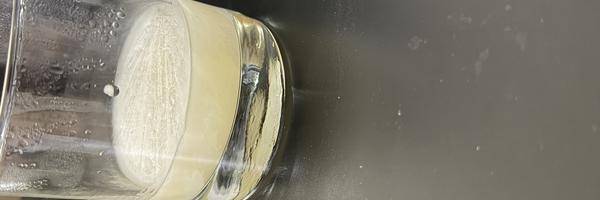
For my first three trials, the Hot Ice worked perfectly! I used the same recipe every time: 4 tablespoons of baking soda mixed with 1 liter of vinegar, then boiled it down until it was a thick syrup. When I triggered the liquid, it turned into solid crystals.It was an exothermic reaction, which means it got really warm, just like those reusable hand warmers you buy at the store. My timing was super consistent, too. Trial 1 took 25.78 seconds to fully freeze, Trial 2 took 26.61 seconds, and Trial 3 took 27.38 seconds. Even though it got a tiny bit slower each time, the experiment was a huge success because it did exactly what it was supposed to do every single time! Instead of turning into a solid, hot block of ice, the liquid became a slushy and grainy mess. It was much slower, too, taking 1 minute and 26 seconds (Trial 1), 1 minute and 23 seconds (Trial 2), and 1 minute and 28 seconds (Trial 3) to finish. Another big difference was the temperature; while the 4-tablespoon batch got really hot, this weak version just went from cold to normal room temperature. This proves that if you don't have enough baking soda, the reaction isn't strong enough to create a solid crystal or release a lot of heat. The final trials used 6 tablespoons of baking soda, creating a highly unstable solution. In Trial 1, the liquid crystallized while cooling, resulting in a time of 0 seconds. Trials 2 and 3 were much slower, taking 2 minutes and 12 seconds and 2 minutes and 35 seconds. Unlike the 4-tablespoon batch, these trials remained cold and produced only a grainy texture. This suggests that if the concentration is too high, the solution "crashes" and fails to release exothermic heat.
Analysis
My results show that the amount of baking soda changes everything about the "Hot Ice" reaction. The 4-tablespoon batch worked the best because it had the perfect balance of ingredients. This allowed the liquid to turn into a solid block quickly and release a lot of heat. When I used only 2 tablespoons, there wasn't enough baking soda to build a strong crystal, so it stayed a cold slush. When I used 6 tablespoons, the liquid was too crowded. This made it "crash" and freeze too early or turn into a grainy mess that stayed cold. This proves that you need the exact right amount of baking soda to make the crystals grow fast and get hot.
Conclusion
My question was: Does different quantities of baking soda effect the crystal trrigerization? The answer to my question is: Yes. The quantity of baking soda significantly changes the speed, heat, and texture of the reaction. The 4-tablespoon mixture was the only one that created a fast, solid, and hot reaction. The 2-tablespoon mixture was too weak and stayed slushy, while the 6-tablespoon mixture was too unstable and "crashed" before it could work properly. Was mi hypothesis correct: I predicted that different quantities of baking soda would cause the crystallization to react differently. My data showed that the 4-tablespoon batch was the "sweet spot." Using too little (2 tbsp) resulted in a slow, cold slush, and using too much (6 tbsp) caused the solution to become unstable and fail to release heat. This proves that the concentration of the solution is the most important factor in a successful exothermic reaction.
Application
Sodium acetate is a phase change material that acts like a reusable chemical battery for heat. It is unique because it can stay as a liquid at room temperature and only releases its stored thermal energy when the crystallization process is triggered. This makes it very useful for creating eco-friendly heating tools that don't need electricity, such as medical heat packs and hand warmers. It is also used in construction to help buildings regulate their temperature and on airport runways as a safe way to melt ice. Because it is non-toxic and biodegradable, sodium acetate is a great way to develop heating systems that are both cheap and safe for the environment.
Sources Of Error
- Because the heat couldn’t reach the top evenly the bottom of the acid was forming the white crust on the bottom even before it was syrupy. That's why we had to take it out before, and the crystal particles were not snapping together to form the crystal because it was too thin and the particles had too much space in between them
- The amount of the baking soda ( 6tbsp) was too much for 1 litre of vinegar to handle and that's why tiny specks of crystals started to show up and ruined the liquid.
Citations
| What is crystallization? | ThoughtCo | https://www.thoughtco.com/definition-of-crystallize-605854 | Jan/13/2020 |
|---|---|---|---|
| what is a seed crystal? | Science Notes | https://sciencenotes.org/how-to-grow-a-seed-crystal/ | Mar/25/2020 |
| What is sodium acetate? | ChemiGnition | http://chemignition.com/blog/sodium-acetate-properties-structure-uses | Apr/4/2025 |
Acknowledgement
I would like to express my sincere gratitude to my four teachers [Ms. Olfret], [Ms. Duncan], [Ms. Nanji],and [Ms. Kim] for their guidance, encouragement, and support throughout this experiment. Their help and their patience with my questions made this project possible. I also want to acknowledge the various educational websites and science creators whose articles provided the inspiration and procedures for this experiment. Their clear explanations helped me understand the chemistry of sodium acetate and the process of supersaturation. I would also like to thank Gemini for summarizing the articles for me to understand it more clearly.