
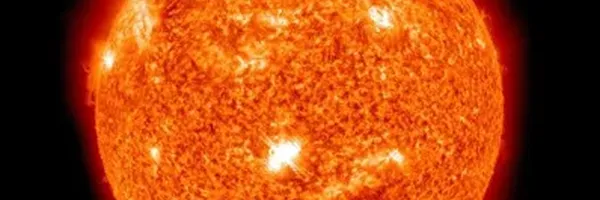
The absence of the Sun
Tito Ogunmola
St. Marguerite School
Grade 6
Presentation
No video provided
Problem
I want to find out whether humans could live without the Sun for a short period of time. I am also looking for ways that we could potentially replicate the Sun (e.g, Nuclear Fusion, Physical representation of the Sun). Another problem is that for the humans who will live when the Sun explodes, what would they do? How would they survive?
Method
First, I will go to sites like Google, Kiddle, Wikipedia, and National Geographic. I will also check online articles for more info. I will design some pdf's, slides, and docs to create a poster and print it out (in colour or not). Canva is also included in this, and it will be the base for my posters and pdf's. Next, when I am finally done editing and printing, I will glue or staple the posters and pdf's to my trifold.
Research
Humans have replicated the Sun in some ways, but not in the ways that can really help. For example, humans have created the same nuclear fusion in Labs using devices like Tokamak to heat hydrogen to over 150 000 000 degrees celsius which is 10 times hotter than the surface of the sun. We can also replicate the light from the sun with artificial light. Although we can replicate the sun in those ways, we can’t replicate it physically. We don’t have enough hydrogen, and even if we did, it would take millions of years. The sun takes about eight minutes for its light to reach Earth, so you wouldn’t notice that the sun was gone until about eight minutes. Then, as soon as the eight minutes ended, chaos would come. The Earth would swing out of its orbit and be at speeds of 30 kms! The Sun gives us vitamin D, which is essential for us. Our plants also need energy from the sun. No sun equals no plants, and no plants equals no food. Although it may seem that food isn’t that important, if we don’t have food for approximately 3 weeks, we would die. Also, little kids who are in elementary or preschool would need more nutrients for their bodies to grow. It would take 7.14 quadrillion units of LED lights to replicate the sun. It would take 44 million big electric power plants( each of them producing 1 billion watts) to replicate just a small amount of the Sun's energy that reaches the Earth. It would take 7.14 quadrillion units of LED lights to replicate the sun. It would take 44 million big electric power plants( each of them producing 1 billion watts) to replicate just a small amount of the Sun's energy that reaches the Earth. Geothermal energy might be a good way to replace the sun's heat. It is the heat from below the surface that is really hot. This could be an idea, but what about the vitamin D? Again, where would I get our nutrients? Without our Sun, you can say goodbye to gravity. We would be knocked out ,and so would all the other planets. We would be floating in space for thousands, maybe even billions of years.
Data
| Nuclear fusion: pros | Nuclear fusion: cons | Artificial light: pros | Artificial light: cons |
|---|---|---|---|
| Near limitless power( just a few grams can produce as much energy as a person needs for 60 years) | Extreme cost ( It costs billions of dollars for a project, and it consumes more energy to start than to go on) | Control (we can adjust LED lights to a light similar to the sun) | Biological disruption ( although artificial light is close to the sun, it wouldn’t quite be good enough and could cause cancer. |
| Safety ( Unlike traditional nuclear plants, Nuclear Fusion has no chance of meltdowns) | Rarity (one of the main fuels, Tritium is rare and very hard to find) | High energy demand ( If we really did need artificial light,s the demand would be too high to get it to everyone) | |
| Low waste (it produces minimal radioactive waste,e unlike other nuclear things) | Engineering difficulty ( to make something that can sustain that amount of heat is incredibly hard) |
Conclusion
My conclusion is that no, we wouldn't survive if we lost the Sun. The reason why is that no matter what we do, we can't replicate the Sun. Nuclear Fusion might seem like a good idea, but truly, only scientists have access to things like that. Also, creating something that can withstand a lot of heat is extremely challenging and impossible to make for 8 billion people. On the other hand, trying to recreate the Sun's light with LEDs is actually impossible. You would need more than a billion units of LEDs to cover a small portion of Earth. Lastly, even in a bunker, you would need some sort of vitamin D and would eventually die from how cold it is. We can't forget that Earth would swing out of its orbit so fast that you wouldn't even blink, and you'd be dizzy. My conclusion is that, even with all the technology we have on Earth now, we wouldn't survive the Sun suddenly dissappearing.
Citations
National geographic kids
Google AI overview and Gemini Grammarly Zack D. Films YouTube shorthttps://www.google.com/search?sca_esv=fd1b7ca8ddeb381e&rlz=1CAVARX_enCA1014CA1014&sxsrf=ANbL-n7iS6BPov_u86vTj8UrvtzJWQncwQ:1771390905542&udm=7&fbs=ADc_l-aN0CWEZBOHjofHoaMMDiKpaEWjvZ2Py1XXV8d8KvlI3jljrY5CkLlk8Dq3IvwBz-Qg9gdZYJriKd9fBMKKfwqZsp5a2Z8RykAyI8QON1GKtNJOssmbpPvaOpAriL5ZmTwtx9B17VeAaoqb-qf2R_XTlcg6QIT-dCFYKZUSMNTtLZ72W3kEX7yJunhV8fObfw2b2yNqJD-ZmRex00cp8ruSqBTbIg&q=what+would+happen+if+the+sun+disappeared&sa=X&ved=2ahUKEwjXprutoeKSAxXrEzQIHeY9HNMQtKgLegQIFhAB&biw=1601&bih=766&dpr=1.2#fpstate=ive&ip=1&vld=cid:535925b3,vid:o8jKFze6tH0,st:0
Cleo Abram YouTube shorthttps://www.google.com/search?sca_esv=fd1b7ca8ddeb381e&rlz=1CAVARX_enCA1014CA1014&sxsrf=ANbL-n7iS6BPov_u86vTj8UrvtzJWQncwQ:1771390905542&udm=7&fbs=ADc_l-aN0CWEZBOHjofHoaMMDiKpaEWjvZ2Py1XXV8d8KvlI3jljrY5CkLlk8Dq3IvwBz-Qg9gdZYJriKd9fBMKKfwqZsp5a2Z8RykAyI8QON1GKtNJOssmbpPvaOpAriL5ZmTwtx9B17VeAaoqb-qf2R_XTlcg6QIT-dCFYKZUSMNTtLZ72W3kEX7yJunhV8fObfw2b2yNqJD-ZmRex00cp8ruSqBTbIg&q=what+would+happen+if+the+sun+disappeared&sa=X&ved=2ahUKEwjXprutoeKSAxXrEzQIHeY9HNMQtKgLegQIFhAB&biw=1601&bih=766&dpr=1.2#fpstate=ive&ip=1&vld=cid:4406bd27,vid:S53iIWJovZ4,st:0
Bright side serieshttps://www.google.com/search?sca_esv=fd1b7ca8ddeb381e&rlz=1CAVARX_enCA1014CA1014&sxsrf=ANbL-n7iS6BPov_u86vTj8UrvtzJWQncwQ:1771390905542&udm=7&fbs=ADc_l-aN0CWEZBOHjofHoaMMDiKpaEWjvZ2Py1XXV8d8KvlI3jljrY5CkLlk8Dq3IvwBz-Qg9gdZYJriKd9fBMKKfwqZsp5a2Z8RykAyI8QON1GKtNJOssmbpPvaOpAriL5ZmTwtx9B17VeAaoqb-qf2R_XTlcg6QIT-dCFYKZUSMNTtLZ72W3kEX7yJunhV8fObfw2b2yNqJD-ZmRex00cp8ruSqBTbIg&q=what+would+happen+if+the+sun+disappeared&sa=X&ved=2ahUKEwjXprutoeKSAxXrEzQIHeY9HNMQtKgLegQIFhAB&biw=1601&bih=766&dpr=1.2#fpstate=ive&ip=1&vld=cid:d1c9c483,vid:SFqU4YJvxDg,st:0
Acknowledgement
I acknowledge the mentors who helped us because they gave me a lot of ideas that I used for this. I also acknowledge Mrs. Kline because she gave me some ideas about what I should do for my project. I acknowledge my friend Michelle because she helped me with the format of my trifold and encouraged me. I acknowledge my Parents because they helped push me to keep working and encouraged me to try harder, and they told me I would be one of the five people from my school selected. I also acknowledge Google Gemini because it gave me the idea to do nuclear fusion, and it gave me data on the sun and fun facts about it.