

Brain Waste Clearance - How Sleep and Concentration Clears Brain Waste
Emma Schmillenkamp, Shyla Kaushik
Master's College
Grade 7
Presentation
No video provided
Hypothesis
We believe that using breathing methods will affect how well a participant does on the test because it will increase focus and concentration, and that the better sleep they get, the better they will do on the word search test.
We believe that people function better by utilizing brain waste clearance methods. This can be achieved especially through breathing methods such as the 4-7-8 breathing. By reducing brain waste, people find themselves having better overall mental health through anxiety and stress reduction. Anxiety and stress are very problematic issues in many peoples lives, therefore the 4-7-8 breathing method will have a calming effect on the individual.
Research
Brain Waste Clearance: Brain Waste Clearance is the process of how the brain rids itself of waste during moments when the body is asleep. The project explores how the brain cleans itself during sleep and mind concentration. It investigates the effects of sleep quality and brain wave activity on overall mental health. To demonstrate how brain waste removal is enhanced during sleep and concentration. Analyze how, as the brain is not rested enough, its efficiency decreases. Explain the connection between dysfunctional waste clearance and mental health disorders. In order to boost concentration and essentially stimulate the brain and mind, breathing methods prove to be very effective. We are using a 4-7-8 breathing technique, this is a stress reduction technique. The result of these breathing techniques is a calmer mind and clearer thinking, which increases focus. This repetitive breathing method helps to calm the mind from any other distractions around the person, essentially ‘clearing their brain’. Also, the 4-7-8 breathing method calms you and activates your parasympathetic nervous system, like we stated before, so it puts you in a more relaxed and calm state, which helps when falling asleep. Because of this method, people can fall asleep faster and easier, allowing their brain to rid itself of waste more thoroughly.
Why it works It promotes relaxation by activating the body's natural relaxation response. It helps calm the mind and reduce anxiety. It can be used to help you fall asleep. Consistent practice can help manage stress and emotional responses. It can be a natural way to help manage the effects of stress on your body**.**
What is 4-7-8: The 4-7-8 breathing method is used in pranayama, an Indian ancient method of yoga. This practice incorporates breath control for relaxation.
The 4-7-8 breathing method’s pattern is to breathe in for four seconds, hold it in for a count of seven seconds, and exhale for eight seconds with a ‘whoosh’ sound.
This method reduces stress and anxiety, calming and regulating the sympathetic and parasympathetic parts of the nervous system. It works almost immediately, if you repeat over a long time, it will come more quickly and have more effectiveness. It is best used as a daily practice.
Additionally, it's easy to do whenever and wherever you want, and it requires no equipment.
How it works: The 4-7-8 breathing method allows you to relax the sympathetic nervous system, it also activates the parasympathetic nervous system, to bring you back to a normal or lower heart rate, deeper breathing, and a calmer mind. Your parasympathetic nervous system controls relaxation, and once you activate it, you will suppress your sympathetic nervous system. It is great for helping with sleep because it reduces your heart rate and blood pressure. While doing this method, ensure you are sitting up straight or lying flat on your back. Rewrite: The 4-7-8 breathing technique helps calm the body by slowing the sympathetic nervous system and stimulating the parasympathetic nervous system. When you inhale deeply, oxygen enters your lungs and increases oxygen levels in your bloodstream, which signals your heart to slow its rhythm. As you exhale slowly and release carbon dioxide, the increase in oxygen demand and buildup of carbon dioxide enhances relaxation, allowing parasympathetic “Rest and Digest” responses to take over.
How it Works: In the nervous system, there are two parts, the sympathetic nervous system and the parasympathetic nervous system. The sympathetic nervous system boosts energy and increases your heart rate when your body senses any sort of danger. It also causes adrenaline which triggers the human flight or fight reaction. However, the parasympathetic nervous system (often called the rest and digest system) slows your heart and breathing once the danger passes. For example, the sympathetic nervous system is like a gas pedal, and the parasympathetic nervous system is like a brake. The brain controls the whole nervous system, and they have to work together to maintain a balance.
How To: To start, find a comfortable position, either standing or sitting up straight, or lying flat on your back. Next, exhale all the air in your lungs, then close your mouth and inhale through your nose for four seconds. Then, hold your breath for a count of seven and exhale completely for eight seconds. This completes one breath, repeat the cycle three more times for a total of four breaths. If you are just starting, do no more than four cycles or there can be a risk of hyperventilation or neurological shock, because this method is quite powerful.
Brain Concentration: In order to boost concentration and essentially stimulate the brain and mind, breathing methods prove to be very effective. Diaphragmatic breathing especially, which means breathing using the diaphragm muscle instead of your chest, which activates your parasympathetic nervous system. The parasympathetic nervous system initiates calming of the mind, the lowering of heart rate, and promotion of relaxation. The result of these breathing techniques is a calmer mind and clearer thinking, which increases focus. This repetitive breathing method helps to calm the mind from any other distractions around the person, essentially ‘clearing their brain’. A quote by Dr. Melissa Young states, “The counting sequence is a way to focus your mind on something other than your worries.” Some people claim that this breathing method helps them get to sleep in only one minute. There is limited scientific evidence/research to support and back up this point, but there is a lot of unscientific evidence as well. Brain concentration is actually based on a lot from an individual’s sleep pattern. For example, the more regular and consistent a person’s sleep is, the better their brain waste clearance and concentration. To conclude, breathing methods activate the parasympathetic nervous system, which is in charge of calming the mind. As a result, this also clears the brain, allowing for immense focus and concentration.
Variables
Manipulated Variable:
- The word search
- The breathing method
Responding Variable:
- How many words the participant can find
- Their sleep quality and duration
Controlled Variable:
- The controlled word search
- How many words the participant can find in 2 minutes
- The amount of time for breathing method
- Time in between control group and experiment group
Procedure
We ask the participants how they would rate their sleep over the past three days, then we ask what time they slept and woke up on past 3 days.
1. Individual does concentration word search without breathing method
- See how many words they can find in 2 minutes
- Game that everyone does: word search
2. Individual start breathing method right away
- How to do the breathing method instructions are given to participant
Instructions:
- Find a comfortable position
- Place your tongue against the back of your top teeth and keep it there
- Exhale all the air in your lungs
- Close your mouth and inhale through your nose for four seconds.
- Hold your breath for a count of seven
- Exhale completely for eight seconds
- This completes one breath, repeat the cycle four more times for a total of four breaths
3. Individual does another word search
- See how many words they can find in 2 minutes, and compare that to the first result
Observations
| Participant | Avg Sleep Duration in last 3 days | Sleep Quality reported by participant | Word Search result before 4-7-8 breathing test | Word Search result after 4-7-8 breathing test |
|---|---|---|---|---|
| P1 | 8 hrs | Good | 5 | 6 |
| P2 | 5.11 hrs | Poor | 6 | 5 |
| P3 | 6.983 hrs | Poor | 8 | 8 |
| P4 | 8.96 hrs | Good | 6 | 8 |
| P5 | 8.8 hrs | Good | 6 | 8 |
| P6 | 8.83 hrs | Good | 5 | 4 |
| P7 | 7.63 hrs | Good | 4 | 10 |
| P8 | 9.4 hrs | Good | 4 | 5 |
| P9 | 7.96 hrs | Poor | 4 | 6 |
| P10 | 7.83 hrs | Good | 6 | 6 |
| P11 | 8.63 hrs | Poor | 5 | 4 |
Data Details:
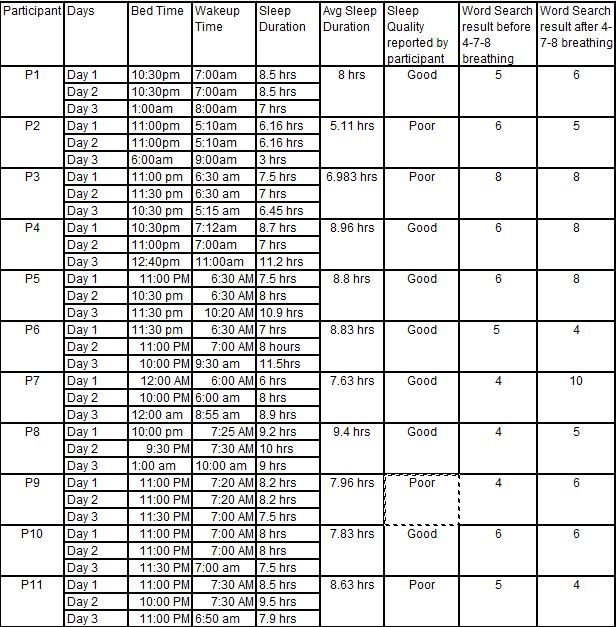
Analysis
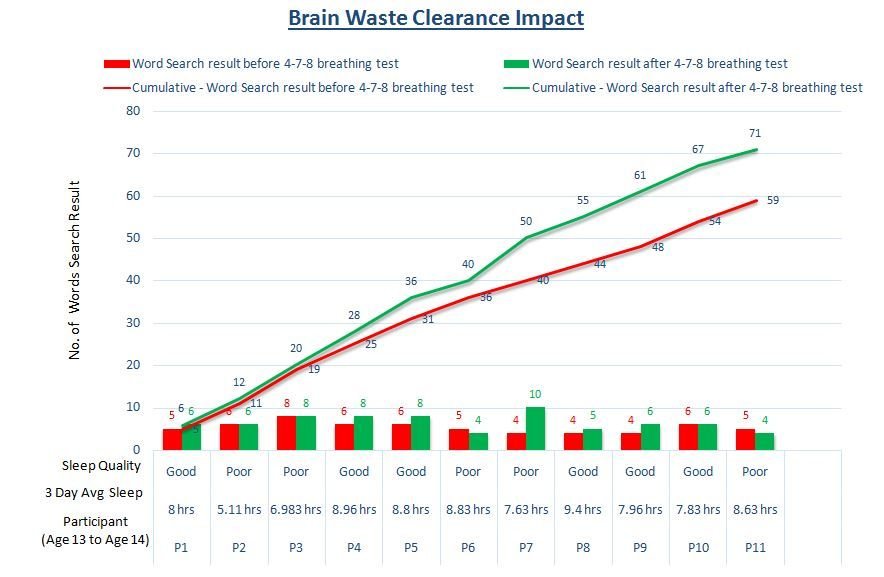
In the graph above, we are looking at how many words each participant found before and after the breathing method, their average hours of sleep, and how they would rate their sleep over the past three days. We are also looking at the total of words found before and after the breathing method.
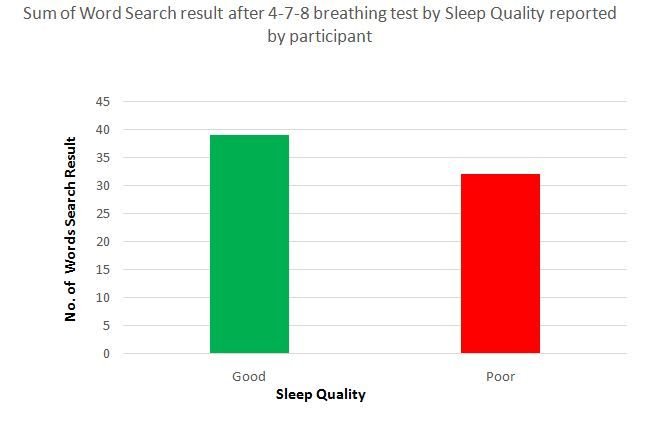 Here we are comparing how good and bad sleep reflected the participants results and how many words they found.
Conclusion
For this experiment, our hypothesis was proved correctly, because if participants had a better sleep, they generally found more words in the word search. In the first graph, the people who had a better sleep average and better sleep generally did better, because their brain had more time to clear itself of waste. In the second graph, we see the same results, because as a whole, people who had better sleep were more concentrated and focused during the test, so they found more words after doing the breathing method. From this we can conclude that not only does the 4-7-8 breathing method activate your parasympathetic nervous system and allow you to be more focused and calm, but better sleep equals a better brain overall. There is a correlation between sleep and the breathing method where the breathing method is most effective when the participant has had enough sleep. The breathing method was useful in the experiment because it allows you to be more relaxed and calm, which allows for your brain to work at its best, but if your brain is cluttered with waste from not enough sleep, you will not do as good, which was proven from our experiments.
Application
This applies to real life because many people deal with stress issues that are related to brain waste clearance. By utilizing the 4-7-8 breathing method and spreading the word, people can find calm in their day-to-day lives. Many people suffer from panic attacks, but finding breathing method that effectively calm the parasympathetic nervous system can not only benefit people but save lives. In the long run, brain waste clearance is vital to a person's health, so if we use and develop more methods like the 4-7-8 breathing method, we can prevent diseases in the brain, maintain diseases, and support a person's overall memory, just by doing a little breathing each day.
Sources Of Error
During several of the experiments—particularly those involving participants 6 through 11—there was noticeable background noise, ranging from quiet murmurs to periods of loud chatter. This sound environment may have affected the participants’ concentration. In addition, a few participants appeared distracted or spoke during the task, which likely disrupted their focus and could have influenced their performance.
Citations
Acknowledgement
We would like to acknowledge Mrs.Calvert from Masters Academy and College. As well, we would like to acknowledge Shreya Kaushik from school, because she started the Science Fair club at our school and inspired us. We would also like to acknowledge our parents for guiding and supporting us.