
Popping Pearls
Katie Hay
R. T. Alderman School
Grade 6
Presentation
Hypothesis
If there are three different types of liquids with different pH values, then cream will thicken the most, because its pH is closest to neutral and more neutral things will make better spheres. This is because there won't be too many or too few hydrogen or hydroxide ions to interfere with the bonds that are formed in the spherification process between sodium alginate and calcium lactate.
Research
Molecular Gastronomy:
Molecular gastronomy is a type of cooking that focuses on the physical and chemical reactions between different foods. It is used to make creative food dishes. A few examples are:
- Spherification (popping boba and fruit caviar)
- Flash freezing (using liquid nitrogen to immediately freeze food - ice cream, decorations, garnishes)
- Edible paper (made with potato starch and soybeans and infused with different ingredients for colour and flavour)
Spherification & Reverse Spherification
Spherification:
Spherification is the process in which liquid is given a jelly-like shell made from sodium alginate and calcium chloride or calcium lactate. Sodium alginate comes from brown seaweed. There is direct or basic spherification and reverse spherification.
Direct or basic spherification is when the sodium alginate is added to the liquid and then dipped in calcium chloride or calcium lactate.
Reverse spherification is when calcium lactate is added to the liquid and then dipped into the sodium alginate.
The reaction for both occurs when the calcium that has a plus 2 charge binds to the recently released strands of sodium alginate which have a negative 1 charge. One calcium will bind to two of the sodium alginate strands, because it has a plus 2 charge, and each of the strands has a negative 1 charge. It will form calcium alginate. That's what creates the jelly layer on the outside of the popping boba.
Why neutral?
If you want to get a better sphere, a neutral pH is the way to go. If you have a too acidic substance, the extra hydrogen ions (which have a +1 charge) are fighting to bind with the alginate ions before the calcium ions do. If the hydrogen ions do bind with the alginate, then not as many calcium alginate molecules are able to form. Because of that, it makes a weaker membrane. A similar thing happens for a more basic substance. Extra hydroxide ions are floating around (which have a -1 charge) and they bind with a calcium ion instead of the calcium binding to the alginate. This means that less calcium alginate molecules are able to form, again making the membrane weaker.
It’s best to let the mixture that has the liquid in it to set in the fridge for at least 1 hour to help the bubbles leave the mixture. A popping boba should be in the sodium alginate or calcium chloride bath for at least one minute. That way it doesn't pop too fast but the shell is still soft.
What is pH?
pH is a measurement of the acidity or basicity of a substance. A substance with a pH lower than 7 is considered acidic, while a pH higher than 7 is considered basic and a pH of 7 is considered neutral. The pH measurement originated from a Danish biochemist, S.P.L. Sorensen. The measurement was to represent the hydrogen ion. A hydrogen ion (H+) is a hydrogen atom with a positive charge. A pH is measured with pH paper or a pH meter. A pH meter measures the concentration of hydrogen ions that are present in the solution. A pH meter is better for measuring colored liquids like juices and sticky substances that you might use when working with foods. A substance with a higher concentration of hydrogen ions will be more acidic and a substance with a lower concentration of hydrogen ions or a higher concentration of hydroxide ions (OH-) will be more basic.
What is force?
Force is either a push or a pull. It is normally measured in Newtons. The more force that is applied to an object, the faster it moves, where if less force is applied, it will move slower. Force has a vector showing which direction it is being moved, like up and down, north, west, east, south. These directions are shown with arrows.
How is force measured?
Force can be measured with a force gauge or something called a dynamometer. You can also figure out the force if you know the math equation. Force in math is equal to mass times acceleration (F=m x a).
What are weight and mass?
Mass is how much matter an object is made of. Weight is a measure of the force of gravity on an object. It is equal to the mass times the acceleration due to gravity (which is 9.81m/s2). If the acceleration is only due to gravity, then the force and weight will be the same. Kitchen scales measure the weight or force of gravity on an object, but they use the acceleration due to gravity to convert the number you read into grams.
Variables
| Manipulate Variable | Type of liquid used |
|---|---|
| Controlled Variables | Amount (g) of sodium alginate, amount (g) of calcium lactate, amount (g) of distilled water, time sodium alginate solution is mixed with the hand blender and the time the sodium alginate solution sits in the fridge, amount (g) of liquid mixed with the calcium lactate, brand of each liquid, size of each semi-sphere mold |
| Responding Variable | Weights it takes to pop the pearl |
Procedure
Materials:
- Sodium alginate
- Calcium lactate
- Distilled water
- Pocket scale
- Baking scale
- Cling wrap
- pH meter
- Syringe
- Small spoon
- Hand blender
- Glass cups and bowls
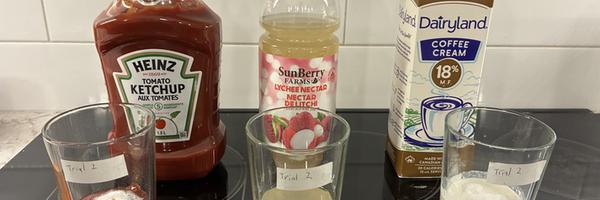
- Ketchup
- Cream
- Lychee juice
- Semi-sphere silicone molds
- Fridge & Freezer
- Thick fries
- Metal straw
- Small Weights
- Timer
- Cookie sheet
Procedure:
Step 1. Mix 2 grams of calcium lactate into 100g of each of the liquids in a glass cup (ketchup, cream and lychee juice) and blend well with a hand blender (15 seconds for cream and 30 seconds for ketchup and lychee juice). Take a small amount of each liquid and measure the pH with a pH meter. Record the number.
Step 2. Use a syringe to fill semi-sphere silicone molds with each of the liquids and then flatten the tops with the back of a knife. Then put the silicone mold tray on a cookie sheet and place it in the freezer.
Step 3. When the spheres are frozen, make the sodium alginate bath in a small glass bowl. Add 1g sodium alginate to 200g distilled water. Blend with a hand blender for 5 minutes. Let it sit in the fridge for 1 hour.
Step 4. Remove the first pearl from the silicone mold and weigh it on the pocket scale. Record the starting weight and then place the pearl in the bath. Remove the first pearl after 30 seconds. Repeat the same steps and keep the next pearl in for 1 minute. Repeat this again for 1.5 minutes, 2 minutes, 2.5 minutes, 3 minutes, 3.5 minutes, 4 minutes, 4.5 minutes and finally 5 minutes.
Step 5. After each pearl is removed, weigh it again, measure the width and height of it, and then lower different amounts of weights onto the pearl until it pops. Start with 1 gram and keep increasing the weight by 1 gram until the pearl pops. Record each of these measurements.
Step 6. Repeat two more times for each of the three liquids so that there are three trials for each liquid.
Observations
Qualitative Observations:
| Ketchup Pearls | The ketchup pearls were a red/orange color and they made nice easily poppable pearls. They didn’t become as solid as the other pearls in the molds when they were taken out of the freezer. They were still a little bit soft. |
|---|---|
| Cream Pearls | The cream pearls were a bright white color and were the hardest to pop but still made nice pearls. They looked a bit curdled inside when they popped. |
| Lychee Juice Pearls | The lychee juice pearls were the lightest in color and the pale yellow color made it hard to tell if it had popped or not. |
Quantitative Observations:
pH of liquids
| Liquid | Trial 1 | Trial 2 | Trial 3 |
|---|---|---|---|
| Ketchup | 3.84 | 3.83 | 3.79 |
| Cream | 6.02 | 6.09 | 6.12 |
| Lychee Juice | 4.06 | 4.07 | 4.12 |
Table 1. Average weight gain of pearl (grams) for trials 1-3
| Time in sodium alginate bath (minutes) | Ketchup | Cream | Lychee Juice |
|---|---|---|---|
| 0.5 | 0.22 | 0.24 | 0.19 |
| 1.0 | 0.24 | 0.23 | 0.22 |
| 1.5 | 0.26 | 0.26 | 0.24 |
| 2.0 | 0.32 | 0.33 | 0.28 |
| 2.5 | 0.33 | 0.33 | 0.30 |
| 3.0 | 0.39 | 0.39 | 0.35 |
| 3.5 | 0.40 | 0.38 | 0.37 |
| 4.0 | 0.45 | 0.42 | 0.43 |
| 4.5 | 0.47 | 0.46 | 0.41 |
| 5.0 | 0.49 | 0.46 | 0.44 |
Table 2. Average height of pearl (cm) for trials 1-3
| Time in sodium alginate bath (minutes) | Ketchup | Cream | Lychee Juice |
|---|---|---|---|
| 0.5 | 0.70 | 0.81 | 0.73 |
| 1.0 | 0.73 | 0.85 | 0.83 |
| 1.5 | 0.76 | 0.85 | 0.85 |
| 2.0 | 0.83 | 0.88 | 0.93 |
| 2.5 | 0.83 | 0.93 | 0.90 |
| 3.0 | 0.85 | 0.92 | 1.00 |
| 3.5 | 0.90 | 0.93 | 1.05 |
| 4.0 | 0.90 | 0.95 | 1.13 |
| 4.5 | 0.90 | 1.00 | 1.05 |
| 5.0 | 0.93 | 1.02 | 1.12 |
Table 3. Average weight to pop pearl (grams) for trials 1-3
| Time in sodium alginate bath (minutes) | Ketchup | Cream | Lychee Juice |
|---|---|---|---|
| 0.5 | 13.00 | 58.02 | 51.00 |
| 1.0 | 14.30 | 115.50 | 66.13 |
| 1.5 | 18.00 | 151.20 | 112.00 |
| 2.0 | 22.00 | 189.00 | 169.35 |
| 2.5 | 32.30 | 196.30 | 173.42 |
| 3.0 | 29.00 | 253.60 | 251.00 |
| 3.5 | 47.00 | 244.30 | 249.33 |
| 4.0 | 48.00 | 255.40 | 304.41 |
| 4.5 | 34.30 | 300.00 | 279.00 |
| 5.0 | 90.32 | 298.14 | 292.40 |


Analysis
After concluding my experiment, the data (Table 3 & Figure 3) showed that cream needed the most amount of weight to pop the pearls and ketchup pearls needed the least amount of weight to pop them. The lychee juice was in between the cream and ketchup pearls. The amount of weight needed to pop the cream pearls ranged from 58.02 grams to 300.00 grams, whereas the ketchup's range was from 13.00 grams to 90.32 grams. The lychee juice was closer to the cream pearls than the ketchup pearls and ranged from 51.00 grams to 304.41 grams, beating the cream pearls highest amount by 4.41 grams. After inspecting the graph (Figure 3), the cream was still higher than the lychee pearls most of the time, except for between 3.5 and 4.0 minutes in the sodium alginate bath, where lychee juice ended up being slightly harder to pop.
More neutral liquids are supposed to form stronger bonds between the calcium and the alginate, and more acidic liquids can weaken those bonds, which is what the data showed. Cream, which was the most neutral was the hardest to pop, and ketchup, which was the most acidic, was the easiest to pop. Ketchup is also a non-Newtonian fluid, so it may have also become less viscous when more force or weights were applied. That might also have been why it popped so easily.
The height and weight gain of all three of the pearls (Figure 1 & Figure 2) increased the longer the pearls were in the sodium alginate bath, showing that the jelly layer on the pearl gets thicker and grows more outwards the longer the pearl is in the sodium alginate bath. From my background research, reverse spherification is supposed to make the jelly layer grow outwards, which is what the results showed.
The results showed that the weight gain for ketchup and cream was similar (Figure 1), but ketchup ended up being equal to the cream pearls at the 3 minute mark but then consistently gained a little bit more weight than cream afterwards, with its 3.5 minute mark being 0.02 g more, and its 4 minute mark being 0.03 g more. It dropped its weight gain cycle just a little bit on the 4.5 minute mark by only beating cream by 0.01 g, but it went up again by gaining 0.03 g more than cream for the 5 minute mark. Lychee juice gained slightly less weight than the other two pearls. This could be because ketchup was the most dense, followed by cream and then lychee juice. Cream being be more dense than lychee juice is probably why cream pearls gained a bit more weight than the lychee juice pearls did.
The lychee juice pearls were taller than the other liquids (Figure 2) because out of all the liquids, lychee juice was the least dense. Cream was the next tallest and then ketchup. Cream was more dense than lychee juice but less dense than ketchup.
A force gauge didn’t work in this experiment, because the pearls have pretty thin membranes, and the force gauge I tried didn’t measure less than 2 Newtons. From my background research, the force needed to pop the pearl can be calculated by multiplying the mass times the acceleration. When you lower the weights so that they just rest on the pearl without pushing on them, then the acceleration should be only from gravity which is 9.81m/s2. Since that number would always be the same, the trends on the graph for the force to pop the pearl would still be the same as the amount of weights needed to pop the pearl, but only in Newtons instead. This is because the acceleration never changes. That’s why you can use weights as well to figure out force.
Conclusion
My hypothesis was proven to be correct. The cream pearls, which were the closest to neutral pH, thickened the most in the sodium alginate bath, and the ketchup pearls thickened the least. Cream had an average pH of 6.08, which was the most neutral, lychee juice had an average pH of 4.08, which was more acidic, and ketchup was the most acidic, with an average pH of 3.82. This experiment showed that the less acidic the pH of the liquid, the more weight it took to pop the pearls in the sodium alginate bath, which likely meant that the membrane was thickest for cream and thinnest for ketchup. Weight gain and height of the pearls seemed to be affected more by density instead of the pH of the liquids. Since the ideal thickness of a pearl is not too thin so it won’t stay together and not too thick so you have a membrane that’s too chewy when you bite it, using the weights to pop the pearl to test for ideal thickness makes the most sense, since it would be similar to teeth pushing on the pearl when we bite it.
Application
Applications:
Some real world applications from this experiment are ketchup filled fries, which can be used as a way to insert an appropriate amount of ketchup into a fry, wasting less plastic and other materials on tiny ketchup packets. Making popping boba out of things like mustard and ketchup can be used to create more creative and appealing dishes for fast food and sit down restaurants. Some ways to use cream would be to not add calcium lactate to it and make the pearls that way so they could be used as alternative coffee creamers for coffee and reduce waste. Juices like the lychee juice are used today as popping boba for boba drinks and gourmet false caviar. With the help of my experiment, beginner boba makers will now know that the time in the sodium alginate bath does affect thickness and that between two to three minutes will give a good thickness for most pearls.
Next Steps:
- The cream pearls could be made without adding calcium lactate because of its high calcium content. That way, it might make a better pearl that would curdle less.
- Using a different size of sphere mold to make different sizes of boba and see if it affects the thickness of the pearl.
- Other juices and liquids can be used to make popping boba pearls.
- The pearls could also be made with direct spherification instead of reverse spherification and see how that would affect the thickness.
- Popping boba can be used to make creative versions of food like my ketchup filled fries (see video in attachments) or possibly even popping coffee creamers.
- An interesting way to use popping boba would be to try to coat a pill and see if you can keep it from dissolving in the wrong part of the body like the stomach, because the pearl membrane is not supposed to dissolve in acids.
Sources Of Error
- The starting weight for all the pearls was slightly different because after a few failed practices for making the pearls, making them all the same weight was difficult. Frozen molds were easier, so that’s why the change in weight was measured instead.
- The cream could only be blended for 15 seconds instead of 30 seconds like the lychee juice and ketchup when the calcium lactate was mixed in, because it would otherwise start to thicken and curdle the cream. The other two liquids couldn’t be mixed in well enough in 15 seconds because the calcium lactate didn’t dissolve properly for the other two liquids, so they needed to be blended a little longer. This may have affected the measurements, although it was probably more important that the calcium lactate was mixed in properly.
- Resting the weights on the pearls without pushing on them wasn’t always easy. If the weight slipped a little on the pearl or was accidentally pushed a little, the pearl would have popped earlier than it was supposed to.
- Measuring the height and width of the pearls would have probably been more accurate with a caliper than measuring with a ruler.
Citations
Pueblo science (n.d.). YouTube https://www.youtube.com/watch?v=1Os0j8_o2RU Bite scized education (n.d.-a). YouTube. https://www.youtube.com/watch?v=i_z22D_aOXQ Science buddies (n.d.-a). YouTube. https://www.youtube.com/watch?v=74RnO_wHX7k Science buddies. (n.d.-a). YouTube. https://www.youtube.com/watch?v=WSRv89CiM-0 Molecular gastronomy | history\, theory\, techniques\, & facts | britannica. (n.d.). https://www.britannica.com/topic/molecular-gastronomy Molecular gastronomy | history\, theory\, techniques\, & facts | britannica. (n.d.-a). https://www.britannica.com/topic/molecular-gastronomy What is molecular gastronomy?. WebstaurantStore. (n.d.). https://www.webstaurantstore.com/blog/3012/what-is-molecular-gastronomy.html Logsdon, J. (2012, December 12). What is sodium alginate and how to use it in cooking. Amazing Food Made Easy. https://www.amazingfoodmadeeasy.com/info/modernist-ingredients/more/sodium-alginate What is force? (n.d.-b). YouTube. https://www.youtube.com/watch?v=vZ0ehaOEZKE Ph | definition\, scale\, uses\, examples\, & facts | britannica. (n.d.-c). https://www.britannica.com/science/pH What is a force gauge?. ANDILOG Technologies. (n.d.). https://www.andilog.com/content/what-is-a-force-gauge.html The science behind spherification. It’s Chemically Delicious! (2013, February 8). https://itschemicallydelicious.wordpress.com/2013/02/07/the-science-behind-spherification/
Acknowledgement
I would like to acknowledge my Mom for always being there to help assist me with parts of my experiment that I had trouble doing alone. I would also like to thank my entire family for helping me along the way.