

Holding Water in a Dry World: Improving Drought Resilience Through Low-Cost Soil Amendments
Diksha Mehta
Kavita Mehta
Grade 11
Presentation
No video provided
Hypothesis
Adding 20% cattle manure (organic) or vermiculite (inorganic) to potting soil will increase water retention by increasing soil microporosity.
Inorganic amendments (vermiculite) is expected to produce greater and longer-lasting water retention than manure because its expandable layered mineral structure creates more internal pore space for water storage than organic amendments and does not decompose over time.
In contrast, manure improves water retention by promoting soil aggregation (“glue-like” bonding of soil particles). However, cattle manure doesn’t create as many pore spaces as inorganic amendments, so the space for water storage is comparatively low, and organic amendments also decompose relatively quickly, so this binding effect declines as the organic matter breaks down, reducing long-term water retention.
Therefore, vermiculite is expected to provide the greatest and most durable drought resistance.
Research
Drought: Shortage of precipitation over an extended period (a season or more), resulting in insufficient water availability, negatively impacting plants, animals, and people. - Huge problem in Alberta and many regions around the world.
Climate change is set to continue and worsen this trend, making droughts more frequent, severe, and prolonged, because climate change raises global temperatures, which alters precipitation patterns, and leaves ecosystems increasingly vulnerable to dry conditions, and strain water supplies by increasing both evaporation rates and water consumption by plants.
Statistics: How Big of a Problem is Drought? Globally:
- The number of recorded droughts increased by 29% over the past 20 years.
- In 2023, nearly half (48%) of the global land area experienced at least one month of extreme drought conditions.
- By the end of the century, 40% of the global land area is expected to experience year-round drought.
- Economic costs of drought are estimated at approximately $307 billion annually, and are expected to increase by 35% by 2035, mostly faced by the agricultural industry.
In Canada:
- As of November 30, 2025, 84% of Canadian land was abnormally dry or experiencing drought conditions.
- Crop insurance payouts due to drought surged from $890 million in 2018 to $4.9 billion in 2022, showing how costly drought has become for farmers.
- Drought is classified as the most significant climate-related risk to the Canadian agriculture sector, with 80%-85% affected.
In Alberta:
- As of December 2025, 74% of Alberta’s land was experiencing drought, and 14% was classified as abnormally dry.
- For the 2023–24 crop year, AFSC reported it covered approximately $9.5 billion in total crop insurance liability across Alberta, and paid out over $1.5 billion for crop losses, with drought identified as the main cause of non-hail claims.
- Western Canadian drought contributed to wheat production declines of about 19.6 % in 2023, with central and southern Alberta identified as among the hardest-hit areas.
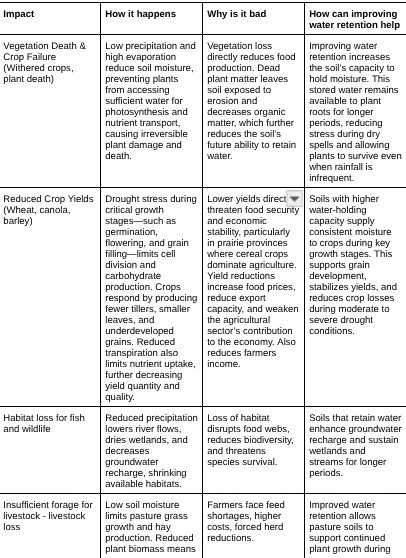
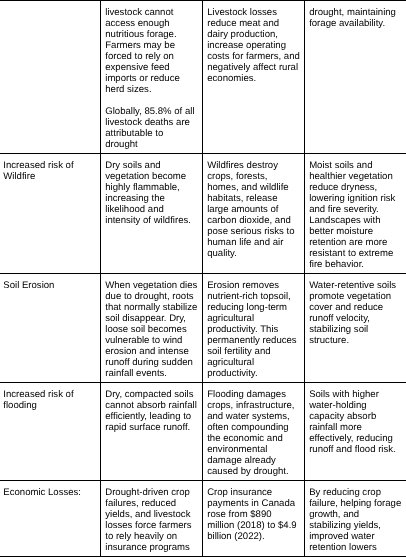
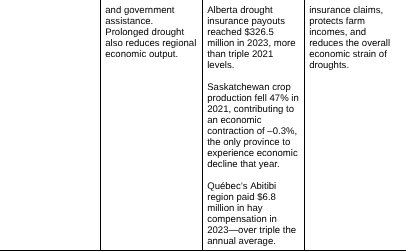
Specific Impacts of Drought:
Current Solutions for Drought Management:
- Rainwater harvesting: Process of collecting and storing rainwater from rooftops or other surfaces in tanks or reservoirs. This stored water can later be used for irrigation, cleaning, or household needs after treatment. During droughts, it provides an extra water supply and reduces dependence on natural water sources like rivers and groundwater.
- Drip Irrigation: A system that delivers water slowly and directly to the roots of plants through small tubes and emitters. This targeted method minimizes evaporation and runoff, making water use more efficient. In times of drought, drip irrigation helps farmers grow crops using much less water than traditional watering methods.
- Harvesting water from the air: Involves collecting moisture from humidity or fog and converting it into liquid water. Devices such as atmospheric water generators or fog nets capture water vapor and condense it into usable water. This method provides an alternative water source in areas with limited rainfall.
- Water Reuse and Recycling: Process of treating used water so it can be safely used again. Wastewater is cleaned through filtration and purification systems and reused for irrigation, industry, or household purposes. This practice reduces the demand for fresh water and helps conserve limited supplies. In drought conditions, recycling water ensures a more sustainable and reliable water source.
- Conserving Water: Using water carefully and avoiding unnecessary waste in daily activities, as well as coordinated efforts by governments, industries, and communities to manage water resources efficiently, like improving infrastructure to reduce leaks, implementing water-efficient industrial systems, and protecting reservoirs/watersheds. During droughts, conservation helps stretch limited water supplies so they last longer for communities and ecosystems. It also reduces stress on rivers, lakes, and groundwater sources, supporting long-term water sustainability. Alberta also has a Drought Response Plan, that primarily focuses on conserving water from all non-essential uses, and directs it to the agricultural sector.
Problem with Current Solutions: Water Retention: Soil’s ability to hold onto water (like a sponge) after rain or irrigation, keeping it available for plants, rather than letting it evaporate.
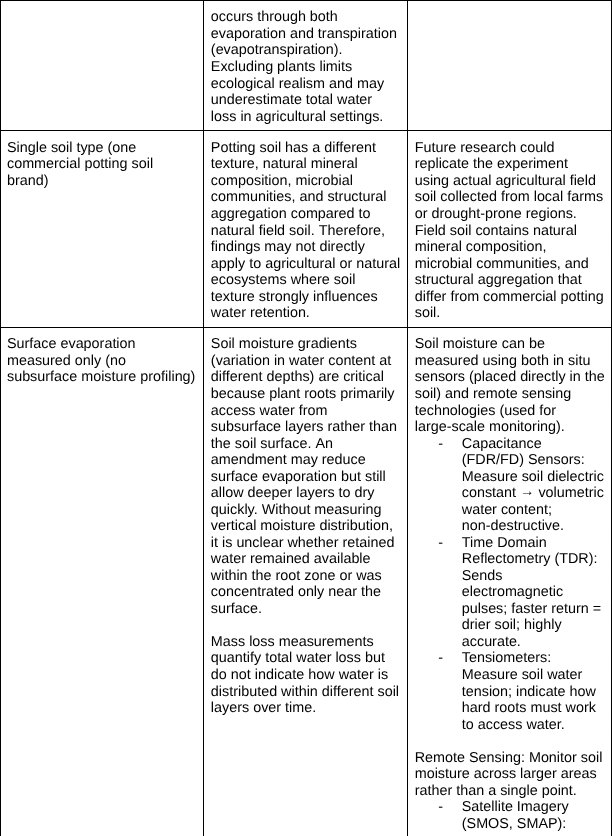
These solutions are only effective at solving half of the problem, and not completely effective at managing drought, because they only focus on increasing the amount of available water, but during drought/dry conditions, the water retention capacity in soil becomes extremely poor, so simply having more water is not going to be effective, because it will get evaporated before the soil can retain it and deliver it to the plants/crops, due to the dry environment. Therefore, increasing the water retention capacity in soil is the bigger part of the solution to drought management.
Key Quality Parameters - Soil:
- Aeration: Refers to the air content within the soil, the balance between oxygen and CO2, because healthy soil requires sufficient oxygen for roots to respire and for beneficial microorganisms to thrive, preventing anaerobic conditions.
- Drainage: Process by which water moves through and out of soil. Proper drainage prevents waterlogging that impairs aeration, and ensures that soil retains enough moisture.
- Structure: How individual soil particles bind together to form larger aggregates/peds. Good structure means a stable matrix that allows for water movement/ aeration/ root penetration, and bad structure leads to compaction/ reduced productivity.
- Water Retention: Capacity of soil to hold water after irrigation/rainfall, prevent water from evaporating or running off, and make it available to plants.
Since the project is about making plants/crops more resistant to drought conditions, so for the scope of this project I will be focusing on just the soil’s water retention property.
Proposed Solution - Soil Amendments: Soil amendment: Products added to the topsoil to improve soil conditions/structure and plant growth. - 2 Main Types:
- Inorganic: Made from non-living sources (mined or manufactured).
- Organic: Originates from something that was living.
How organic and inorganic soil amendments impact soil’s water retention - How are there mechanisms different?
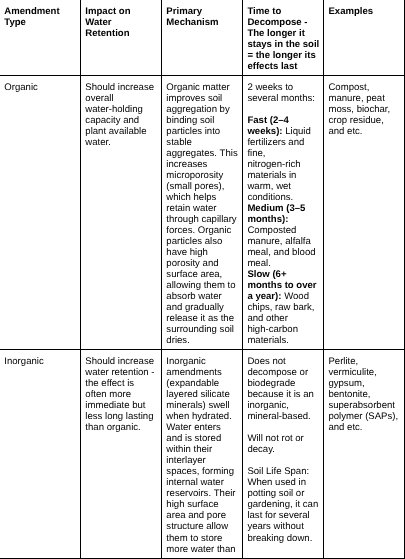

How is water stored in pore spaces: Capillary forces are the forces that allow water to move through and remain in small pores. Capillary retention occurs because of cohesion (attraction between water molecules) and adhesion (attraction between water molecules and solid surfaces). In very small pores (micropores), these combined forces are strong enough to hold water against gravity. The smaller the pore diameter, the stronger the capillary force retaining the water.
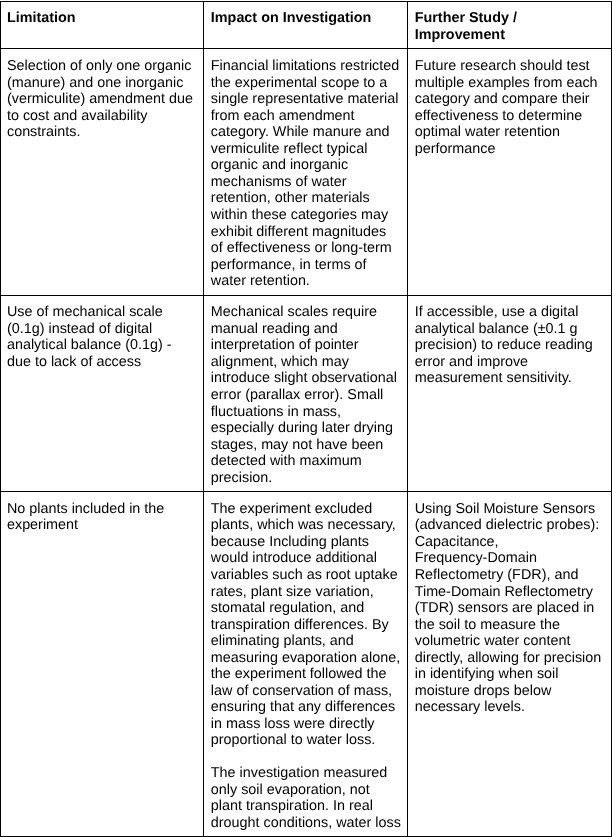
Since all examples from each organic and inorganic category of soil amendment share a similar primary mechanism, only one example from each category was chosen to experiment with, - Organic = Manure, Inorganic = Vermiculite. The selection was based on materials availability and cost - because this experiment was started off season (in January), many of the examples in each soil amendment category were unavailable in-store and expensive online.
Side Effects of Soil Amendments on Soil Health: Both organic and inorganic soil amendments generally do not have any negative impacts on soil, unless misused, over-applied, or of poor quality.
Organic amendments (compost, manure, biochar) generally improve soil structure and microbial life but if overused can cause:
- Nutrient imbalances and salt toxicity from excess phosphorus, potassium, or salts
- Increased soil alkalinity, reducing nutrient availability
- Introduction of pathogens, microplastics, or contaminants
- Heavy metal accumulation over time
- Temporary nitrogen deficiency when high C/N materials are used
Inorganic amendments if overused may:
- Acidify soil if over-applied, limiting nutrient uptake
- Reduce microbial diversity and harm soil organisms
- Disrupt soil structure, increasing erosion risk
- Cause nutrient leaching or runoff, polluting water
- Accumulate salts, potentially harming plant roots
To prevent negative impacts: Regular soil testing is essential to understand a soil’s nutrient levels, pH, organic matter, and potential contaminants. Testing is usually done by collecting small samples from different parts of a field or garden and sending them to a lab, where chemical analyses measure nutrients, salts, and acidity. Some tests can also be done in the field using portable kits for pH or moisture. Knowing the soil’s exact condition allows us to choose the right type and amount of organic or inorganic amendment, preventing problems like nutrient imbalances, salt buildup, or harm to microbial life. This ensures that soil amendments improve fertility safely, support healthy plant growth, and reduce environmental risks such as runoff or leaching.
Research Question: How much, if any, impact do low-cost soil amendments have on soil’s water retention capacity?
- More specifically, which type of soil amendment increases a soil sample’s water retention capacity the most?
To determine water retention capacity, this experiment will measure four parameters:
1. Field Capacity: Water Capture Efficiency
- Maximum amount of water a soil can absorb after an irrigation event, before the water drains deeper and becomes groundwater, or the soil is soaked and can’t absorb any more water.
- The captured water is usable/available water - plants and evaporation only use this water.
-
Increased field capacity = more absorbed/stored water in soil = more usable/available water for plants = good for drought resistance.
2. Gravimetric Soil Moisture Content/Gravimetric Water Content: * Quantifies the amount of water present in soil relative to mass of dry soil particles. - How much water is present in the soil at a given time. * Calculated daily, until the mass of the soil sample stops changing. * Important to know because it tells us the amount of days the soil can stretch the stored usable/available water during drought conditions (so without further irrigation). * Most number of days = most efficient use of available water = better water retention.
3. Evaporation Rate: * How much water is leaving the soil at a specific time - the lower = the better. * Captures a daily snapshot of water loss - useful when comparing short term differences and immediate reactions between different treatments. * Only reliable for daily/short term comparison - can’t be used to predict long-term pattern because of exponential decay.
Exponential Decay: A phenomenon that states that the shape of the drying (water evaporation) is curved not linear, so water evaporation doesn’t happen at a constant rate, but rather water is lost quickly at first when the soil is wet and more slowly as it dries - that’s why evaporation rate is only relevant for short term impacts/comparison, not long-term pattern.
4. Moisture Decay:
- Takes exponential decay into account and gives us the speed of evaporation (how fast the water is being evaporated).
- A single number (K/day) that summarizes the soil’s overall drying behavior (exponential decay - fast initial loss to later slower loss).
- The smaller the value = the lower speed = the better for drought resistance.
- Gives a complete picture of how different soil amendments affect long-term water retention behavior in soil - critical to know for long-term implications in drought.
Variables
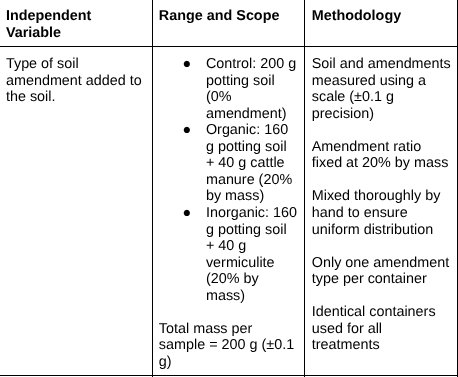
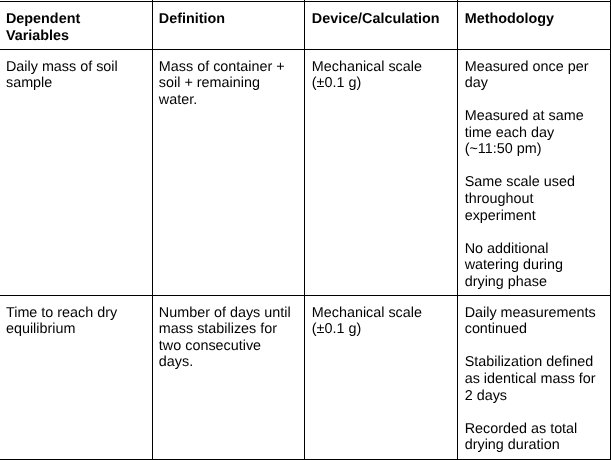
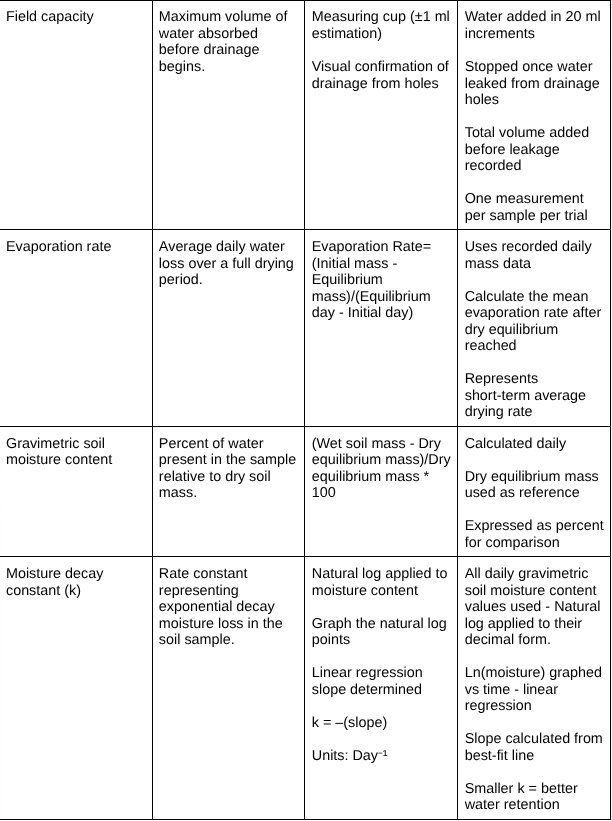
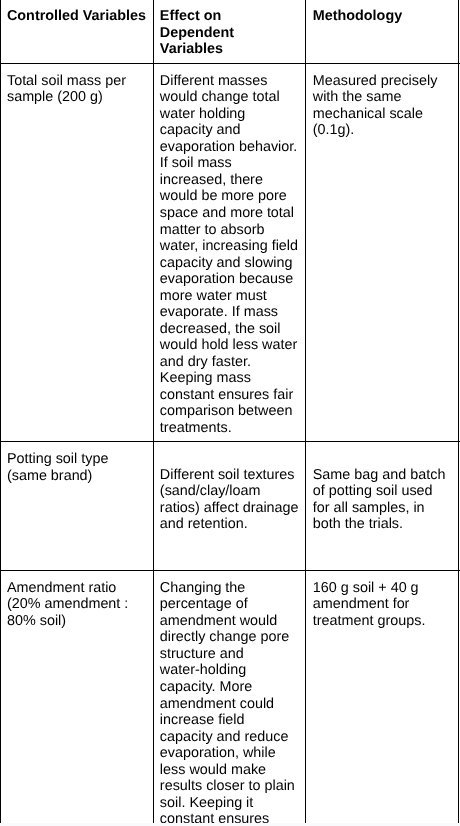
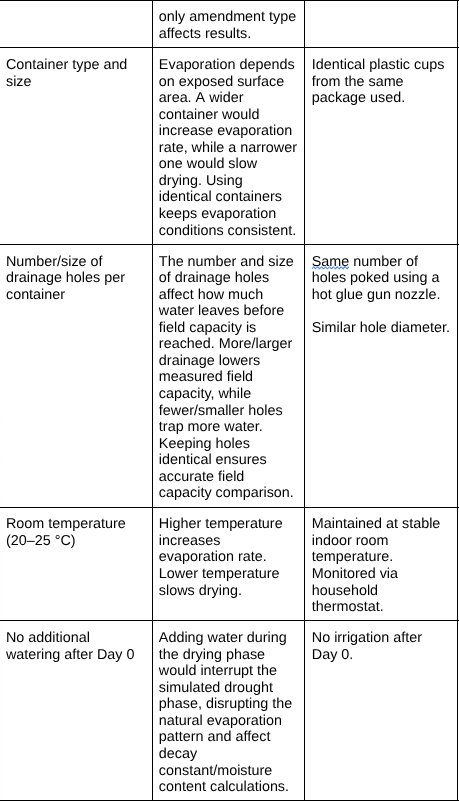
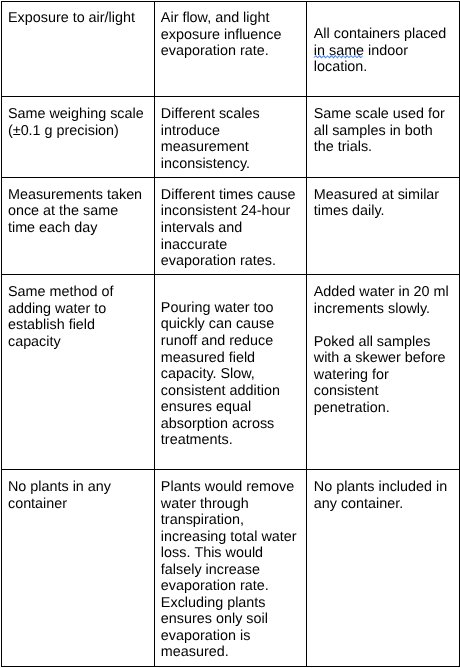
Procedure
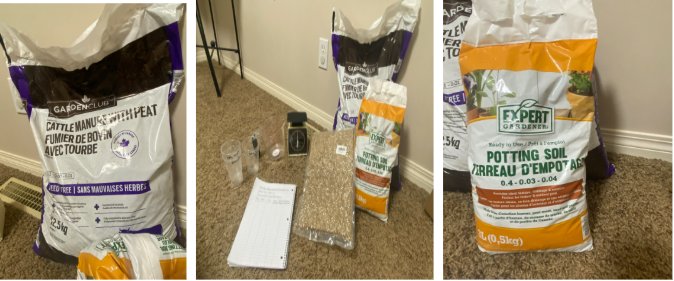
Materials Needed:
- Potting soil
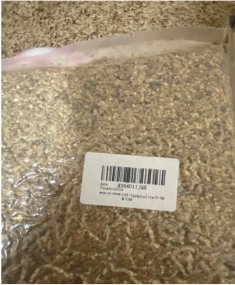
- Vermiculite (Garden Grade)
- Manure
- Weighing scale (+0.1g) - 0.01g scale is precise enough for my experiment, because I am not measuring in a very small time frame (minutes) nor in from a very tiny sample, so the water loss will never be less than 0.1g.
- Identical plastic containers
- Measuring cup
- Labels + markers + glue gun (to poke holes in containers)
- Notebook to record data
- Phone to take pictures
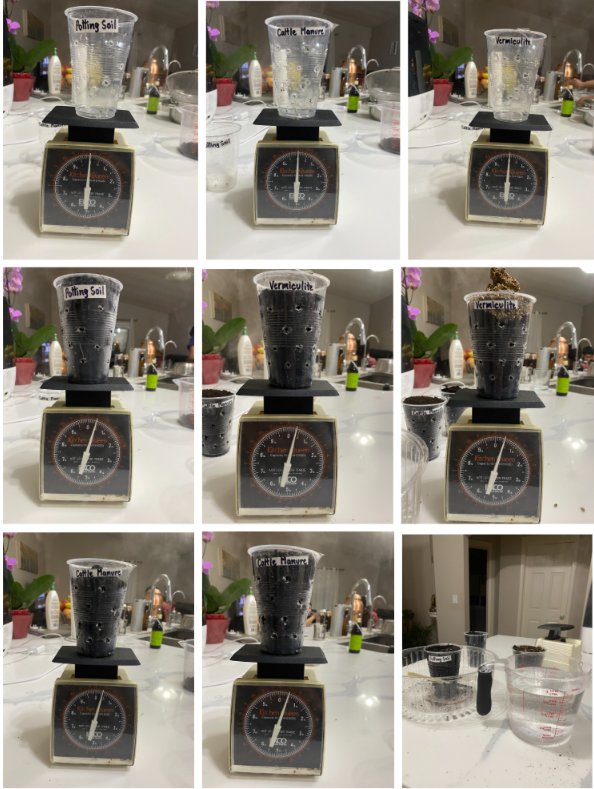
Step 1: Preparing containers:
- Poke the same number of drainage holes on the three plastic cups, with the nozzle of a hot glue gun.
- Label the containers (vermiculite, manure, potting soil) with a sharpie.

Step 2: Preparing samples:
- Control group: Measure 200g of potting soil into one cup.
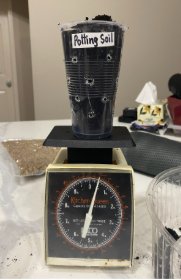
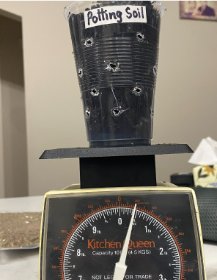
-
Treatment group: Mix 20% of soil amendment to 80% potting soil (this is the general recommendation for adding soil amendments)
1. 160g of potting soil + 40g of manure
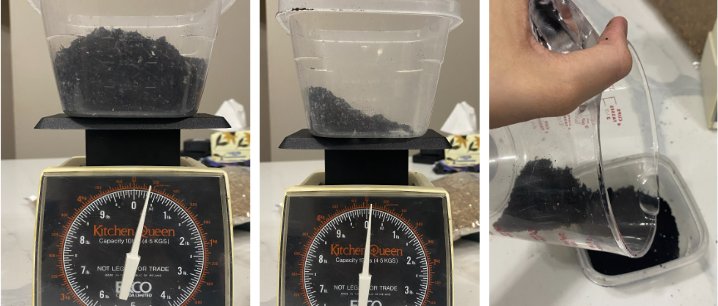
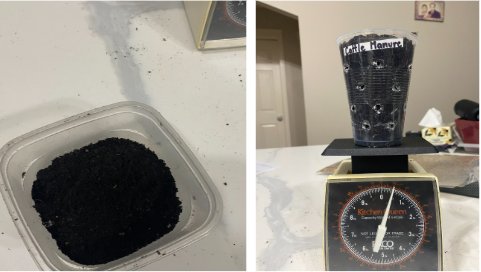 2. 160g of potting soil + 40g of vermiculite
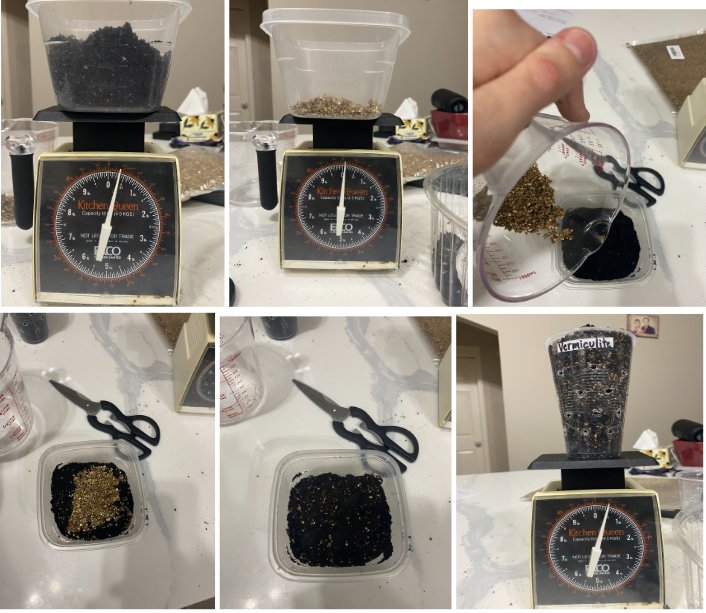
Step 3: Establishing field capacity:
- Poke holes in the soil sample using a skewer for penetration.
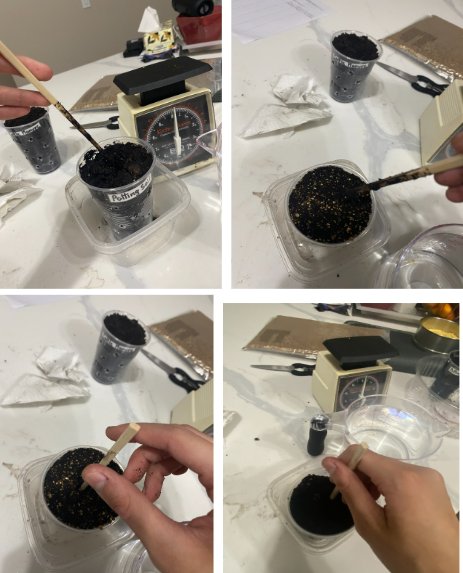
- Using a measuring cup, slowly add water to each cup in measure intervals (20ml), to prevent overflowing, until it starts to leak from the drainage holes.
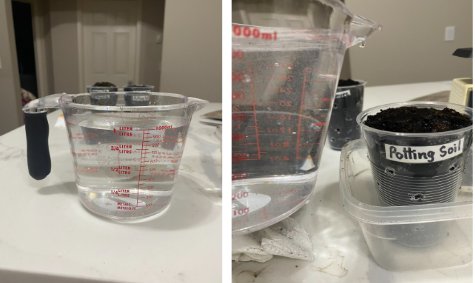
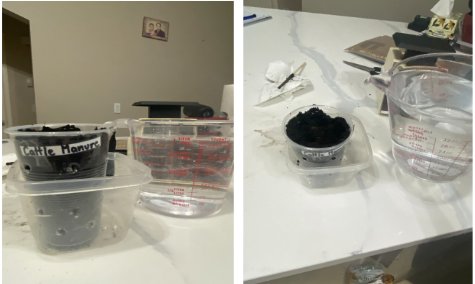
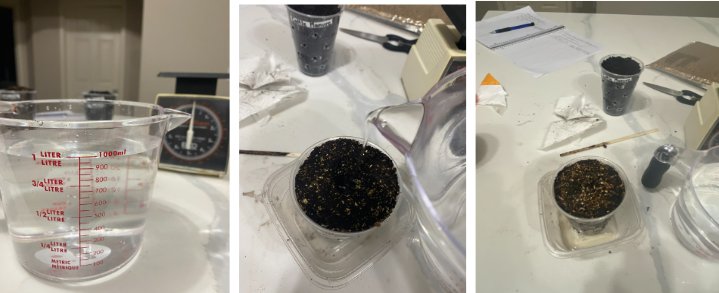
- Determine the total volume of water added before leakage by looking at how much water lessened from the measuring cup. This is the amount of water the soil can store/absorb, thus its field capacity.
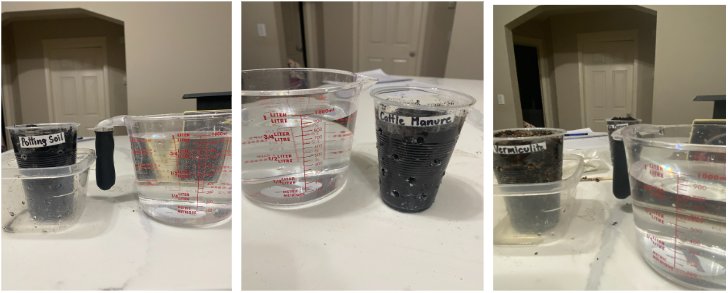
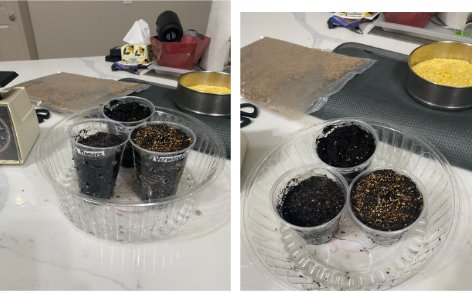
Step 4: Initial mass measurement:
- Weigh each cup after establishing field capacity, and record this mass as Day 0 mass.
Step 5: Simulated drought phase:
- Place all containers in the same indoor location. - Indoor placement reduces environmental variability.
- Maintain the same room temperature (20 - 25 degrees Celsius)
- Do not add any additional water - no water simulates drought conditions.
Step 6: Daily mass measurements:
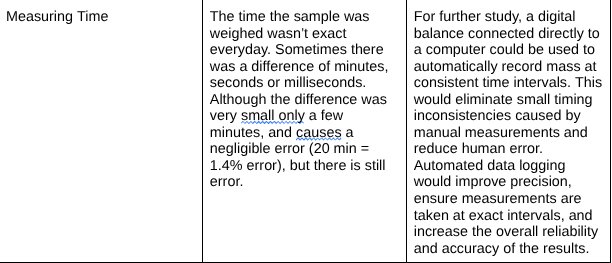
- Weigh each container once per day at the same time - Because there are no plants or other forms of drainage, all mass lost is assumed to be of water, due to evaporation. This follows the principle of conservation of mass.
Step 7: Determining dry equilibrium mass:
- Record mass everyday until measurements stabilize for two consecutive days.
- This final stable mass is recorded as dry equilibrium mass.
- Dry equilibrium mass: Also known as dry soil mass is the final mass after which the mass of the whole sample stops changing.
Step 8: Data processing
- Field Capacity:
- Evaporation Rate (water lost/day) - Average the daily values of water/mass lost at the end for each sample. - Evaporation Rate = (Initial mass - Equilibrium mass)/(Equilibrium day - Initial day) - Measured daily 24 hour period (standard practice)
- Gravimetric Soil Moisture Content: - Gravimetric Soil Moisture Content = (Mass of water/Dry equilibrium mass) * 100 - express mass of water as a percent of the dry soil’s mass. - Mass of water = Wet soil mass (measure everyday) - Dry equilibrium mass
- Moisture Decay (k) - Take all the daily Gravimetric Soil Moisture Content for each sample - Since it's a curve (due to exponential decay)\, apply natural log(In) to straighten the curve into a line (linear regression - statistical method used to model the relationship between a dependent variable (target) and one or more independent variables (features) by fitting a straight line (line of best fit) to the data) - Natural log transforms curves into simpler lines\, without modifying the data\, so underlying patterns become more visible and easy to understand. - Graph: Time (days) on the x-axis and In(moisture) on y-axis. - The k = -(slope) of this line is the moisture decay\, so find slope: b = -((y2 - y1)/(x2 - x1)) and k = -((in(moisture)2 - in(moisture)1)/(time2 - time1)) - Units: Day^-1 - means that a constant fraction or percentage of the reactant is consumed per day\, regardless of how much material is present. For example\, if\, it means 10% of the remaining reactant breaks down every day. Note: Unit simply depends on the time unit used (minutes\, hours\, days).
Observations
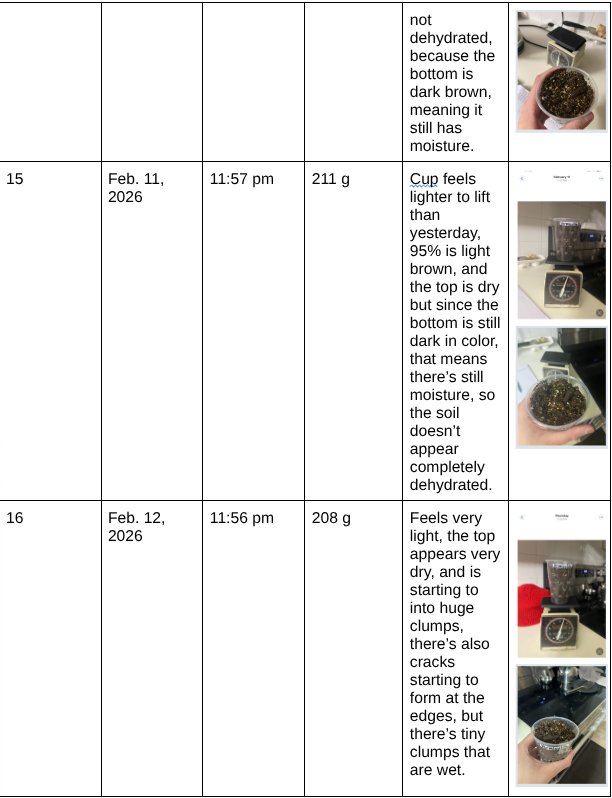
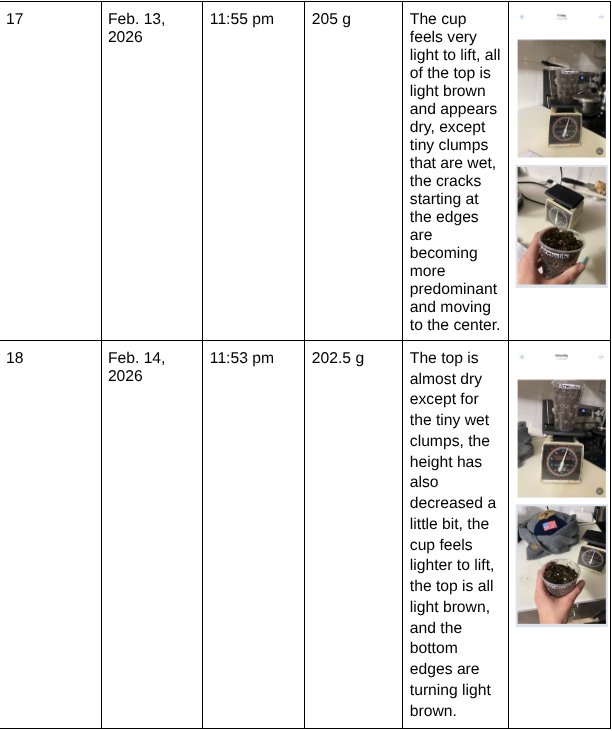
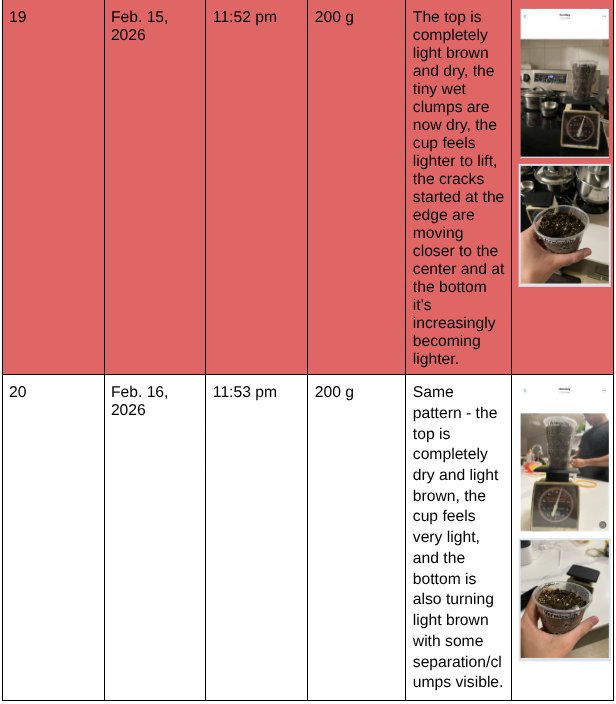
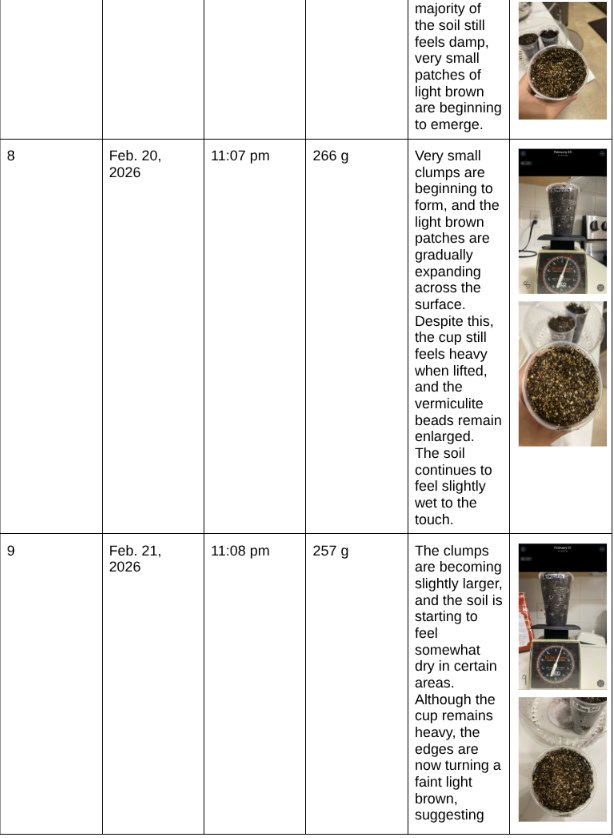
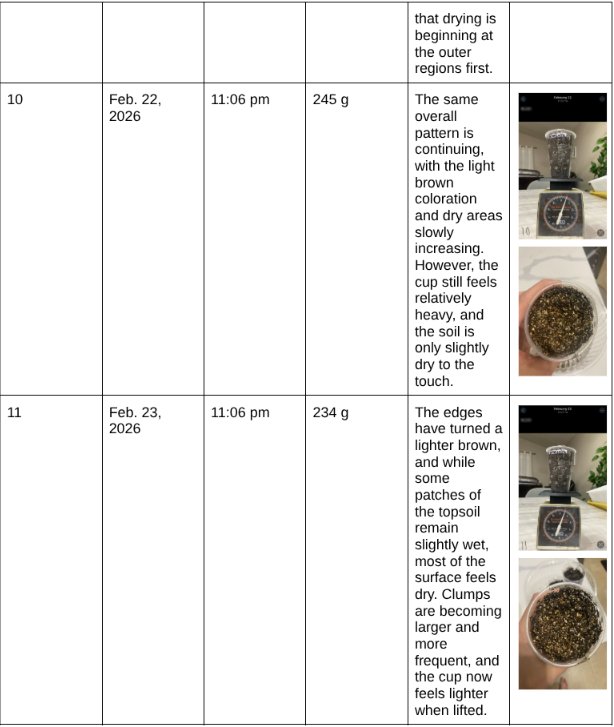
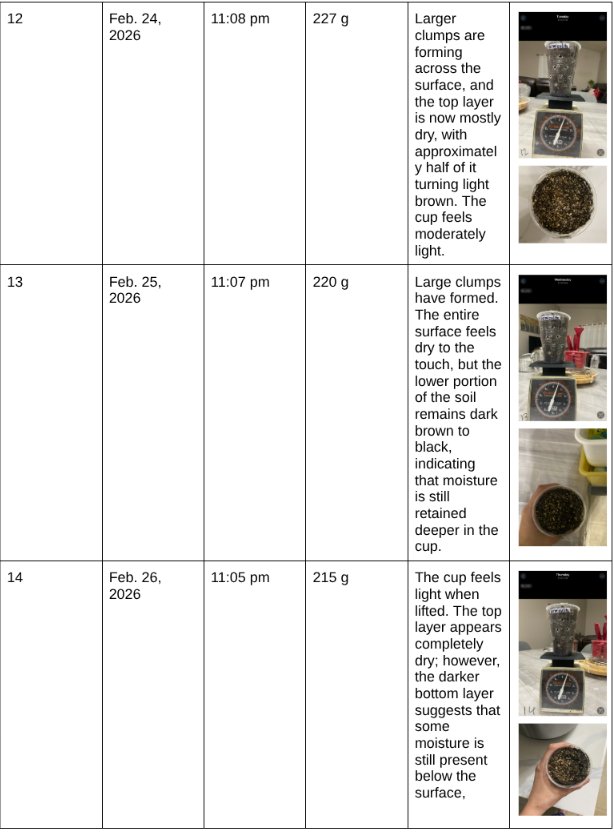
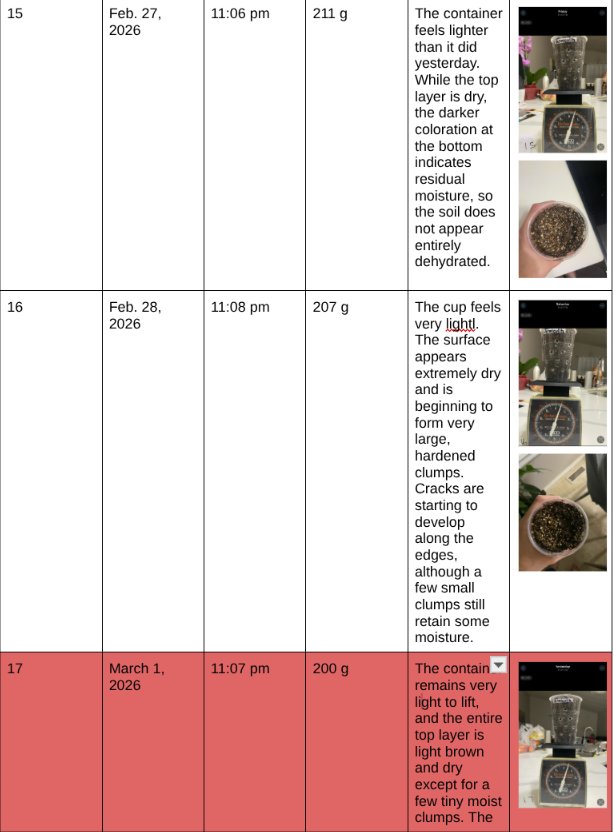
Trial 1
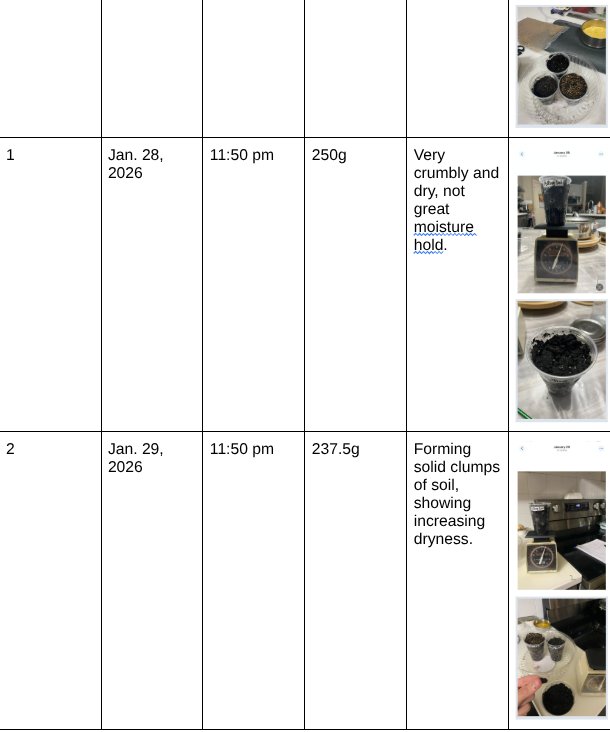
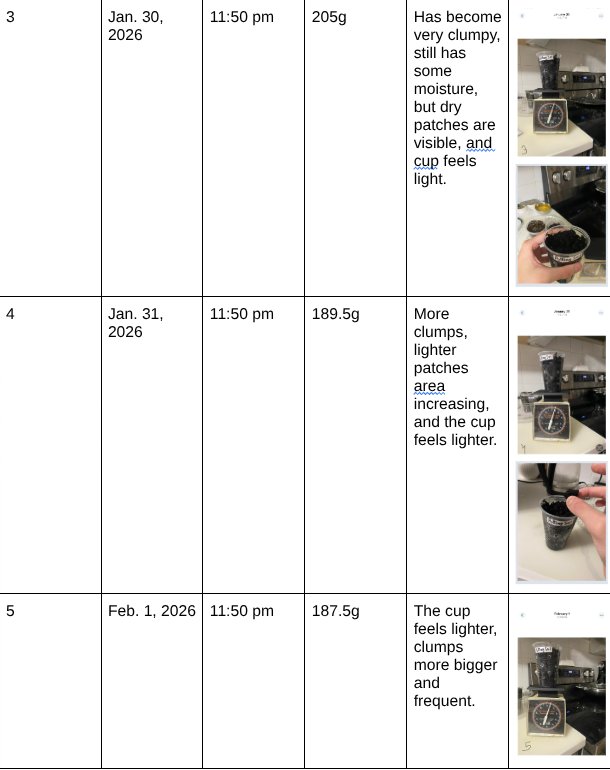
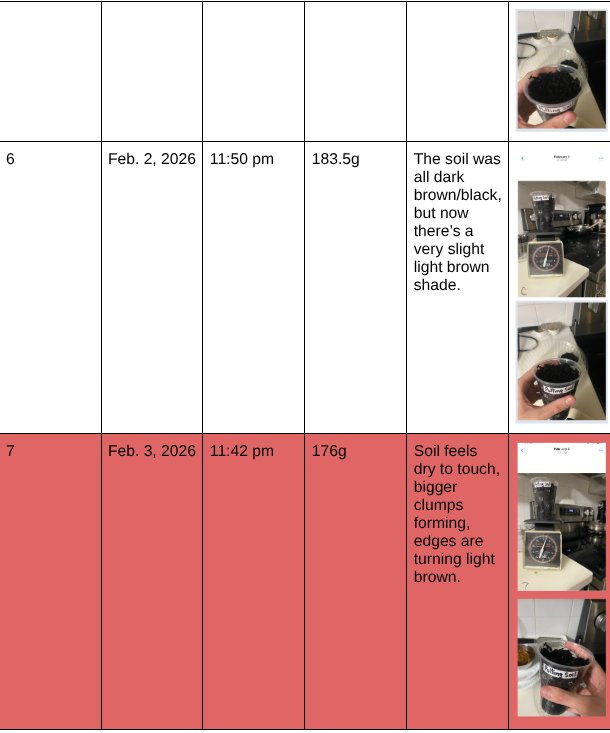
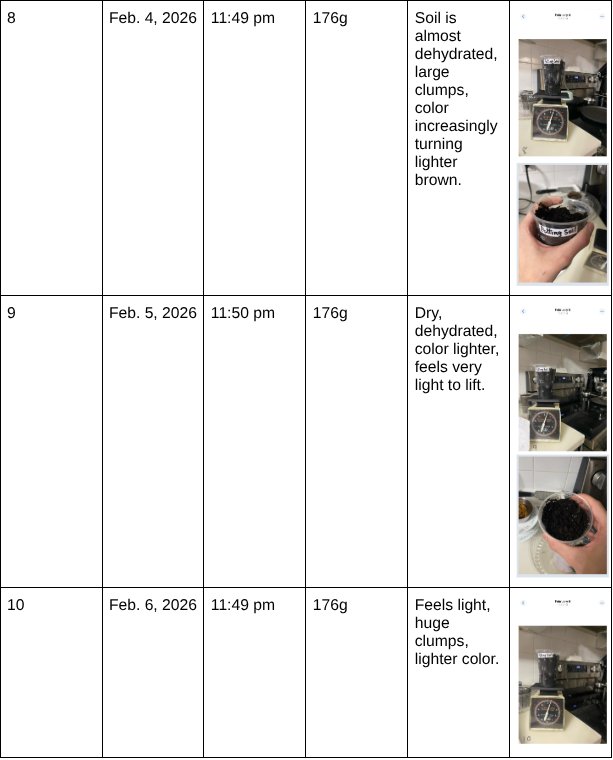
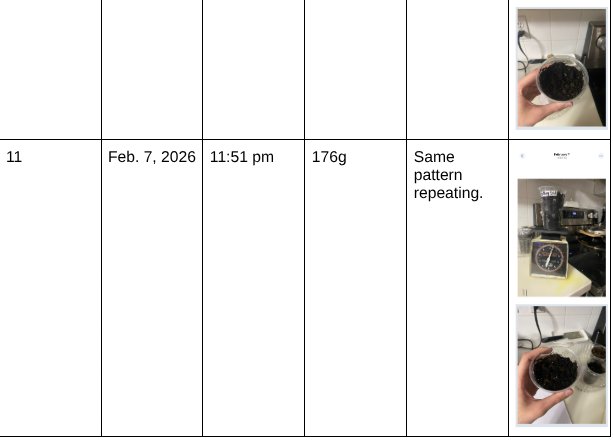
- Sample Type: Plain Potting Soil - 200g
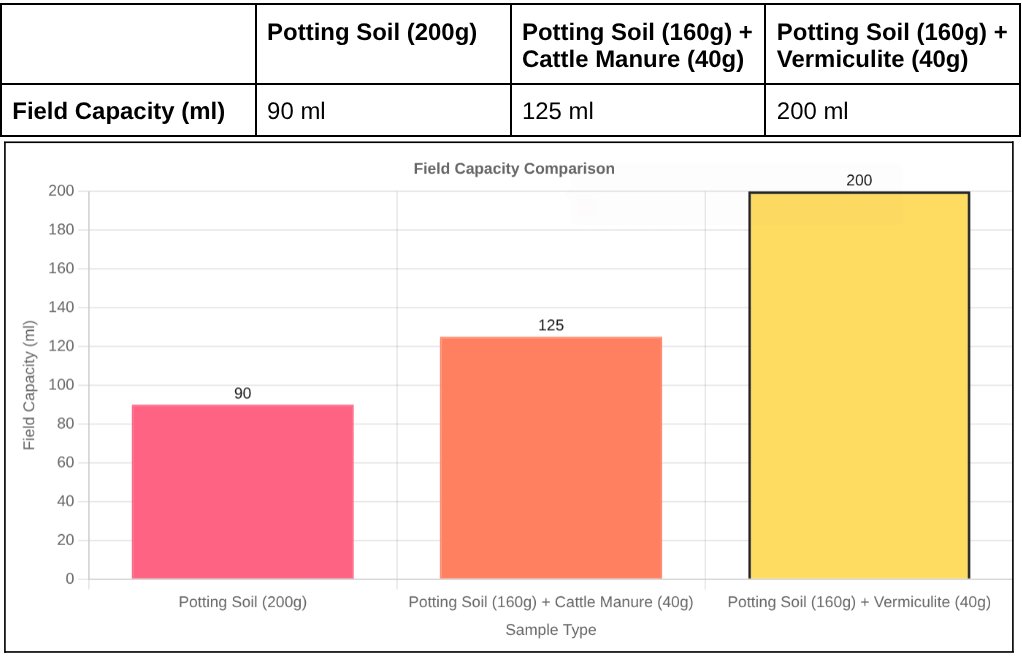
- Initial Water Added (ml): 90 ml
- Dry Equilibrium/ Final Stable mass: 176g - Day 7
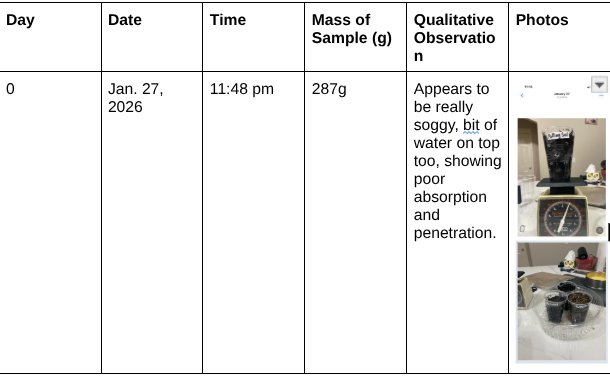
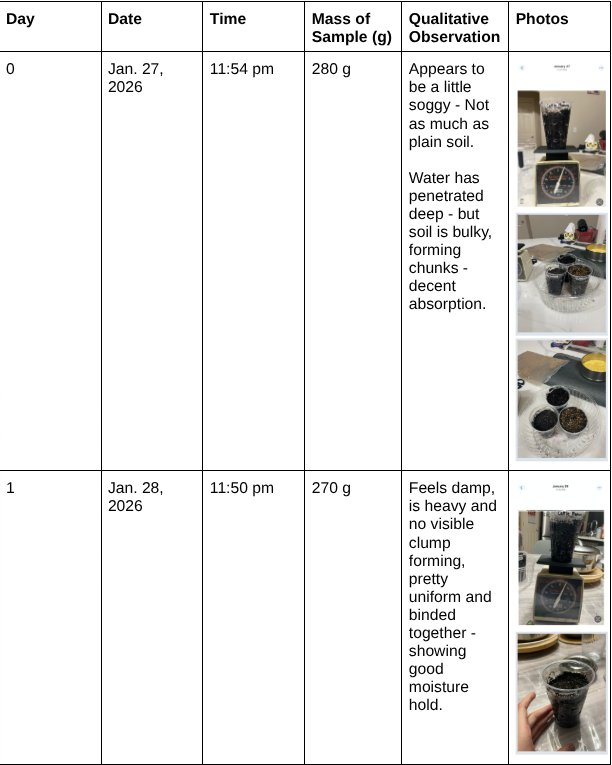
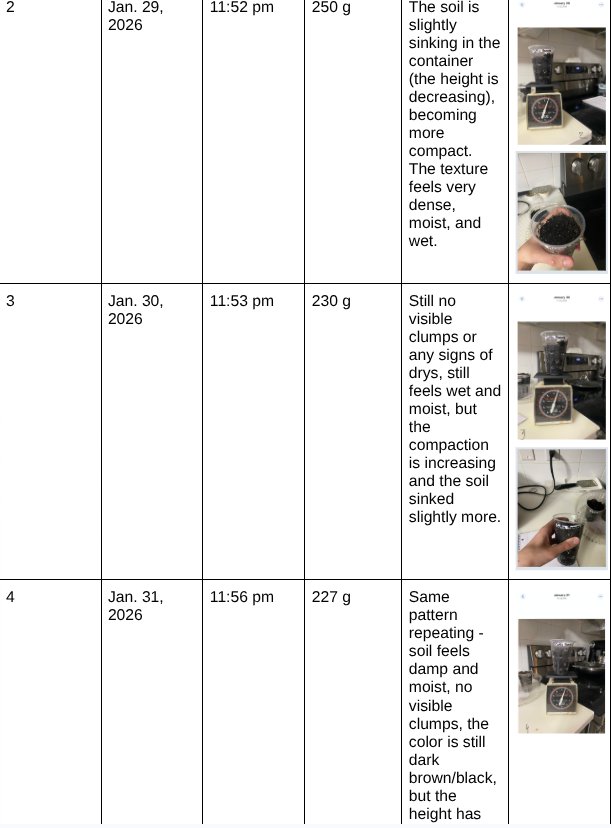
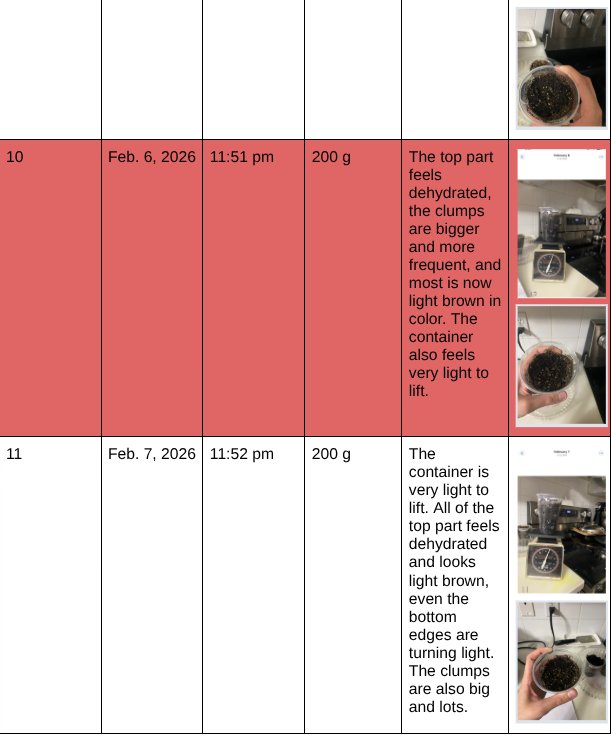
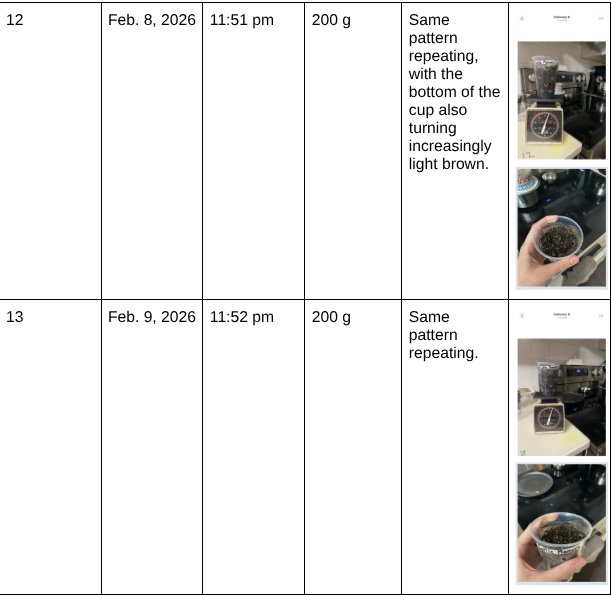
- Sample Type: Cattle Manure - 160g Potting Soil + 40g Cattle Manure
- Initial Water Added (ml): 125 ml
- Dry Equilibrium/ Final Stable mass: 200g - Day 10
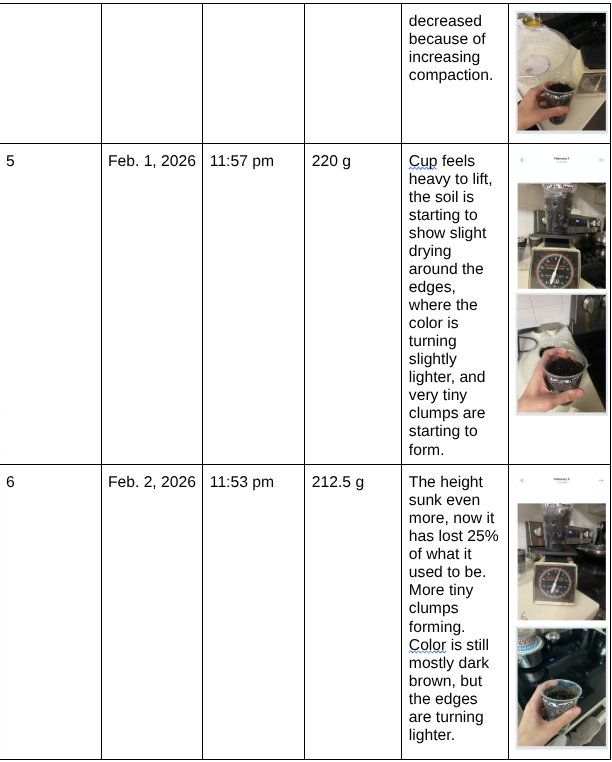

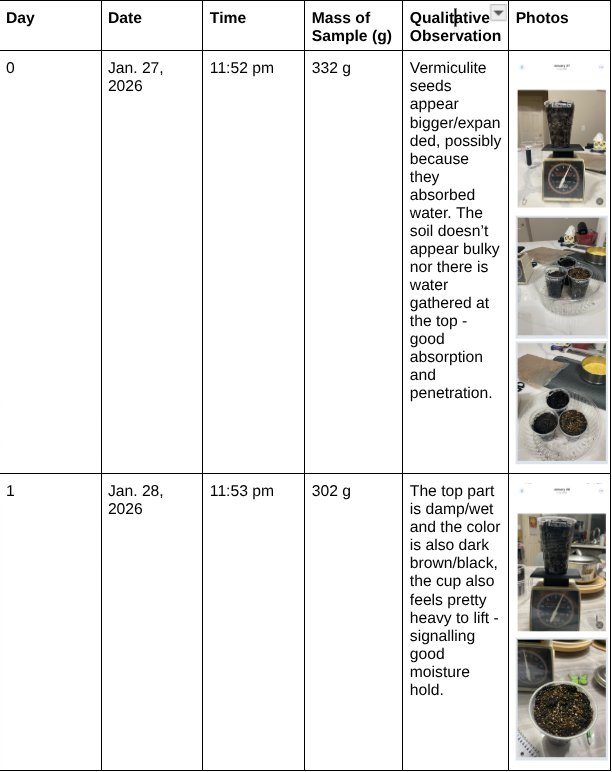
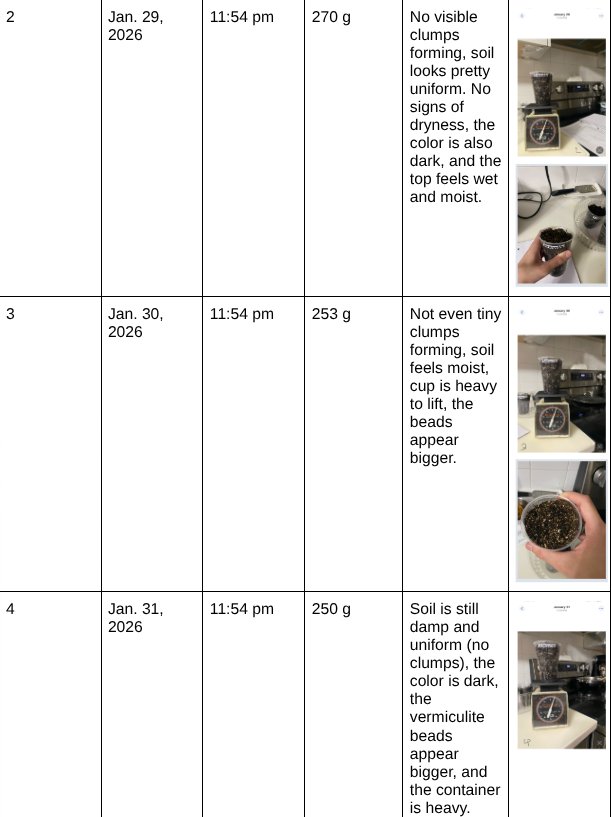
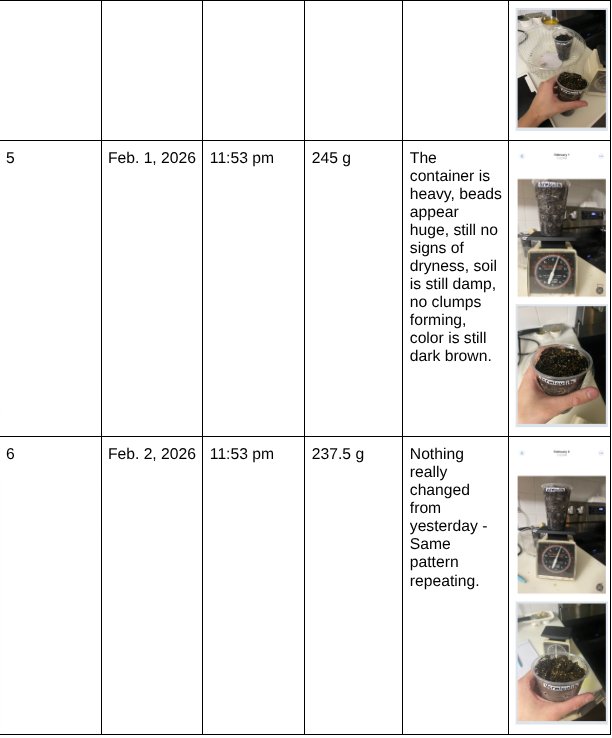
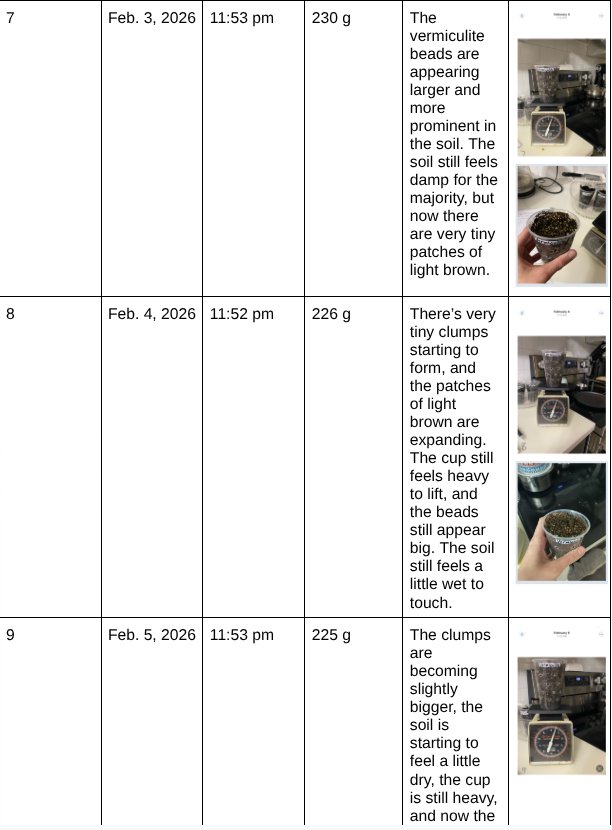
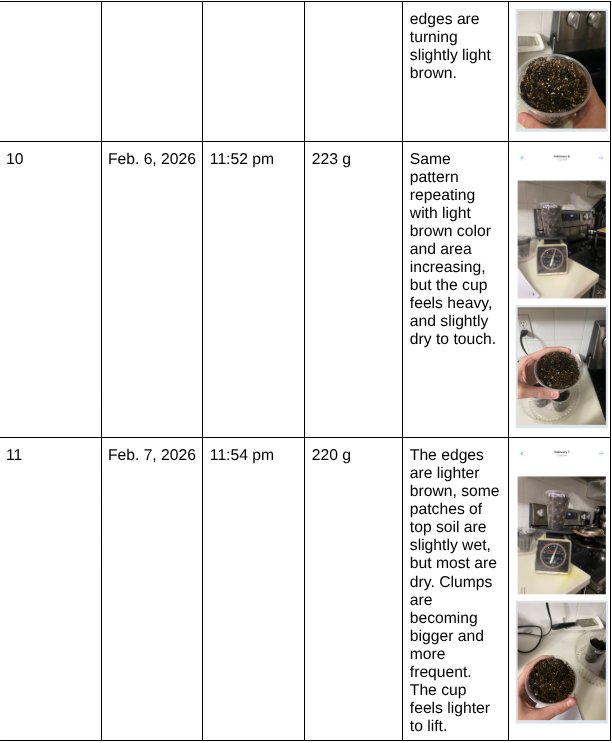
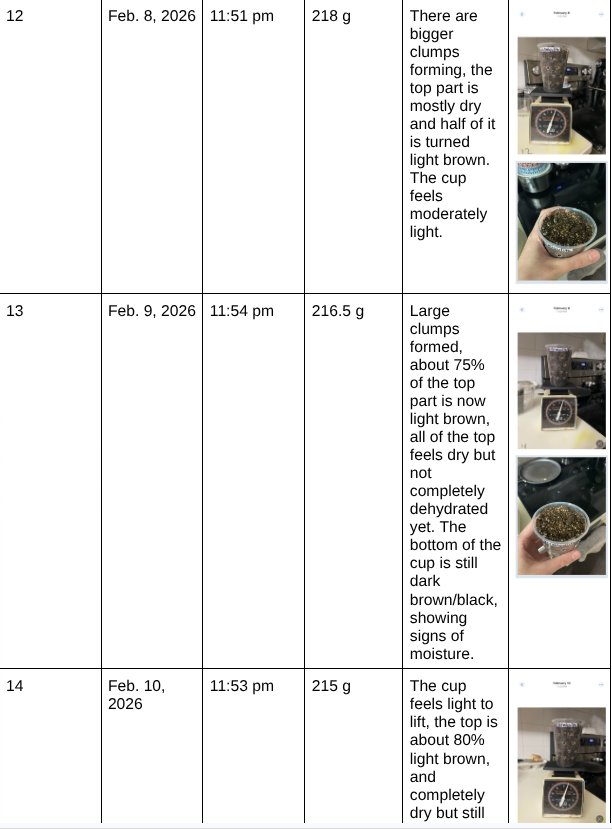
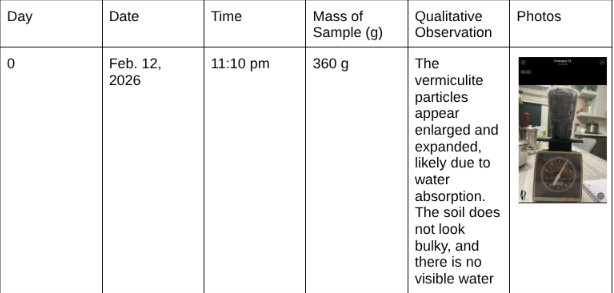
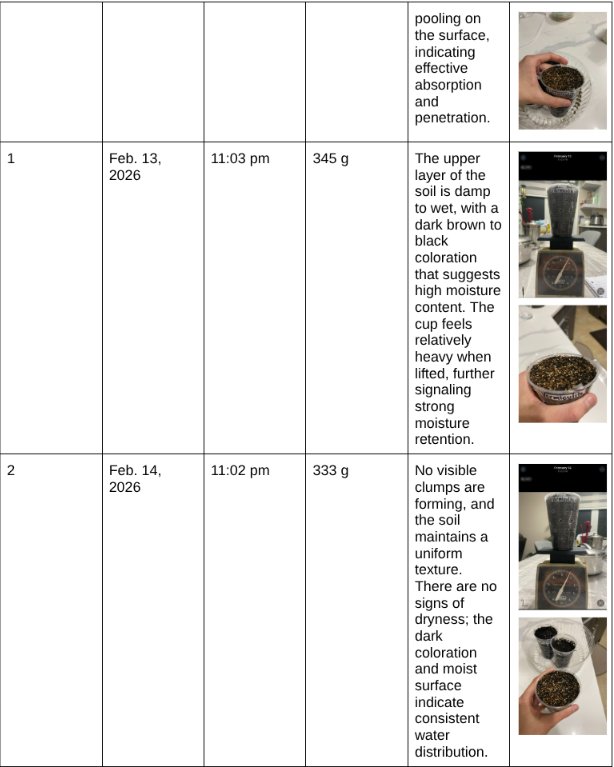
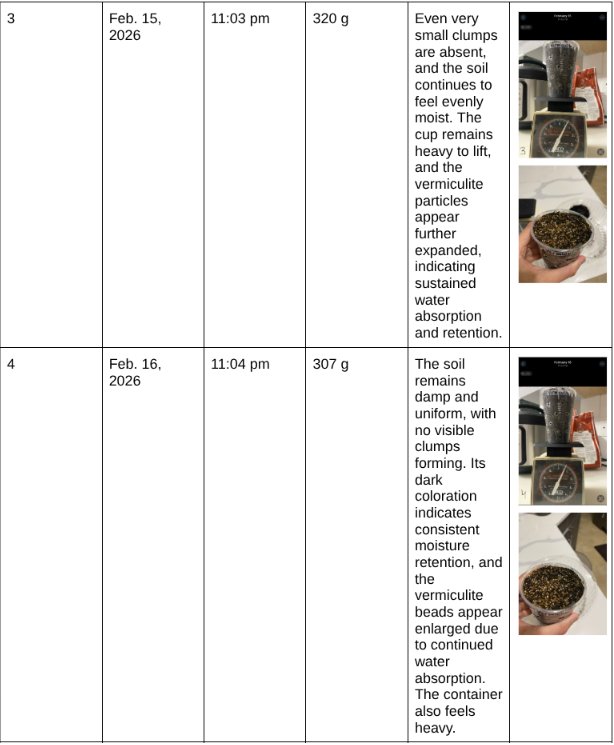
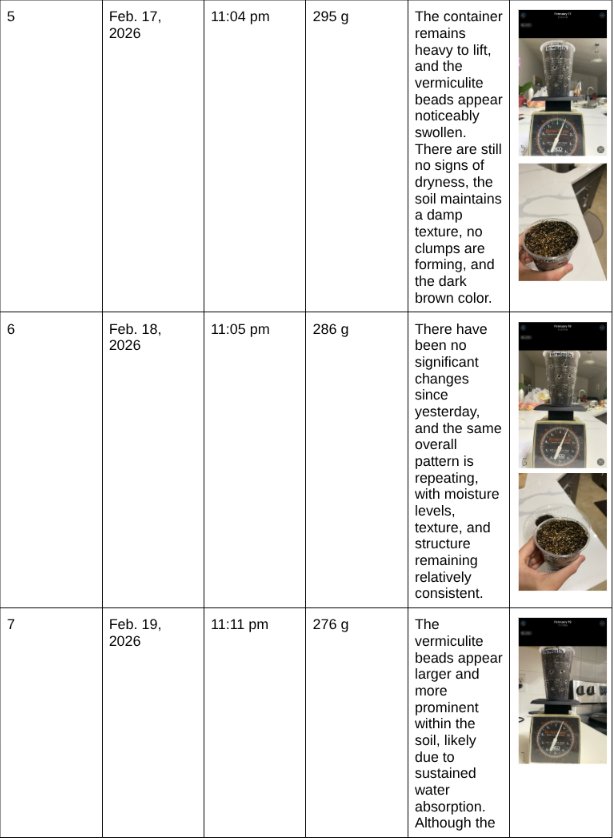
- Sample Type: Vermiculite - 160g Potting Soil + 40g Vermiculite
- Initial Water Added (ml): 200 ml
- Dry Equilibrium/ Final Stable mass: 200g - Day 19
Trial 2
Preparation:
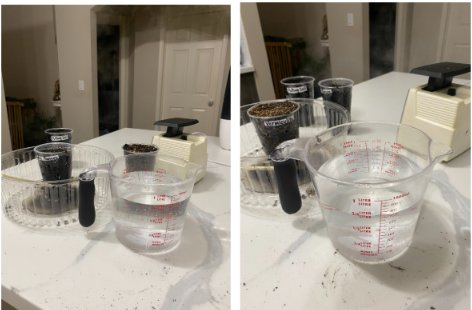
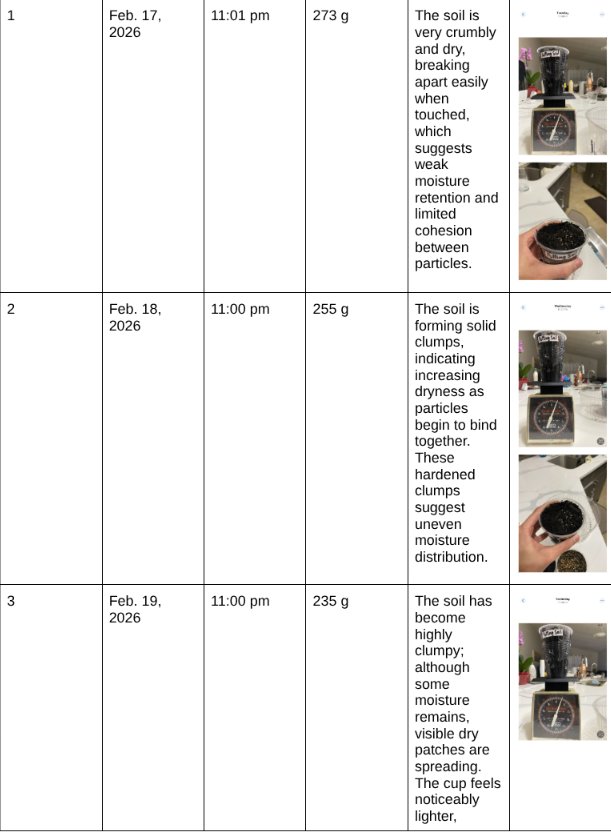
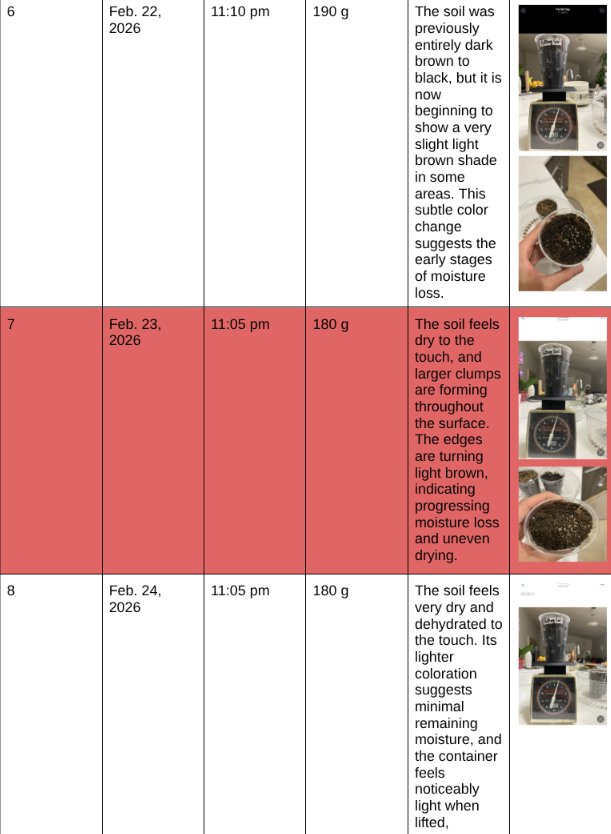
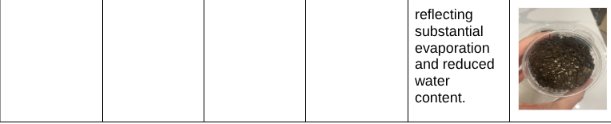
- Sample Type: Plain Potting Soil - 200g
- Initial Water Added (ml): 100 ml
- Dry Equilibrium/ Final Stable mass: 180g - Day 7
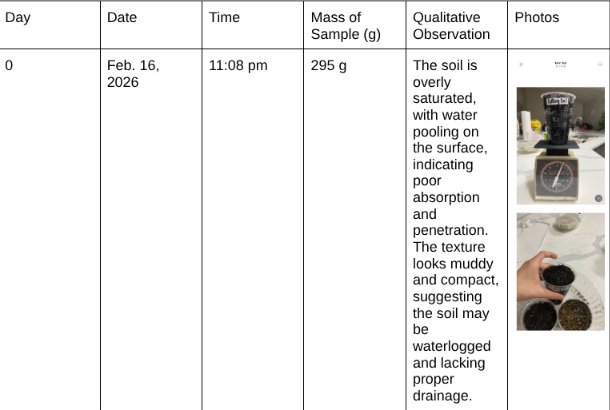
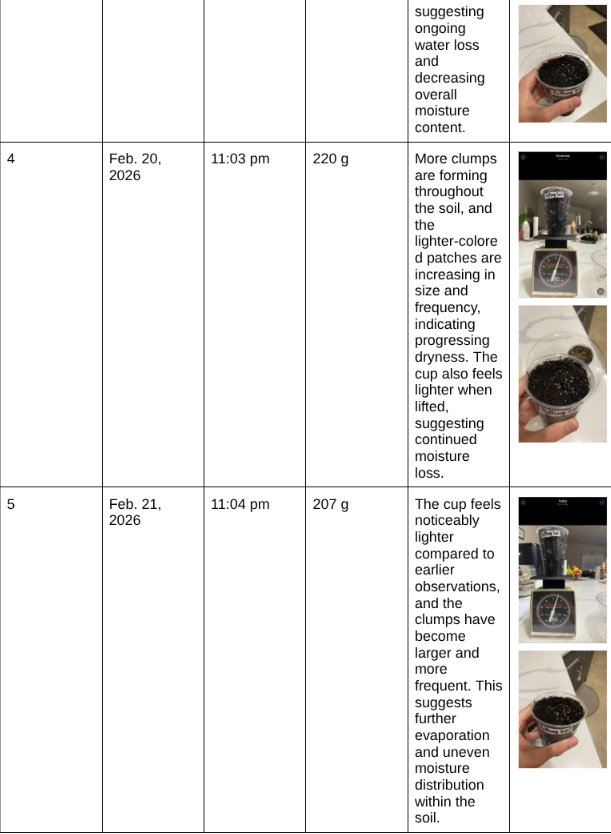
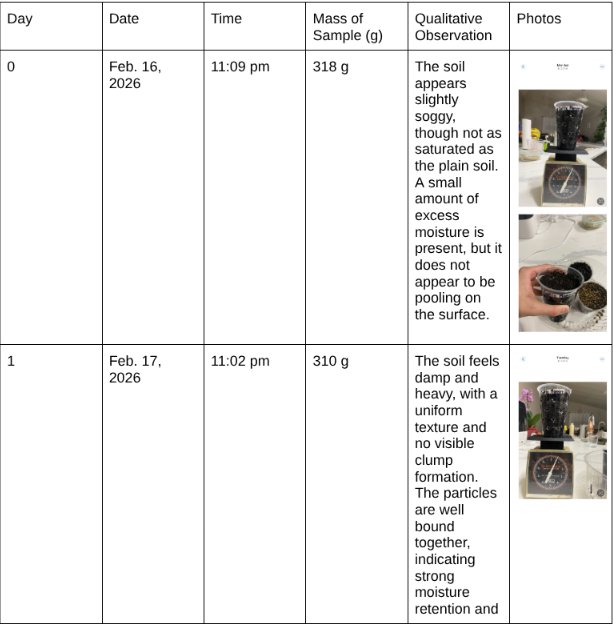
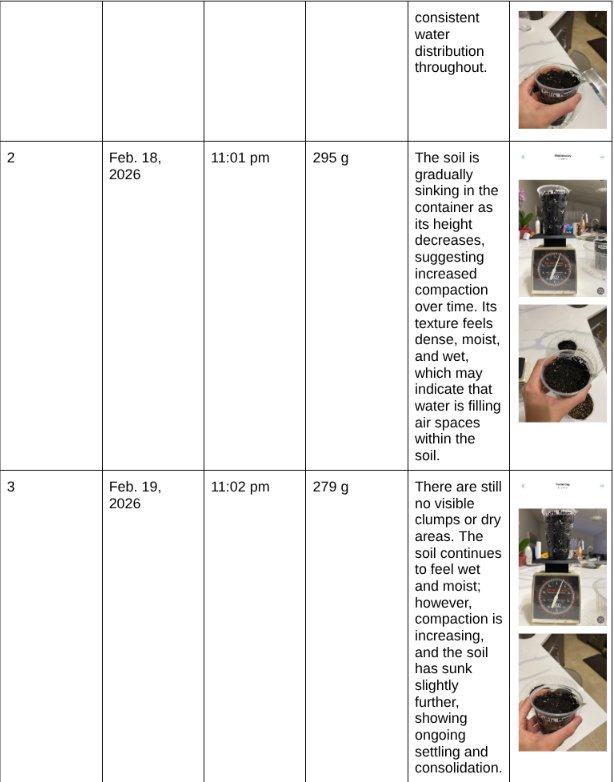
- Sample Type: Cattle Manure - 160g Potting Soil + 40g Cattle Manure
- Initial Water Added (ml): 175 ml
- Dry Equilibrium/ Final Stable mass: 215g - Day 9
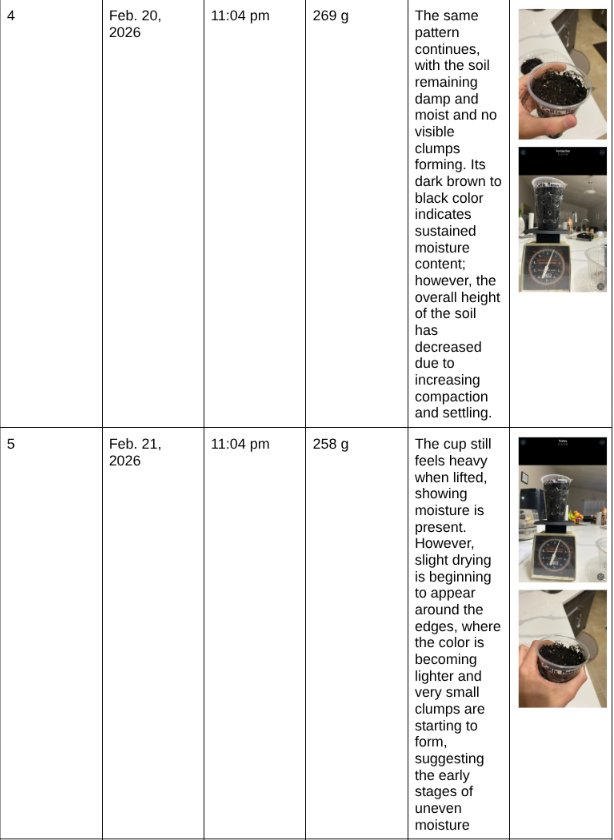
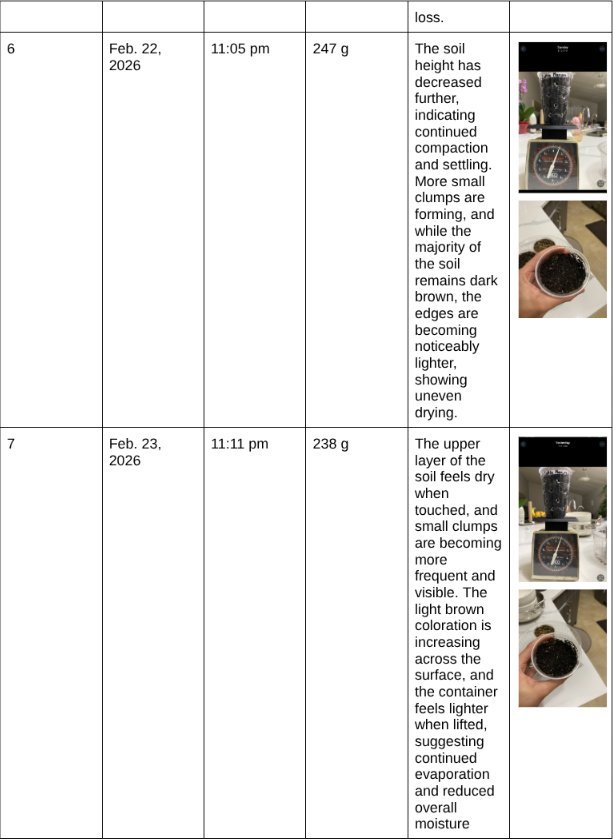
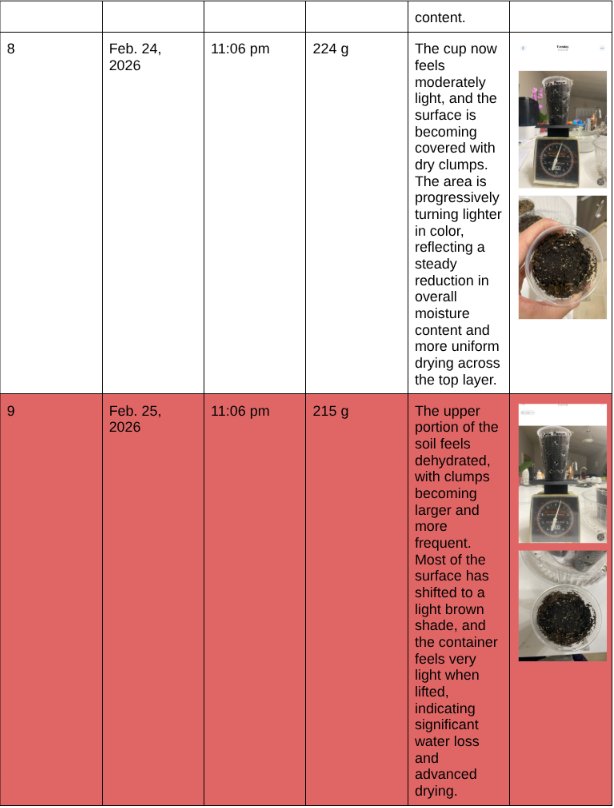
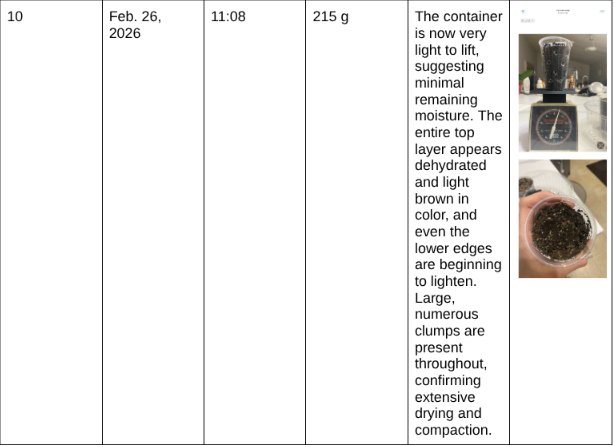
- Sample Type: Vermiculite - 160g Potting Soil + 40g Vermiculite
- Initial Water Added (ml): 250 ml
- Dry Equilibrium/ Final Stable mass: 200g - Day 17
Analysis
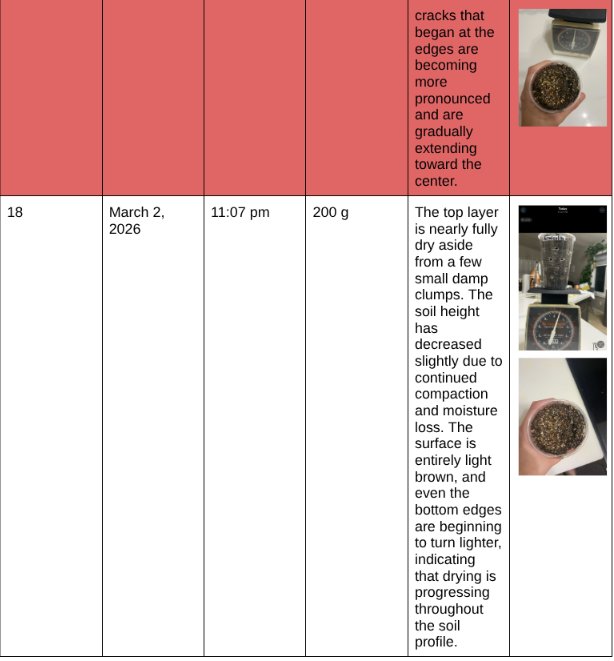
Summary of Observations - Mass Loss Pattern Comparison
Trial 1:

Trial 2:

Trial 1
Four Parameters to Determine Water Retention Capacity:
Field Capacity Comparison:
Evaporation Rate Comparison:
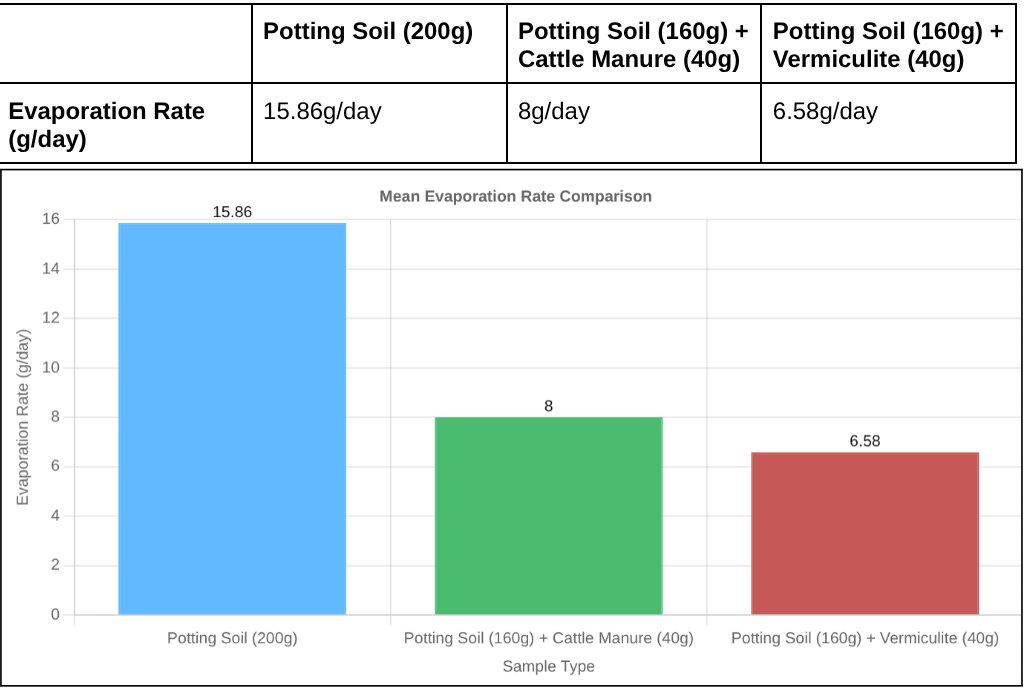
Evaporation Rate = (Initial mass - Equilibrium mass)/(Equilibrium day - Initial day)
- Potting Soil: Evaporation Rate = 287g - 176g/7 - 0 = 111g/7days = 15.86g/day
- Cattle Manure: Evaporation Rate = 280g - 200g/10 - 0 = 80g/10days = 8g/day
- Vermiculite: Evaporation Rate = 325g - 200g/19 - 0 = 125g/19days = 6.58g/day
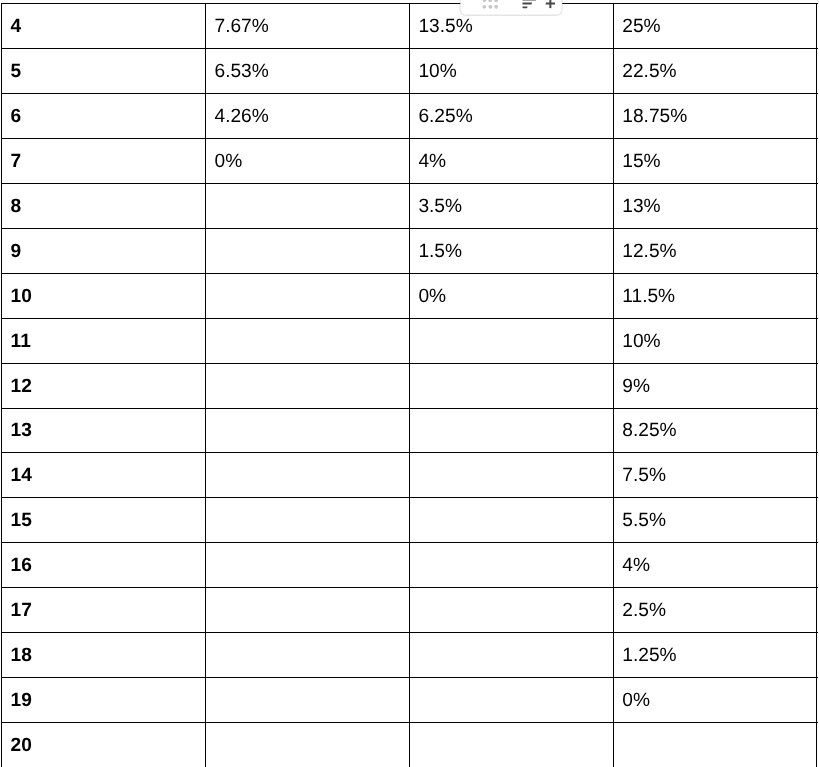
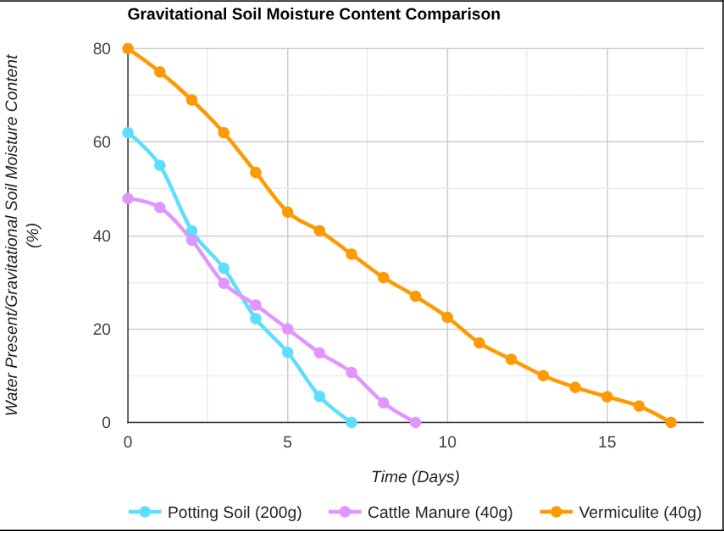
Gravitational Soil Moisture Content Comparison:
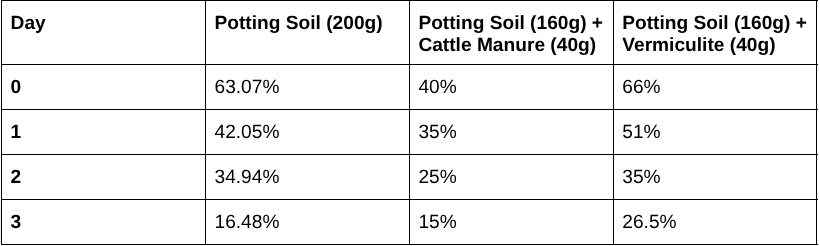
Gravitational Soil Moisture Content (%) = (Wet soil mass - Dry equilibrium mass)/Dry equilibrium mass * 100

Moisture Decay Constant (k) Comparison:
Potting Soil (200g):
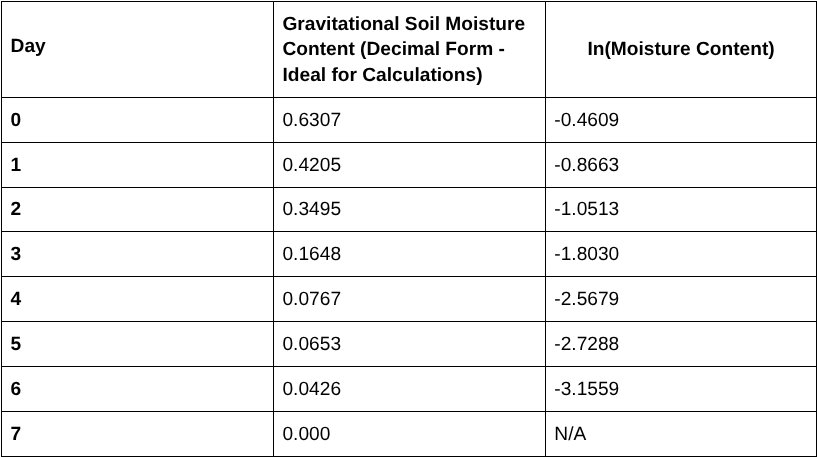
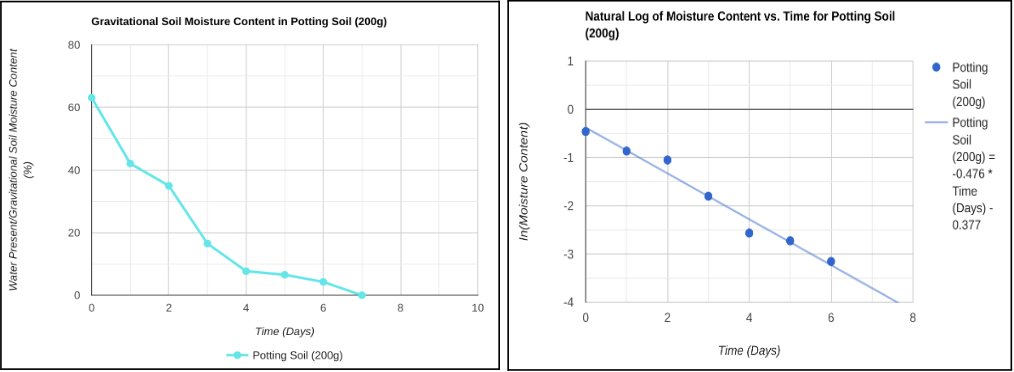
- y = -0.476*x - 0.377
- k = -(slope) = -(-0.476) = 0.476 day^-1
- The soil loses approximately 47.6% of its remaining moisture content each day.
Potting Soil (160g) + Cattle Manure (40g):
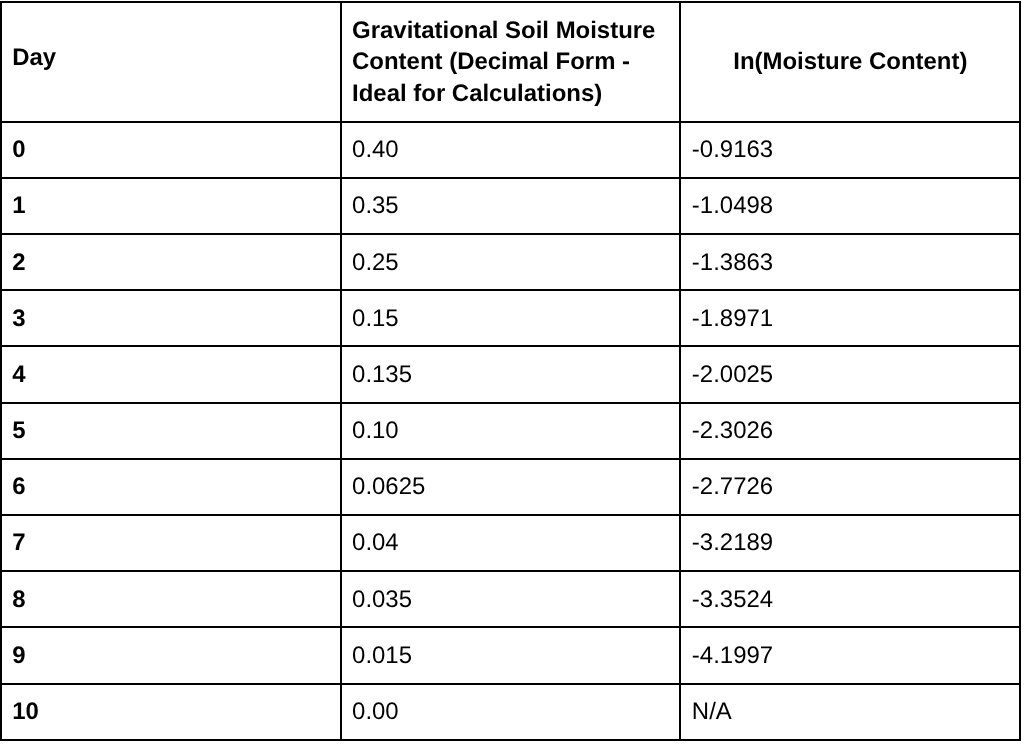
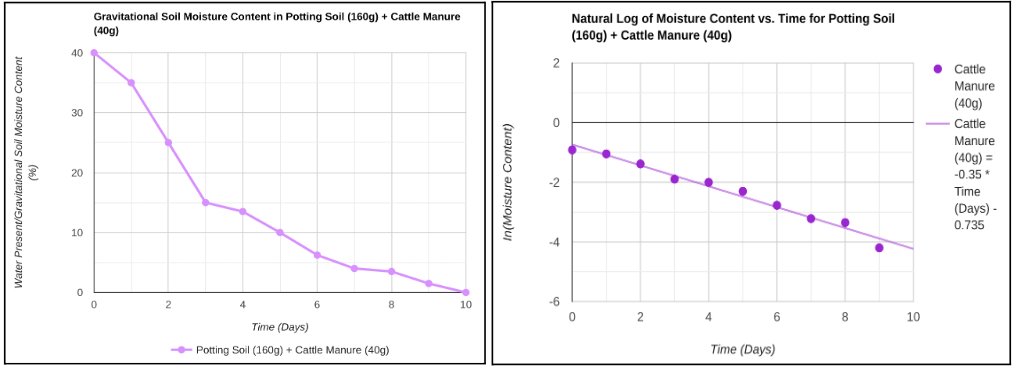
- y = -0.35*x - 0.735
- k = -(slope) = -(-0.35) = 0.35 day^-1
- The soil loses approximately 35% of its remaining moisture content each day.
Potting Soil (160g) + Vermiculite (40g):
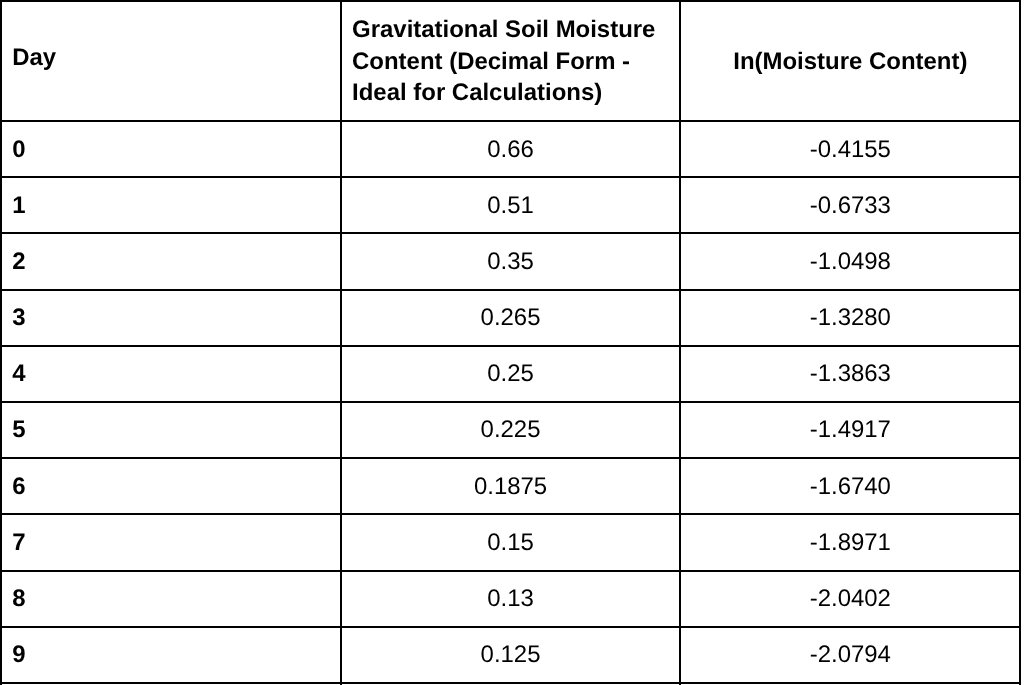

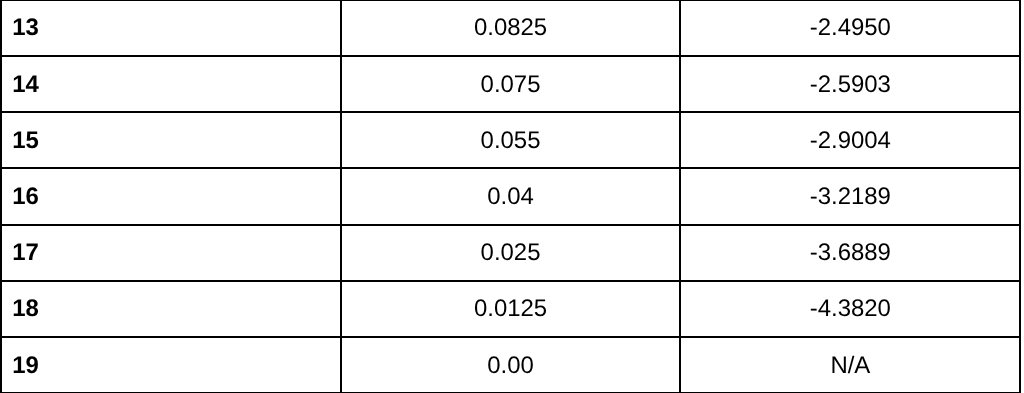
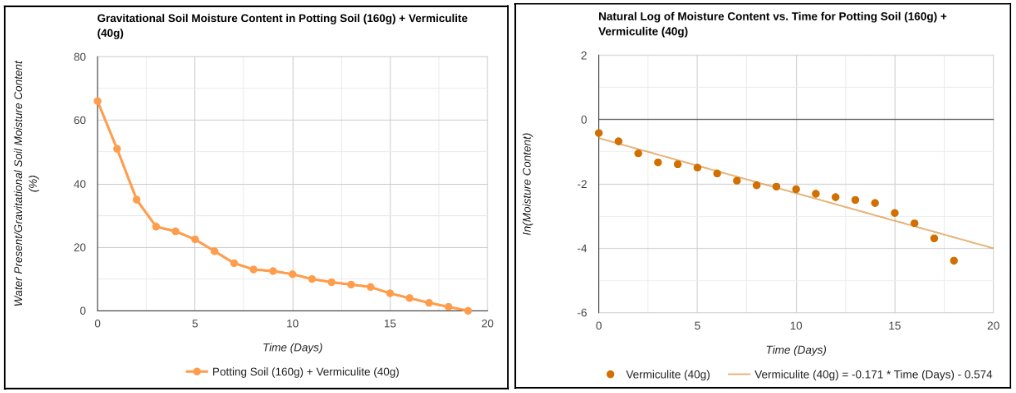
- y = -0.171*x - 0.574
- k = -(slope) = -(-0.171) = 0.171 day^-1
- The soil loses approximately 17.1% of its remaining moisture content each day.
Trial 2
Four Parameters to Determine Water Retention Capacity:
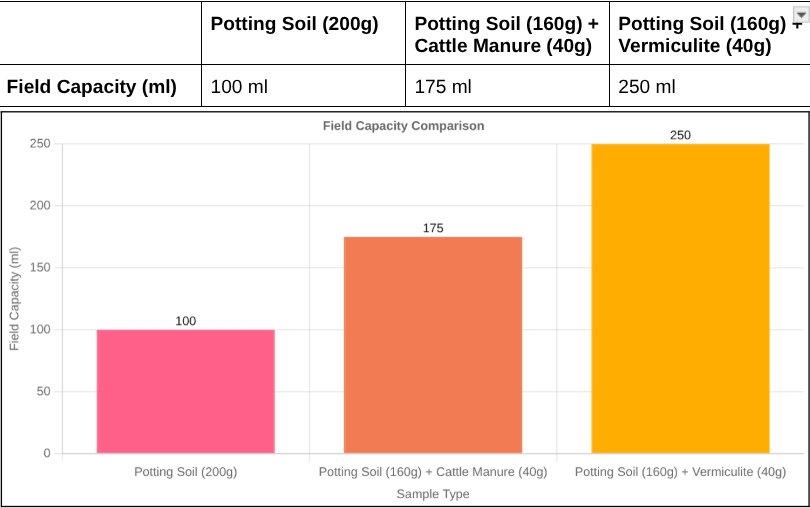
Field Capacity Comparison:
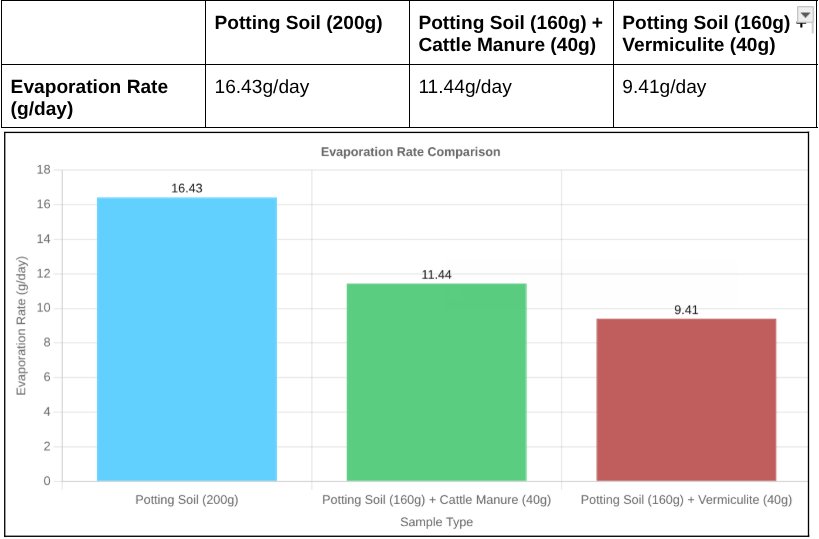
Evaporation Rate Comparison:
Evaporation Rate = (Initial mass - Equilibrium mass)/(Equilibrium day - Initial day)
- Potting Soil: Evaporation Rate = 295g - 180g/7 - 0 = 115g/7days = 16.43g/day
- Cattle Manure: Evaporation Rate = 318g - 215g/9 - 0 = 103g/9days = 11.44g/day
- Vermiculite: Evaporation Rate = 360g - 200g/17-0 = 160g/17days = 9.41g/day
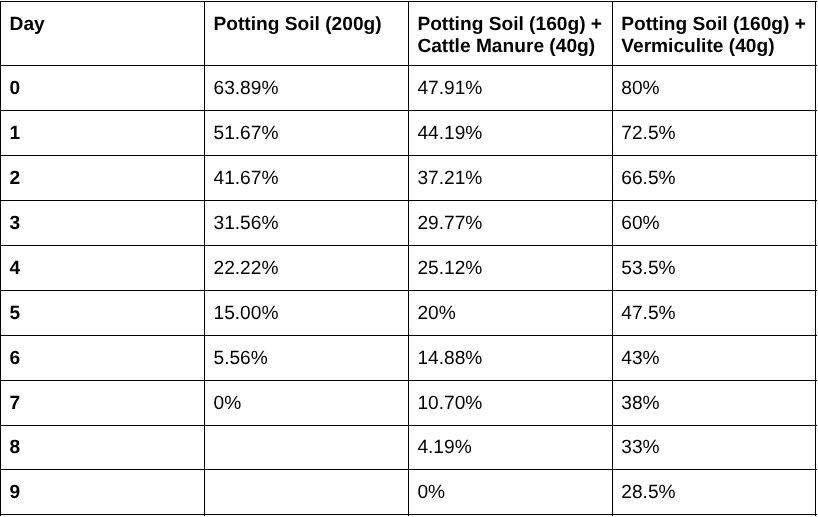
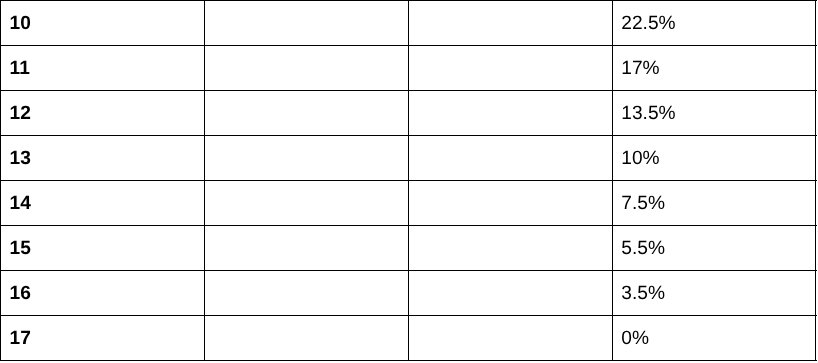
Gravitational Soil Moisture Content Comparison:
Gravitational Soil Moisture Content (%) = (Wet soil mass - Dry equilibrium mass)/Dry equilibrium mass * 100
Moisture Decay Constant (k) Comparison:
Potting Soil (200g):
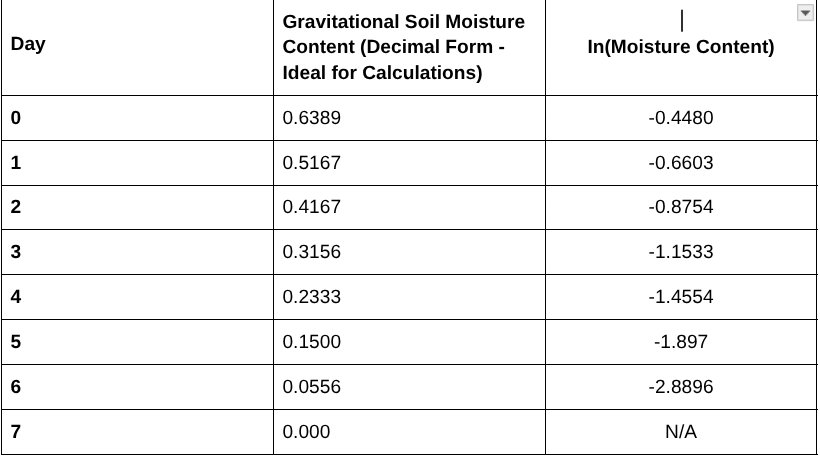
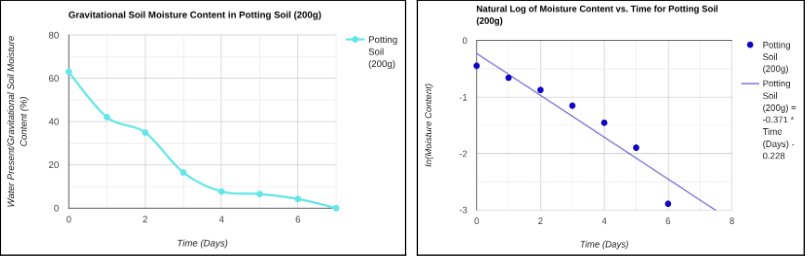
- y = -0.371*x - 0.228
- k = -(slope) = -(-0.371) = 0.371 day^-1
- The soil loses approximately 37.1% of its remaining moisture content each day.
Potting Soil (160g) + Cattle Manure (40g):
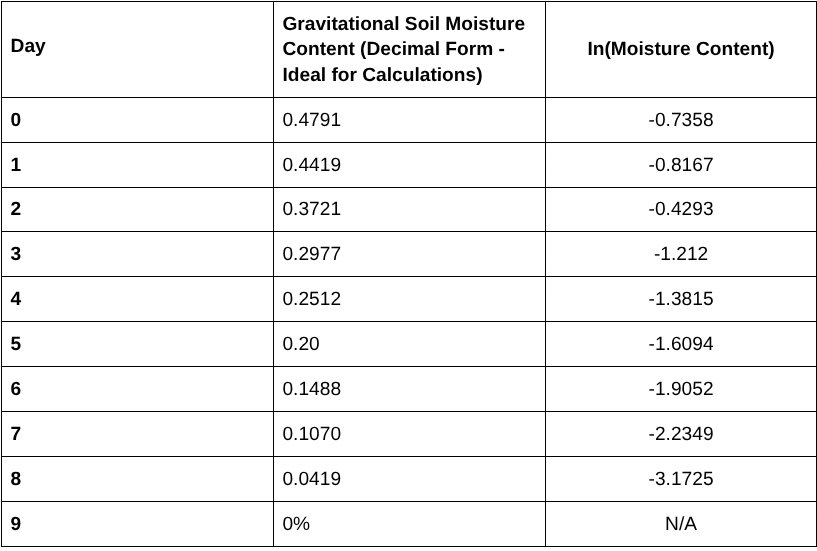
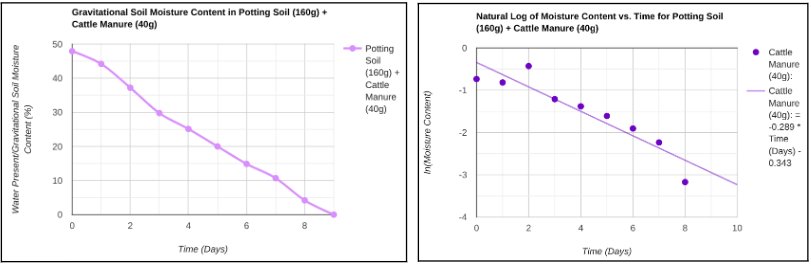
- y = -0.289*x - 0.343
- k = -(slope) = -(-0.289) = 0.289 day^-1
- The soil loses approximately 28.9% of its remaining moisture content each day.
Potting Soil (160g) + Vermiculite (40g):
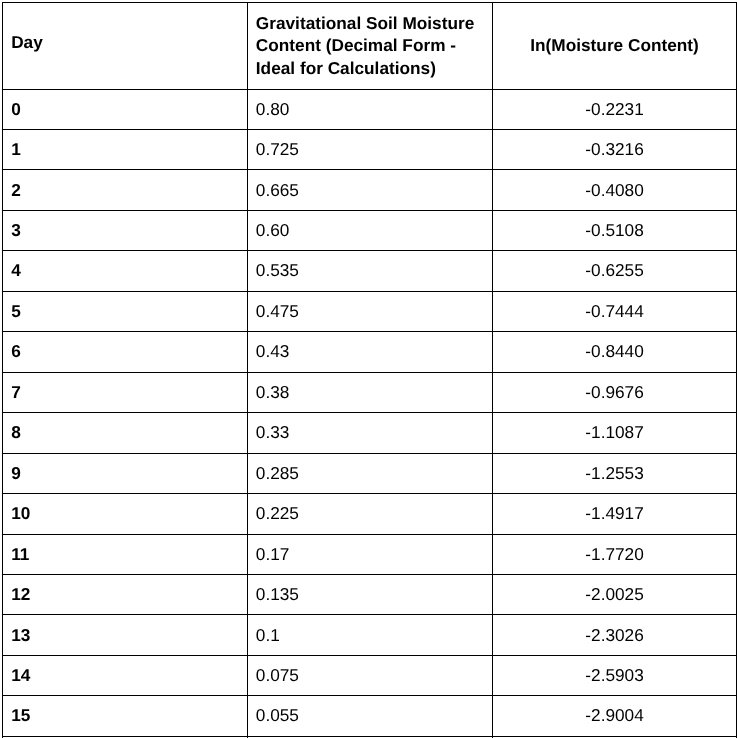

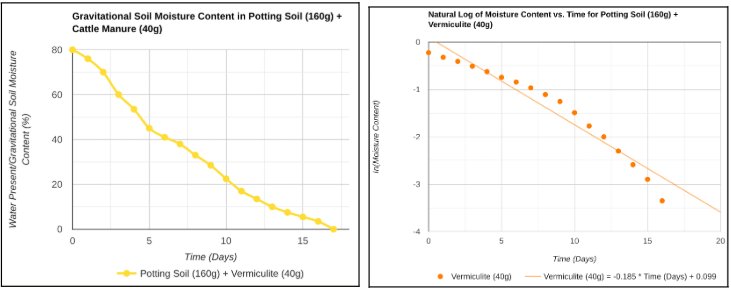
- y = -0.185*x - 0.099
- k = -(slope) = -(-0.185) = 0.185 day^-1
- The soil loses approximately 18.5% of its remaining moisture content each day.
Conclusion
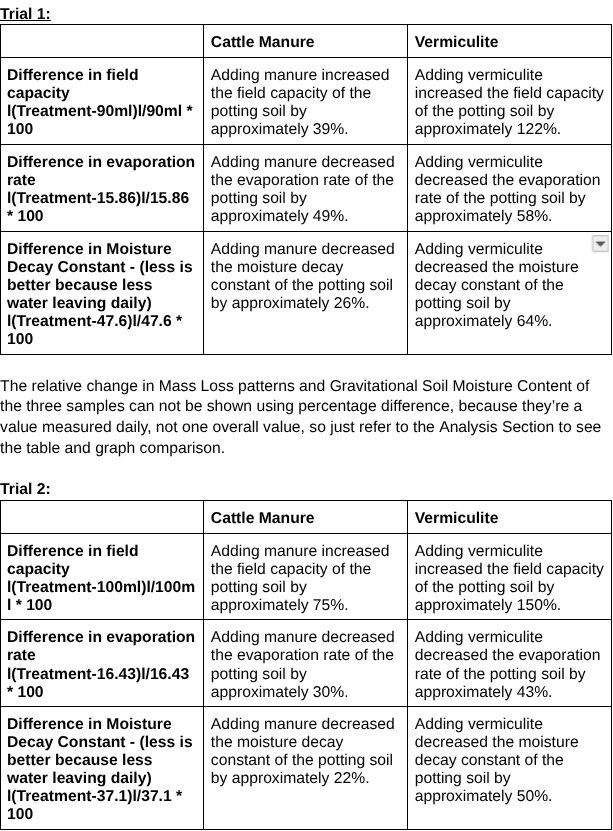
Percentage difference to show the relative impact of treatment groups compared to control group: l(Treatment - Control)l/Control * 100
Conclusion
Drought is one of the most severe and costly climate-related risks facing agriculture today. In Canada, and particularly in Alberta, large portions of land have experienced prolonged dryness, with billions of dollars in crop insurance payouts linked directly to drought. Beyond economics, drought reduces crop yields, kills vegetation, risk food security, threatens livestock, increases wildfire risk, accelerates soil erosion, and destabilizes ecosystems. As climate change intensifies temperature and evaporation rates, droughts are becoming more frequent, more severe, and longer-lasting. Most current solutions, such as irrigation, rainwater harvesting, and water recycling, focus primarily on increasing the amount of water available. However, this addresses only half of the problem. During drought conditions, soil's water retention capacity becomes extremely poor. Simply adding more water is not sufficient because much of it evaporates before the soil can store it and deliver it to plant roots. Therefore, improving soil water retention capacity is a fundamental and often overlooked component of effective drought management. This investigation evaluated whether low-cost soil amendments could increase soil's water retention, which is tested through four parameters, and determine which type, organic (cattle manure) or inorganic (vermiculite), was most effective.
1. Field Capacity (Water Capture Efficiency):
- Both manure and vermiculite increased the amount of water the soil could absorb before drainage, but vermiculite produced a dramatically larger effect.
- Trial 1:
- Manure increased field capacity by \~39%
- Vermiculite increased field capacity by \~122%
- Trial 2:
- Manure increased field capacity by \~75%
- Vermiculite increased field capacity by \~150%
- Across both trials, vermiculite consistently more than doubled the soil’s water-holding capacity relative to control, confirming that its expandable layered mineral structure creates substantial internal pore space for water storage. Manure improved field capacity through aggregation and microporosity formation, but its impact was notably smaller.
2. Evaporation Rate (Short-Term Water Loss):
- Both amendments reduced daily water loss compared to plain soil, meaning stored water remained available for longer.
- Trial 1:
- Manure reduced evaporation by \~49%
- Vermiculite reduced evaporation by \~58%
- Trial 2:
- Manure reduced evaporation by \~30%
- Vermiculite reduced evaporation by \~43%
- Vermiculite consistently slowed water loss more effectively than manure, indicating improved short-term drought buffering. While manure enhanced moisture retention through improved aggregation, vermiculite’s internal water reservoirs likely reduced surface evaporation more efficiently.
3. Gravimetric Soil Moisture Content and Time to Reach Dry Equilibrium:
- Time to reach dry equilibrium directly reflects how long soil can sustain stored moisture under drought simulation. However, this must be interpreted alongside gravimetric soil moisture content (GSMC), which shows how much water remains available relative to dry soil mass at each point in time.
- Plain soil reached equilibrium in 7 days (both trials), with GSMC dropping to 0% rapidly.
- Manure extended drying to 9–10 days, maintaining measurable GSMC for longer.
- Vermiculite extended drying to 17–19 days, sustaining significantly higher GSMC values throughout the drying period.
- Not only did vermiculite delay equilibrium by more than double the time of plain soil, but its GSMC declined much more gradually. Even when the surface appeared dry, measurable moisture remained deeper in the soil profile. This confirms that vermiculite both stores more water initially and releases it more slowly over time.
4. Moisture Decay Constant (Long-Term Drying Behavior):
- The moisture decay constant (k) provides the most comprehensive representation of long-term drying behavior because it incorporates exponential moisture loss over time. A smaller value indicates slower moisture depletion and stronger drought resistance.
- Trial 1:
- Manure decreased k by \~26%
- Vermiculite decreased k by \~64%
- Trial 2:
- Manure decreased k by \~22%
- Vermiculite decreased k by \~50%
- In both trials, vermiculite reduced the overall drying rate approximately two to three times more than manure. This confirms that vermiculite not only stores more water initially but releases it more gradually over extended drought conditions.
Overall Conclusion:
The hypothesis was supported: adding 20% soil amendment increases soil's water retention by increasing microporosity. However, inorganic vermiculite produced the greatest and most durable improvement across all four parameters, field capacity, evaporation rate, gravimetric soil moisture content, and moisture decay constant. Manure improved water retention through aggregation and increased microporosity, but its effect was moderate and short-lived, because of its quick breaking down (decomposition). In contrast, vermiculite’s expandable mineral structure created stable internal pore spaces to store water that substantially increased field capacity, reduced evaporation rate, lowered the moisture decay constant, and extended drying duration across both trials. Importantly, these findings were consistent across two independent trials, strengthening reliability and demonstrating reproducibility despite minor variations in initial water added.
Application
Why Increasing Soil Water Retention Capacity Matters:
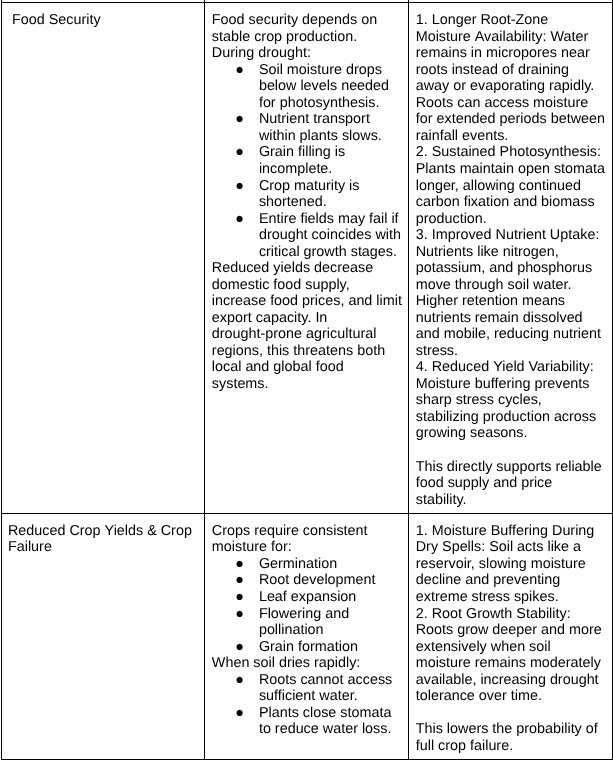
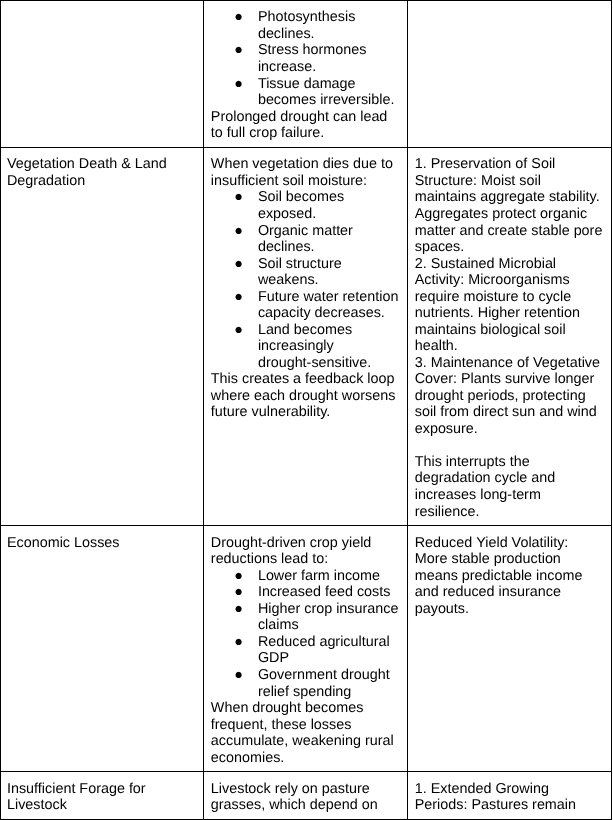
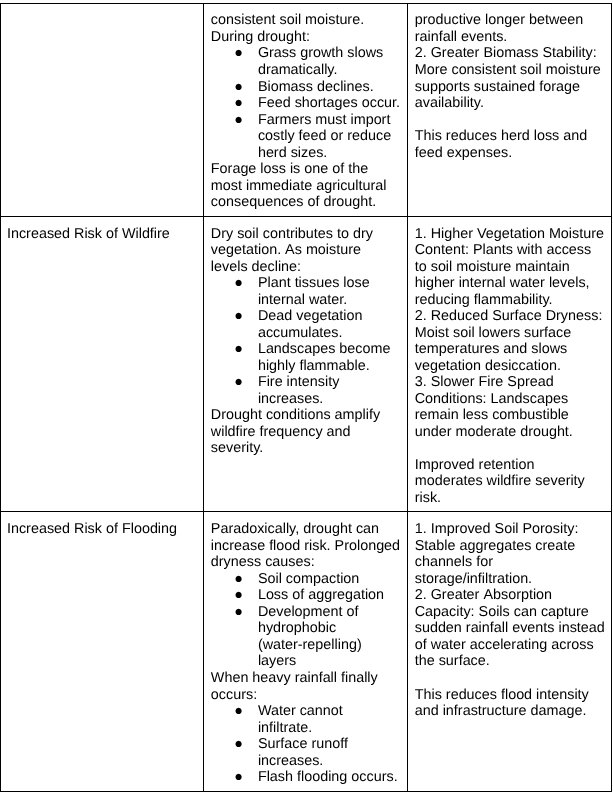
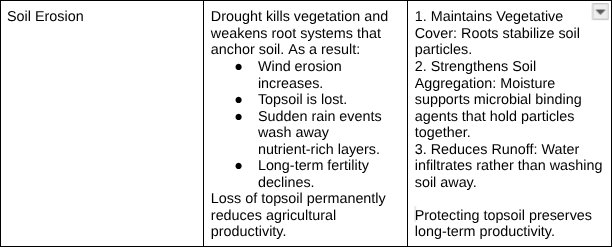
Who Will Benefit?
1. Farmers & Agribusinesses: Drought creates unpredictable income\, rising input costs\, and increased insurance claims. If soil water retention improves\, farmers could:
- Reduce the frequency of total crop failure.
- Lower irrigation costs (fuel, electricity, labor).
- Increase fertilizer efficiency by preventing nutrient loss.
- Stabilize annual yield and cash flow.
- Decrease dependence on emergency loans or subsidies.
2. Livestock Producers: Forage shortages during drought force producers to purchase expensive supplemental feed or reduce herd size. Improved soil moisture stability could:
- Extend pasture productivity.
- Lower feed import costs.
- Reduce herd liquidation risk.
- Improve long-term grazing land quality.
3. Governments & Public Budgets: Billions of dollars in drought-related payouts strain public resources. If soil amendments can reduce crop failure frequency or severity\, this could:
- Decrease agricultural disaster relief spending.
- Reduce crop insurance payouts.
- Lower emergency livestock compensation programs.
- Minimize infrastructure damage from drought-induced flooding and erosion.
- Reduce wildfire suppression costs.
- Preventative soil management is significantly cheaper than repeated emergency response funding.
4. Insurance Companies: Agricultural insurance providers face increased claims during severe drought years. Improved soil water retention could:
- Lower claim frequency.
- Reduce payout severity.
- Increase actuarial predictability.
- Improve long-term profitability.
5. Consumers & Food Markets: When drought reduces production\, food prices rise. Increased soil water retention could:
- Stabilize crop output.
- Reduce price spikes.
- Protect supply chains.
- Improve long-term food availability.
- This benefits consumers through price stability and food security.
6. Rural Economies: Agriculture drives employment and local business revenue in rural regions. Drought weakens entire communities. Improved soil retention could:
- Protect farm incomes.
- Sustain agricultural employment.
- Reduce economic downturn cycles in drought-prone areas.
- Stronger soil resilience strengthens regional economic resilience.
7. Environmental Management Agencies: Drought contributes to wildfire risk\, erosion\, and habitat degradation. Increased soil water retention could:
- Reduce landscape flammability severity.
- Lower erosion-related land restoration costs.
- Protect watershed health.
- Reduce flood mitigation spending.
- This lowers long-term environmental management expenses.
Practicality and Cost Effectiveness:
One of the strongest aspects of this solution is affordability and accessibility. Cost Comparison:
- Vermiculite: $10 for 400 g
- Cattle Manure: $4.50 for 12.5 kg
At first glance, manure is significantly cheaper per kilogram. However, effectiveness must be considered alongside cost.
- Vermiculite delivers greater performance, especially in terms of long-term drought buffering. Although more expensive per gram, its durability (it does not decompose) means it can last several years in soil, potentially making it cost-effective over time.
How This Solution Can Be Applied
1. Agricultural Fields
- Incorporate 20% amendment into topsoil before planting season.
- Target high-value crops (e.g., vegetables, specialty crops) where drought buffering has the greatest economic return.
- Apply to sandy or low-organic soils where water retention is weakest.
2. Drought-Prone Zones
- Prioritize application in drought-prone zones (southern and central Alberta) where drought impact is highest.
- Use mechanical tilling equipment for even distribution.
3. Reclamation and Soil Restoration
- Apply in degraded soils to improve structure and reduce erosion risk.
- Use in wildfire-prone landscapes to maintain soil moisture.
Long-Term Climate Adaptation Impact:
Drought resilience is becoming essential for agricultural sustainability. Enhancing soil water retention:
- Increases drought resilience without requiring advanced technology.
- Reduces dependence on external water sources.
- Improves water-use efficiency.
- Protects food supply stability.
- Strengthens rural economic resilience.
Most importantly, this solution is proactive rather than reactive. Instead of responding to drought after it happens, improving soil's water retention prepares for drought before it occurs, through creating water storing reservoirs in the soil itself.
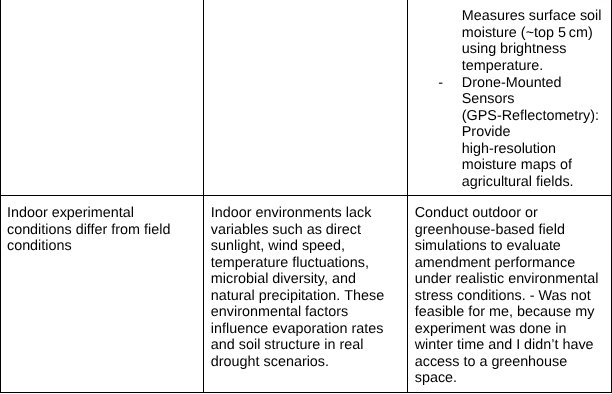
Sources Of Error
Citations
https://www.organic-center.org/research/50-year-study-impacts-inorganic-fertilizer-shows-reduced-soil-structural-stability#:\~:text=50%2Dyear%20study%20on%20the,to%20separate%20rather%20than%20aggregate.
https://www.frontiersin.org/journals/earth-science/articles/10.3389/feart.2014.00030/full
https://natural-resources.canada.ca/climate-change/climate-change-impacts-forests/drought
https://www.ebsco.com/research-starters/chemistry/gravimetric-analysis
https://climateinstitute.ca/news/fact-sheet-climate-change-and-drought/#:\~:text=Climate%20change%20is%20making%20droughts,worsen%20(IPCC%202023%2C%20p.
https://journalistsresource.org/media/standard-deviation-data-journalists/#:\~:text=When%20researchers%20analyze%20quantitative%20data,View%20project%20in%20full%20screen.
https://www.ruralrootscanada.com/severe-drought-for-alberta/#:\~:text=READ%20MORE:%20Alberta%20Assembles%20a,securely%20managed%20in%20the%20future.%E2%80%9D%20%20https://www.alberta.ca/drought-101
https://www.pioneerseeds.com.au/resource-centre/corn-resources/technical-insights-agronomy-info/water-retention-and-nutrient-availability-in-soil
https://www.swansonsnursery.com/soil-calculator
https://soilhealthinstitute.org/news-events/how-does-soil-health-increase-resilience-to-drought-and-extreme-rainfall-2/
https://www.mdpi.com/1996-1944/14/21/6658
https://www.mrslopeguy.com/blog/teaching-standard-deviation-with-real-data-from-sports-stats-to-science#:\~:text=In%20scientific%20experiments%2C%20standard%20deviation,variability%E2%80%94data%20is%20spread%20out.
https://jgme.kglmeridian.com/view/journals/jgme/4/3/article-p279.xml
https://www.canr.msu.edu/news/compost_increases_the_water_holding_capacity_of_droughty_soils
https://wpcdn.web.wsu.edu/wp-puyallup/uploads/sites/403/2015/03/soil-amendments.pdf
Acknowledgement
I would like to sincerely thank my parents for their constant support and encouragement throughout my science fair project. Their guidance and help made this experiment possible. I am also grateful to my neighbor for kindly allowing me to borrow her mechanical scale, which was essential for my experiments!