
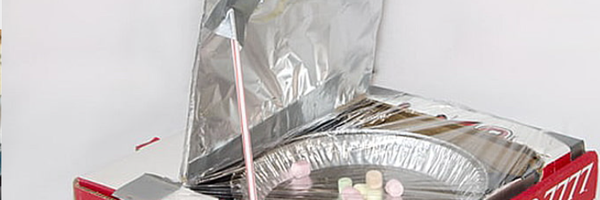
Solar Oven
Haneet Kaur Gill, Harsimrat Kaur Sandhu
Gobind Sarvar School Guru Nanak Gate Campus
Grade 6
Presentation
No video provided
Hypothesis
We think chocolate will melt the fastest because it melts at room temperature. It also melts in your hands, considering it is the easiest to melt. It melts in about 5-10 mins.
Candy canes take a longer time to melt because they don’t normally melt at room temperature. They require high temperatures like 120 degrees celsius. They take about 40-50 mins.
Lollipops take a longer time to melt than candy canes because they require a lot of licks just to get skinnier and thinner. They melt at 145-154 degrees celsius. They melt in about 2 hours.
Research
A solar oven is a device that uses the sun’s energy to cook food by converting solar radiation into thermal energy and trapping the heat. The interaction between the light energy and the receiver material converts light to heat and this is called absorption.
Variables
Independent Variable :Type of candy (chocolate, lollipop, candy cane).
Dependent Variable: Time taken to melt in the solar oven.
Controlled Variables : ame solar oven, Same sunny location, Same time of day (as much as possible), Same size/amount of candy, Same placement inside the solar oven, Same weather conditions.
Procedure
Put the candy canes in solar oven.Make sure your solar ovens plastic is tight and it is secure.
Then you have to put the solar oven in a really sunny spot so the candy canes gets melted faster.
After you do that you have to come check on the candy canes every 20 to 30 minutes. Repeat 3 trials.
Repeat all the above steps with chocolate and lollipops.
Observations
Based on the results from the three trials, chocolate melted the fastest in the solar oven, while the candy cane melted the slowest.
Chocolate melted very quickly in all three trials, with an average time of 4.7 minutes.
Lollipops took much longer to melt, with an average time of 53.3 minutes. Candy canes took the longest time to melt, with an average time of 85.3 minutes.
The results were consistent across all three trials, showing that softer materials with lower melting points melt faster, while harder sugar candies take more time to melt in a solar oven.
Analysis
A solar oven uses a simple method to convert the Sun’s rays into heat. The solar oven has a transparent cover (glass/plastic wrap) that captures sunlight and traps it to heat inside. The solar oven uses the greenhouse effect, where the heat gets trapped and can’t escape. The inside of the solar oven is a dark color like black, because darker colours are better at capturing heat. When the heat is captured, it spreads out inside of the solar oven, heating or cooking the food like a normal oven.
Conclusion
The results of our experiment show that chocolate melted the fastest in the solar oven, while the candy cane melted the slowest. Chocolate had an average melting time of 4.7 minutes, which is much faster than the lollipop at 53.3 minutes and the candy cane at 85.3 minutes. This happened because chocolate has a lower melting point and a softer texture, so it melts quickly when heated. Lollipops and candy canes are made mostly of hard sugar, which requires more heat and time to melt. Overall, our prediction that chocolate melts the fastest in a solar oven, proving that different materials melt at different rates depending on their properties was good.
Application
We can use this in our daily life because it is very essential. It is also a economy-friendly way for cooking and heating food. It also reduces the use of energy and electricity, making it helpful for the world and us. The solar oven's lifespan is also pretty long, lasting about 20-35 years so we don't have to worry about making or getting a new one in a few years.
Sources Of Error
While doing our experiment, we realized that we weren’t getting enough heat and sunlight for the solar oven to work properly. At first, the sun wasn’t strong enough, and because it was afternoon, its position kept shifting, which made the oven less effective. The next day, we placed the solar oven directly in front of a bright window with full sunlight. After a few minutes, the oven started to get warmer, and eventually, the candy canes melted! This showed us how important the position of the sun and direct sunlight are for the solar oven to work effectively.
Citations
Florida Solar Energy Center-Solar ovens and Cookers A technical report explaining how solar ovens focus solar radiation to produce heat for cooking. References | SpringerLink
Stella Andrassy-The Solar Cookbook Combines solar oven principles with cooking recipes and tips. Solar cookers – Knowledge and References.Build a Pizza Box Solar Oven | STEM Activity Science Buddies https://www.sciencebuddies.org › stem-activities › solar-.
Steven E. Jones-The BYU Solar cooker/Cooler It is a scientific publication written in the early 21st century. This book represents a comprehensive guide on constructing and utilizing an innovative solar solar cooker and cooler that harnesses solar energy for cooking food and purifying water. Solar cookers – Knowledge and References
Acknowledgement
Mrs. Sharma because she helped us in editing the slides and choosing the title.
Haneet’s Mom because she helped in choosing the backgrounds and she helped us make the solar oven.