
Which Soil Will Affect Plant Growth
Ella Huber, Monroe Ash
LYNX West
Grade 7
Presentation
No video provided
Hypothesis
We are using rosemary, thyme, basil, mint, zucchini and kale for the plants and sandy, chalky, clay, silty, peat, and regular for our soil. We think that clay soil will not react best with all of the plants and we think that sandy soil will react the best with all of the plants. The reasons why we think that clay will not be a good match is because it will get to dry and it will rot really quickly. We think that sandy soil is good because it has different % of different soils that react well to the plants we are using.
Research
Our project is about plants and soils. We are testing different types of soils and plants and combining them together. Plants grow when a seed breaks open and starts to absorb water and nutrients. Plants can recognize their siblings through roots.
Plants are triggered by the warmth and moisture to start growing. The growth occurs at zones called meristems at the root. Plants often join in a trade with soil that has bacteria and fungi. Soil particles hold water that absorbs via osmosis. Healthy soil soil has around 50% pore filled with air and water.
We are using rosemary, basil, zucchini, kale, mint and thyme for our plants. Rosemary can heal and treat wounds. Fresh basil has a source of vitamin k for blood clotting. Zucchini has skin benefits and health sources like a mind diet. 2 tablespoons of fresh mint provide around 3% of the daily value for vitamin A. Thymol is a main ingredient to most mouthwashes.
It takes roughly 500 years to naturally farm 2.5cm of top soil. so stores more corbon than the entire atmosphere and all the worlds forests combined. microbiologists recently discovered active, slowly growing, microbes at death of up to 70 feet. a single teas spoon of healthy soil contains move living organisms icluding billons of bactreria and fungi than there are humans on the earth. Soil acts as earths skin and primary water filter it naturally degrades, detoxifiles and immobllizes potentional pollutions before they reach undergroud equifers.
We talked about different types of plants and soils and how they help your health benefits grow. We learned that there are a lot of different plants and soils to use for our experiment. we wanted to find out what plants go well with different soils, at different time.
Variables
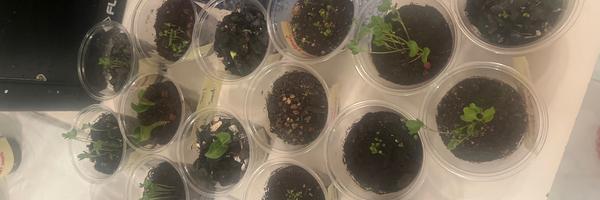
Manipulated variable: we are using various plants and various soils. Responding variable: how each plant responds to each of the soils each day. Controlled variable: how much they are watered each day. How much sunshine they get each day. The size of the containers should be the same. This is the variables I come up with
Procedure
- We first need rosemary, basil, thyme, kale, mint, and zucchini seeds for step 1.
- For step 2 we need peat, sandy, silty, regular, clay, chalky soil.
- Step 3 we need to get a mini shovel to dig in the seeds and get it in the right place.
- For step 4 we need to get plant pots to grow the plants (36 of them)
- Step 5 find all of the stuff by Feb 20 to grow the plants.
- Step 6 start to grow them on Feb 20 to Feb 21.
- Step 7 water them everyday twice morning and night for the first week and then only water them once every 2 days.
- Step 8 we will be taking photos everyday and putting it in our presentation box.
Observations
On day 1 the plants were awakening and slowly rising to the top, with rich moist soil.
On day 2 the kale seeds in the silty soil popped up and started to grow faster and faster.
Then on day 3 most of the kale seeds popped up but the clay soil with kale took a little longer then the rest.
Then day 4 all of the kale seeds were up, the thyme seeds started growing in the silty soil and a few of the basil seeds popped up.
Day 5 the kale seeds were growing really fast, a new thyme seed popped out of it`s shell growing really smooth. One more basil seed popped up and started growing really nice but really slow and one zucchini seed popped up.
Day 6 more thyme seeds popped up fast, more basil seeds popped up and 2 zucchini seeds in the chalky soil and silty soil.
The 7th day the kale seeds got really tall and the silty soil is growing the tallest, the silty soil with the basil is growing really nice and same with the peat soil and basil. The zucchini`s are taking their sweet time but still growing tall.
The 8th day everything is basically the same as day 7 but the sandy zucchini rotted and the regular zucchini popped up.
Analysis
We noticed that the silty soil is growing the best with most plants we have and the clay soil is not going the best with the plants we have and we think peat and sandy is in the middle. We think kale is going the best with all the soils and we think mint is not going too well with the soils we have. Zucchini is in the middle for sure because it rotted in sandy soil and it isn't really growing in other soils other then regular, silty and chalky.
Conclusion
In conclusion of our project we were wrong about sandy soil reacting the best, it turns out silty soil was the best match for most of the plants. We were right about clay not reacting the best with all the plants, it started growing last in most plants and just taking its time. Silty soil was really fast to grow and is growing very smoothly with most of the plants.
Application
Our project can help a lot for farmers with crops using some of the soil we used here`s why: silty soil worked really well with most of our plants and it should work with other plants too. It grows really fast and smooth with plants, doesn`t rot easily and has a really nice texture. We would not recommend using clay soil because it takes longer to grow, it`s quite hard to find and doesn`t grow easily with a lot of plants and doesn`t really absorb the water as well as others, as it`s very dense soil.
Sources Of Error
Here`s how we could have made our project better. Not letting some of our plants rot, one of our zucchini plants in sandy soil rotted but we cant figure out why. Changing our water schedule by only watering it once a day because before that we were watering it twice a day.
Citations
The websites we used: https://www.wikipedia.org https://isric.org https://sis.agr.gc.ca https://www.apsnet.org https://plants.usda.gov