
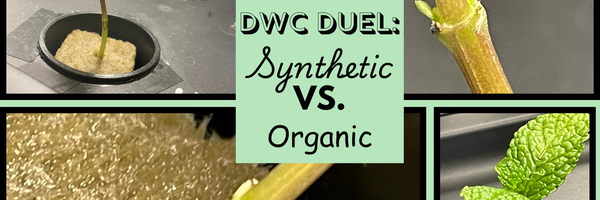
DWC Duel: Synthetic vs Organic
Aaradhya Patil
Louis Riel School
Grade 8
Presentation
Hypothesis
Hypothesis
If I compare the mineral-based solution and the compost-based solution, the mineral-based solution will be the best option for the height and number of leaves on the mint, because it tends to have more precise measurements and ratios than organic solutions, which rely solely on the microbes in the compost.
Research
Background Research
Introduction/Problem
My topic is hydroponics, in which I will compare a masterblend/mineral-based/synthetic solution to an organic solution. I chose this topic because hydroponics is becoming increasingly popular among companies worldwide. This is due to two main reasons: efficiency and cost-effectiveness. Hydroponics uses significantly less water compared to geoponics (soil), thus conserving much more water. It can also boost growth rates by up to 50%, ensuring more crops in a shorter time. Although some companies specialize in organic hydroponics, most use synthetic nutrients for efficiency and promising results. I wanted to test whether mineral-based solutions truly yield better results than organic solutions. Many beginner gardeners avoid using organic solutions for various reasons, and my project aims to determine which solution is the most beneficial to use, especially for beginners.
Hydroponics vs. Geoponics
Geoponics (Soil) : In geoponics, plants have to search for specific nutrients in the soil. After locating the required nutrients, they must be broken down before the plant can feed on them. This process takes a lot of energy from the plant and lots of time.
Hydroponics: In hydroponics, nutrients are already efficiently dissolved in the water for the plants to absorb. The plants have easy access to food because no process is needed to break down the nutrients. This allows the plants to effectively direct most of their energy towards growing taller and producing more leaves, rather than searching for nutrients.
Methods
Deep Water Culture (DWC) Plants are suspended in nutrient-enriched water with continuous aeration and solution refills.
Nutrient Film Technique (NFT) Similar to DWC, but instead of 1, there are 2 levels- one for the plants, and one for the solution.
Kratky Plants are suspended in nutrient-enriched water with no aeration or refills. As plants consume the solution, roots are exposed to oxygen.
Organic vs Mineral - Based
Organic: In an organic solution, a compost tea must be prepared. This compost tea is made by soaking compost in water to release bacteria that feed plants. This process mimics how plants grow in soil, but with tea, the nutrients are already available to nourish the plant.
Mineral-Based: In a mineral-based solution, instead of relying on the microbes in the compost tea to feed the plant, the nutrients the plants need are dissolved directly in the water. Rather than feeding on nutrients from compost, the nutrients are immediately available in the water and ready for the plant to absorb.
Rockwool:
Rockwool: Rockwool, a common tool in hydroponics, is a growing medium used to support the plants when growing in their pots. Rockwool is naturally very alkaline, which is not an optimal pH level for our plants to grow. To solve this problem, the rockwool has to be soaked in plain water with a pH of about 5.5. This ensures that the plants can survive in the rockwool without dying from the alkalinity.
Aeration:
Aeration: Aeration is a significant component of hydroponics. Like humans, plants need oxygen to survive.
Organic: 1.6- 2.4 litres of air/minute for every gallon of water. The organic solution needs more air because the living microorganisms that provide the plant food also need to breathe. This ensures the microorganisms don't breathe the air that the plants need.
Mineral-Based: 1 litre of air/minute for every gallon of water.
Nutrients:
Nutrients: Plants need a variety of nutrients, which are classified into two groups\~
Macronutrients: 5 main nutrients Nitrogen: Responsible for healthy leaf growth Phosphorus: Responsible for root development Potassium: Responsible for overall plant health Calcium: Responsible for robust cell walls Magnesium: Responsible for chlorophyll production
Micronutrients: Micronutrients include copper, boron, and zinc. These micronutrients are often offered to the plant in smaller quantities and contribute to the plant's health by supporting the main jobs of the macronutrients.
Electrical Conductivity:
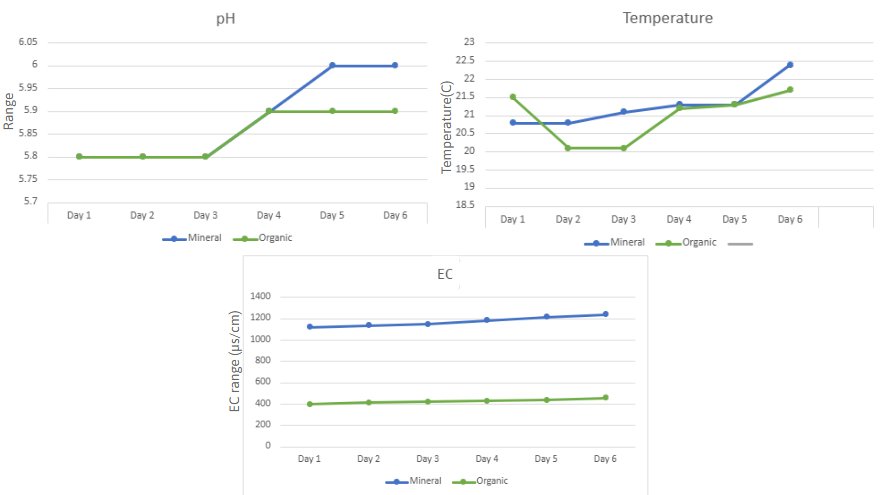
Electrical Conductivity (EC): Electrical conductivity measures how many nutrients in your hydroponic solution are available to your plants. The EC is known for measuring conductivity between minerals. EC is important because it tells us how many nutrients we need for our plants, and if the plants are actually able to feed on the nutrients we provide. For example, pure distilled water would have an EC of zero. If we add minerals, the EC will gradually increase. If the water level in the setup decreases, but the EC increases, this means that the plant is drinking the water but not absorbing the nutrients. If the water level stays the same, but the EC levels are decreasing, then the plant is absorbing the nutrients but not drinking the water. Equal consumption of water and nutrients should be present.
Potential of Hydrogen (pH):
pH is a logarithmic scale, going from 0 to 14, with 0 being very acidic and 14 being very alkaline. pH is important in hydroponics, as it tells us if our plants have an optimal environment to thrive. Plants usually prefer the more acidic side of the scale, from around 5.5-6.5. If the pH is under or lower than this general range, the plants cannot absorb the nutrients in the solution properly, an event known as nutrient lockout. The pH should be measured every day, and should be adjusted accordingly if needed.
Variables
Variables
Controlled
Methods
Different hydroponic methods expose plants to varying amounts of oxygen, with those that provide more oxygen leading to faster plant growth.
Crop
Different plants have different nutrient needs, meaning that if I use different plants in the hydroponic solution, some might thrive while others might grow more slowly.
Light
The colour of the lights influences the growth of the plant, as some colours are more effectively absorbed by chlorophyll, while other colours, like green, are not absorbed (since plants reflect green light).
Manipulated
Variation of homemade hydroponic solution (minerals vs compost steeped solution)
Responding
Height (mm) New leaf count ( at the end)
Procedure
Procedure # 1: DWC setup
- Draw and cut 4 circles equivalent to the size of your net pots. Try to keep the holes at equal distances from each other.
- Cut a Repeat the process for the organic bin
- Label each bin ‘mineral or organic.’
Procedure # 2: Rockwool
- Fill a large bowl with filtered water
- Test the pH
- If it is above 5. 8 (most likely it is), slowly add a few drops of pH down to the bowl (with gloves)
- Test the pH
- Repeat steps 3 and 4 until the pH is no less than 5.5
- Add 8 rockwool cubes to the solution (and extra if you like) and make sure the cubes are fully submerged. Let this soak for 16-24 hours.
- After the rockwool is fully soaked, take some pH-adjusted water and gently pour a tablespoon until the water in the rockwool starts to drip.
- Catch the water that drips and test the pH. If it is 5.5-5.8, you have successfully reduced the alkalinity in the rockwool!
Procedure # 3: Compost Tea Brewing/ Organic solution
- Acquire a bucket bigger than 2 gallons - 3 to 4 gallons is preferred
- Take your first garbage bag and line the inside with it. Secure it with tape (Note: If you have a food-grade bucket, skip this step, along with 3 and 4)
- Take your second bucket, and layer it on top of the first bag
- Secure with tape
- Fill the bucket with 1.5 gallons of water and 3 cups.
- Take a mesh bag/ paint strainer and fill it with 1 and ½ of compost
- Take the second paint strainer and put the first in the second.
- Secure the top with a rubber band and place it in the bucket.
- Add 0.75 tbps of maple syrup directly into the water
- Take one air stone and connect it to the airline tube
- Connect the tube to the pump and turn it on
- Repeat 9 and 10 to have 2 pumps.
- Ensure the air stones are at the bottom of the bucket
- Leave the bucket in a dark place for 20-24 hours
Procedure # 4: Mineral Solution
- Fill a large bowl with 1.5 gallons of filtered water
- Calculate ⅔ of each ingredient in the recipe provided by the masterblend company (almost 50% less strength)
- Use the scale to precisely measure the new calculations
- Dissolve the NPK fertilizer completely
- Dissolve the Epsom salt completely
- Lastly, dissolve the calcium nitrate and mix thoroughly
- Adjust pH to 5.5 to 5.8 using the pH down if needed.
Procedure # 5: Aeration/Plant Setup
- Pull your airline tube through the hole for the tube
- Attach an air stone to the end of the pipe, inside the lid
- Attach the end of the outside of the bucket to the pump
- Start the pump and ensure all the holes are receiving equal bubbles
- Take a toothpick and carefully poke a hole halfway through the rockwool.
- Take your mint cutting and trim them diagonally until they are 4 inches long. Ensure these cuts have the same number of leaves that are around the same size.
- Take your mint cuttings and slowly insert them into the holes.
- Take these cubes and place them in the net pots
- Place the net pots into the holes in the lid
- Fill the bins with the solution
- Start the pump
Procedure # 6: Additional steps
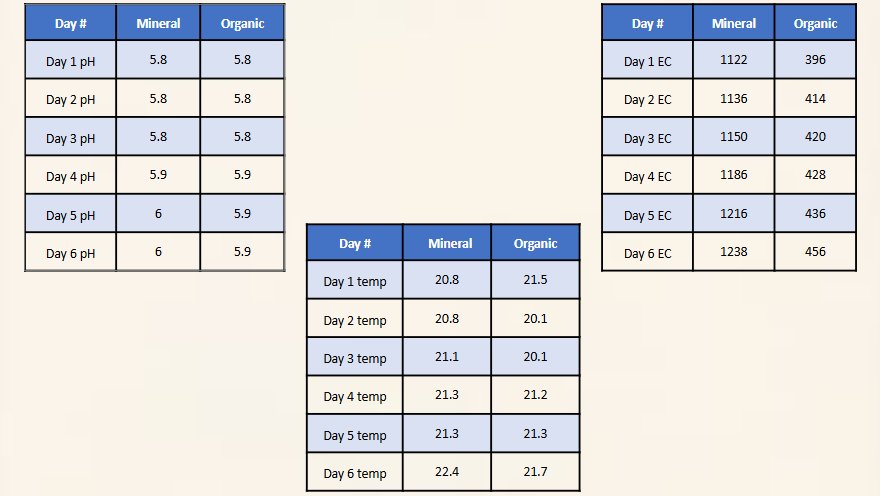
- Check the pH daily and adjust if needed
- Check the EC daily
- Monitor the temperature daily
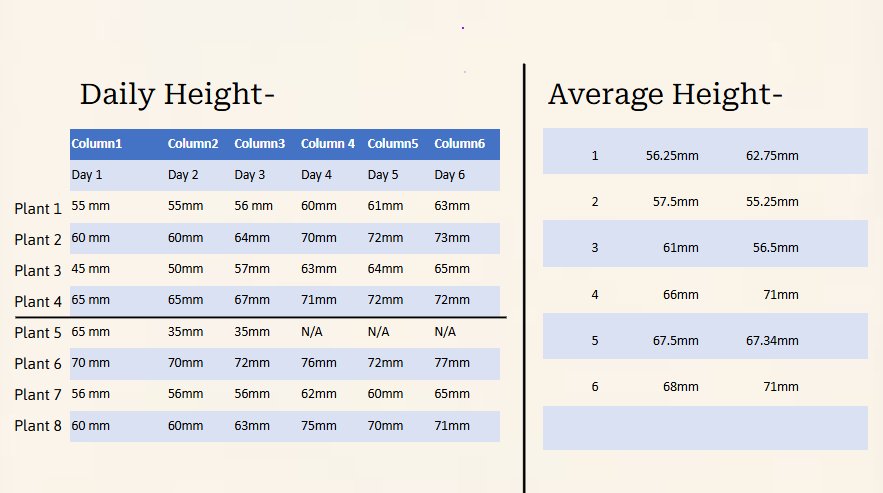
- Measure the height daily
- Record the numbers 1, 2, 3, and 4 daily
Observations
Observations
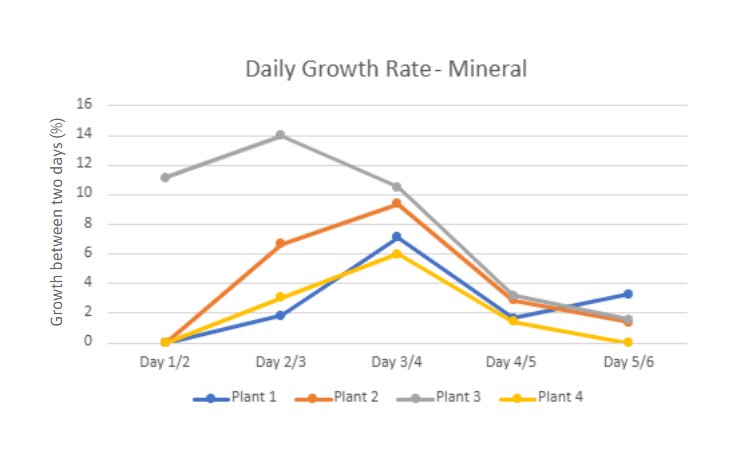
- The plants were directing their energy into increasing their height rather than growing roots or leaves
- The very first night I set up my plants without taking any measurements, I left one light on for 3 hours. When I went to turn it off, the plants seemed to angle themselves to capture the maximum sunlight possible
- For the first few days, the bottoms of the pots did not touch the water. This is known as the gap method. I realized that this method was for cuttings with roots; therefore, I added 3 cups of water to ensure that the net pots were touching the water. After this, the next morning, my mint started growing at an incredible speed.
- The EC of both my solutions were rapidly rising. I realized that this was because my plants did not have roots to absorb the majority of the nutrients, and the light near the plants was causing some water to evaporate.
- Because the nutrients in the Masterblend are more concentrated than the ones in the organic solution, the leaves on one of the plants in the mineral solution started to turn brown due to the salt dehydrating the plants
- Some of the plants got shorter due to the stem cells compressing from the long night with less light
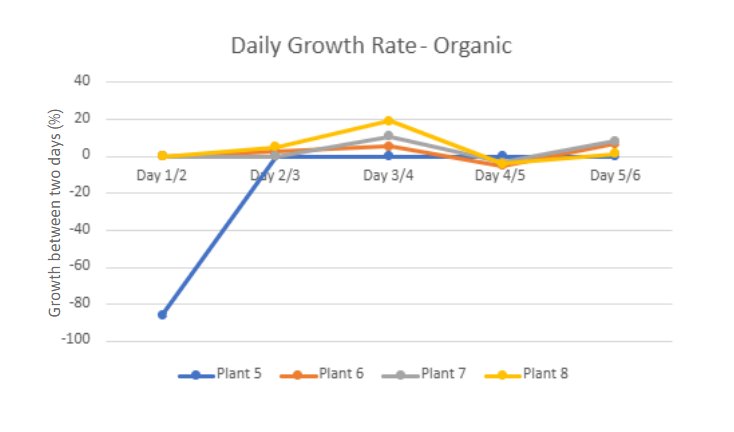
- Plant 5 in the organic bin died quickly due to the stem breaking. The stem broke most likely due to etiolated growth. This caused the stems to crack and cause stem rot.
Analysis
Conclusion
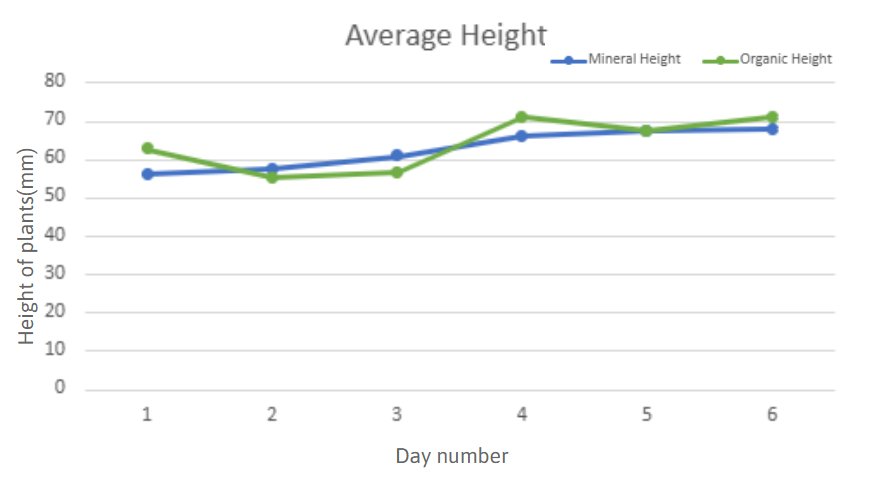
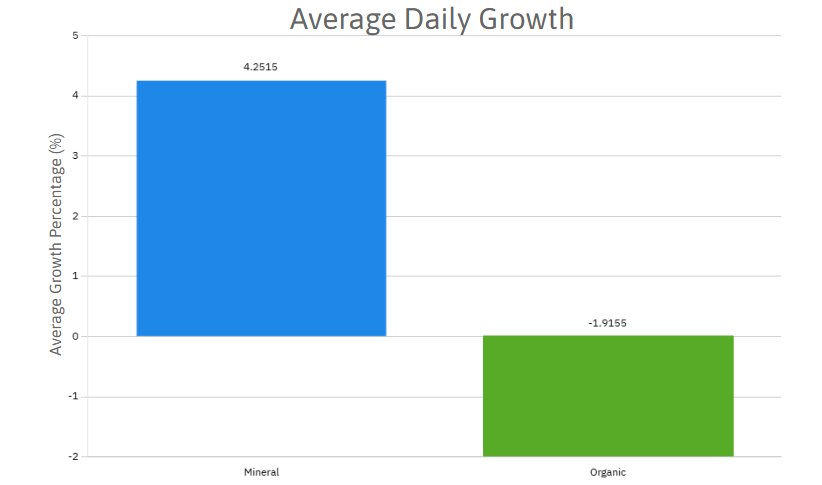
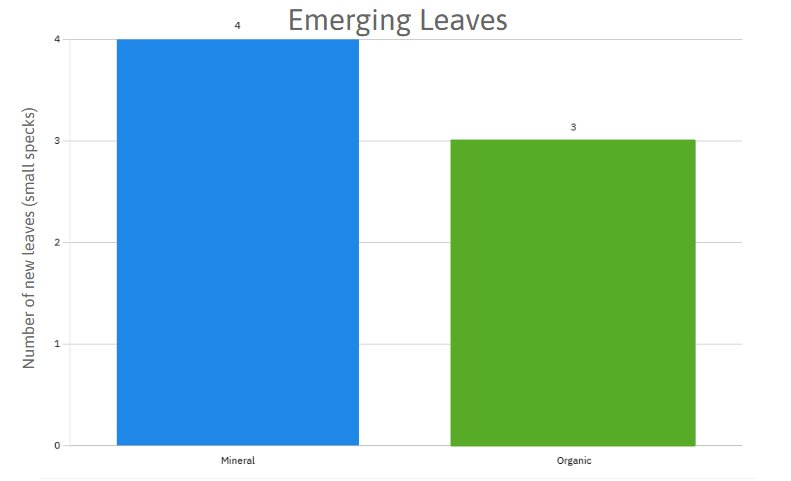
Conclusion In conclusion, my hypothesis was correct. Because of the higher dose and more concentrated nutrients, my plants were able to grow leaves and grow taller in the Masterblend/ mineral-based solution. Although my hypothesis was correct, the mineral solution caused brown leaves, while the organic tea initiated root growth and leaf growth first. But my organic solution caused one of the plants to fail, and the other plants to direct their energy into growing roots, rather than growing taller and producing more leaves.
Application
Application This idea is important because many people grow indoor farms. If gardeners, especially beginners, are looking the most safe and efficient way to grow a sustainable indoor food source, they need to know which solution is the best. If the gardeners want more height and leaves, they should know to choose synthetic nutrients as it is precisely measured to help plants grow. Organic teas can cause many issues such as clogging and bad bacteria, which is the reason many gardeners don’t attempt this method until after they have gained much experience.
Sources Of Error
Sources of Error -The first time I brewed the compost tea, it was clear. This was because I did not use a food-grade bucket, I realized no sunlight could pass, there was not enough maple syrup, and I needed one more pump because of the extra need for oxygen. Also, I did not know that I needed to soak the rockwool. -The first day, my plants started wilting. This was because all my plants were losing more water than they could drink through transpiration through the big leaves. I stripped these and the next morning, they started to straighten out. - I used the gap method\, which led to slow growth\, so I added more water. -I did not realize that a window in the room would affect the plants, so I covered it with cardboard to eliminate unfair light advantages.
Citations
Agriculture and Agri-Food Canada. (2021, June 25). What is hydroponics? agriculture.canada.ca
Behnaz. (2025, February 27). Types of aquaponic systems: Which is right for you? Atlas Aquaponics. www.atlasaquaponics.com
Churchill, S. (2025, August 23). Compost tea brewing like a pro: The ingredients, the recipe, the process. Urban Worm Company. urbanwormcompany.com
DWC - how much air do I need? (2021, April 28). One Stop Grow Shop. www.onestopgrowshop.co.uk
Epic Gardening. (2015, September 28). Nutrient film technique (NFT) hydroponics system tutorial [Video]. YouTube. www.youtube.com
Hydroponics vs. soil: Which will grow plants faster. (n.d.). ScottsMiracle-Gro. scottsmiraclegro.com
Kyriacou, S. (2024, December 4). How to use rockwool in hydroponics: Basics for healthy plants. Hyjo Indoor Garden. hyjo.co.uk
Logicsun. (2025, October 23). Deep water culture (DWC): What it is and how it works. NIDO PRO. www.nidopro.com
Master Plant-Prod Inc. (2024, April 2). pH-scale-vertical [Diagram]. www.plantprod.com
MasterClass. (2021, June 7). How to make compost tea for your all-natural garden. www.masterclass.com
National Geographic. (n.d.). Chlorophyll. education.nationalgeographic.org
Pomelo. (2025a, July 30). Nutrient solution for hydroponics - the ultimate guide. Atlas Scientific. atlas-scientific.com
Pomelo. (2025b, July 30). What is EC in hydroponics? Atlas Scientific. atlas-scientific.com
Pomelo. (2025c, July 30). Why is pH important for hydroponics? Atlas Scientific. atlas-scientific.com
Rezazadeh, A., & Rezazadeh, A. (2025, April 17). Kratky hydroponic method: A simple way to grow plants without soil. UF/IFAS Extension St. Lucie County. blogs.ifas.ufl.edu Rowe, K. (2024, September 30). Spraying maple syrup on garden plants: Useful hack or harmful? Epic Gardening. www.epicgardening.com
Safe compost tea: Storage and handling guide. (n.d.). Thrivelot. www.thrivelot.com
Walmart. (n.d.). Rockwool cubes garden rock wool stonewool grow starter plugs [Photograph]. www.walmart.ca
Which is the best hydroponics system for me? (2023, June 14). One Stop Grow Shop. www.onestopgrowshop.co.uk
Acknowledgement
I want to thank my parents for their ongoing support, suggestions, and helpful feedback throughout this experiment. I also want to thank my teachers for their guidance and valuable feedback on both my research and the final presentation of my work.