
Prevention of Soil Erosion on Riverbanks
Yuto Tsuneda
R. T. Alderman School
Grade 9
Presentation
Hypothesis
If five methods, sandbagging, riprap, willow spilling, and vegetation establishment are tested on a small scale riverbank, then the sandbagging method will be the most effective, as it prevents both abrasion and mass failure.
The prediction is that of the five methods, sandbagging will be the most effective, willow spillings would be second, and riprap and vegetation will be similar, but last. But, due to last year’s experiment, it is predicted that all of the methods will drastically decrease the amount of eroded soil compared to the control.
Research
Introduction Soil erosion occurs everywhere, but it is particularly relevant near a water source. Meandering and such can change the size and direction of a river over time. This experiment tests what method of preventing the erosion of riverbanks is the most important. In last year’s experiment, it was concluded that geotextiles and terracing are the most effective on a hill. But, neither of those methods can be used on a river, so this experiment will test out completely new methods. Those methods are: sandbagging, riprap, willow spilling, and vegetation establishment.
Sandbags Sandbags are used in many ways, including stopping/diverting water and stabilizing. It can prevent water and wind from passing through and is very heavy, making it a good barrier. It is actually not the sand that prevents the water from passing through in a sandbag, it is the clay and silt that is getting eroded in the water. As soil is eroded, silt and clay get washed away, and when that goes inside of the sandbag, it gets caught inside of the sand. And , as that silt and clay fills up the space between the sand, it gets less porous. That will let less of the debris through, making the sandbag less and less porous. Then, less and less water will be able to pass, making it ”water proof”. That way , it can act as a barrier against water, therefore protecting riverbanks. It can also stop the riverbank from crumbling all together, as it will add weight to the soil under it. Overall, sandbags work more efficiently where a lot of soil is already eroded, as it uses those eroded materials to prevent water from passing through.
Riprap
Riprap is basically a slope of boulders along riverbanks that pack down the soil and slow down the velocity of the river. It is usually made of lime stone, granite, or cement, in some cases. Granite and limestone can make the water less acidic, helping wildlife thrive. In Calgary, in most places granite is used for riprap, but cement was used when the flood occurred and there wasn’t granite on hand. Granite is also very heavy, so it will not be carried away by the current. One con about riprap is that the boulders used have to be carried all the way from the Rockies, where it is produced.
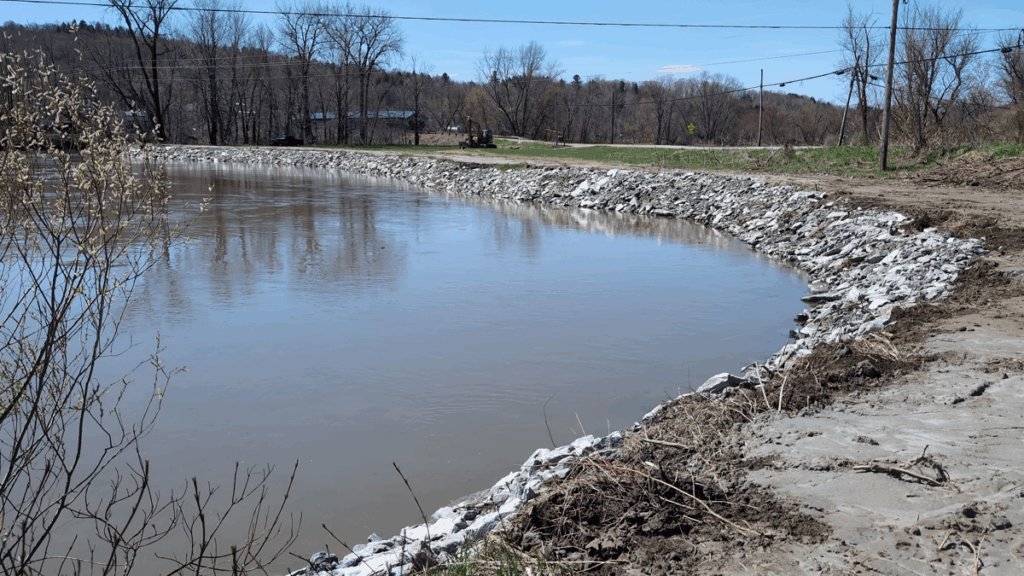 (image from vermont river conservancy)
Willow spilling
This is a natural method where willow rods are stuck into the riverbank, and smaller branches are woven in between. Then, roots grow out from the branches and make it even more stable. This is sort of like a hybrid of sandbagging and vegetation establishment, acting as a barrier and holding the soil in. Since this method only uses natural resources, it gives a positive impact on the environment. But, since this method uses large amounts of willow, it is impractical to use on a large scale. This method is also used in some parts of the bow river.
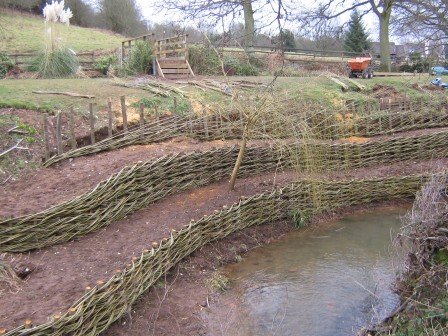 (image from coppice products)
Vegetation establishment In areas where ground near a riverbank is bare, there are no plants to keep the soil down, and it is very unstable. Large chunks of the ground can fall off in these areas, making the river bigger and faster. This exact thing happened in Yellowstone during the 1950s, when the deer population exploded, killing off a large number of plants. By replanting vegetation, riverbanks can be reinforced, preventing erosion in those areas. It can also prevent the meandering of a river, providing more space for wildlife to thrive.
How riverbanks get eroded There are three main parts to a river getting eroded; fluvial scour, mass failure, and abrasion. First, fluvial scour is where river banks, or any moving body of water, slowly get weathered down by the water. At the beginning, small rivulets of water slowly seep into the ground, and through the process of melting and freezing, they make cracks into the ground. That way, more water can go into the crack, making it wider. Eventually, it causes the river to expand, and erode. Next, mass failure is where large amounts of sediment break off or slide off the riverbank. This is mainly caused by fluvial scour cutting off the sediment beneath the sediment, and rain or wind softening the soil, causing it to collapse. However, this method takes a long time, as the piece of sediment has to become soft enough to break off. Finally, abrasion is where soil carried by the river current grinds down the sides of the river, bringing down more soil particles into the current. Because of that, more soil is eroded downstream. This also makes the river meander, causing loss of land with time. Although this mechanism does not erode the river bank as much as the other two, it causes mass failure downstream.
Variables
Manipulated variable: the method of preventing soil erosion Responding variable: the mass of soil eroded(g) Constant variable:
- The amount of water
- The amount of soil
- The speed of the water
- The density/type of soil
- Temperature
- Angle of slope
Control variable: just the soil
Procedure
1. Set up the vegetation establishment method on 1 sheet prior to experiment 2. On all methods\, add soil in the sheet so there is still about 3 cm from the top. Create a river that is 6-8 cm in width. Pack down\, and slightly wet the soil 3. Set up the method\, and place the board so that it is angled 15 degrees\, place a container at the bottom to collect the soil and water eroded
- Sandbagging: create a sand bag that is the length of the sheet, and about 5 by 2 cm, and stack 2 on either side of the river
- Riprap: set the gravels 5 cm in height and 2 cm in width on either side
- Willow spillings: place bigger pieces of wood vertically, but parallel to the riverbank, with 5 on each side. Then, weave smaller, but longer pieces of wood between the vertical ones so there is minimal space between them. Pour in 500 ml of water in the course of 10 seconds, and filter out the soil with a coffee filter 4. Measure the weight of the soil in grams 5. Reset the method 6. Repeat steps 4 to 6 5 times 7. Repeat steps 3 to 6 with all methods
Observations
- qualitative
- For the control, there was less soil eroded at the middle of the river
- For the control, there was more abrasion occurring at the beginning, and a bit of mass failure at the end.
- For the vegetation establishment, there was a bit of abrasion, but no mass failures.
- For the riprap, the gravel slowed down the flow of the river, decreasing the abrasion
- For sandbagging, there was some water going through the sandbags, but the soil seemed to have been filtered out.
- For the willow spillings, there was not a lot of abrasion, but as the soil became more wet, mass failure started to occur.
| quantitative | control | Veg. establishment | riprap | sandbagging | Willow spilling |
|---|---|---|---|---|---|
| 1. | 15g | 5g | 3g | 5g | 7g |
| 2. | 14g | 4g | 6g | 6g | 8g |
| 3. | 17g | 7g | 4g | 2g | 5g |
| 4. | 12g | 7g | 6g | 4g | 7g |
| 5. | 15g | 8g | 4g | 4g | 10g |
Averages: control 14.6g, veg. Establishment 6.2g, riprap 4.6g, sandbagging 4.2g, Willow spilling 7.4g Mode: control 15g, veg. Establishment, 7g, riprap 6/4g, sandbagging 4g, willow spilling 7g
Analysis
Comparison to real life First, because in the control group there was more abrasion upstream and mass failures downstream, it could be said that the experiment replicated the erosion of a riverbank on a real river. So, the results of this experiment are most likely similar to what would happen in a real river. comparison and results Results Next, the results of this experiment show that the sandbagging was the most effective, the riprap was second, vegetation establishment was third, and the willow spillings was the least effective against riverbank erosion. Since the averages and the modes were similar for each method, it can be said that there are almost no outliers. Another thing is, since the difference of the averages between the sandbagging and riprap methods was less than 0.5 grams, it could be said that both methods are equally efficient. This can also be said with the mode. There was a difference of about 2 grams between the sandbagging/riprap method and the vegetation establishment method, while it was only about 1 gram between vegetation establishment and willow spillings. That shows that there is a “drastic” difference between riprap/sandbagging and the other 2 methods. Comparison against the control variable Third, although there is a big difference between the methods, it could be said that all methods decrease the erosion of a river. For the willow spillings, it decreases it by about 50%, and for the sandbagging method, it decreases the amount of soil erosion by about 70%. So, in a place where 500 grams of soil is eroded per meter in a year, 350 grams of it can be prevented if either sandbagging or riprap is used. Another thing to consider is using multiple methods at once. For example, if the 2 most effective methods are used together, theoretically 91% of soil erosion can be prevented. This is because the first method will prevent 70% of the soil from getting eroded, and the second method will prevent 70% of the soil that still escapes. Conclusion Overall, although all of the methods were effective against preventing soil erosion, the sandbagging method and the riprap methods are the most effective. But, all of the methods still prevent riverbank erosion by about half. This result can be used in future attempts to prevent riverbank erosion. Especially when aiming for a quick result, riprap or sandbagging should be used over vegetation establishment or willow spilling.
Conclusion
The hypothesis of this experiment was correct, as sandbagging was the most effective method along with riprap. But, the predictions were partially incorrect, with the willow spilling method being the least effective of all methods. Overall, this experiment is accurate, as the same thing that would happen in a real river occurred with the control group. It was also concluded that all of the methods are effective at preventing soil erosion, as even the least effective method, willow spillings, prevented half of the soil from eroding. Overall the experiment was fairly accurate, and it could be said that sandbagging and riprap is the most effective at preventing erosion on riverbanks. Next steps could be to test other methods of preventing riverbank erosion on different landforms and circumstances. Merging multiple methods could also be tested.
Application
There are many consequences of river bank erosion, but one example is the loss of land. As a river meanders and mass failure occurs, land area decreases, while the river becomes larger. Another impact is flooding. As a river increases its size, the volume of water flowing through increases, making the area around it more prone to floods. This can damage the land and properties. One final consequence of river bank erosion is that it can kill off many species of fish and other marine life. As the amount of soil particles carried off by abrasion increases, it makes the water unclean. Many species of fish , such as bio-indicators can only thrive in clear water. So, as a river gets more eroded, it makes it harder for those animals to thrive there.
If each method were to be used in one part of a river, then riprap and sandbagging should be only used as a temporary measure, or in an area where the water flow is slow. This is because while these two were the most effective methods, they easily get worn down, so they will lose their effectiveness over time. compared to that, vegetation establishment and willow spillings are both plant-based, so they have the chance to regrow before the method stops working. Another thing is that sandbagging should be used more in an industrial area, while vegetation establishment should be used in places where wildlife is abundant. This is because in a industrial area, vegetation establishment would be in the way of workers.
Sources Of Error
There were some weaknesses to this experiment, though. The first thing was that it was not tested in an actual river. and it wasn’t life size. In a real river different factors would have affected the experiments. Some of them include the current, wind and sunlight, animals/humans, and time. If, for example, the riverbank becomes more or less hard over time, the methods may have been more or less efficient. Another flaw was that the riverbed was not realistic. Instead of it being mud or rock, the riverbed in this experiment was styrofoam. The water flow would have been different if rocks were used, and some of the methods could have increased the amount of erosion on the riverbed. One final source of error was that the measuring of the soil and water could have been slightly off.
Citations
Ayres Associates. (n.d.). What is riprap and why it rocks. https://www.ayresassociates.com/what-is-riprap-and-why-it-rocks/ Calgary. (n.d.). Riverbank stabilization. City of Calgary. https://www.calgary.ca/water/stormwater/riverbank-stabilization.html Coppice Products. (n.d.). Willow spilling. Coppice Products. https://www.coppice-products.co.uk/product-type/willow-spilling/ Geosyntec Consultants. (n.d.). Riprap. Mega Manual. https://megamanual.geosyntec.com/npsmanual/riprap.aspx HowStuffWorks. (n.d.). How sandbags work. https://science.howstuffworks.com/nature/natural-disasters/sandbag.htm JPS Civil & Environmental. (n.d.). Erosion control. https://www.jps.ca/erosion-control Kazuend. (2015, July 21). Rushing stream [Photograph]. Unsplash. https://unsplash.com/photos/body-river-surrounded-by-dress-cCthPLHmrzI Palmetto Industries. (n.d.). What are sandbags used for? https://www.palmetto-industries.com/what-are-sandbags-used-for/ River Restoration Centre. (n.d.). Erosion protection & bridge scour studies. http://www.riverrestoration.com/portfolio/erosion-protection-bridge-scour-studies/ TrapBag. (n.d.). Natural materials for riverbank protection. https://trapbag.com/blog/natural-materials-for-riverbank-protection/ United Nations Office for Disaster Risk Reduction. (n.d.). Terminology: Hazard, exposure, vulnerability and risk. https://www.undrr.org/understanding-disaster-risk/terminology/hips/gh0404 Vermont River Conservancy. (2025, June 18). What is riprap? Vermont River Conservancy. https://vermontriverconservancy.org/news/what-is-riprap Water of Leith Conservation Trust. (2022). Willow spilling: A traditional natural solution to riverbank erosion. https://www.waterofleith.org.uk/blog/2022/03/willow-spilling-a-traditional-natural-solution-to-riverbank-erosion-in-the-heart-of-edinburgh/ Yorkshire Willow. (n.d.). Willow spiling: Riverbank stabilisation. https://www.yorkshirewillow.co.uk/willow-spiling-riverbank-stabilisation
Acknowledgement
Thank you for Mr.B, for helping and advising me on science fair. I also thank my parents for supplying me with all of the materials, as well as a place to do the experiment.I also thank mu dad for helping e on the video.