
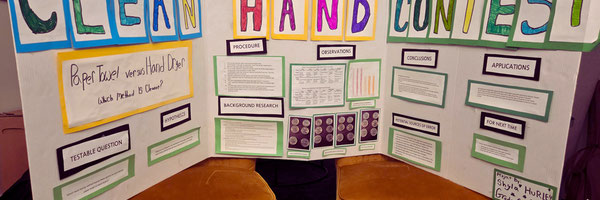
Clean Hands Contest
Shyla Hurley
Olympic Heights School
Grade 6
Presentation
Hypothesis
My hypothesis is that this experiment will show that hand dryers spread the most bacteria on your hands when compared to drying your hands with paper towels.
Research
DevonScience TikTok account – hand dryer test - This account is what gave me the idea for this project. She tests bacteria left by hand dryers and paper towels\, and the air in bathrooms.
MythBusters tv show episode - Down and dirty/Earthquake survival (Episode 199) - The show hosts (Jamie and Adam) built a bathroom to test if hand dryers or paper towels leave more germs on their hands - They sprayed E.coli on volunteer’s hands, swabbed their hands before and after washing, used either a hand dryer or paper towel to dry their hands, and swabbed again - They found 7 times more bacteria on the hands of volunteers who used the hand dryers - Hand dryers reduced bacteria on hands by 23% - Hand towels reduced bacteria on hands by 71%
The bacterial horror of the hot-air hand dryer (Harvard Health Publishing blog post) by John Ross - Scientists put petri dishes in bathrooms, and exposed them to hand dryer air for 30 seconds. Those petri dishes grew up to 254 bacteria colonies (but most grew 18 to 60 colonies of bacteria). - They tested the dryers and found that most of the germs came from the bathroom air.
AsapSCIENCE YouTube Series - Paper towels vs. hand dryers: Which is more hygienic? - More than 80% of infectious disease is spread by hands. - You should shake off your hands 12 times to get the extra water off, and then dry them with 1 paper towel to reduce waste. - If you wash your hands with soap it kills nearly all the bacteria. - How you dry your hands matters more when you don’t wash them with soap or wash them incorrectly. - Bacteria spreads more with wet skin. - Many scientific studies have found that paper towels leave less bacteria on your hands than hand dryers do. That’s because hand dryers take 45 seconds to get your hands 97% dry versus paper towel that takes 10 seconds to get to 96% dry. But most people only use the dryer for 22 seconds. - Some hand dryer may have germs in the air they blow on your hands - Some hand dryers are better than others
Variables
Independent variable: Hand drying method - hand dryers versus paper towels Dependant variables: Bacteria on hands Controlled variables:
- Same bathroom
- Same hand dryer
- Same paper towel
- Same sink
- Same soap
- Same agar plates
- Same swabs
- Same distilled water
- Agar plates incubated in same place
Procedure
- Find a public bathroom with a hand dryer and paper towel.
- Find 6 people to help with my experiment. Have them all sign consent forms.
- Buy pre-made agar plates and sterile swabs.
- Go to a public washroom. Swab all 6 people’s hands with sterile swabs dipped in distilled water. Wipe the swabs on 6 agar plates.
- All participants wash their hands with soap and scrub for 20 seconds. Then they rinse their hands for 20 seconds
- The first 3 participants dry their hands under a hand dryer for 10 seconds.
- Then I swab their hands for 10 seconds and wipe each swab on a separate agar plate.
- The next 3 participants dry their hands with paper towel for 10 seconds.
- Then I swab their hands for 10 seconds and wipe each swab on a separate agar plate.
- Put all the agar plates in the boxes they came in. Leave at room temperature for 4 to 6 days (those are the instructions that came with the agar plates).
- Examine the agar plates on days 3, 4, and 5 to see if there are bacteria colonies growing on them.
Observations
- The three paper towel agar plates had the most bacteria colonies.
- The three paper towel agar plates has at least double the amount of bacteria colonies compared to the hand dryer agar plates.
- The difference between the hand dryer and paper towel agar plates were very easy to see with just my eyes.
- For the hand dryer samples, the dirty hand samples grew more bacteria colonies.
- For the paper towel samples, only one person's dirty hands grew more bacteria colonies.
- My results did not confirm my hypothesis that hand dryers would put more bacteria on your hands than paper towels.
Analysis
- The three participants who dried their hands with paper towels had agar plates with high bacteria colony counts. - The three participants who dried their hands with hand dryers had agar plates with medium bacteria colony counts.
Bacteria Colony Observations - Before Subject’s Washed Their Hands
| Piper (dryer) | Shyla (dryer) | Klera (dryer) | Dylan (paper towel) | Kerri (paper towel) | Stephanie (paper towel) | |
|---|---|---|---|---|---|---|
| Colour | White, yellow | White, yellow | White, yellow | White, yellow | White, yellow | White, yellow, pink |
| Shape | Circular, irregular | Circular, irregular | Circular, irregular | Circular, irregular | Circular, irregular | Circular, irregular |
| Elevation | Flat, a few raised | Flat, a few raised | Flat | Flat | Flat | Flat, a few raised |
| Colony count | More than 100 | More than 100 | More than 100 | Way more than 100 | 52 | More than 100 |
| Size | 3 larger circles (1.0 cm),mostly pinpoints | Small circles, mostly pinpoints | Big circles (0.8 cm), tiny pinpoints | Mostly tiny pinpoints, and a few very small pinpoints | Tiny pinpoints, large colonies (1.2 cms) | Big circles (0.7 cm), tiny pinpoints |
Bacteria Colony Observations - After Subject’s Dried Their Hands
| Hand dryer | Paper tower | |
|---|---|---|
| Piper (dryer) | Shyla (dryer) | |
| Colour | Pink, white, yellow | Pink, white, yellow |
| Shape | Circular, irregular | Circular |
| Elevation | Flat | Flat |
| Colony count | Only pinpoints | More than 100 |
| Size | More than 30 | 1 medium colony (0.3 cm), mostly pinpoints |
Conclusion
My hypothesis was incorrect.
I thought that paper towels would be the hand drying method that would leave fewer germs on your hands. The results of my experiment showed that paper towels left the most bacteria on the hands of my participants.
I think a few factors could explain why my experiment didn’t prove my hypothesis: - We used the hand dryer first\, and paper towels second. I think we should have used paper towels first because hand dryers can blow around bacteria that’s in the bathroom air. - Maybe the hand dryer was new or really clean\, so it wasn’t blowing that much bacteria onto hands. - I only had 6 volunteers for my experiment. Maybe the results would have been different if I used more volunteers.
Application
My experiment showed that people leave the bathroom with bacteria on their hands, no matter how they dried them. People should make sure they wash their hands really well to prevent the spread of bacteria.
My background research showed that dirty hand dryers spread bacteria onto people's hands. When people clean public bathrooms, they should make sure they clean the hand dryers so they spread less bacteria. Janitors should also make sure they clean the paper towel dispensers to keep them clean.
Hand sanitizer should be in bathrooms, so that people have another way to kill germs on their hands.
Sources Of Error
- We used the hand dryers first. That could have spread bacteria around the bathroom, and contaminated the air. Next time, I would use the paper towel first and then the hand dryer.
- We did out experiment in a small bathroom. My experiment could have had different results if we had done it in a larger bathroom.
- We had everyone dry their hands for 20 seconds for both drying methods. If we dried the hands for 30 seconds, maybe the results would have been different.
- We kept the agar plates in my house to incubate them. I think that the temperature could have fluctuated, and it may have changed the results.
- We used the soap that was in the public bathroom. Maybe the soap was watered down. Next time, I would bring my own soap to do this experiement.
Citations
AsapSCIENCE. (2014, September 18). Paper towels vs. hand dryers: Which is more hygienic? [Video]. YouTube. https://www.youtube.com/watch?v=2g4fWaegoDk Basic Science Series. (2024, March 27). Bacterial colony classification | Microbiology | Basic Science Series [Video]. YouTube. https://www.youtube.com/watch?v=enmYUyDJmcc Beyond Productions. (2013, May 15). Down and dirty/Earthquake survival (Episode 199) [TV series episode]. In MythBusters. Discovery Channel. DevonScience [@devonscience]. (2025, October 13). [TikTok video] [Video]. TikTok. https://www.tiktok.com/@devonscience/video/7564394263555919126 PBS KIDS. (2020, March 15). Journey of a germ | Sid the Science Kid [Video]. YouTube. https://www.youtube.com/watch?v=mI_Tl9A_vM0 Ross, J. (2018, May 11). The bacterial horror of the hot-air hand dryer [Blog post]. Harvard Health Publishing. https://www.health.harvard.edu/blog/the-bacterial-horror-of-the-hot-air-hand-dryer-2018051113823
Acknowledgement
Thank you to my mother & Ms. Song, also Mrs. McNeil for helping me with my project & a big thanks to my mother for buying all the supplies I needed. One last big thanks is to my participants for being a part of my experiment. Thank you Pipper, Klera, Dylan, Steph ( my mother), and Kerri.