

Temperature Effects on Golden Eagle Migration
Ava Fox, Brooklyn More
Banded Peak School
Grade 7
Presentation
No video provided
Problem
We know that Golden Eagles migrate to southern latitudes in the winter, and during the summer they nest in northern latitudes. Golden Eagles don’t migrate because of temperature, but because their food migrates. They will follow their food sources such as small to medium sized mammals and reptiles. Another large impact on their migration is wind and sun patterns. Golden eagles mainly migrate in conditions that consist of wind, sun, and elevation. They use these conditions to draft upwards on thermal updrafts and orographic lift. Climate change is altering the patterns of wind and precipitation which will theoretically adjust golden eagle migration timing and numbers. Considering that prey, wind, and updraft patterns can be related to temperature, we wanted to determine if temperature change can be a predictor of Golden Eagle migration patterns and numbers.
Method
In order to analyze any trends between temperature change and impacts on Golden Eagle migration numbers and patterns, we first had to obtain temperature and migration count data. We contacted the Rocky Mountain Eagle Research Foundation in Kananaskis, AB. We coordinated a time to go to their count site at Mount Lorette Ponds and meet with one of their volunteers. At that meeting, we discussed our project with them and they were able to provide us with daily migration count data for the spring and fall from 2010 - 2025 and temperature data from a local weather station for the same time period.
We attempted to get matching data count sets from the Yukon and Utah. However, we were not able to get complete data sets from these locations, so we only analyzed the Kananaskis count and temperature data.
We partnered with an energy scientist from The Peregrine Fund who assisted us with our data analysis and interpretation. Data was analyzed in Microsoft Excel. Next, Means and Standard Deviations were calculated. We then generated graphs to help us interpret the trends we saw between the data sets.
Research
Temperature Effects on Golden Eagle Migration
Background Research
1. Basic Information
Scientific Name: Aquila chrysaetos This evidence is relevant because I don’t know anything about golden eagles and we need to understand the basics of Golden eagles in order to determine how golden eagles are impacted by temperature.
Wingspan six to seven feet; length 30 to 40 inches. Dark brown with a golden or light brown nape and dark eyes and beak. Legs are feathered to the toes. Immature golden eagles have a patch of white on the tail; the adult tail is gray and brown.
I am including this information because we needed some basic info for a subtopic in our slideshow and this fits perfectly in identifying its migration behavior, maybe based on its appearance and characteristics.
Golden Eagles prey mainly on small to medium-sized mammals, including hares, rabbits, ground squirrels, prairie dogs, and marmots. Black-tailed jackrabbits are a key prey species throughout much of their range. These eagles are also capable of taking larger bird and mammal prey, including cranes, swans, deer, and domestic livestock. They have even been observed killing seals, mountain goats, bighorn sheep, pronghorn, coyotes, badgers, and bobcats. In addition to live prey, Golden Eagles often feed on carrion, following crows and other scavengers to a meal. They also catch fish, rob nests, and steal food from other birds.
This evidence is relevant because I don’t know anything about golden eagles and we need to understand the basics of Golden eagles in order to determine how golden eagles are impacted by temperature.
Golden Eagles live in open and semi open country featuring native vegetation across most of the Northern Hemisphere. They avoid developed areas and uninterrupted stretches of forest. They are found primarily in mountains up to 12,000 feet, canyonlands, rimrock terrain, and riverside cliffs and bluffs. Golden Eagles nest on cliffs and steep escarpments in grassland, chaparral, shrubland, forest, and other vegetated areas.
This evidence is relevant because I don’t know anything about golden eagles and we need to understand the basics of Golden eagles in order to determine how golden eagles are impacted by temperature.
2. Migration Routes / Patterns
The golden eagle has never been common in the eastern United States. Fewer than 30 historical breeding territories are documented in the Northeast, primarily in New York, New Hampshire, and Maine [26].
This is important for our research because we need to know if Golden eagles often migrate in the east of the US and this tells us parts of their migration routes, but most importantly their patterns that they often take.
The golden eagle winters from south-central Alaska and the southern portions of the Canadian provinces south throughout the breeding range to Mexico, rarely to coastal South Carolina [8,9]
This shows the Golden Eagles migration patterns, and what it usually does or where it doesn't go. This also shows the routes that they normally would take.
Populations inhabiting boreal and arctic regions are obligate migrants (all age classes migrate long distances), whereas many/most individuals in more southerly temperate regions do not migrate.
This is important to our science fair project because it shows their migration patterns or their behaviors when it comes to migrating.
Marmots may be optimal sized prey for golden eagles and can be an abundant and stable food source. However, their distribution is limited by the availability of suitable rocky habitat and they only occur at high frequencies in the diets of golden eagles in particular areas, such as at high elevations.
Context on their energy source is significant to figuring out Golden Eagles migration patterns and their overall behaviors.
3. Migration Corridors
“Migration corridors are the paths that animals use to travel between summer and winter habitats. The knowledge of these areas is often passed down from generation to generation of wildlife species, so the same corridors are consistently used year after year. Migration corridors are not only important movement pathways, but also provide critical seasonal resources when animals stop over for short periods within corridors.”
This is important because it explains the migration corridors for animals. I couldn’t find just golden eagles, but I think that this can give us a pretty good idea of what we are looking for. This shows SLC.
4. Food Migration
Golden eagles prey primarily on mammals such as rabbits and hares as well as larger rodents. Up to 20 percent of their diet consists of birds and reptiles. Golden eagles feed mostly on food which they catch, although they will eat carrion.
This shows the food for the Golden Eagles migration patterns and how their food may migrate and how that will affect their migrations. The RMERF said that their migration moved based on their food and not about the climate.
Golden Eagles eat small mammals such as jackrabbits, mice, and prairie dogs; they may also eat reptiles, birds, fish, and even large insects. They are capable of killing larger birds and mammals, including deer and domestic livestock, bighorn sheep, bobcats, seals, etc.
I am including this because, now I can research where their food is migrating and that will show their migration patterns.
Yes, Golden Eagles will sometimes eat carrion. They will even follow crows or other scavengers to carrion, which they will then take for themselves.
This shows what kind of a hunter golden eagles are and can help us understand their food better and how they are migrating.
Marmots hibernate and are unavailable as prey during most or all of the golden eagle's nonbreeding season, depending on the region and elevation.
I included this because it shows what their food source is and how it is affected by when their food source hibernates. This could also show where the Golden eagles are going to get their food in particular areas.
Although they favor small prey, eagles are powerful predators that sometimes catch prey larger than themselves including bighorn sheep, mountain goats, deer, pronghorn, caribou, seals, coyotes, badgers, and bobcats. Large avian prey include Wild Turkeys, swans, cranes, Great Blue Herons, and Ospreys. The species regularly feeds on carrion, especially in winter. Although Golden Eagles rarely prey on domestic animals, they often are viewed as a threat to livestock.
This evidence will help me identify where these listed animals migrate and if Golden Eagles actually care about that and how it affects their own migration.
Golden Eagles are regarded as predators and scavengers on reindeer calves and calving remains, and herders receive partial compensation for eagle predation on reindeer in Sweden. There is an ongoing dispute about whether this compensation is sufficient, on the total amount of calves lost to eagle predation, and on the proportion of the golden eagle population that visits the calving areas.
This website talks about how Golden Eagles migrate spring distances that match the timing and location of reindeer migrations to calving areas. It also says that, “The concept of migratory coupling suggests predators can shift their seasonal movement behaviour based on prey migration. "
Further, the timing of eagle migrations synchronized closely with the reindeer migration in spring.
This also shows that Golden eagles migration correlated with the reindeer migration. This is not all the website says that is helpful.
5. Are Golden Eagles Changing Where They Migrate and If So Why?
Migration varies with population and cohort and is a function of both food supply and climate.
I am including this because it shows the different factors that are affecting the migration of the Golden Eagles like food supply, and climate.
They were already studying the species when the war started, with the dangers faced by migratory birds usually related to disruptive weather or drought, changes in land use affecting traditional stopping-off points, or destruction of essential habitats.
I am including this evidence because it shows that Golden Eagles can change where they are migrating. When the conditions of the war with Ukraine and Russia began, the Golden Eagles changed where they were going because of it.
Golden eagles exhibit a broad range of seasonal movement behaviors, influenced by geographic origin, age, breeding status, and annual variation in prey resources.
This also conveys if golden eagles are changing where they migrate based on certain factors. Most Golden Eagles are impacted by climate change significantly, like many other birds.
6. Where They Are Coming From and Where They Are Going
The golden eagle is found in North America, Eurasia, and northern Africa. During the winter, they can be found in southern Alaska and Canada, the western United States and Mexico.
I am including this evidence about range because it tells us where they are coming from and where they are going.
Departure from northern breeding areas coincides with the first lasting snowfall, freeze-up, north winds, or decreasing prey abundance. Golden Eagles migrate during the day.
This also shows their migration patterns that they tend to go off of.
7. Other Factors That Impact Their Migration
Numerous weather factors produce different daily combinations to which migrating eagles respond opportunistically.
This evidence shows that different weather factors can also impact their migration timing. It is important for us to know this because if there are some days with no eagles spotted, it is probably due to other factors besides temperature such as precipitation, air pressure, or air quality.
During migration, the number of raptors moving on a given day may be influenced by barometric pressure (Kerlinger 1989), thermal updrafts (Gerrard and Gerrard 1982), wind speed and direction.
These are more factors that may impact our data, and our results.
Barometric Pressure
Barometric pressure also changes with the weather—or rather, the weather changes with changes in barometric pressure. Being able to measure and analyze small changes in atmospheric pressure helps meteorologists track the weather and predict storms.
Barometric pressure changes can impact golden eagle migration patterns and timing because if the weather is changing rapidly, then it will impact when eagles migrate and how many are migrating. For example, if it is really rainy one spring, the eagles will probably change when and where they migrate to help them avoid the rain.
Average barometric pressure at sea-level is commonly cited as 14.7 pounds per square inch (PSI). However, this figure is just an average. In reality, barometric pressure varies across the world, especially at higher elevations where atmospheric pressure is much lower than at sea level. In fact, there are 50% fewer air molecules at 18,000 ft. than there are at sea level.
This evidence tells us that golden eagles most likely fly at a certain elevation, with a certain air pressure, meaning the temperature may be slightly different from the data we have. PSI may also be another factor of migration timing, patterns, and numbers that we can look into for our project.
Thermal Updrafts and Orographic Lift
Heavy-bodied species, such as golden eagles (Aquila chrysaetos), rely upon soaring flight to conserve energy during migration
Golden eagles rely on air currents to conserve energy while migrating. They use thermal updrafts and orographic lift.
some topography features of ridgelines generate vertically-deflected air (orographic lift) that provide sources of lift to soaring birds
Orographic lift comes from drafts of air traveling up the side of mountains, creating rising air currents for eagles to gain elevation without using as much energy.
Strong winds reduce the availability and creation of thermals, forcing birds to rely upon orographic lift.
Golden eagles have to rely on both thermal updrafts and orographic lift because when there are strong wind speeds they reduce the number of thermal updrafts, and increase the number of orographic lift areas.
Data
Conclusion
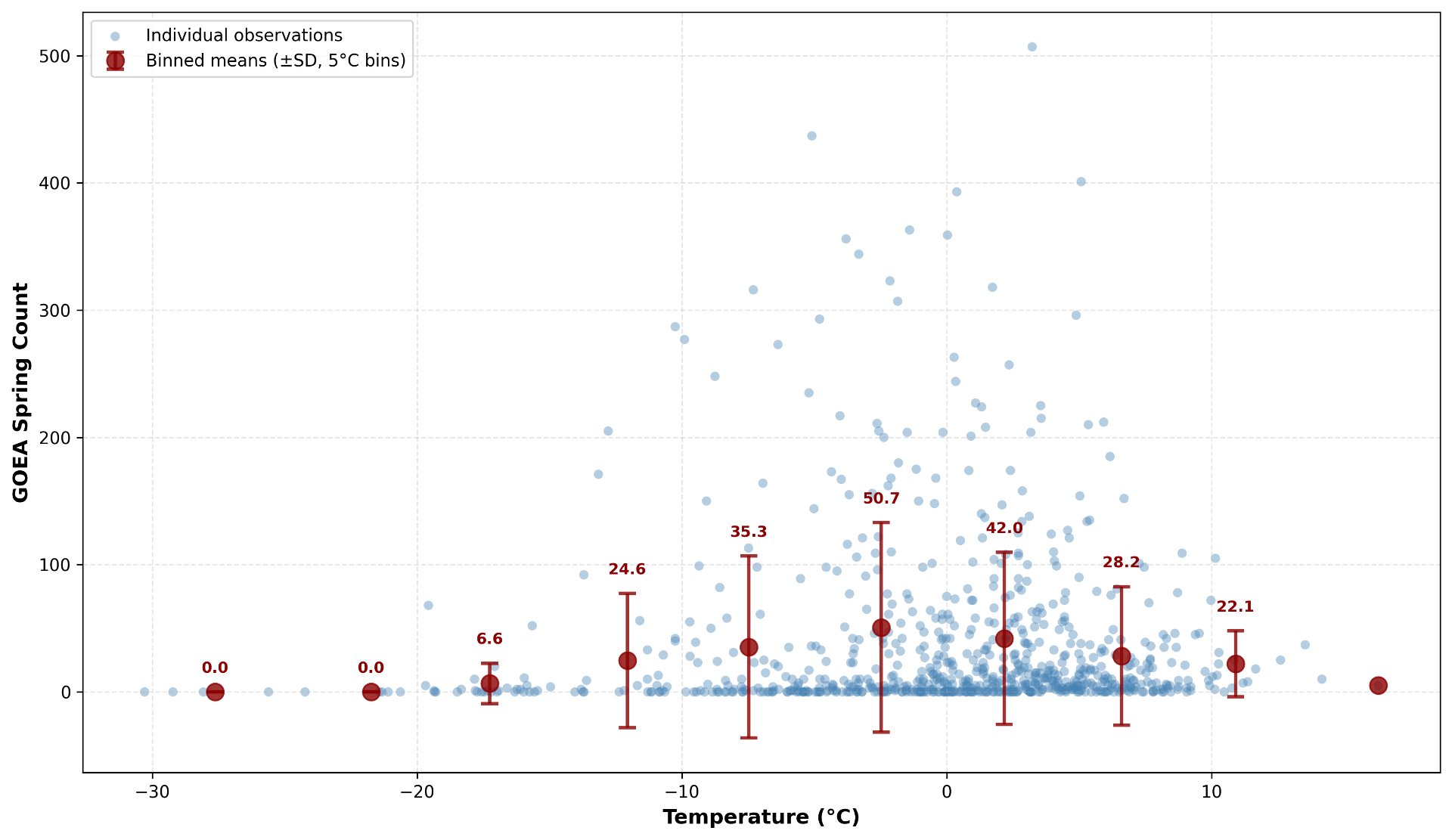
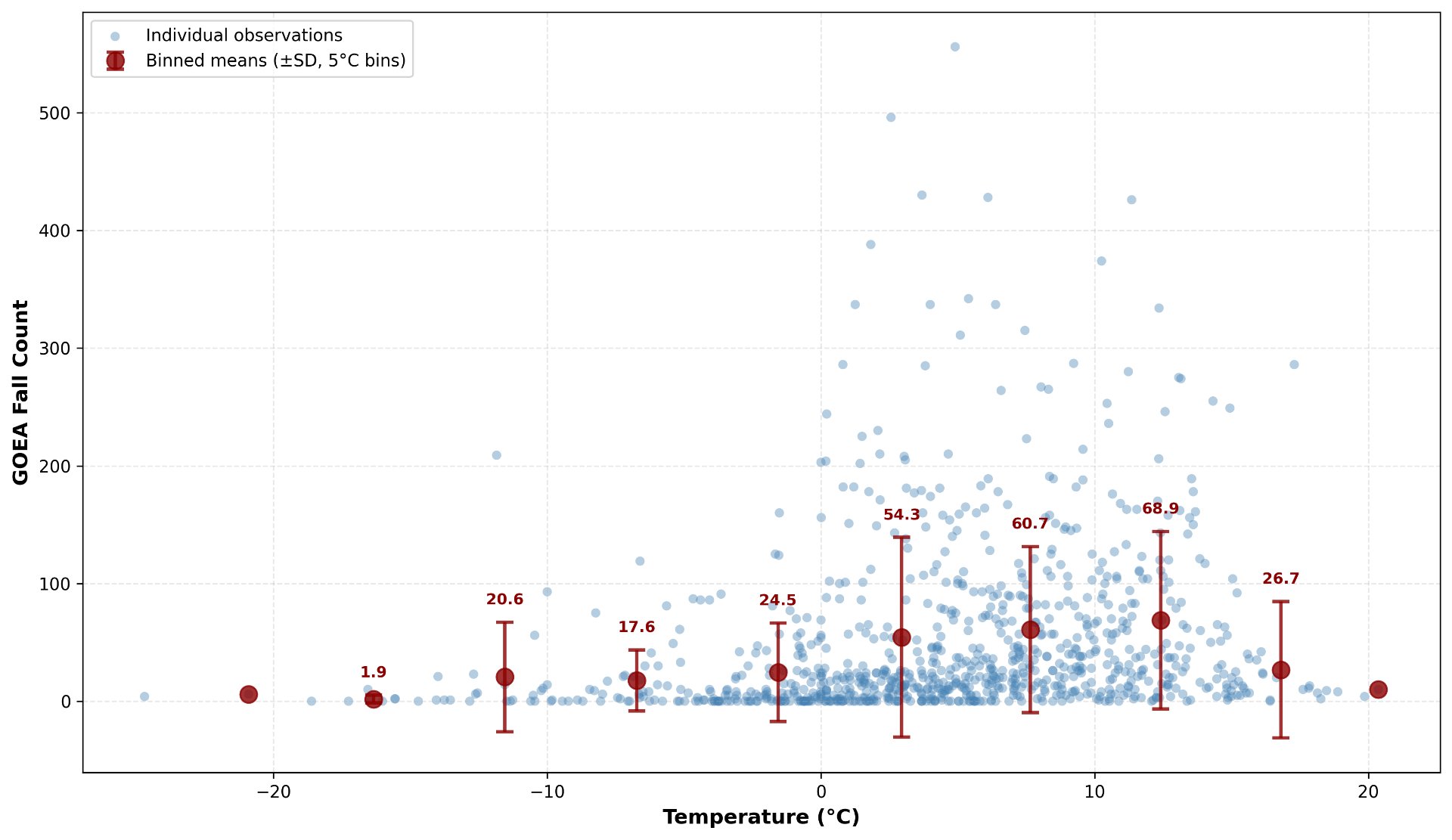
CONCLUSION: In conclusion, after comparing temperature and count data from 2010 - 2025 from Kananaskis, AB, we found that in the fall, eagles don’t migrate as commonly below -15°C and above 15°C. The majority of golden eagles migrate south in the fall between 0°C and 15°C. In spring, Golden eagles migrate most commonly between -10°C and 5°C. We are not seeing a lot of golden eagle migration activity below -15°C in both the spring and fall. Similarly, we are not seeing much golden eagle migration above 15°C in the spring and fall. Golden eagles appear to prefer cooler temperatures for flying while there are still thermal updrafts and orographic lift. Overall, temperature change is a predictor of Golden Eagle migration numbers and patterns but there are many other factors that can impact their migration such as wind, temperature, and precipitation.
DISCUSSION: We learned that Golden Eagles aren’t actually directly impacted by temperature, but their food is, causing their prey to migrate, and they follow to keep a food source throughout the colder months. In the North, during the winter, the sun hardly ever rises, but they are not nocturnal meaning that they require light to hunt. We also learned that during the summer, Denali national park is a very popular breeding ground for Golden Eagles. We most likely got the results that we did because of orographic lift and thermal updrafts. When it is warmer, there is generally less wind, causing less orographic lift. Higher temperatures also create more thermals, allowing the golden eagles to fly higher and farther from ridges making it harder for counters to spot and identify them. When it is colder, there are less thermals and less wind, leading to less orographic lift and thermal updrafts. Colder temperatures also may correlate with snow storms. Golden Eagles do not like to fly in precipitation or storms so they will perch in trees and wait out the storm. We noticed that in both the spring and the fall, Golden Eagles migrate most commonly in mild temperatures. When it is too hot or too cold they lose access to thermal updrafts and orographic lift. Although similar, they migrate at slightly different temperatures in spring and fall. Golden Eagles appear to prefer migrating in slightly cooler temperatures in the spring because they are less likely associated with storms or precipitation. Thermal updrafts are the warmth from the sun hitting the earth and reflecting back, creating warm air currents. These air currents help to carry birds up while saving energy because they don’t have to flap their wings as strongly or constantly. You can see birds using thermal updrafts when they are slowly rising and spiraling but aren’t flapping their wings. Birds like ducks don't use thermal updrafts meaning that they have to flap their wings constantly and quickly to keep themselves up. Orographic lift occurs when prevailing winds are blowing across the surface of the earth and then hit prominent ridges and travels up the side of the ridge creating an air current that carries raptors and birds upwards, above mountains and ridges. Count sites are generally located near ridges or in valleys because in a valley, you have orographic lift happening all around you. This allows the counters to spot the birds when they are rising.
Citations
References American Eagle Foundation. (n.d.). Golden Eagle Diet. American Eagle Foundation. Retrieved February 18, 2026, from http://eagles.org/what-we-do/educate/learn-about-eagles/golden-eagle-diet/ Caton, E., Yates, R. E., Mcclelland, B. R., Mcclelland, P. T., Key, C. H., & Bennetts, R. E. (2024, January). The Influence of Weather on Golden Eagle Migration in Northwestern Montana. Digital Commons @ USF. Retrieved December 15, 2025, from https://digitalcommons.usf.edu/cgi/viewcontent.cgi?article=2476&context=jrr Cornell Lab. (N/A, N/A N/A). Golden Eagle Range Map, All About Birds, Cornell Lab of Ornithology. About Birds. Retrieved February 3, 2026, from https://www.allaboutbirds.org/guide/Golden_Eagle/maps-range Golden Eagle Overview, All About Birds, Cornell Lab of Ornithology. (2026). About Birds. Retrieved November 19, 2025, from https://www.allaboutbirds.org/guide/Golden_Eagle/overview Hawk Mountain. (N/A, N/A N/A). Golden Eagle. Hawk Mountain Sanctuary. Retrieved February 10, 2026, from https://www.hawkmountain.org/raptors/golden-eagle Johnston, N. N., Bradley, J. E., & Otter, K. A. (2014, March 26). Increased Flight Altitudes among Migrating Golden Eagles Suggest Turbine Avoidance at a Rocky Mountain Wind Installation. PLOS One. Retrieved January 2, 2026, from https://tethys.pnnl.gov/sites/default/files/publications/Johnston-et-al-2014.pdf Lish, T. (2025). What is Barometric Pressure? Setra Systems. Retrieved December 19, 2025, from https://www.setra.com/blog/what-is-barometric-pressure Singh, N. J., Ecke, F., Katzner, T., Bagchi, S., Sandstrom, P., & Hornfeldt, B. (2021, July 5). Consequences of migratory coupling of predators and prey when mediated by human actions. Wiley Online Library. Retrieved February 10, 2026, from https://onlinelibrary.wiley.com/doi/10.1111/ddi.13373?utm_source=chatgpt.com State of Utah. (N/A, N/A N/A). Migration Corridors. Wildlife Migration Initiative. Retrieved December 18, 2025, from http://wildlifemigration.utah.gov/land-animals/corridors/ Tesky, J. (1994, March). Aquila Chrysaetos, Golden Eagle. Forest Service U.S. Department of Agriculture. Retrieved November 26, 2025, from https://research.fs.usda.gov/feis/species-reviews/aqch?utm_source=chatgpt.com University of East Anglia. (2024, May 20). Endangered migrating eagles impacted by Ukraine war, new study shows. Phys Org. Retrieved December 14, 2025, from https://phys.org/news/2024-05-endangered-migrating-eagles-impacted-ukraine.html?utm_source=chatgpt.com University of Minnesota. (N/A). Golden eagle | The Raptor Center. The Raptor Center. Retrieved November 26\, 2025\, from https://raptor.umn.edu/about-raptors/raptors-north-america/golden-eagle?utm_source=chatgpt.com U.S. Fish & Wildlife Service. (N/A, N/A N/A). Golden Eagle Science in the West. U.S. Fish & Wildlife Service. Retrieved February 3, 2026, from https://www.fws.gov/project/golden-eagle-science-west#:\~:text=Golden%20eagles%20exhibit%20a%20broad,risks%20posed%20by%20development%20proposals
OpenAI. (2026). ChatGPT (March 2 version) [Large language model]. https://chat.openai.com Google. (2026). NotebookLM [Large language model]. https://notebooklm.google.com Statement of Use: ChatGPT and NotebookLM were used to assist with organizing, formatting, and clarifying research content. All data analysis and conclusions were completed by the student.
Acknowledgement
- Our parents, for helping and supporting us along the way.
- Mrs. Summerscales, for making this possible.
- Vincent Slabe (PhD - The Peregrine Fund Energy Scientist), for mentoring us.
- Rocky Mountain Eagle Research Foundation, for giving us our data and for answering our questions.