
Walking in My Words: Understanding the Dyslexic Brain
Ayana Kassam
FFCA High School Campus
Grade 10
Presentation
No video provided
Hypothesis
Question: What effect does dyslexia simulated text have on reading speed and accuracy?
Hypothesis: If students read a dyslexia simulated text, then their reading time will increase and they will make more errors because the simulation disrupts normal visual and phonological processing similar to what occurs in dyslexia.
Research
What is Dyslexia?
Dyslexia is a learning difference that affects reading, language processing, reading speed, spelling and decoding words. People with dyslexia often have normal or above average intelligence. Dyslexia is neurological, meaning that it is related to how the brain works, not how much effort or motivation the individual puts in.
How Does Dyslexia Affect the Brain?
Reading requires multiple parts of the brain to work together, especially areas in the left side of the brain which handle language and word recognition. In people without dyslexia, these areas work in sync to recognize letters, match sounds to words, and read fluently. In people with dyslexia these areas in the brain are less active and communicate differently, which makes reading slower and more effortful. Brain imaging studies (like MRI scans) show that individuals with dyslexia often rely on different neural pathways when reading. This can cause letters to appear jumbled, reversed or harder to process quickly, because of this reading can take longer and lead to many mistakes or misunderstandings, especially when the text is long and dense.
How Does Dyslexia Affect Reading Speed?
Reading speed depends on how efficiently the brain recognizes words and connects words and letters to sounds. Typically the brain can quickly identify whole words by using specialized language paths, allowing reading to become fast and automatic. In individuals with dyslexia, these neurological pathways process written language differently, often requiring words to be decoded letter by letter which slows reading speed. Since reading speed is less automatic, people with dyslexia must use more mental effort while reading. Dyslexia simulations attempt to recreate this experience by disrupting visual and language processing, which can cause non-dyslexic readers to experience slower reading times.
How Does Dyslexia Affect Reading Accuracy?
Reading accuracy refers to the ability to correctly read words without skipping, mispronouncing, or repeating them. Dyslexia affects the brain's phonological processing system, which is responsible for connecting written letters to spoken sounds. When this system functions differently, reading errors become more common. Neuro-imaging studies show that individuals with dyslexia may rely on alternative neural pathways during reading. This can increase the likelihood of mistakes such as skipped words, misread letters, or repeated phrases.
Why Use A Dyslexia Simulation?
A dyslexia simulation alters text to visually represent some of the challenges that people with dyslexia experience, such as letter movement or spacing issues. While a simulation cannot completely recreate dyslexia, it helps people without dyslexia understand how reading can feel confusing or difficult. Using a simulation allows researchers to compare reading performance under normal and simulated conditions.
What Is The Connection To This Experiment?
In this experiment, participants read normal text and dyslexia simulated text so that their reading time, number of mistakes, and difficulty ranking can be compared. If the dyslexia simulation increases reading time, Errors, and difficulty ratings, then this experiment supports existing research showing that dyslexia affects how the brain processes written language. This project helps increase awareness and empathy by demonstrating these challenges in a controlled way.
Variables
Manipulated: Type of text being read (Normal vs. Simulated text) Responding: Reading time, Number of errors, and the difficulty level (1-5) Controlled: Same length and difficulty of paragraph, same font size, same instructions given to all participants, and all participants ranging from grade 9-12.
Procedure
- Prepare the dyslexia simulator website so the same text and simulation settings are used for all participants.
- Test participants individually in a quiet place
- Use the same device whenever possible, if different devices are used ensure that the device is around the same size and has the paragraphs saved in the same way (pdf of website).
- Before starting, ensure that a parent/gardian consent form has been signed.
- Explain the experiment to the participant and remind them that participation is voluntary and that they can stop at any time.
- Assign each participant an id number and do not record names.
- Display the normal (non-simulated) text from the website onto the screen.
- Start the stopwatch when the participant begins reading and stop it when they finish.
- Record the reading time and number of errors.
- Ask the participant to rate the difficulty of the text on a scale of 1-5 (1 being very easy and 5 being very difficult) and record their rating.
- Allow the participant to have a 30-60 second break.
- Display the dyslexia simulated text on the same screen.
- Have the participant read the simulated text.
- Time the reading again and record the reading time, number of errors and difficulty rating.
- Thank the participant for their time and repeat steps 5-14 for each participant.
- After all the trials are completed, calculate the average reading time, number of errors, and difficulty rating for both the normal and simulated texts.
- Graph the results and analyze how the dyslexia simulation affected reading performance.
Observations
During the experiment, most participants appeared to read the dyslexia simulated text at a slower pace than the normal text. Several participants paused more often, reread words, or lost their place while reading the simulated version. Many participants also reported tat the simulated text felt confusing, tiring, or frustrating compared to the normal text.
Analysis
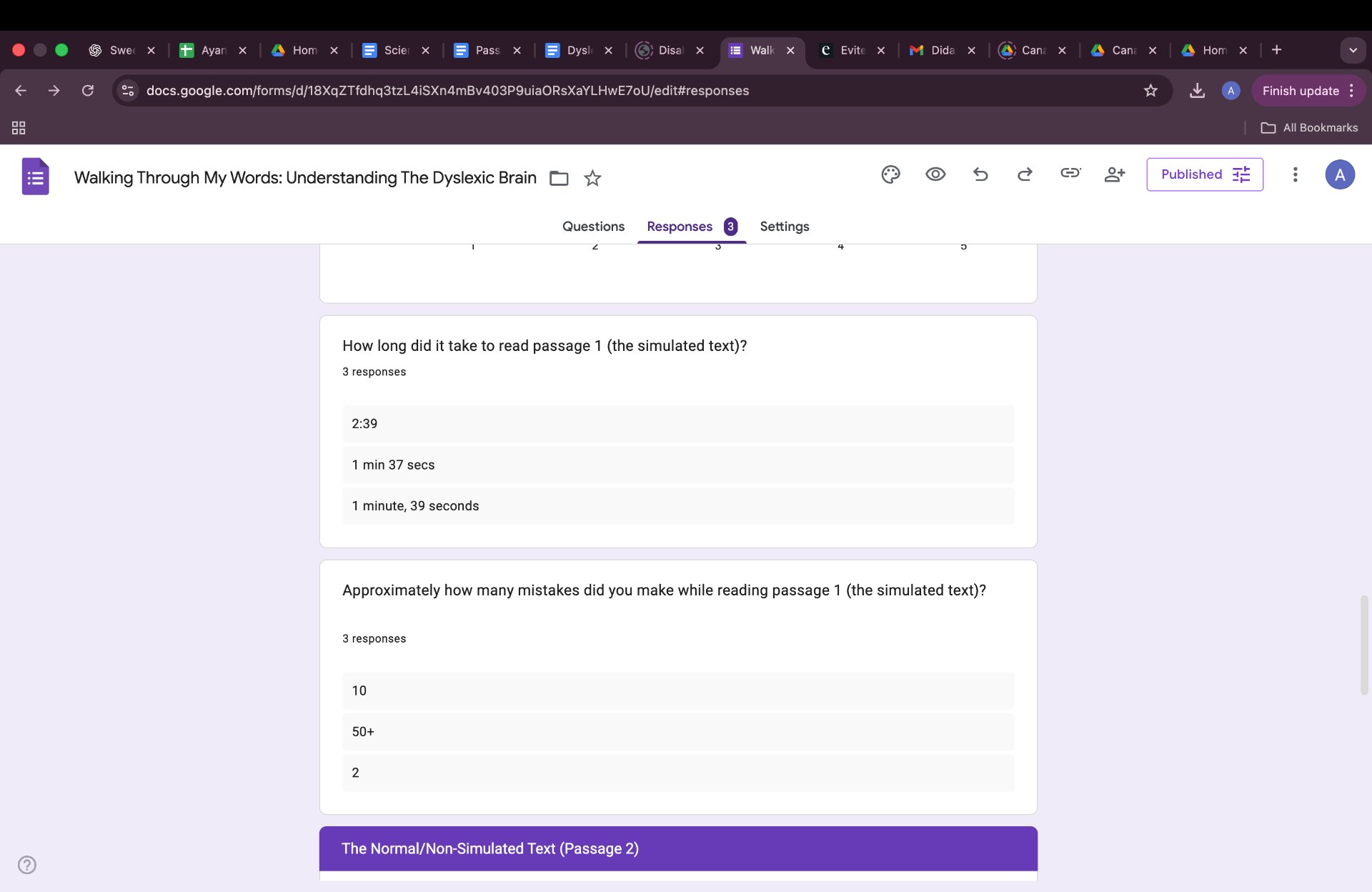
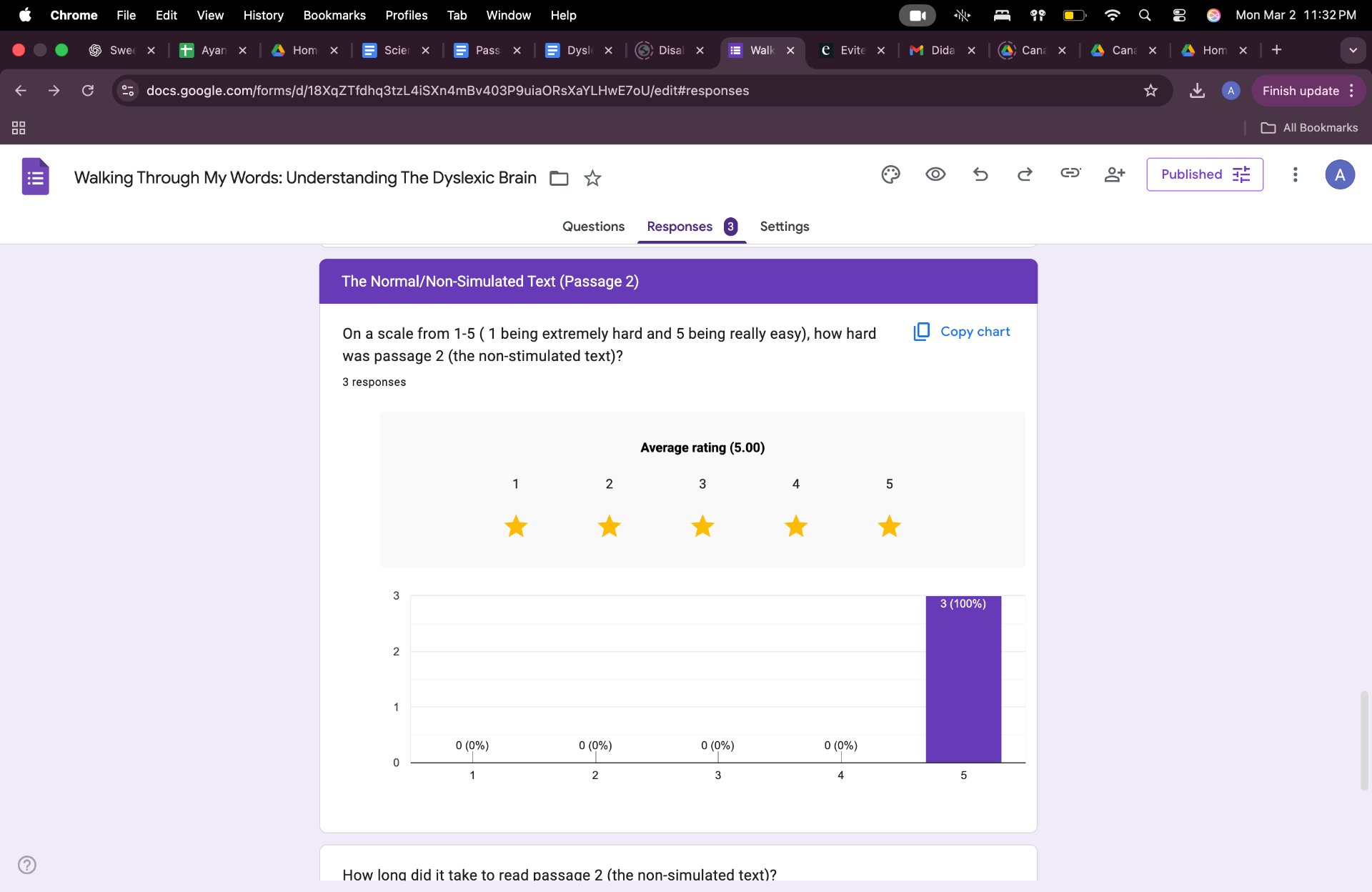
The data showed that average reading time and reading errors increased when participants read the dyslexia simulated text compared to the normal text, as well as most participants rated the simulated text as more difficult on the difficulty scale.
These results suggest that disrupting visual text patterns increases cognitive effort, which aligns with research showing that dyslexia affects how the brain processes written language. The increase of reading time, errors, and perceived difficulty supports the hypothesis that dyslexia- like visual challenges negatively impact reading performance.
Data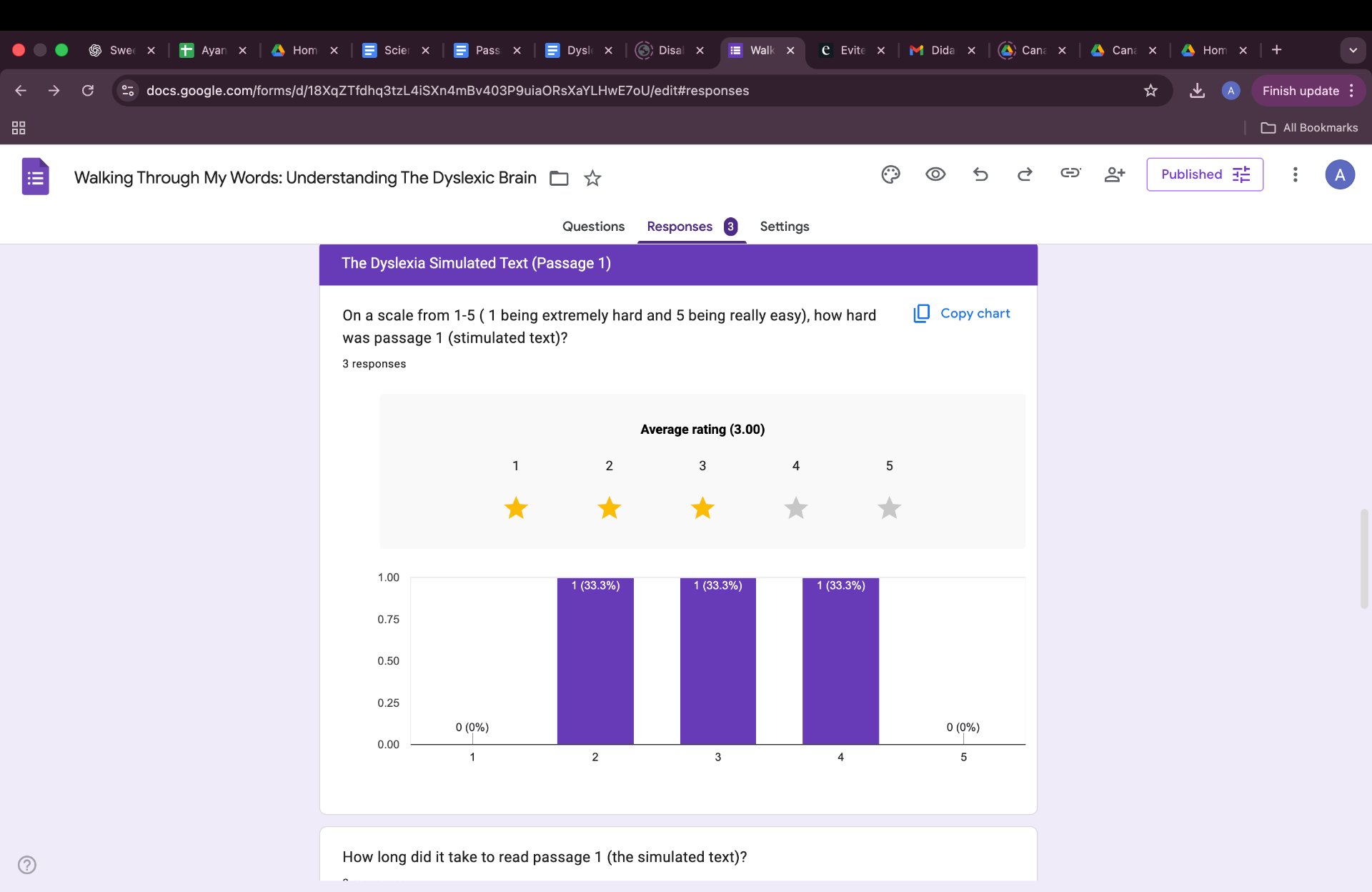
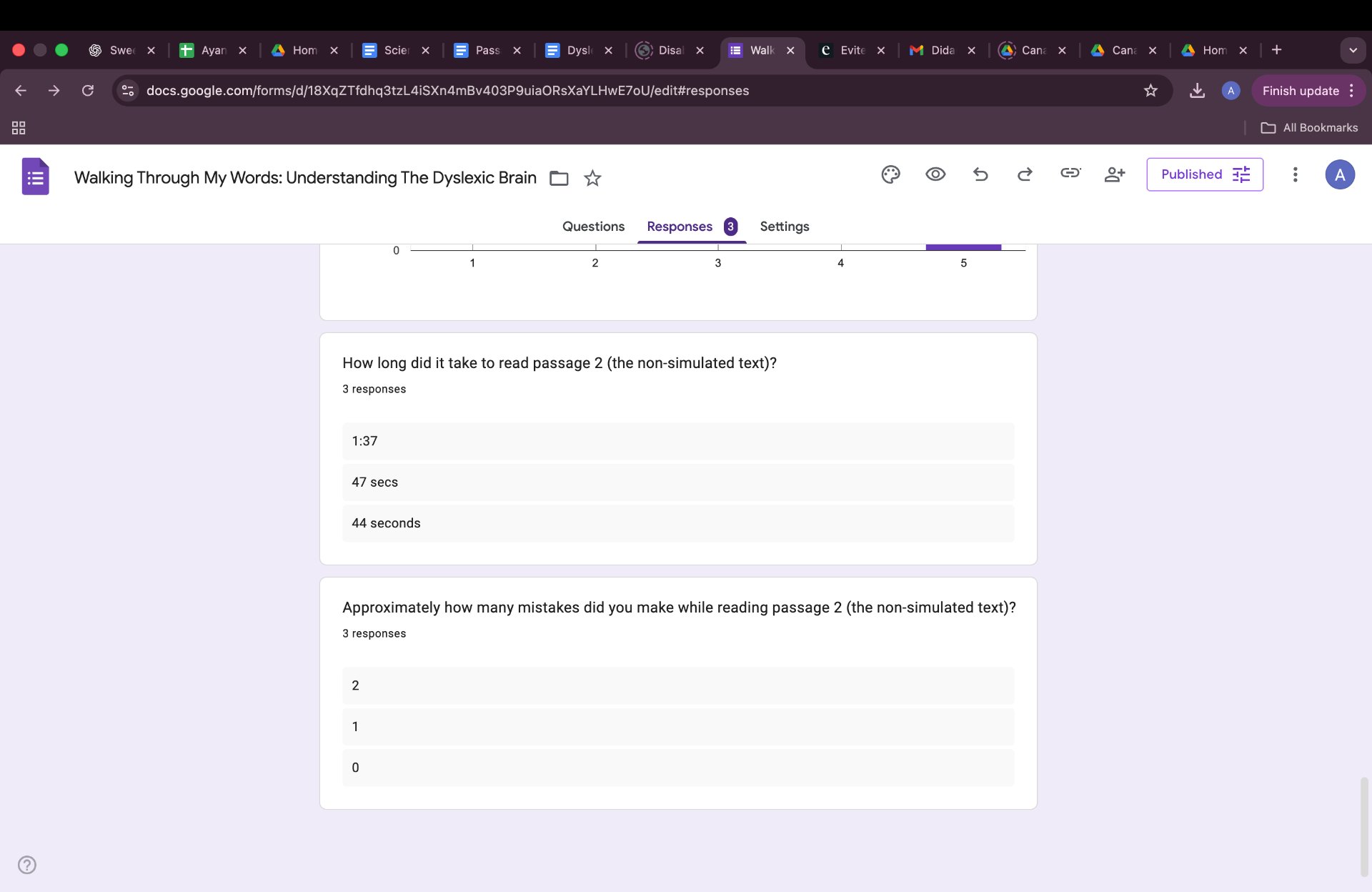
Conclusion
The results from the experiment support the hypothesis that dyslexia simulated text increases reading time, reading errors, and perceived difficulty compared to normal text. This suggests that when the brain needs to work harder to process written language, reading becomes slower and more effortful. The experiment demonstrates how dyslexia can impact reading performance and highlights the importance of awareness and understanding.
This project was personally meaningful to me because I have dyslexia and growing up, I felt that reading required a lot more effort for me than for others, but it was always hard for me to explain exactlyn why. Through this experiment, I was able to scientificlaly explore demonstrate how reading challenges can affect speed, accuracy, and perceived difficulty. One of the most powerful parts of this project was observing participants react to the dyslexia simulation. Many expressed frustration, confusion, anger or mental fatigue after only one short passage. This helped me realize that the experiences I have had for years can only be partially understood by others. This project reinforced that dyslexia is not related to intelligence, but rather to differences in the way our brains process written language. This project has also helped me grow as a researcher. I learned how to design an experiment, controll variables, collect data ethically, and review the results with an analytical perspective even when the topic was personal to me. It has taught me that science can be used to discover information and also be used to build empathy and awareness. Overall, this experience has increased my confidence and strengthened my understanding of both neuroscience and myself.
Application
This project can help increase understanding and empathy toward individuals with dyslexia, so that teachers, parents, classmates and other individuals can get a better perception of how it feels to have dyslexia. By spreading awareness, people are able to be more supportive and accommodate their friends with dyslexia.
I chose to do this project so that people in my life can see how I feel on a daily basis, and be aware of the challenges that come with it. For me, this research shows that learning differences deserve awareness and acceptance, and that science can be used to promote inclusion.
Sources Of Error
- Participants used different devices (phone, laptop, tablet)
- Differences in reading ability between participants
- Different lighting conditions at various locations
- Small sample size
- Some participants may have felt nervous
- internet speed affecting text movement in the simulation
Citations
“Disability Simulator.” Disabilitysimulator.com, 2026, www.disabilitysimulator.com/dyslexia?utm. Accessed 3 Mar. 2026. “Dyslexia.” Understood, 6 June 2022, www.understood.org/en/topics/dyslexia. “Dyslexia Canada | Official Website.” Dyslexia Canada, 19 Jan. 2024, dyslexiacanada.org/. “Home.” Dyslexie Font, dyslexiefont.com/en/. International Dyslexia Association. “International Dyslexia Association – …until Everyone Can Read!” Dyslexiaida.org, 2017, dyslexiaida.org/. Marshall, Abigail. “Brain Scans Show Dyslexics Read Better with Alternative Strategies.” Dyslexia the Gift, 30 June 2019, www.dyslexia.com/research/articles/alternative-brain-pathways/. Mayo Clinic. “Mayo Clinic.” Mayoclinic.org, Mayo Foundation for Medical Education and Research, 2025, www.mayoclinic.org/. McDonough\, Molly. “Dyslexia and the Developing Brain | Harvard Medicine Magazine.” Magazine.hms.harvard.edu, Dec. 2023, magazine.hms.harvard.edu/articles/dyslexia-and-developing-brain. NIH. “Homepage | NICHD - Eunice Kennedy Shriver National Institute of Child Health and Human Development.” Nih.gov, 2019, www.nichd.nih.gov/. Terada, Youki. “Do Dyslexia Fonts Actually Work?” Edutopia, 24 June 2022, www.edutopia.org/article/do-dyslexia-fonts-actually-work/. Wilkinson\, Freddie. “The History of Space Exploration | National Geographic Society.” Education.nationalgeographic.org, National Geographic, 24 Oct. 2022, education.nationalgeographic.org/resource/history-space-exploration/. “Yale Dyslexia.” Yale Dyslexia, 2017, dyslexia.yale.edu/. Zettler-Greeley, Cynthia. “Understanding Dyslexia (for Teens) - KidsHealth.” Kidshealth.org, May 2022, kidshealth.org/en/teens/dyslexia.html.
Acknowledgement
I want to thank my teacher for all of her guidance and support throughout this project. I also want to thank the participants and their parents for volunteering their time. Finally, I appreciate the researchers and organizations whose studies on dyslexia helped me to complete this project.