
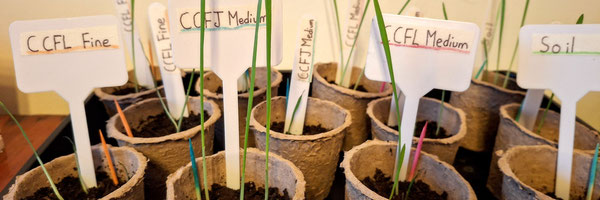
Soil Amendment and Carbon Sequestration with Biochar
Benjamin Mathew
Madeleine D' Houet Bilingual School
Grade 8
Presentation
Hypothesis
QUESTION AND HYPOTHESIS
Main Question:
Does Biochar perform better than soil alone when growing plants?
Hypothesis: Amending soil with biochar will grow a better plant than soil alone can.
Water Retention Test
Questions: Does biochar retain more water than soil alone? Which type of biochar has the best water retention?
Hypotheses:
- Soil will retain less water than biochar.
- Soil will retain the same amount of water as coarse biochar as they have similar porosity in a 20 g sample.
- If the granularity of the biochar gets finer, then the water retention will increase, because there is more surface area to house pores which hold water.
- If biochar is made of more than one feedstock, then it will retain the same amount of water as one made of multiple feedstocks, because the surface area will not change when there is multiple feedstocks.
- If the time biochar is soaked increases, then the biochar will retain more water, because it has more time to absorb and adsorb the water.
Nutrient Retention Test:
Question: Which soil amendment has the highest nutrient retention indicated by conductance?
Hypothesis:
- If biochar is made of more than one feedstock, then it will retain more nutrients, because the varied feedstocks gives the biochar varied nutrients to trade.
- If the granularity of the biochar increases, then nutrient retention will increase because there is a bigger surface area that can house more pores which hold fertilizer.
- Biochar will perform better than soil alone as biochar has a much greater surface area for storing nutrients.
Plant Growth Test
Question: Which soil amendment can support plant growth the best?
Hypothesis:
- Medium biochar will perform better than fine and coarse because too fine of biochar clogs soil permeability while too coarse of biochar has less pores.
- If biochar is made of more than one feedstock, then it will amend plant growth better, because the varied feedstocks will give the biochar varied pore sizes and varied nutrients to trade.
- Biochar will perform better than the soil alone as biochar has better nutrient and water retention capacities than soil as proven by my prior tests because the biochar has more pores.
Research
RESEARCH
1. Climate change is on the rise and we are all feeling the impact: extreme weather events, water scarcity, drought and more. One of the main factors of climate change is carbon dioxide and other greenhouse gases. My first idea was to research carbon sequestration, the practice of storing carbon dioxide underground and what can be done with it. Going into my project, I wanted to take carbon or carbon dioxide, something that is generally viewed as bad, and use it in a good way. I started my project by looking at carbon and carbon dioxide, what they are and what positive impacts they can have.
CARBON: Carbon is an element on the periodic table that forms many precious items today such as fossil fuels and diamonds. Carbon is necessary for plants to grow.
CARBON DIOXIDE: Carbon dioxide is a greenhouse gas that is odorless and invisible. Greenhouse gases are good gases that store heat around the earth, as without them we would freeze. However, too much carbon dioxide is a problem as it results in too much heat stored around the earth and the planet begins to overheat. This is a key contributor to climate change.
2. When I was researching ways to use carbon dioxide and keep it out of the atmosphere I came across the practice of pumping carbon dioxide into greenhouses. I did more research about carbon dioxide being used to help agriculture and I found a soil amendment called biochar. Biochar also has the benefit of sequestering carbon by keeping it locked in the soil and then used by plants to create oxygen in photosynthesis.
3. After being introduced to biochar I began to look into biochar production and whether I could produce it myself. My research led me to understanding pyrolysis which is the main method used to produce biochar.
PYROLYSIS: Pyrolysis is the process through which biomass (crop residues, plants, algae, etc.) is converted into biochar. Pyrolysis is performed in a pyrolysis kiln which heats the biomass to temperatures ranging between 300-700° Celsius in the absence of oxygen for between an hour and a day. Pyrolysis is what makes biochar porous because, when the biomass is heated the water inside it evaporates and the volatile organic compounds inside it break down making microscopic pores on the biochar.
4. I learnt the two key benefits of biochar: improved water and nutrient retention. These two factors are greatly supported by biochar's porosity. The nutrients in the form of cations and anions are stuck to the biochar through the cation exchange. Having more surface area allows for more nutrients to be adhered to the surface of the biochar.
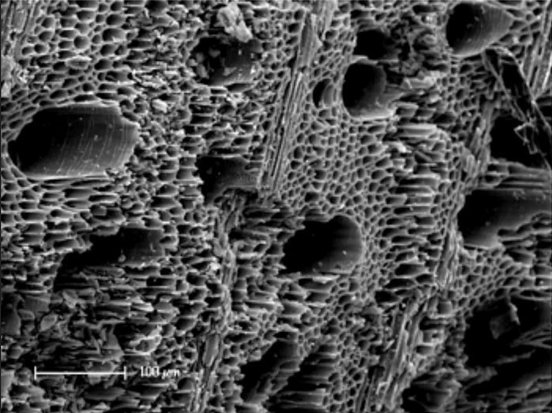 https://www.researchgate.net/figure/Biochar-under-a-microscope-Brownsort-UK-Biochar-Research-Centre-From_fig1_317185366
POROSITY and SURFACE AREA: Biochar is highly porous and has an even bigger surface area, 1 cubic foot of it can have more than 300+ acres of surface area or 1.5x Stampede parks. Its porosity is due to the pyrolysis process. During pyrolysis water and volatile organic compounds within the biochar will evaporate leaving tiny pores in the biochar. Porosity is incredibly beneficial to the soil as the immense surface area allows for a high cation exchange capacity allowing a plant’s roots to have access to many nutrients. Additionally, the pores can be a home for beneficial organisms that can boost plant growth. The surface area also reduces the frequency that fertilizer needs to be applied as the biochar can hold the fertilizer to its surfaces better than soil alone can.
CATIONS and ANIONS: Cations are positively charged ions meaning they have more protons than electrons, examples are potassium, calcium, magnesium, and ammonium. Anions are the opposite having more electrons than protons, examples are nitrate and sulfate. Most soils are negatively charged allowing for cations to stick to the soil. Both ions are traded between plants and the soil in either the cation or anion exchange. These exchanges are when the soil trades a cation such as potassium for an cation from the plant such as hydrogen. However certain ions have a bigger difference than one between their protons and electrons. This means that the plant would have to trade two hydrogen cations with a positive charge of one each for a divalent cation which has a positive charge of two such as calcium. Biochar possesses a very high cation exchange capacity due to its immense porosity which gives it a massive surface area allowing for many cations to be held in a single piece of biochar.
Once I had realized that I could not produce biochar myself because I do not have access to a pyrolysis kiln, I began to look at how I could test it. I sent emails to David Layzell and Robert Edwards, both professors at the University of Calgary. I then also reached out to Vicky Levesque, a researcher who studies biochar with agriculture Canada. I had a response from professor Layzell who directed me to the company Charterra, specifically Don Harfield and Rob Lavoie. These two individuals have helped me research biochar providing feedback on my tests and results. Additional terms and learning from speaking with Mr. Lavoie are included below.
MICROBE: A microbe is a living organism that is very small. Viruses, bacteria, funguses and probiotics are all examples of microbes. Microbes can greatly aid plant growth and soil. The many pores and humid climate of biochar make it a perfect environment for microbes to live in. Microbes can be added to biochar by adding compost to biochar as microbes dwell in compost.
ELECTRICAL CONDUCTIVITY PROBE: An electrical conductivity (EC) probe can be used to measure the amount of available nutrients for a plant. It does this by measuring the ions in and around the roots of a plant. I would have liked to use an EC probe to test the nutrient retention of biochar but as I had none available to me I used a multimeter instead.
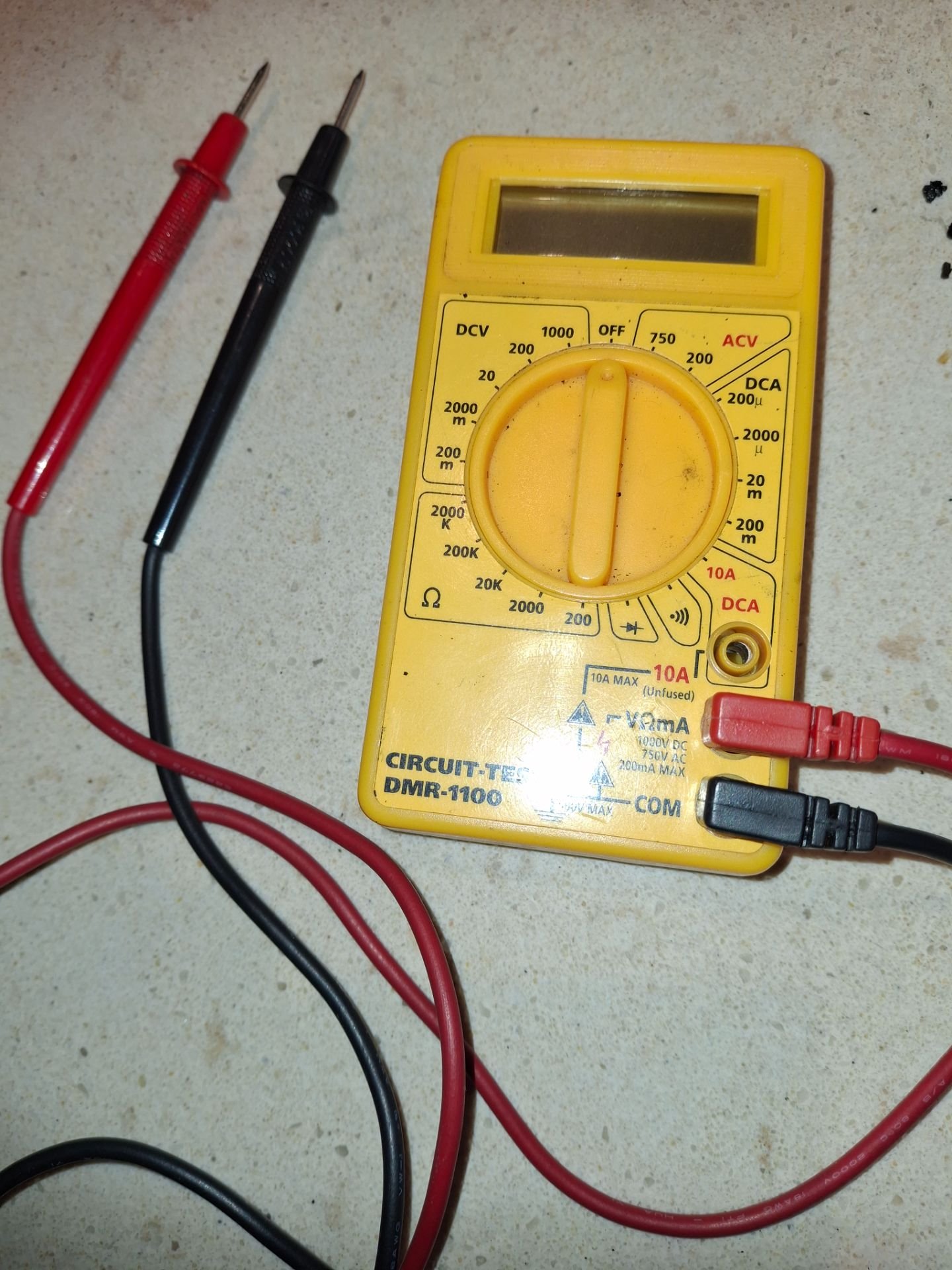
MULTIMETER: A multimeter is used to measure resistance, voltage and current. Conductance is the inverse of resistance meaning a multimeter reading of resistance can be turned into conductance.
Variables
Plant growth:
Manipulated:
Granularity of biochar
Controlled:
Amount of soil - 60mL , Amount of soil amendment (charged biochar or charged soil) - 20mL , Size of pots, Number of seeds - 3
Respondent:
Height of plants in millimeters
Nutrient retention:
Manipulated:
Granularity of biochar
Controlled:
Amount of soil amendment - 80mL, Amount of fertilizer - 80 mL, Distance of probes - 1 cm
Respondent:
Conductance in Siemens
Water retention:
Manipulated:
Granularity of biochar
Controlled:
Amount of water, Amount of soil amendment, Size of funnel
Respondent:
Water retained by biochar in mL
Procedure
Water Retention Test
Materials per test:
- Glass jar
- Funnel
- Filter paper
- 60 mL or 50 mL of Water
- 20 mL or 5g of Biochar
- Graduated cylinder
Method
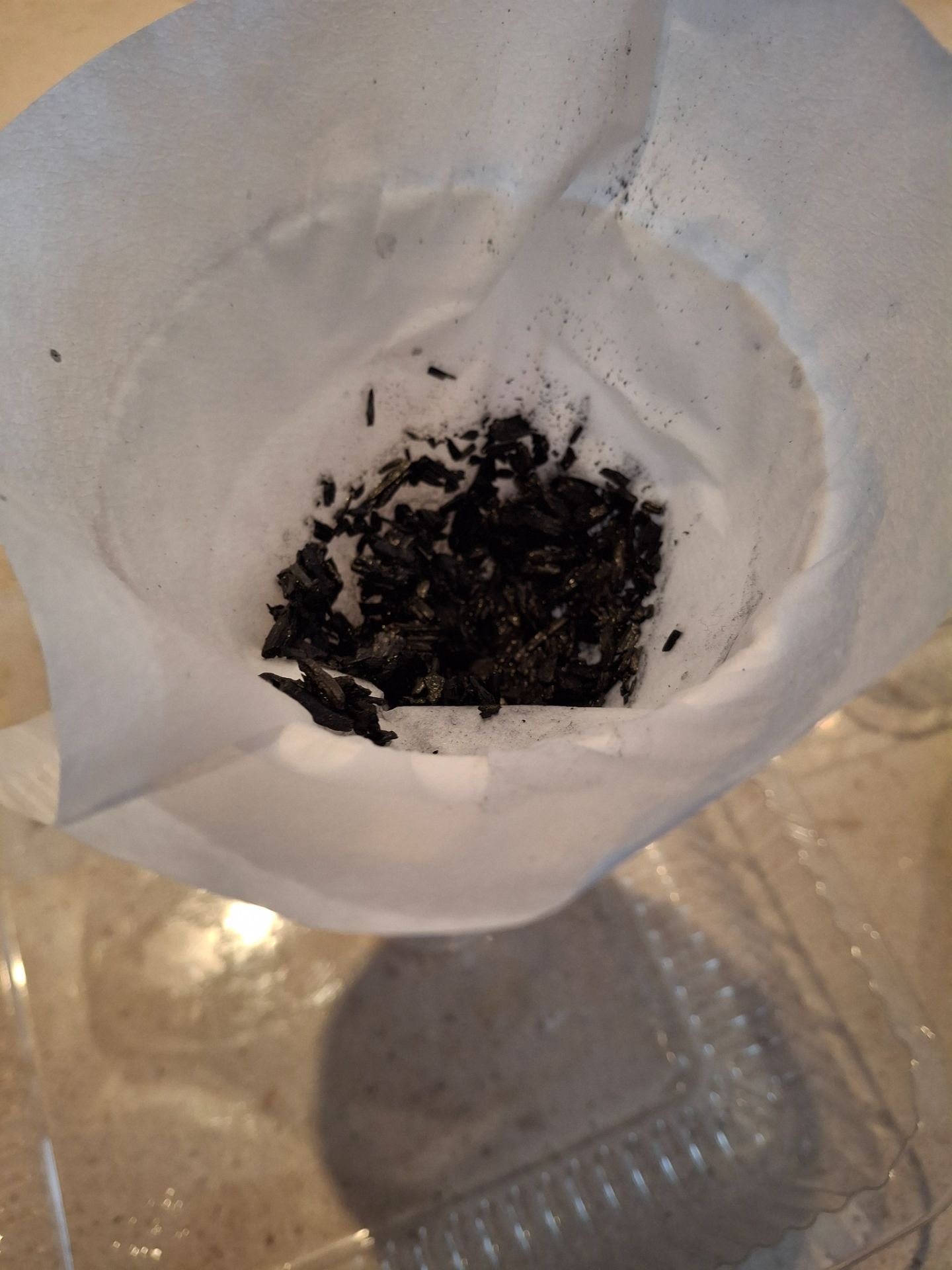
- Line the funnel with filter paper and place the funnel in the graduated cylinder.
- Pour a measured amount of water into the jar.
- Put the biochar in the bowl and start a timer.
- After 𝒙 amount of time pour the water into the funnel atop the cylinder.
- Measure the amount of water in the cylinder.
- Subtract the amount of water in the measuring bowl from the amount poured in and you are left with the amount retained by the biochar.
- The test should be performed 4 times where the first 𝒙 should be 1 hour and the second 𝒙 should be 24 hours, the third and fourth are the same as the first two except measuring the biochar by weight instead of volume.
Nutrient Retention Test
Materials per test:
- Jar
- Measuring glass
- Multimeter
- 80 mL of Biochar
- 80 mL Liquid plant fertilizer prepared with deionized water (Miracle Grow)
- Graduated cylinder
Method
- Prepare the fertilizer as per outdoor plant once a month feeding instructions on the bottle. Use 5 ml of liquid fertilizer to 1 L of deionized water.
- Mix the biochar and the fertilizer solution together, let sit for 24 hours.
- Drain the fertilizer from the biochar
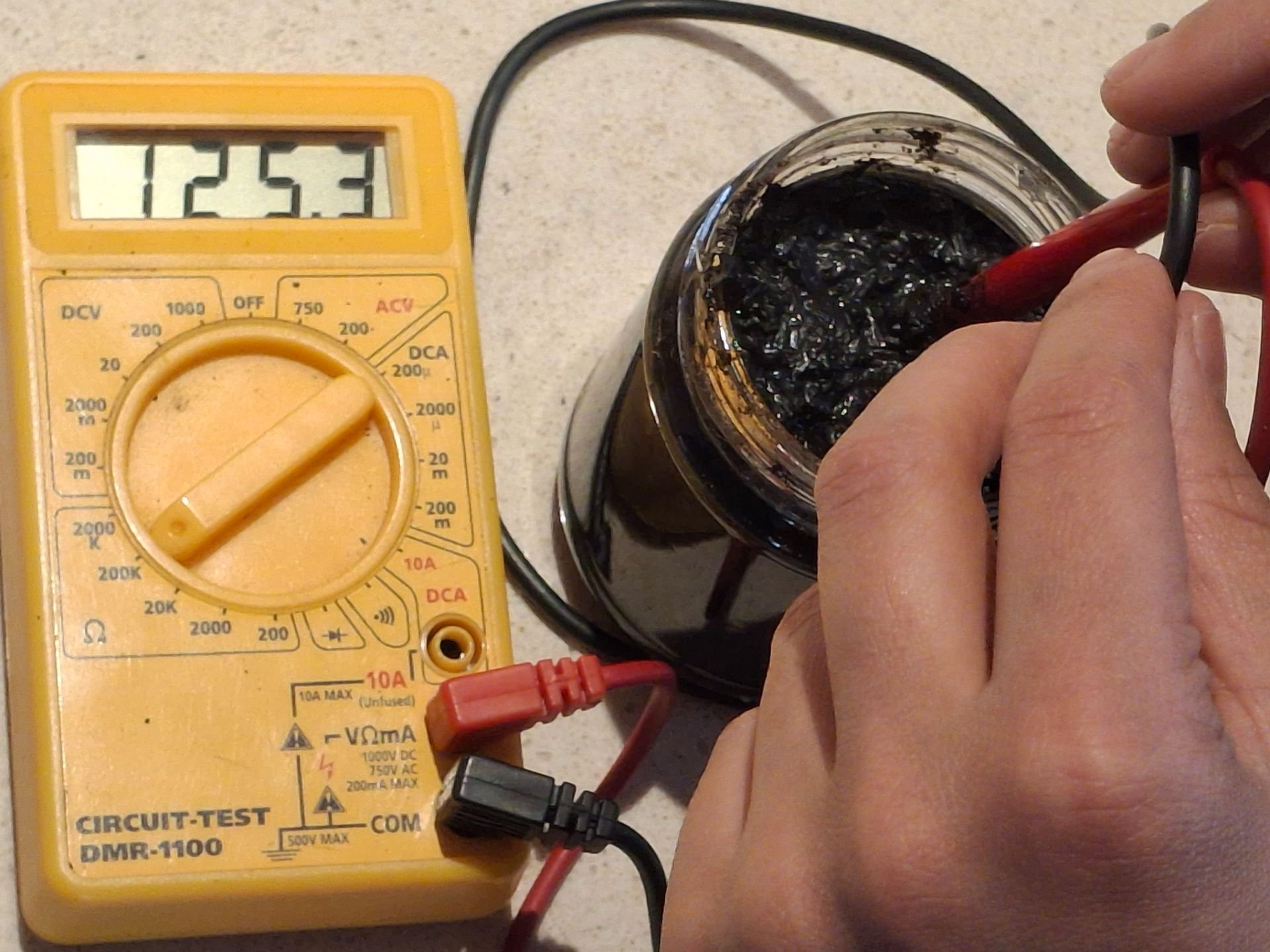
- Set the multimeter to measuring the lowest multiple of Ω(ohms) possible.
- Tap the 2 probes together to center the reading at zero
- Insert the 2 probes approximately a centimeter apart and once the reading has stopped changing, note the reading.
- Convert the reading of xΩ to the actual value of ohms by multiplying the reading of ohms by the number shown when setting the reading (ex: a reading of 5Ω while the meter is reading 100 Ω is interpreted as 500 Ω).
- To calculate conductance, divide 1 by the resistance(r) to be left with the conductance. c= 1r (Using the prior example 1/500 = 0.002)
Plant Growth Test
Materials per sample:
- Plant pot
- 3 cat grass seeds
- 60 mL of soil
- 20 mL of soil amendment
- 20 mL of prepared fertilizer (miracle gro)
- Jar
- Bowl
Materials used for multiple samples:
- Ruler
- Spray bottle
- Mini greenhouse
Method:
- Pour the fertilizer and the biochar into a jar and let sit for 24 hours to charge. (Do this for all samples at once.)
- Mix the fertilized biochar and soil together.
- Scoop the biochar into the plant pots and make 3 holes ¼ of an inch deep for the seeds.
- Place the seeds in the holes and gently cover the holes.
- Place the sample into the mini greenhouse making sure not to let the plant pots touch.
Observations
WATER RETENTION
NUTRIENT RETENTION
PLANT GROWTH
Analysis
ANALYSIS
Water Retention:
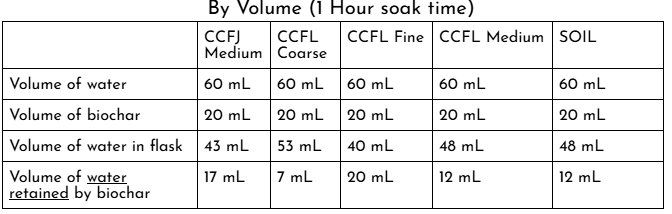
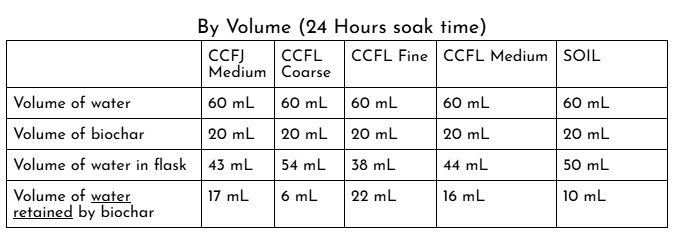
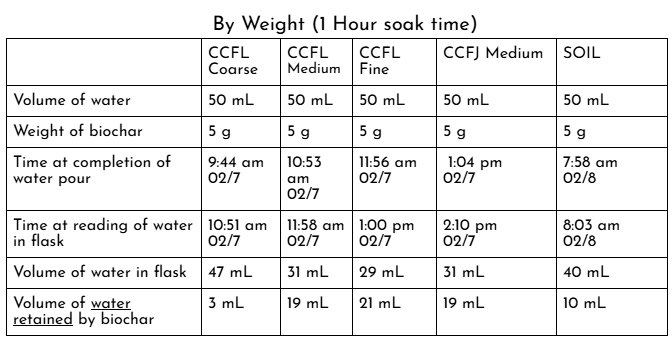
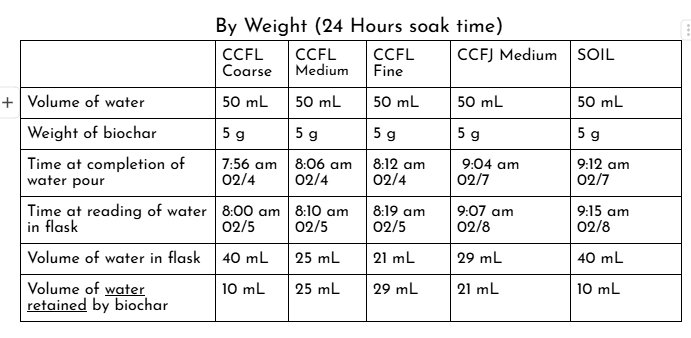
All four water retention tests show that the fine biochar retains the most water followed by medium, and then either coarse or soil depending on the test. Additionally the biochar made of pine, spruce and cedar retained less water than the biochar made of pine alone when measuring samples by volume but retained more when measuring samples by weight. Lastly, fine and medium biochars retained more water when soaking for 24 hours compared to 1 hour. However both coarse biochar and soil retained the same or less water when soaked for 24 hours compared to 1 hour (excluding coarse biochar measured by weight).
When examining the fine biochar there was a small visible pool of water in the filter held by the biochar. This is an indication of how too fine of biochar can clog soil permeability.
Also, when testing the fine biochar and soil, the water appeared black, meaning that some of the solid had either dissolved into the water or slipped through the filter. I let both of these tests sit overnight and in the morning there was a layer of black at the bottom. I subtracted the amount that had slipped through the filter from the reading.
Nutrient retention:
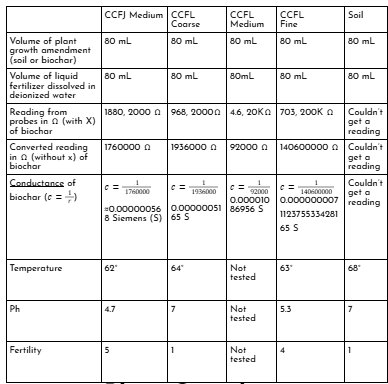
The nutrient retention tests show that the medium biochar is the best at retaining nutrients. Medium biochar has a good varied size of pores. Fine biochar does not have the larger pores that medium biochar possesses. Coarse does not have the number of pores medium biochar possesses.
The tests also showed that the biochar made of a mix of feedstocks (pine, spruce and cedar) retained more nutrients than the one made of just pine. This is likely as varied feedstocks allow for diverse pore structure allowing the biochar to catch nutrients. Diverse feedstocks also allow for different starter nutrients to exchange for the nutrients in the fertilizer.
Lastly when testing the nutrient retention of the soil I was not able to get a reading meaning that it had a very low conductance which can indicate that it is the worst at retaining nutrients.
Plant Growth:
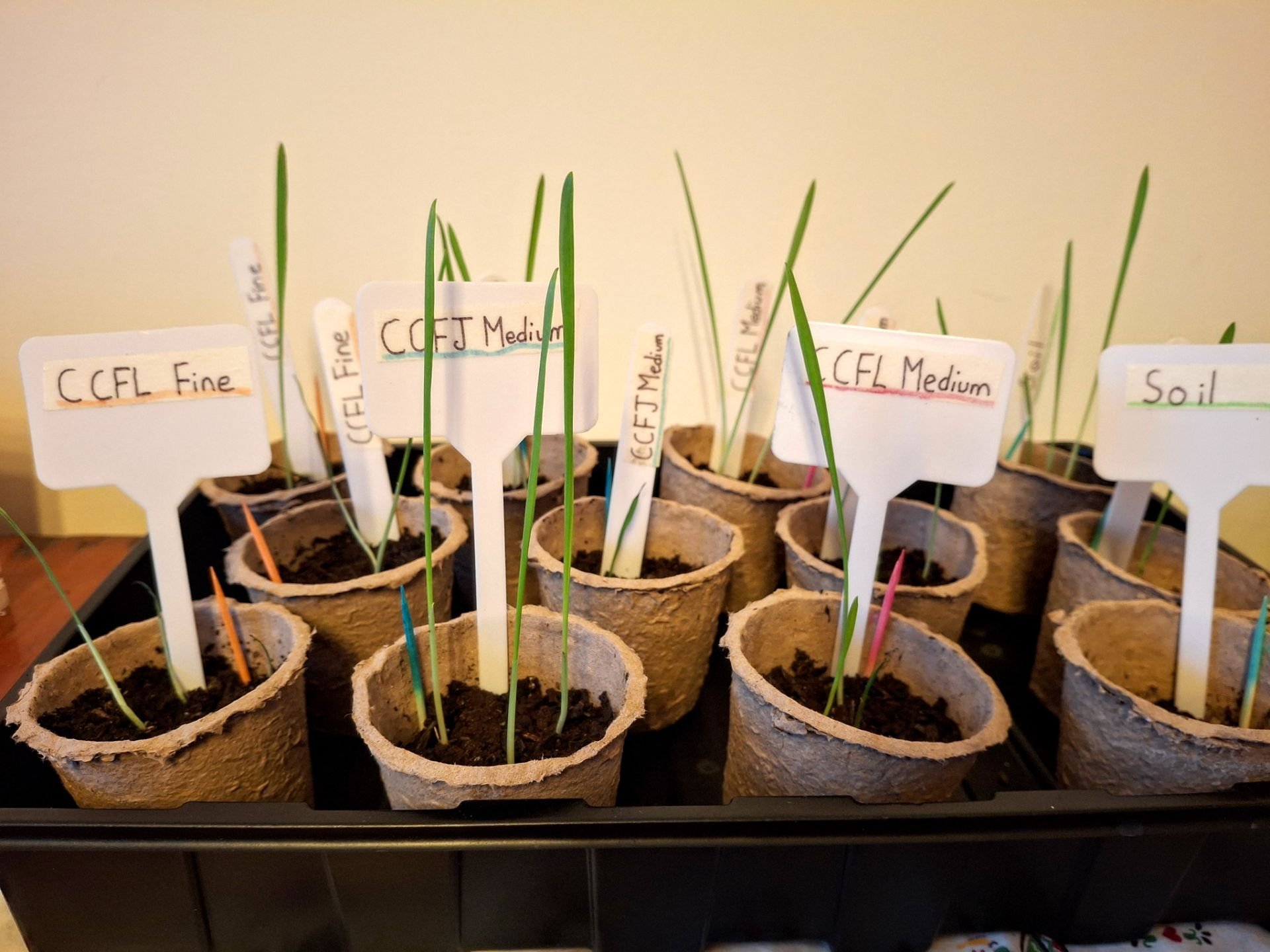
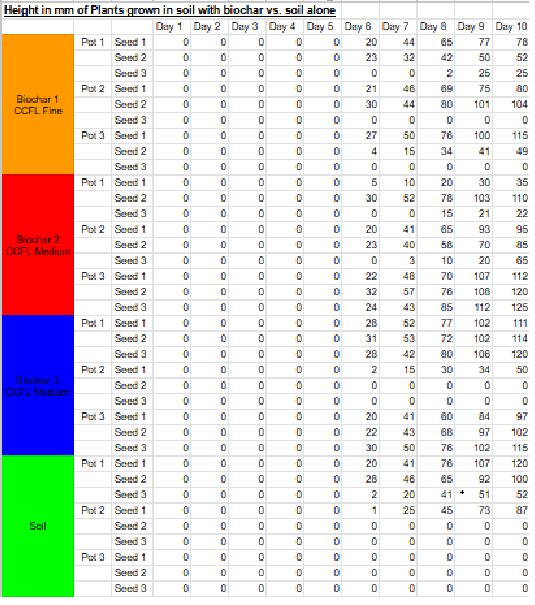
The plant growth tests show that the medium biochar supports the growth of oat grass the most, followed by fine and then soil. Additionally the tests show that the biochar made up of a multitude of feedstocks performs better than one made of uniquely pine. The tests also show that all biochars can greatly improve soil's ability to grow plants and increase the size of plants. Below is a table that shows the average of all the seeds I grew categorized by the type of biochar.

Conclusion
Conclusions
Through the course of this project I have proved that biochar can improve soil's ability to grow plants by amending soil water and nutrient retention capabilities. Biochar's power to sequester carbon and improve growing conditions is unmatched.
This project has taught me about a lot : the making and history of biochar, plant growth, the cation exchange, and more. If I were to continue this project I would obtain an electrical conductivity probe and perform the nutrient retention test again with the electrical conductivity probe and add its results into my findings. I would also like to perform the plant growth tests again this time performing the tests longer and using edible crops that farmers might grow. Lastly I would like to perform all the tests for other feedstocks of biochar so that I can prove which sources can produce the best biochar.
Application
APPLICATION
My project can be used to help prove that biochar performs well as a soil amendment. Farmers can benefit from using biochar on their crops as biochar can increase both the yield and size of the crops it helps grow. Additionally as biochar sequesters carbon, when farmers buy biochar they’re not only helping their business they’re helping the climate. Every tonne of biochar sequesters between two to three tons of carbon dioxide, meaning that if many farmers started to use biochar in their fields much carbon dioxide would be sequestered.
Sources Of Error
SOURCES OF ERROR
Water Retention:
In the water retention test a certain amount of water is absorbed by the filter paper, marginally increasing the reading of water retention. Also for the fine biochar and soil tests the water was dark meaning that some of the solid had either dissolved or slipped through the filter. I let those tests sit for a while and the dark part separated itself from the water, allowing me to subtract the amount of sediment that had found its way into the water from my results.
Nutrient Retention:
In the nutrient retention test, it was hard to keep the multimeter probes consistently 1 cm apart. Additionally the probes may not have always had the same oxygen surrounding them as each piece of biochar provides a different shape and surface area.
Plant growth:
When watering the samples not all seeds received exactly the same amount of water putting some at an advantage and some at a disadvantage. Not all seeds were evenly spaced in all the cups as well which could result in seeds colliding and fighting for nutrients. There is also the chance that certain seeds might be nonviable before even being planted, this is why I planted multiple samples.
Citations
Works Cited
- American BioChar Company, American BioChar Company, https://ambiochar.com/cec-and-biochar/.
- “AGA - Use of carbon dioxide in greenhouses.” YouTube, 22 August 2018, https://www.youtube.com/watch?v=Lqfmm7DZpyg. Accessed 23 February 2026.
- “Biochar can turn plant waste into healthy soils and improve the environment.” Agriculture and Agri-Food Canada, Agriculture and Agri-Food Canada, 24 February 2022, https://agriculture.canada.ca/en/science/story-agricultural-science/scientific-achievements-agriculture/biochar-can-turn-plant-waste-healthy-soils-and-improve-environment.
- “Carbon Dioxide - Earth Indicator.” NASA Science, December 2025, https://science.nasa.gov/earth/explore/earth-indicators/carbon-dioxide/. Accessed 23 February 2026.
- “Carbon reinvented.” Mission Zero, https://www.missionzero.tech/technology.
- “Cation Exchange.” YouTube, LearningGamesLab, 13 September 2016, https://www.youtube.com/watch?v=HmEyymGXOfI. Accessed 23 February 2026.
- “Cation Exchange Capacity (CEC) | Soil Lab Modules.” Soil Lab Modules\, 2008\, https://labmodules.soilweb.ca/cation-exchange-capacity-cec/. Accessed 23 February 2026.
- “Char fuel production in developing countries – A review of urban biowaste carbonization.” Renewable and Sustainable Energy Reviews, vol. 59, 2016, pp. 1514-1530. Science Direct, https://www.sciencedirect.com/science/article/pii/S1364032116001180?via%3Dihub.
- “A critical review on the biochar production techniques, characterization, stability and applications for circular bioeconomy.” Biotechnology Reports, vol. 28, 2020. Science Direct, https://www.sciencedirect.com/science/article/pii/S2215017X20300023?ref=pdf_download&fr=RR-2&rr=993c5595aa14bef9#upi0005.
- Fatoba, Oluwafemi. “Exploring Biochar Production at the Bow Valley.” Exploring Biochar Production at the Bow Valley, 1 ed., vol. 1, UNIVERSITY OF CALGARY, 2025, pp. 1-49. 1 vols.
- “From Waste to Wonder: The Surprising Uses of Carbon Dioxide.” YouTube, Engineering with Rosie, 26 April 2022, https://www.youtube.com/watch?v=KpGvHpB7SQ0. Accessed 23 February 2026.
- “Greenhouse Carbon Dioxide Supplementation.” Oklahoma State University Extension, Bruce Dunn, Megha Poudel, September 2023, https://extension.okstate.edu/fact-sheets/greenhouse-carbon-dioxide-supplementation.html.
- “How to Use a Multimeter.” YouTube, Science Buddies, 6 March 2019, https://www.youtube.com/watch?v=ts0EVc9vXcs. Accessed 23 February 2026.
- Lehmann, Johannes, and Stephen Joseph, editors. Biochar for Environmental Management: Science and Technology. Earthscan, 2009.
- Motis, Tim. “Can you use an ohm/volt meter to test soil or water salinity?” ECHO Community, April 2016, Can you use an ohm/volt meter to test soil or water salinity?
- “The potential of biochar as a microbial carrier for agricultural and environmental applications.” Science of The Total Environment, vol. 886, 2023. Science Direct, https://www.sciencedirect.com/science/article/pii/S0048969723025895.
- Scheub, Ute, et al. Terra Preta: How the World's Most Fertile Soil Can Help Reverse Climate Change and Reduce World Hunger : with Instructions on how to Make this Soil at Home. Greystone Books, 2016.
- “WATER RETENTION OF SOIL.” Youtube, teachingbioproject, 30 April 2012, https://www.youtube.com/watch?v=Ond_-SsiWE8.
- “What Affects Plant Growth.” Fast Growing Trees, https://www.fast-growing-trees.com/pages/plant-growth.
- “What Is Biochar Carbon Removal?” BioFlux, BioFlux, https://www.bioflux.earth/blog/what-is-biochar-carbon-removal.
- Woods, William I., editor. Amazonian Dark Earths: Wim Sombroek's Vision. Springer, 2009.