
Ocean Under Pressure: Testing How Nature Fights Acidification
Asmaa Elsharkawy, Jaweriya Siddiqui
Calgary Islamic School, Omar Bin Al-Khattab Campus
Grade 7
Presentation
Hypothesis
Objective: To test whether adding aquatic plants or crushed shells can slow the decrease in pH when carbon dioxide is added to saltwater.
Hypothesis: If carbon dioxide is added to saltwater with different natural materials, then each container will show a different rate of pH decrease, with crushed shells slowing acidification the most.
Scientific Question: How quickly does ocean water reach a harmful acidity level when absorbing carbon dioxide, and can natural materials such as aquatic plants or crushed shells slow this process?
Prediction:
- Plain saltwater will become acidic the fastest because it has no buffering system.
- The plant container will slow acidification because plants absorb carbon dioxide during photosynthesis.
- The crushed shell container will slow acidification the most because calcium carbonate acts as a natural buffer.
Research
Research - Executive Summary
What is ocean acidification?
- According to the National Oceanic and Atmospheric Administration, ocean acidification is the ongoing decrease in ocean pH caused by the ocean absorbing carbon dioxide from the atmosphere.
- Over the past 200 years, human activities such as burning fossil fuels have increased carbon dioxide levels. The ocean absorbs about 30% of this carbon dioxide.
- When carbon dioxide dissolves in seawater, it reacts with water to form carbonic acid:
- CO₂ + H₂O → H₂CO₃
- Carbonic acid increases hydrogen ions (H⁺), which lowers pH and makes the ocean more acidic.
- As acidity increases:
- Carbonate ions decrease
- Shell-building organisms struggle to form shells
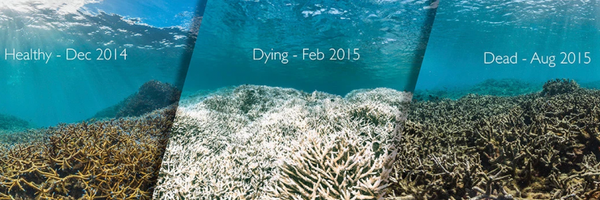
- Marine food webs may be disrupted
Many people depend on ocean life for food and jobs, so ocean acidification can affect human life as well.
The Process Of Ocean Acidification:
When carbon dioxide (CO₂) dissolves in saltwater, it reacts with water to form carbonic acid (H₂CO₃). This reaction lowers the pH of the water, making it more acidic. This chemical process is called ocean acidification.
Variables
Variables
Controlled Variables:
- Amount of saltwater
- Amount of CO₂ (dry ice or reaction amount)
- Time of exposure
- Container size
- Temperature
To keep the test fair and accurate we will use the same amount of saltwater, the same amount of dry ice (CO2), and run the test for the same amount of time.
Independent Variable:
- Filter
The type of filter in each container (aquatic plants, crushed shells, or nothing).
Dependent Variable:
- Ph meter
- The test results
- The pH level of the water over time.
The pH level of the water, which tells us how acidic it is and also the results of the tests
The contents of each container:
- Plain saltwater
- Saltwater + aquatic plants
- Saltwater + crushed shells
Procedure
Procedure:
- Prepare three identical containers.
- Add equal amounts of saltwater to each.
- Leave one as plain saltwater (control).
- Add aquatic plants to the second container.
- Add crushed shells to the third container.
- Add equal amounts of carbon dioxide to each container.
- Measure pH at equal time intervals using a calibrated pH meter.
- Record and compare the rate of pH change.
Observations
Observations
- The plain saltwater container showed the fastest drop in pH which confirmed that dissolved CO₂ forms carbonic acid and increases acidity.
- The plant container slowed the decrease in pH which was likely because the plants absorbed some of the carbon dioxide during photosynthesis.
- The crushed shell container showed the slowest change in pH because the calcium carbonate reacted with excess hydrogen ions reducing the overall acidity this demonstrated buffering capacity.
Analysis
Analysis:
Measurement:
- During the experiment we measured the pH level over time in three containers: plain saltwater, saltwater with plants, and saltwater with crushed shells. All containers received the same amount of CO₂ and were tested for the same amount of time.
- The plain saltwater showed the fastest drop in pH this demonstrates that when carbon dioxide dissolves in water it forms carbonic acid which increases acidity.
- The plant container slowed the pH drop this is likely because plants use carbon dioxide during photosynthesis reducing the amount that forms carbonic acid.
- The crushed shell container showed the slowest change in pH Shells are made of calcium carbonate which reacts with acid and helps neutralize it. This buffering effect made the water more resistant to change.
- Overall the data shows that natural materials can delay acidification but they cannot completely stop it if too much CO₂ is added.
Results:
- The results support the hypothesis that natural materials can slow ocean acidification.
- The crushed shells were most effective because calcium carbonate chemically reacts with acid, directly reducing hydrogen ion concentration.
- The plant container showed moderate buffering because CO₂ absorption reduced acid formation, but plants cannot remove all dissolved carbon dioxide.
- The control container had no buffering system, so acidity increased rapidly.
- This suggests that while natural systems can delay acidification, they may not prevent it if carbon dioxide levels continue rising.
Conclusion
Conclusion:
This experiment tested how quickly ocean water becomes acidic when carbon dioxide is added and whether natural materials can slow this process. The results showed that plain saltwater became acidic the fastest because it had no protection against the added carbon dioxide. The container with aquatic plants slowed the decrease in pH because plants absorb carbon dioxide during photosynthesis. However, the container with crushed shells maintained the most stable pH level. This is likely because crushed shells contain calcium carbonate, which acts as a natural buffer and helps neutralize acid as it forms. This experiment supports the idea that natural buffering systems can delay ocean acidification. However, it also suggests that there may be a tipping point where too much carbon dioxide overwhelms the ocean’s ability to protect itself. This is important because many marine organisms depend on stable pH levels to survive. If ocean acidification continues, it could affect food chains, ecosystems, and even human life.
Application
Application
According to the Intergovernmental Panel on Climate Change, rising carbon dioxide levels are changing ocean chemistry globally. Coral reefs and shellfish rely on calcium carbonate structures to survive. If carbon dioxide continues to increase, even natural buffering systems may become overwhelmed. Understanding these buffering systems can help scientists:
- Protect seagrass ecosystems
- Restore oyster reefs
- Reduce carbon emissions
Nature has defense systems — but they have limits.
Sources Of Error
Sources of error
- The dry ice may not have released exactly the same amount of carbon dioxide in each container. Even small differences could affect pH results.
- The pH meter may not have been perfectly calibrated, which could slightly change the recorded values.
- The aquatic plants may not have absorbed carbon dioxide at the same rate if lighting or plant condition varied.
- The crushed shells may not have been evenly sized. Smaller pieces react faster because they have more surface area.
- The experiment was short-term. In the real ocean, acidification happens over many years, so long-term effects were not tested.
- The containers cannot fully copy ocean currents, pressure, temperature changes, or biological interactions.
Citations
Citations
- National Oceanic and Atmospheric Administration. (n.d.). What is ocean acidification? NOAA Ocean Service. Retrieved from https://oceanservice.noaa.gov
- National Aeronautics and Space Administration. (n.d.). Ocean acidification: The other carbon dioxide problem. NASA Climate. Retrieved from https://climate.nasa.gov
- National Geographic Society. (n.d.). Ocean acidification. National Geographic Resource Library. Retrieved from https://www.nationalgeographic.org
- United States Environmental Protection Agency. (n.d.). Effects of ocean and coastal acidification on ecosystems. EPA. Retrieved from https://www.epa.gov
- National Ocean Service. (n.d.). How does carbon dioxide affect the ocean? Retrieved from https://oceanservice.noaa.gov
- Intergovernmental Panel on Climate Change. (2021). Climate Change 2021: The Physical Science Basis. Retrieved from https://www.ipcc.ch
- Woods Hole Oceanographic Institution. (n.d.). Ocean acidification facts. Retrieved from https://www.whoi.edu
- Smithsonian Ocean Portal. (n.d.). Ocean acidification. Smithsonian Institution. Retrieved from https://ocean.si.edu
Acknowledgement
Thank you to our parents for supporting me through this great process. We are grateful to have the support of our science teacher for helping perfect our processes and making our work the best it can be. Thank you to Sara for inspiring us to do the best project we possibly could do. Thank you to Omar bin Al Khattab school and to the CYSF instructor/help in science project, Ms.Hadil El-Cheikh making this possible. Lastly, this was a great experience thanks to everyone who helped develop and make our project come true!